A Year in Drawing at Galerie Lelong

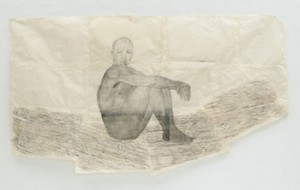
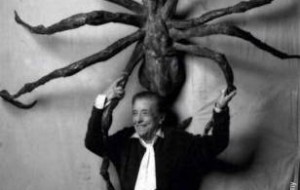
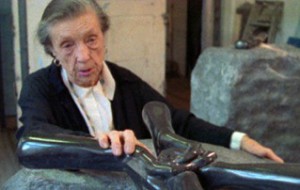
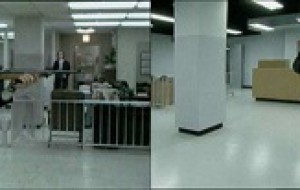
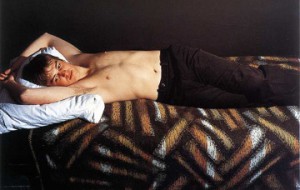
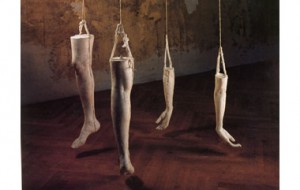
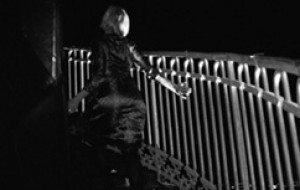
A Year in Drawing opened last week at Galerie Lelong’s New York space. From the light-handed to the potent, the drawings reflect a wide range of sensibilities, subject matter, and materials. The sixteen artists in the exhibition are either represented by the gallery or are close friends. The diverse mix includes Sol Lewitt, Sean Scully, Kate Shepherd, and Art21’s Louise Bourgeois, Kiki Smith (both Season 2), Nancy Spero and Ursula von Rydingsvard (both Season 4).
A Year in Drawing runs through August 1st.
Spaceship Earth

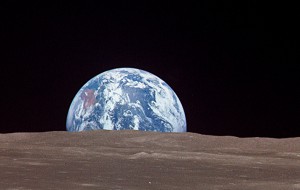
Buckminster Fuller was one of the most inventive and prolific visionaries of 20th century who was keenly intuitive. Much of the work in the new Whitney exhibition, Buckminster Fuller: Starting with Universe, is on display for the first time. “We are not going to be able to operate our Spaceship Earth successfully for much longer unless we see it as a whole spaceship and our fate as common. It has to be everybody or nobody.”
2001: A Space Odyssey (1968), the science fiction classic, was created at the pinnacle of the Apollo space exploration project beginning with manned Earth orbiting missions and reaching its plateau with landing on the moon on July 20, 1969. The Hal 9000 computer gave us a preview into how computers would one day dominate our lives.
In Is Google Making Us Stupid? Nicolas Carr makes several references to Hal: “… the implacable astronaut Dave Bowman, in a famous and weirdly poignant scene toward the end of Stanley Kubrick’s 2001, is calmly and coldly disconnecting the memory circuits that control its artificial brain. ‘Dave, my mind is going,’ HAL says forlornly. ‘I can feel it. I can feel it.’” Reading about Carr’s experience and how Internet searching and surfing has affected his thinking process and focus level, I realize that I am not the only one.
Are we becoming more aware of the hybridization of human and machine even though our minds are numbing by the plethora of information? As Internet has shifted our reading habits, how is it influencing the way we perceive art? Do we spend as much time contemplating works of art as we did in the past?
Depth and form are perceived in the visionary light creations of James Turrell (Season 1). His Roden Crater Project acts as a giant naked eye enabling viewers to see the sky as a dome and to feel the roundness of Earth. This is an experience similar to what Fuller experiences, “The earth is revolving to obscure the sun. The sun is not going down. I want you to really feel this with me. We’re rolling around to obscure the sun. We’re about to have a sunclipse: the earth is revolving around rapidly to obscure the sun. It’s perfectly easy to feel it, particularly if you face north and look over your left shoulder. Just watch! and you suddenly begin to feel this enormous earth revolving on its axis.”
Another visionary artist who is acutely aware of the environment is Roni Horn (Season 3). Her Vatnasafn/Library of Water replaces the solid with liquid as it engages the community to participate and to interact through a variety of activities. It is the epitome of relational art. An extensive collection of books on Fuller, Horn and Turrell are available for on site and take home use at the Art Collection of Mid-Manhattan Library.
At the 2005 Art Basel Miami Conversation, Hans Ulrich Obrist asked Robert Rauschenberg what advice he had for young artists and he replied, “Just nurture your curiosity and have respect for change. And I think the curiosity part will make life very exciting. It will also fight back habits like repeating oneself.”
Earthrise. NASA AS11-44-6548
“Oliver Herring | Task” in Seattle tomorrow

Season 3 artist Oliver Herring brings Task, his ongoing collaborative performance, to the Seattle Public Library tomorrow. In an unprecedented collaboration between the Frye Art Museum, Tacoma Art Museum, On the Boards and the Library, he will stage a day-long Task performance from 10 am to 5:30 pm.
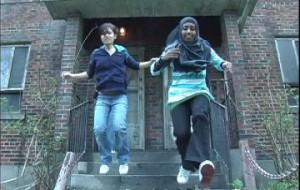
An improvisational art-making event, Oliver Herring | Task brings together a group of strangers of diverse ages, professions and backgrounds to create a unique site-specific contemporary artwork. Herring devises simple “tasks” for the participants, which become catalysts for performance.
“I write a bunch of simple tasks in order to get the performance going,” Herring once explained. “Each one is put in a task pool, and the performance starts with each participant taking an envelope, opening it and trying to fulfill that task. Once they’re done, they each write a new task, put it back in the task pool, grab a new task and go on with business.” After the first five or 10 minutes, the performance is entirely self-perpetuating.” The performance’s unpredictability is inherent to its process: the artwork takes shape according to the interests and creativity of those on stage as well as the relationships they form with one another.
Herring has staged Task performances at the Hirshhorn Museum and Sculpture Garden (2006); Plaza de Toros in Santa Cruz de Tenerife (2003), the Former Federal Security Bank in Lake Worth, Fla. (2003); L’Ecole Supérieur National des Beaux Arts, Paris (2002); and the Masonic Temple at the Great Eastern Hotel, London (2003). The upcoming Seattle Public Library performance will be the first staged indoors, and the first involving multiple organizations.
Image: Oliver Herring. Task – Photo Archive #34, 2006. Digital C-print. 14 1/4 x 9 1/2 in. Collaborative performance at the Hirshhorn Museum and Sculpture Garden, Washington, D.C., 2006. Courtesy of the artist and Max Protetch Gallery, New York

The streets of Berlin have been unusually rowdy these past few weeks, with the screams of belligerent football fans reverberating off every wall. As is customary in this country, a home team victory is ceremoniously followed by bleary-eyed Germans taking to the streets, in their cars no less, and driving around drunk while laying on the horn, waving flags out their windows and yelling nonsense at any pedestrian unfortunate enough to be on the sidewalk at this historic hour. It’s “a cultural experience,” albeit slightly disturbing and undoubtedly dangerous, but soccer is a religion over here and this is how the locals worship. After Germany’s victory over Turkey last Wednesday, in a match-up that hit quite close to home considering the continuing controversy surrounding Turkish immigration in Deutschland (and especially in the country’s capital), Berliners are gearing up for the final game on Sunday and even the art world has been invaded by football fanaticism.
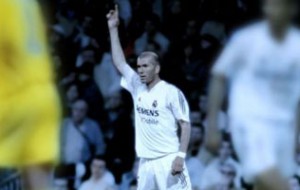
DAAD Galerie is currently showing a video by Douglas Gordon and Philippe Parreno entitled Zidane: A 21st Century Portrait, which follows the legendary French footballer’s every move with 17 cameras during a 2005 match against FC Villareal. The resulting portrait serves to further idolize Zinedine Zidane, a polarizing figure in the football world, whose final match- the 2006 World Cup championship game against Italy- will always be remembered for the notorious head-butting incident, in which Zidane attacked an opponent who had apparently disrespected his mother and/or sister, and was thrown out of the game. Depending on your perspective it was either staggeringly heroic or appallingly disgraceful.
Although there’s no head-butting in Gordon and Parreno’s piece, it is reminiscent of Paul Pfeiffer’s (Season 2) series The Four Horsemen of the Apocalypse, which captured professional basketball players in iconic poses, illuminated by the court’s glaring lights, their bodies glowing in artificial halos surrounded by legions of followers. Similarly, Zidane: A 21st Century Portrait depicts the soccer star from the eyes of a fanatic, elevating a mere mortal to the ranks of the Gods. Whether or not you agree that these players deserve their deification, the fact remains that come Sunday, the entire city will be praying for some kind of divine intervention on the soccer field. The losers will be sacrificed and the winners will be immortalized. Regardless of the outcome, stay away from cross walks once the final whistle blows. Schoenes Wochenende.
Facebook: Images of People in Photographs

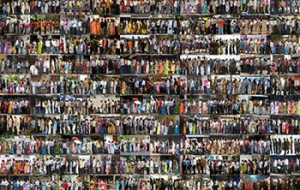
Facebook: Images of People in Photographs from the Permanent Collection consists of just fifty photographs from nearly 3,000 prints in the Frances Lehman Loeb Art Center collection. On view today through August 10, 2008, the exhibition examines the development of the photographic portrait from the nineteenth century through today. According to ArtDaily, “While the Facebook social networking website has proven to be enormously popular, linking millions of photographs of faces to searchable biographical data, the notion of collecting and cataloguing pictures of people is not a new one…prior to the information age, photographs were helpful tools for research, record keeping, and documentation.” The Frances Lehman Loeb Art Center is located on the Vassar College campus. The above photograph by Rinieke Dijkstra was a gift of Vassar alumni and art dealer Jeanne Greenberg Rohatyn (class of 1989).
Facebook features many influential photographers of the twentieth century including August Sander, Walker Evans, Diane Arbus, Cindy Sherman, and some newly acquired Polaroids by Andy Warhol, which depict celebrities such as John Denver and Liza Minnelli. Also included in the exhibition: Sally Mann (Season 1), Laurie Simmons (Season 4), Althea Thauberger, Berenice Abbott, Walead Beshty, Richard Avedon, Philip-Lorca DiCorcia, Lee Freidlander, Nan Goldin, Mark Goodman, Lewis W. Hine, Sherrie Levine, Helen Levitt, Lee Miller, Thomas Ruff, Paul Strand, Larry Sultan, Weegee, and Garry Winogrand.
Sound & Language

The human voice is the most specific expression of an individual. With its infinite potential for sound effects and imitation along with its prime role in communication, it is clearly the most versatile and valuable instrument.
In 1939, Marian Anderson captivated an audience of 75,000 and millions of radio listeners during her Lincoln Memorial recital. Her response to weeks of debate fueled by the refusal of the Daughters of American Revolution to grant her a permit to perform at Constitution Hall was, “Music to me means so much, such beautiful things, and it seemed impossible that you could find people who would curb you, stop you, from doing a thing which is beautiful. I wasn’t trying to sway anybody into any movements… I just wanted to sing and share.”
Four years earlier in 1935, Melvin Tolson an English professor and poet inspired his students to organize Wiley College’s first debate team that moved on to face off Harvard University’s national champions. The Great Debaters is a dramatic depiction of the true story of Tolson, his life at Wiley, the people of Marshall and the four brilliant aspiring team members. The debate scenes are a testament to their consuming passion for language, education, and freedom.
The acclaimed writer, painter, and educator N. Scott Momaday said, “If I do not speak with care, my words are wasted. If I do not listen with care, words are lost.” Care for language, its look, meaning and sound is what we experience in the work of Jenny Holzer (Season 4). Also Laurie Anderson (Season 1) gives a multimedia spin to the use of language in her spectacular storytelling performances. In Writing on the Wall: Word and Image in Modern Art, Simon Morley has compiled the first comprehensive survey of the use of word in art from the past 140 years.
A completely different approach to sound is encountered in the sculptures of Martin Puryear (Season 2). We imagine and hear silent sound, especially in his Ladder for Booker T. Washington as it reaches the sky. On the other hand as Barack Obama is reaching closer to becoming the next president, we look forward to hearing his upcoming debates.
Chess Pieces. Photo by Alan Light
Kerry James Marshall | “Black Romantic”
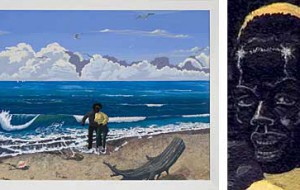
EXCLUSIVE: Kerry James Marshall discusses two recent paintings, both Untitled (2008), during the installation of his exhibition Black Romantic at Jack Shainman Gallery, New York. The exhibition is on view through July 3, 2008.
Kerry James Marshall’s work is based on a broad range of art-historical references, from Renaissance painting to folk art. A striking aspect of his paintings is the emphatically black skin tone of his figures, a development the artist says emerged from an investigation into the invisibility of blacks in America and the unnecessarily negative connotations associated with darkness.
Kerry James Marshall is featured in the Season 1 (2001) episode Identity of the Art:21—Art in the Twenty-First Century television series on PBS.

ART21: Can you say a little about the title of the exhibition?
MARSHALL: The title of the show is Kerry James Marshall: Black Romantic. There are a lot of implications to that title. One of the reasons I used that title was because it relates to an exhibition that was done at The Studio Museum in Harlem a few years ago called Black Romantic (2002). That show was largely about how there’s certain groups of black artists who do a kind of work that is called Black Art.
I’ve always been interested in this place where popular art or vernacular works cross over and move from the popular realm into the mainstream, critical institutional realm. Certain genres of painting are more privileged and less privileged, and this idea of the Black Romantic, with it’s positive imagery of black figures, has a kind of sentimentality that is seen by many artists as being deficient.
For me, it is more important to resolve whatever those deficiencies are and to bring that work, on its own terms, into a space where it can be dealt with differently. Distancing yourself from it — I think that solves nothing. Continue reading »
Laurie Simmons at Carolina Nitsch

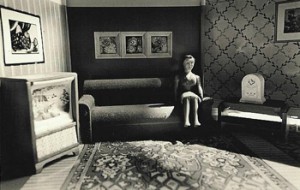
Last call to see the Laurie Simmons (Season 4) exhibition closing tomorrow at Carolina Nitsch Project Room. In and Around the House features the artist’s early black and white photographs from 1976-78, staged images using dolls and dollhouses in which the narratives have been carefully choreographed. Simmons makes references to general stereotypes and her own personal memories, though controlling these perceptions through the deliberate arrangement and dislocation of character, props, and action.
Only 5 x 8 inches in scale, the intimate photographs playfully manipulate big topics like feminism, consumerism, and the nature of child’s play. “Some feature a small, molded plastic doll: a stocky, big-shouldered, short-haired housewife in a sensible dress. She is an archetype of 1950s normalcy, but she has a scary, masklike face and seems to be going crazy. She’s fallen to the floor, she waves her hinged arms about and does headstands in the kitchen” (Ken Johnson, New York Times).
Giving Life
As we continue gearing up for summer and prepare for ways to fuel our work as artists and educators I wanted to take the next few columns and point out some Season 4 artists who have been particularly inspiring over the past months. Catching some of these segments over the summer can have an interesting effect on planning and preparation for the fall!
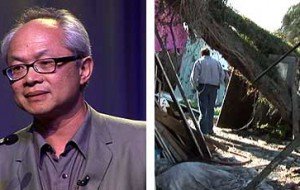
In my column on June 11th, I wrote about the segment featuring Allora & Calzadilla. This month I would like to strongly recommend taking a close look at Mark Dion. The reason I think art educators want to take notice of Mr. Dion is similar to why I choose many Art21 artists to for my own classroom. He helps redefine and change our perspective on what contemporary art can be, what installation can be, and even what sculpture can be. His work giving a tree new life (a second life!) in Neukom Vivarium (pictured above) demonstrates more of what was discussed with Allora & Calzadilla, including the fact that more and more artists are relying on others, sometimes teams of people, to realize works of art. He allows us to consider sculpture and installation that doesn’t just change over time, but grows. He raises interesting interdisciplinary connections between science and art, and the opening minutes featuring rats painted with tar will challenge viewers to talk about the things considered visual art today.
If you have seen the Mark Dion or Allora & Calzadilla segments in Season 4, I would love to hear what you think. What are your ideas about bringing these artists into the classroom? Are there other Season 4 artists you are considering?
1968 | 2008

This is not the first time that Summer Olympics Games are embroiled in environmental and political controversies. In 1968, Mexico City, with its high altitude containing 30% less oxygen than at sea level, proved to be a controversial choice. The lack of air led to terrible results for some, while others were able to achieve world records. Forty years later Beijing is faced with massive air pollution as it completes the preparations for the Olympics. The world renowned Ethiopian runner Haile Gebrselassie has opted out of running in the marathon noting “the pollution in China” as a threat to his health. It remains to be seen how the environmental pollution in China will affect the athletes and the Games’ results.China is also plagued with its outrageous treatment of Tibet, resulting in massive protests around the world. Protest was also seen in Mexico City during the medal ceremonies when the two Americans Tommie Smith and John Carlos “performed their Power to the People” salute. Peter Norman, the Australian silver medalist, wore an Olympic Project for Human Rights badge showing his support for Smith and Carlos.
Another athlete to cancel an Olympic Games participation was Bobby Fischer, one of the greatest chess players of all time, who passed away earlier this year. He had plans to play for the United States at the 1968 Chess Olympiad in Lugano, Switzerland and backed out when he saw the playing hall with its bad lighting.
As athletes were breaking records in 1968, artists were busy reshaping culture. Nancy Spero(Season 4) was working on her War Series (1966-70). Bruce Nauman (Season 1) produced his first video titled Pinch Neck. Romare Bearden, in addition to being involved in founding The Studio Museum in Harlem, also established Cinque Gallery with the help of Norman Lewis and Ernest Crichlow. Cinque provided support for younger minority artists.
1968 marked the passing of Marcel Duchamp and the coinage of “15 minutes of fame” when Andy Warhol stated “In the future, everyone will be world-famous for 15 minutes.” Frank Zappa released his first solo album Lumpy Gravy and performed King Kong with the Mothers of Invention at BBC Studio in London. Chou Wen-chung, who had studied with Edgard Varese, completed Nocturnal (1961-1968), an unfinished piece by Varese.
In his 1968 Nobel Lecture, Yasunari Kawabata explained, “The excitement of beauty calls forth strong fellow feelings, yearnings for companionship, and the word ‘comrade’ can be taken to mean ‘human being.’ The snow, the moon, the blossoms, words expressive of the seasons as they move one into another, include in the Japanese tradition the beauty of mountains and rivers and grasses and trees, of all the myriad manifestations of nature, of human feelings as well.”
How will 2008 be reminisced forty years from now? What will be the low and high points in our cultural and social achievements? Will 2008 be a critical year marking a pivotal change in the way we treat the environment and each other?
China Haze. Credit. Provided by the SeaWiFS Project, NASA/Goddard Space Flight Center, and ORBIMAGE