Provocative Visions at The Met

August 29th, 2008

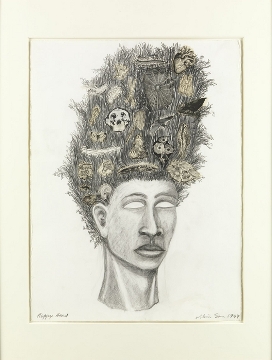
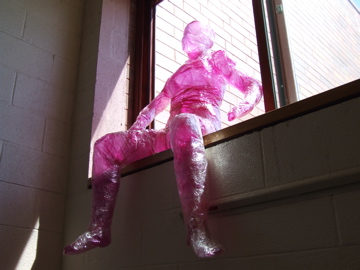
Alison Saar, “Nappy Head @1″, 1997.

On view at the Metropolitan Museum of Art through March 8, 2009, Provocative Visions: Race and Identity—Selections from the Permanent Collection features acquisitions made from 1992–2007. Many are on view at the Museum for the first time. Kara Walker (Season 2), Chakaia Booker, Willie Cole, Glenn Ligon, Whitfield Lovell, Alison Saar and Lorna Simpson “confront issues of racial heritage and identity” in this long-term installation comprising just 13 sculptures, prints, and drawings.

Provocative Visions is on view in the north mezzanine gallery of the Modern Art wing. The Main Building of the Metropolitan Museum, select galleries, public restaurants, and shops will be open from 9:30 a.m. to 5:30 p.m. on Labor Day. Click here for a list of programs and events.

Alfredo Jaar | Gramsci & Pasolini

August 28th, 2008

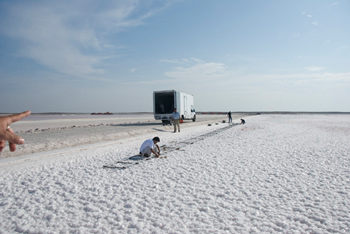
EXCLUSIVE: Alfredo Jaar in his installation Infinite Cell (2004) in Santiago, Chile, and various works.

Through installations, photographs, and community-based projects, Alfredo Jaar explores the public’s desensitization to images and the limitations of art to represent events such as genocides, epidemics, and famines. Jaar’s work bears witness to military conflicts, political corruption, and imbalances of power between industrialized and developing nations, often taking the form of an extended meditation or elegy.

Alfredo Jaar, “The Ashes of Gramsci,” 2005. © Alfredo Jaar, courtesy Galerie Lelong, New York.

SEE: More images, videos, and news for Alfredo Jaar.

LEARN: Alfredo Jaar is featured in the Season 4 (2007) episode Protest of the Art:21—Art in the Twenty-First Century television series on PBS.

DISCUSS: What do you think about this video? Leave a comment!

PHOTO | Alfredo Jaar, The Ashes of Gramsci, 2005. © Alfredo Jaar, courtesy Galerie Lelong, New York.

VIDEO | Producer: Susan Sollins & Nick Ravich. Camera: Bob Elfstrom. Sound: Ray Day. Editor: Lizzie Donahue. Artwork courtesy: Alfredo Jaar. Thanks: Fundación Telefónica, Santiago, Chile.

Artists Respond at MCA San Diego

August 27th, 2008

Iñigo Manglano-Ovalle. “Human Nature” project, 2007/08. Courtesy Artists Respond

Human/Nature: Artists Respond to a Changing Planet opened last week at the Museum of Contemporary Art San Diego. The pioneering artist residency and collaborative exhibition project is the first of its kind to operate on a large scale to investigate the relationships between fragile natural environments and the human communities that depend upon them. Each of the eight participating artists took two trips (one in 2005 and a return in 2007/2008) to eight UNESCO World Heritage sites around the globe to create new work informed and inspired by their experiences in these diverse cultural and natural regions.

The exhibition at MCASD features new commissioned works by Mark Dion, Ann Hamilton, Iñigo Manglano-Ovalle, Marcos Ramírez ERRE, Rigo 23, Dario Robleto, Diana Thater and Xu Bing. The artists’ personal site selections produced a range of engagement, such as Hamilton’s visit to the Galápagos, where she observed many of the animals for which the islands are known: land iguanas, finches, sea lions, and tortoises. The artist returned home thinking about such concepts as buoyancy and balance in relation to human life and natural landforms, concepts that go to the heart of Human/Nature. In response, Hamilton created a poetic text that inventories the animals and plants of the Galápagos, citing population figures and incorporating words from Charles Darwin’s famous texts about the islands. Local elementary schoolchildren recited the words from a boat circling the islands. The exhibition installation features video footage documenting the children’s performance and including images of a wavering horizon line shot from a camera suspended in water.

Other explorations include Mark Dion’s travels to the Komodo and Rinca islands inspired by a childhood fascination with the Komodo dragon and Iñigo Manglano-Ovalle to the Whale Sanctuary of El Vizcaíno, where he was inspired to create an installation that emphasizes the natural beauty and ecological importance of the area in addition to raising awareness of the industrial development that threatens it.

For full project descriptions, visit the Artists Respond website.

Contemporary Art Start at MoCA, Los Angeles

August 27th, 2008

student-detail.jpg

Two weeks ago, from August 11-15, I had the pleasure of spending a week working with a number of outstanding art teachers at the MoCA, Los Angeles summer institute, Contemporary Art Start: High School. Organized by Jeanne Hoel and Denise Gray in MoCA’s Education Department, the institute brought together two dozen L.A. teachers from a variety of districts to learn more about bringing contemporary art into the classroom, as well as giving teachers the chance to create some of their own work inspired by Marlene Dumas (currently on view at the museum) and by Season 4 Art21 artists.

Over the course of one week, teachers created three separate works of art (one being a site-specific work on the 7th floor of the museum itself) and critically viewed eight different Season 4 artist segments including Allora & Calzadilla, Mark Bradford, Jenny Holzer, Lari Pittman, and Ursula von Rydingsvard. They also had the opportunity to learn ways of incorporating Art21 and contemporary art in their curriculum, options for encouraging active participation while watching film with students, ways of organizing a variety of critiques, and considerations before giving praise in the classroom. This was a packed week that featured a lot of hard work all around and it was an honor to be in Los Angeles as this institute kicked off its first year.

Please feel free to share some of your summer work and experiences as we prepare for a new school year. Exhibits that were particularly influential? Destinations that inspired new ideas for the classroom?

Remembering to Remember

August 27th, 2008

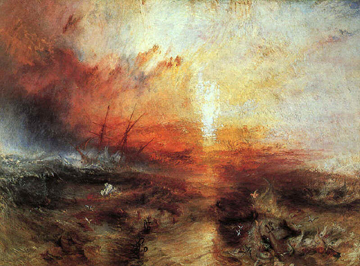
“The Slave Ship” or “Slavers Throwing overboard the Dead and Dying — Typhon coming on”

On view until September 21st at the Metropolitan Museum of Art is a collection of J.M.W. Turner’s picturesque paintings of the harrowing sea as well as some ships and their respective passengers. Turner is not a contemporary artist. He has long vanished under the sea, the rifts and wails of his sailors and mates heard long ago, and is now remembered by the violent paint strokes that so eloquently make up the rhythmic intensity beating within his canvases.

After Hurricane Katrina hit in 2005, one might recall Kara Walker’s (Season 2) After the Deluge, an exhibition of work that she organized featuring a variety of objects from the Met’s collection (including Turner’s infamous Slave Ship.)

Years apart in age and emerging out of different historical contexts, both artists are fascinated by the world around them and in turn have sought to explore these curiosities with the realization that the representation of a time that may seem uncertain can often produce artworks of incredible passion.

Watch Walker discussing the question of one’s role in history in relationship to an installation that she made as an artist-in-residence at the Fabric Workshop in 2004.

New guest blogger: Mary Cook

August 26th, 2008

cat-tail.jpg

Thanks to Sarah Sliwa for taking time away from her Belgian adventures to entice us with her delicious posts. Up next is Mary Cook. Mary is an artist who received her M.F.A in Painting from Pratt Institute in Brooklyn, NY (2008), and her B.F.A in Painting and Drawing from the California College of the Arts in San Francisco/Oakland (2005). She has gained valuable experience as an artist in the studio and in her travels abroad. She developed a particular interest in working for non-profit contemporary art institutions after interning at the Wattis Institute of Contemporary Art in San Francisco, as well as from experience as a curatorial research intern at Art21. Mary contributes to NY ARTS magazine and currenty works as Art21′s Executive Assistant to the Director.

2008 Lucelia Artist Award Nominees Announced

August 25th, 2008

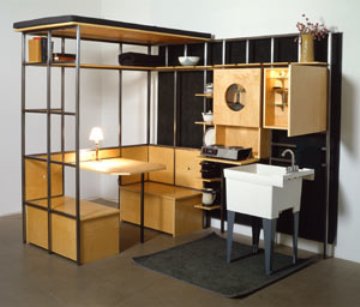
Andrea Zittel, “A-Z Management and Maintenance Unit Model 003,” 1992. Steel, wood, carpet, plastic sink, stove top, mirror. ©Andrea Zittel, Image courtesy of the Andrea Rosen Gallery, NY

The Smithsonian American Art Museum recently announced the nominees for their annual 2008 Lucelia Artist Award. The nominees are: Jennifer Allora and Guillermo Calzadilla, Mark Dion (both Season 4), Trenton Doyle Hancock (Season 2), Slater Bradley, Matthew Buckingham, Doug Aitken, Keith Edmier, Spencer Finch, Harrell Fletcher, Mark Grotjahn, Rachel Harrison, Zoe Leonard, Suzanne McClelland, Wangechi Mutu and Dana Schutz.

Established in 2001, the award of $25,000 recognizes an American artist younger than 50 who has produced a significant body of work and consistently demonstrates exceptional creativity. Five jurors, each with a wide knowledge of contemporary American art, nominate the artists and determine the award winner in a day of discussion and review. Jurors remain anonymous until the winner is announced in September.

Art21 artists Jessica Stockholder (Season 3), Andrea Zittel (Season 1) and Kara Walker (Season 2) were recipients of the award in previous years. Joanna Marsh, The James Dicke Curator of Contemporary Art at the Smithsonian American Art Museum says, “The artists nominated this year “continue to show a sustained commitment to distinctive work that challenges conventional thinking and expectations about the nature of art.”

( An installation by Zittel–winner of the 2005 Lucelia Artist Award–is pictured above.)

Dialog:City Launches in Denver

August 25th, 2008

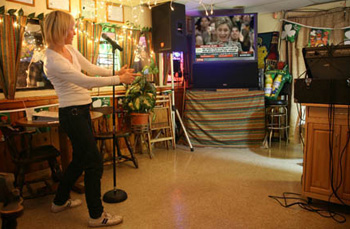
Daniel Peltz, “The Karaoke Convention” (2008. Courtesy the artist and Dialog:City.

Dialog:City, the exciting community-oriented, art-political showcase in Denver taking place concurrently with the Democratic National Convention, opened this past Friday at an outdoor party with Mayor John Hickenlooper in a church parking lot that featured Krzysztof Wodiczko‘s (Season 3) Veteran Vehicle Project, a new media sculpture that transforms a Humvee into a traveling media projection vehicle telling the stories of more than 40 Denver homeless veterans.

Amist the “greenest convention ever,” Dialog:City is designed as a cultural program that converges education, art, democracy, and digital media. In addition to the ten artists who were officially invited to create interactive site-specific works throughout Denver neighborhoods, a slew of other connected events and happenings will invade and inhabit the city. Curated by Seth Goldenberg, Dialog:City presents new projects by Charlie Cannon, Minsuk Cho, Ann Hamilton, Sharon Hayes, Lynn Hershman, Daniel Peltz, Paul Miller aka DJ Spooky That Subliminal Kid, and spurse.

The mind-tingling, serious though not devoid of levity art assault includes Minsuk Cho’s Air Forest, a levitating architectural pavilion, and Daniel Peltz’s Karaoke Convention ’08. Peltz has transcribed the addresses by presidential candidates in the 2008 election into a karaoke format that will have people belting rhetoric out in song at the Supreme Court and local bars.

Season 1 artist Ann Hamilton created Circle of O’s, a collaboration with local choirs, choreographers, and composers to perform a newly written song drawn from the phrases and pace and spirit of Ralph Waldo Emerson writings imagining the “new American voice.” The song will “waft across the city” in a street procession.

For a full schedule and additional information on all the projects, visit the Dialog:City website.

It’s Not Only Rock ‘N’ Roll, Baby!

August 23rd, 2008

“London.” Pet Shop Boys/Martin Parr.

Earlier posts by Marc Mayer and Ben Street have noted the relationship between pop culture, art, and music as well as recent attempts to curate this “magic.” It’s Not Only Rock ‘N’ Roll, Baby, at the Bozar Centre for the Arts in Brussels, is another such attempt. Taking a cue from its featured artists, the show is loud, flashy, and great at drawing crowds—making it an ideal headliner for the summertime, when sunshine, Batman, and vacation compete for attention.

In the curator’s note, Jerome Sans writes that the show “is a gathering of artists, most of whom were visual artists before becoming musicians, or whose visual roots at the heat of their artistic process are often little-known and viewed as separate from their musical fame.” Did you know Yoko Ono made art? Featured “musical legends” include Patti Smith, Brian Eno, Chicks on Speed, Fischerspooner, Devendra Banhart, Pete Doherty, Yoko Ono, Miss Kitten, Antony, The Kills, Bryan Ferry, Riceboy Sleeps, and David Byrne.

Here’s the rub: at admission, you choose between two pay exhibits: Rock n’ Roll or Mapas Abiertos, a traveling exhibition of contemporary Latin American photography, organized by “rituals of identity, scenarios, and alternative histories.” Given the choice between Rock and Maps, most museum-goers chose Rock. Shoot. If you’re under 26, see both: admission is only 1 euro ($1.57).

Rock ‘N’ Roll is uneven in its range from musicians who happened to go to art school to revered artists whose work embraces multiple disciplines–like Laurie Anderson (Season One), Yoko Ono, and Brian Eno. The curator chose to avoid hierarchy and chronology in favor of a “free passage into the universe of each artist.” In these universes, not all stars are equally bright. Moreover, some of the wall text seemed to serve less as an introduction than as a justification for inclusion in the show. An improvement would have been the excerpts from the catalogue interviews about how the contributors approach their visual and musical interests. I complain, but it’s a fun exhibit. With the rain as an excuse, I spent nearly an hour watching music videos from the recesses of a bean bag chair. These included two Pet Shop Boys videos, one by Wolfgang Tillmans and the other by Martin Parr. Even without the super-saturated color that’s a hallmark of Parr’s photography, the sense of humor is distinctly his.

Cai Guo-Qiang Responds to Olympics Fireworks “Controversy”

August 22nd, 2008

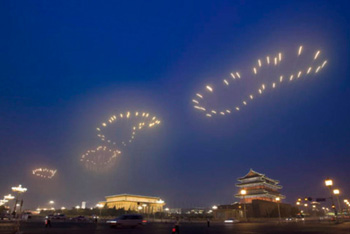
“Footprints” (2008). Courtesy Cai Guo-Qiang Studio.

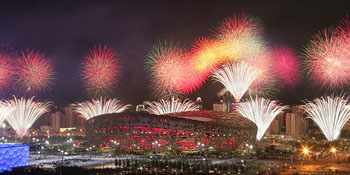
Over 34 million people watched the dazzling opening ceremony of the 2008 Olympics in Beijing. Days later, eager buzz-killers were quick to point out that deceptive “augmentations” were actually employed for television wow factor. Spectacle “constructions” included a lip-synching nine year old girl and a dubbed fireworks display conceived by artist Cai Guo-Qiang (Season 3), who was installed as director of visual and special effects.

Cai’s Footprints of History set off a series of 29 “starbursts” that traversed the sky from Tiananmen Square to the Olympic Stadium. Though the pyrotechnics actually took place, broadcasters used a 55-second digital film as surrogate, claiming the actual effects via television would have been obscured by atmospheric conditions as well as endangering helicopter camera crews.

In an issued statement, Cai responds to the “controversy”:

The explosion event
Footprints of History: Fireworks Project for the Opening Ceremony of the 2008 Beijing Olympic Games consisted of a series of 29 giant footprint fireworks — one for each Olympiad — over the Beijing skyline, leading to the National Olympic Stadium. The 29 footprints were fired in succession, traveling a total distance of 15 kilometers, or 9.3 miles, within a period of 63 seconds.

It is quite customary to prepare a backup reel for major televised events of this scale, and this has been true of the opening and closing ceremonies of previous Olympic Games. We were aware of this and thus created our own reel from dress rehearsal footage of the footprint fireworks. The sequence was then created using computer graphics.

From my own perspective as an artist, there are two separate realms in which this artwork exists, as two very different mediums have been utilized. First, there is the artwork that exists in the material realm: the ephemeral sculpture. This was viewed by people attending the ceremonies inside the stadium and standing outside on the streets of Beijing. This artwork was documented from various vantage points on video, which has been broadcast by many international media outlets.

Second, there is a creative digital rendering of the artwork in the medium of video. It is a single version of the event viewed by a large broadcast audience. Such a conceptual work can exist simultaneously in these two separate realms. And perhaps to also take Footprints of History into this second realm was necessary because in many of my explosion events, such as Project to Extend the Great Wall of China by 10,000 Meters, the very best vantage point is not the human one.