Kerry James Marshall in Southern California

An exhibition of new paintings and drawings by Kerry James Marshall (Season 1) is on view at Koplin Del Rio Gallery in Culver City, California through October 24, 2008. PORTRAITS, PIN-UPS And Wistful Romantic Idylls is Marshall’s sixth solo exhibition at the gallery.
Marshall describes the new work: “This continues my over-arching project of representing aspects of Black Culture rarely made visible in contemporary picture making. Secondarily, I am also interested in foregrounding the black figure in popular genres of painting not usually associated with the socio-political frame in which much African American art is seen through. For example, in the big coffee table book survey, The Great American Pin-Up, published by Taschen, not one of the sexy, dream girls is Black. Likewise, what are the chances of encountering a portrait (imaginary) of John Punch; Angry Black Man in any of the major museums of Los Angeles.” According to the press release, John Punch was an important figure: the first person in American history to be condemned by a State Court to a life sentence of slavery in 1646. Marshall’s John Punch; Portrait of an Angry Black Man is among the new paintings to be featured in the exhibition.
Letter from London: Art During Wartime

All the talk around the potential sale of two of the most important paintings in British collections (Titian’s Diana and Actaeon and Diana and Callisto) has generated more interest than usual in the public value of works of art, or the distinction, at least, between value and worth. That this debate is happening against the backdrop of crumbling financial institutions on the one hand and astronomical flashing of cash on the other makes the discussion all the more important now, underscoring the need for patient re-evaluation of art and its importance to the wider world.
With that in mind, a smaller Titian painting in the National Gallery, Noli me Tangere, has been drawing me back more and more in recent months. Titian was about 19 when he painted this; it’s small enough to be intended for private worship, and to be drowned out in proximity to larger and more celebrated Titians in its room (like this one). Against a backdrop of tumbling hills, farm buildings, scattered sheep and a rich melancholy Venetian sunset, Mary Magdalene reaches towards the recently-resurrected Christ. She’s just realized who he is and what’s happened, and tries to touch him; he bends away (his bent body, like an open parenthesis, imitated by the bend of the tree above), to demonstrate the need to focus on the spiritual rather than earthly, the soul and not the body. What seems to happen is that shape–a curve leaning away from a vertical, like a sprung bow–echoes across the shapes of the painting, like a chorus.
As a meditation on the nature of mortality, the painting is exemplary and that poignancy opened up its second life, during World War II, when the Blitz was ravaging the city (there are still ragged craters—bomb damage—on the sides of Tate Britain and the Victoria and Albert Museum). The National Gallery’s emergency plan was to ship its paintings to the Welsh countryside (contingency plans like this had been actioned by all the major institutions: the Parthenon Frieze spent most of the forties in the dank gloom of a disused tunnel in Aldwych tube station), where they sat in slate mines, gradually brought back one by one to the gallery. The first to return was Noli me Tangere, due to vociferous pressure from the public documented in newspapers of the time. A letter written to the London Times in January 1942 explained, “Because London’s face is scarred and bruised these days, we need more than ever to see beautiful things.”
So for the first month–with the exception of a small display of contemporary paintings–Noli me Tangere was the only painting in the National Gallery. For Londoners under constant threat of extinction from above, this small High Renaissance painting, produced as a display of virtuosity and ingenuity by a young artist on the make in the aristocratic circles of early 16th century Venice, contained an idea of transcendence that collapsed historical time and lived again at that moment. It might be worth reminding ourselves, especially now, that that’s what art is supposed to do.
Art Exhibit as Swap Meet: “Have a Painting? Leave a Painting. Need a Painting? Take a Painting”
Space is at a premium in New York and for that reason the idea of an art swap meet appealed to me. A longtime fan of alternatives to the art world’s boom or bust economics, when I encountered a listing for Erik Sanner and Anna Ogier-Bloomer‘s utopian-sounding Have a Painting? Leave a Painting. Need a Painting? Take a Painting exhibition at the Chashama Performance Window near Penn Station, I knew I had to partake.
I used to live in a loft building in Brooklyn where all the tenants spontaneously created a “giving shelf” where we would leave things for one another (art, books, appliances) so the idea of art barter spoke to me immediately.
My boyfriend and I had been arguing over a few paintings in our collection that either of us disliked. I found the one we disliked the most—it was coincidentally from that aforementioned giving shelf—and I headed to the show painting in hand.

Tucked under scaffolding in an street dominated by small wholesalers and office buildings, Have a Painting… was immediately inviting if somewhat unexpected. Erik Sanner greeted me and seemed genuinely happy to see that I had brought in a painting. He explained that the one stipulation they have is that everyone who drops off or picks up an artwork has to provide their name. Those who picked up an artwork were asked to contact the person who donated it. It seemed like a reasonable thing to ask.
“Some guy came in and sketched this thing,” he said pointing to a small hurried drawing. “He put it up here and then took another drawing that was also done on the spot—it seemed appropriate.”

I was allowed to choose where to hang my donation and I chose a prominent spot. I guess I still harbored some feelings for the canvas. “I may know this artist if it’s a self-portrait,” Erik said examining the image. “Does he live in Jersey City?”
“No, I don’t think so. I got it in Bushwick,” I said.
We chatted about the show’s concept. “It’s like a single art work that is constantly changing,” he explained.
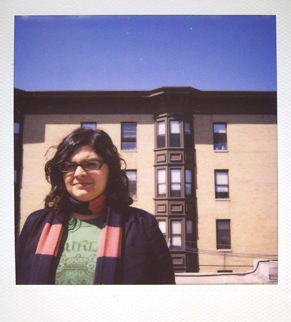
During our conversation a young woman, Alisa Ochoa, walked in with a bubble-wrapped panel. She offered the work up to the show but didn’t ask for one in return. She was jovial and posed for my photo after I explained I was blogging the experience. After she left I asked Erik, “Do a lot of people you don’t know just stop by to leave things?”

“Sure, or simply to pick something up,” he said.
At the time of my visit last Saturday, Erik calculated that 35 artworks had either joined or left the show. I decided if I was to experience the whole exhibit then I would have to take something home. “Can I choose one?” I asked. “Sure, of course,” he gestured towards the walls.
I chose the panel by Ochoa, titled Study for X it is a striking collage of earthworms on a hazy pink background. I knew it would be a hit in my household, and I was right.
The following day and over email I prodded Erik’s co-curator Anna about the nature of the “art” in Have a Painting… “Is it a performance piece?” I asked.
“Well, I have stage fright, so I would say no for me, but truly, it is in many ways because our engagement as curators (and all our other curatorial volunteers) with the public is crucial to making this show happen, to making it a success,” she said. “Almost as much time is spent physically removing works, handing them off, and hanging new work as is spent just watching the work lie on the wall, so I think it is fair to call it a performance. The curator is active, as is the viewer—no one is simply a ‘looker,’ as in the typical gallery experience. Most galleries are a place where most people go to see, not have and hold something, and our exhibition breaks down those constructions,” she explained
As promised I emailed the artist whose work I now owned. “We met at Take a Painting… and I ended up with your painting,” I started my email notifying her that I was the proud new owner of her work. She sounded pleased. “Why did you want to participate in Have a Painting…?” I asked her over email.
“I like participation, reciprocity, and generosity in art,” she responded. And I, for one, appreciated her artistic generosity.
Tomorrow: Speaking with artist Chris Martin about his group show “Party at Phong’s House”
Kelley and Pettibon in Political Correct

On view through October 25, 2008, Blondeau Fine Art Services(BFAS) in Genève, Switzerland presents the exhibition Political Correct. Taking Martin Kippenberger’s 1994 painting Ohne Titel (Political Correct III) as its starting point, the exhibition is comprised of works that might be deemed politically incorrect in content or just “tough to swallow.” Subject matter runs the gamut from war and genocide to sex and nudity, racism, and AIDS.
The 31 artists in the exhibition (mostly American) include Mike Kelley (Season 3), Raymond Pettibon (Season 2), Chris Burden, Sarah Charlesworth, Larry Clark, Michael Cline, Jason Fox, Group Material, Daniel Hesidence, Richard Kern, Edward Kienholz, Louise Lawler, Justin Lieberman, Robert Longo, Robert Mapplethorpe, Jerry Phillips, Charles Ray, Matthew Ronay, Kay Rosen, Martha Rosler, Peter Saul, Stephen Shames, Jim Shaw and Ivan Witenstein, Adel Abdessemed, Maurizio Cattelan, General Idea, Erik van Lieshout , Dominic McGill, Jean-Luc Verna, and Johannes Wohnseifer.
Read the exhibition text by Hudson, from Feature Inc., New York here.
Two Weeks in the Life of a New York Art Blogger

Hi, my name is Hrag Vartanian (Her-ug Var-tan-ian) and for the next few weeks I want to offer you a glimpse of New York’s vibrant art blogging, art non-profit, small gallery and street art scenes.
While New York may have some of the world’s greatest museums, its vibrant arts community is what inspires my life as an art blogger/writer (hragvartanian.com), critic (Brooklyn Rail, ArtCalZine), art advocate (Triangle Workshop) and online social media curator (Flickr, Twitter, Facebook and YouTube).
Tomorrow: Art Exhibition as Penny Tray or Swap Meet
New guest blogger: Hrag Vartanian

Thanks to Erin Riley-Lopez over at the Bronx Museum for highlighting some very intriguing exhibitions. Up next is Hrag Vartanian, a New York-based writer and critic. Born to Armenian parents in Aleppo, Syria and raised in Toronto, Canada, Hrag remembers finding a copy of Susan Sontag’s On Photography on a bench and was inspired to study art history and theory. In 1997, he received his MA in Art History from the University of Toronto and after graduation, he moved to Beirut to work with Lebanese college students. He eventually moved to New York where he has been working in the non-profit field.
He writes regularly for a number of publications, including art criticism for ArtCal and The Brooklyn Rail. He is a passionate champion of the arts and serves on the board of a number of arts organizations, including the Triangle Arts Workshop.
His personal blog, hragvartanian.com, is part of the Culture Pundits blogging network and it combines his passion for art, literature, human rights, photography, pop culture and adventurous ideas. This summer, he began a column about New York’s vibrant street art scene for ArtCal titled “Re:Public.” He is also working on a crime novel.
Pfaff in Albany, Pfeiffer in Berlin

The College of Saint Rose in Albany, New York inaugurated its new art gallery at the Massry Center for the Arts this past weekend with a one-person exhibition by Season 4 artist Judy Pfaff. Judy Pfaff: Paperworks, Year of the Dog, Pig, Rat, Etc. contains a recent series of small, delicate drawings juxtaposed with large-scale works on paper of varied motifs and prints based on the Chinese New Year that the artist produced at Tandem Press earlier this year.

Across the Atlantic, Paul Pfeiffer also recently opened an exhibition at Carlier | Gebauer in Berlin. The Season 2 artist is premiering two new videos plus Live from Neverland, a creepy “Michael Jackson choirlogue” work finished in 2006. Caryatid (Red, Yellow, Blue) and Cross Hall (both 2008) are video pieces that explore surveillance culture and examines their origins. Typical of Pfeiffer’s ingenuity and sophistication, the latter confronts audiences with live transmission of footage from two surveillance cameras, projected to cover an entire wall. An empty passageway is recorded from the end of a neo-classical corridor, and from a room adjacent to that corridor. Behind the surface onto which the images are projected is a diorama, a model of the imposing corridor, which audiences can only see through a peephole. The actual space remains concealed while the perspective of the surveillance camera defines visible reality and constructs it through the projection.
Judy Pfaff: Paperworks, Year of the Dog, Pig, Rat, Etc. runs through November 9th and Paul Pfeiffer through October 11th.
[St.] Raymond Pettibon[e]: 1978-1986

Yesterday, the New York Times published a review of the exhibition [St.] Raymond Pettibon[e]: 1978-1986 at Specific Object in Chelsea. The review and the press release sparked my interest though I was a little disappointed that I hadn’t picked up on this exhibition sooner because it closes September 26. Many of these early Raymond Pettibon graphic works were created for the punk band Black Flag as well as for Red Cross, The Minutemen, Nig Heist, and others. Over two hundred gig flyers, artists’ books, album covers, posters, t-shirts, stickers, skateboard decks, and the first five editioned prints by the Art21 artist chronicle a history of L.A. punk/hardcore between 1978 and 1986.
Though I usually find press releases mind-numbingly boring, Specific Object excerpts great quotes by Pettibon from a 1984 Los Angeles Times article titled, “Black Flag Cover is Pure Pettibon.” Here is one of my favorites:
“(My drawings) are violent,” Pettibon, 24, admits. “And that’s dictated by the medium, in that I just use one frame. You can’t tell a whole story with all kinds of exposition. It’s like taking one frame out of a movie or one crucial scene out of a book at a critical point. You can’t really be subtle.”
Make sure to see this show if you are in New York City. It is located at 601 West 26th Street and is open Monday through Friday. For those of you unable to catch the show, read more about Pettibon’s album covers on Paddy Johnson’s blog, Art Fag City.
New Maya Lin film on Spark
Our friends at KQED’s Spark have just released a brand-new film on renowned Art21 artist and architect, Maya Lin. The film follows her as she plans, constructs, and installs her sculptural work for the California Academy of Sciences in San Francisco’s Golden Gate Park. The site-specific piece is a topographical imagining of the San Francisco Bay. It is placed on the western facade of the new building designed by Renzo Piano, which is set to open to the public in September 2008.
In Lin’s recent artwork, she has explored new ways of looking at the landscape, utilizing topographical maps, sonar imaging, and other scientific data. It was this interest in the natural sciences, as well as a life-long passion for environmental conservation, that prompted Lin to respond to the call for proposals issued by the San Francisco Arts Commission and the California Academy of Sciences in 2006. This public art installation for the CAS will be the first permanent work by New York-based Lin in the City of San Francisco. Read more about the project on Lin’s Spark page here.
Watch a clip from Art:21 in which Maya Lin talks about the duality of being both an architect and an artist:
Find more information about Lin, as well as additional video clips and images on Art21′s PBS website at http://www.pbs.org/art21/artists/lin/index.html
Art of the 1960s at the Blanton Museum of Art

Two new exhibitions opening September 28, 2008 and running through January 18, 2009 at the Blanton Museum of Art in Austin, Texas explore an overlooked chapter in regional art history. Reimagining Space: The Park Place Gallery Group in 1960s New York and The New York Graphic Workshop: 1964-1970 are meant as counterparts in the investigation of this period.
According to the press release, Reimagining Space “presents a groundbreaking exhibition of work by artists associated with the Park Place Gallery, a prominent artists’ cooperative space in 1960s New York. With their commitment to space, the group was often at odds with the predominant aesthetics of many artists of the era, and as a result, their work has largely been ignored in chronicles of 1960s art.” The exhibition features approximately 40 works by this group of artists, including Mark di Suvero, Peter Forakis, Robert Grosvenor, Anthony Magar, Forrest Myers, Dean Fleming, Tamara Melcher, David Novros, Edwin Ruda, and Leo Valledor. It is comprised of major works, as well as photographs and documents, not seen since the era in which these artists worked . The group was connected to Texas both through its members as well as its patrons. The exhibition’s guest curator is Linda Dalrymple-Henderson, David Bruton, Jr. Centennial Professor, Department of Art and Art History, College of Fine Arts, The University of Texas at Austin.
The New York Graphic Workshop: 1964-1970, in the words of the press release, “examines the Conceptualist movement of the 1960s and ’70s through the printmaking practices of the New York Graphic Workshop (NYGW).” The workshop was founded in 1964 by Luis Camnitzer, José Guillermo Castillo, and Liliana Porter, three Latin American artists living in New York. Included in the exhibition will be 70 prints, drawings, and mixed media works by Camnitzer, Castillo, and Porter, as well as Michael Snow, Max Neuhaus, José Luis Cuevas, and Salvador Dalí, because the workshop produced some of their work as well. Curator Gabriel Perez-Barreiro, Director of the Coleccíon Patricia Phelps de Cisneros and former Curator of Latin American Art at the Blanton comments, “the New York Graphic Workshop represents a key moment in the history of both American and Latin American Conceptual art, yet this is the first comprehensive exhibition of the group since it disbanded in the early 1970s. The exhibition will provide a unique opportunity to understand the important contributions of this group of artists, and their pivotal role in the history of art of the 1960s in New York. It will also be the first time many of these artworks have been shown in over three decades.”
If you find yourself in Austin, don’t miss what look to be very exciting and compelling exhibitions at the Blanton. For further information about the exhibitions and for related programming please visit the Museum’s website.