Bourgeois at MoCA, Holzer at MCA

October 31st, 2008

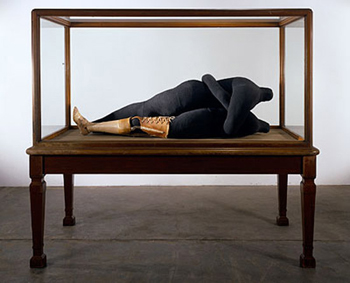
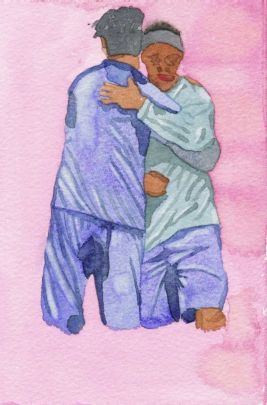
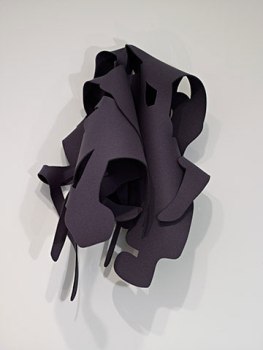
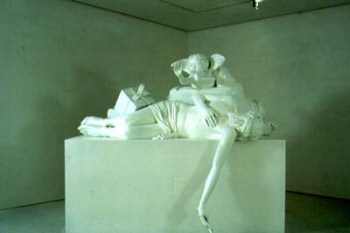
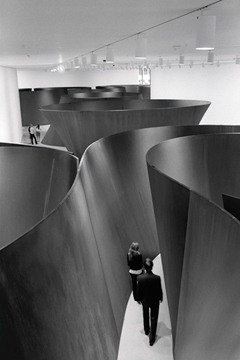
Louise Bourgeois, “Couple IV”. Courtesy the artist. Photo Christopher Burke.

If you missed Louise Bourgeois (Season 2) at the Guggenheim recently, your next opportunity to see the artist’s first major retrospective in 25 years will be at the Museum of Contemporary Art (MoCA), Los Angeles. The traveling exhibition opened this week and runs through January 25th.

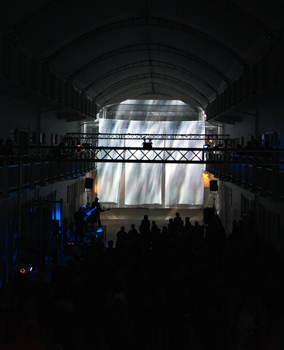
Also opening this past Monday at the Museum of Contemporary Art (MCA), Chicago was Jenny Holzer’s PROTECT PROTECT.  The exhibition centers on the Season 4 artist’s signature electronic text works from the mid-1990s to the present. In addition, a series of her outdoor projections will also make an appearance on a number of notable Chicago buildings, including the Lyric Opera, Tribune Tower, and Merchandise Mart. PROTECT PROTECT ends February 1st.

Jenny Holzer, “Thorax” (2008). Photo Christopher Burke. Courtesy the artist.

Reframing Global Video

October 31st, 2008

Mark Boulos,  “All That Is Solid Melts Into Air,” Two-channel digital video installation (14:20 minutes), 2008.  Courtesy of Pitzer Galleries.

I am always dubious when the word “global” begins an exhibition title. Trying to gauge some sort of global cultural pulse seems absurdly ambitious. But yesterday, when I went to see Narrowcast: Reframing Global Video at Pitzer College’s Galleries, I was genuinely surprised by my own reaction.

I spent well over two hours with the work and I feel like “global” is a fitting adjective for the exhibition. Together, the videos in Narrowcast are about the impossibility of fully grasping globalism and each tries to engage the present, past, and future with probing urgency.

I want to spend my last few days as a guest blogger focusing on the work in Narrowcast, following up on some of the conversations that the exhibition engages. It seems a relevant, timely thing to do, given that the presidential election is four days away and Narrowcast explicitly explores problems of political engagement and resistance.

Mark Boulos,

Narrowcast reprises a 1986 exhibition–called Resolution–that appeared at LACE (Los Angeles Contemporary Exhibitions). Five of the artists in Narrowcast participated in original exhibition; the other five are younger contemporary artists.

One of the newest works in the show, All That Is Solid Melts Into Air (2008), is also one of the most unnerving. Made by Mark Boulos, the piece is a loud, discombobulating, and gripping two-channel installation.

Boulos’ installation pits two videos against each other. Footage of  Nigeria’s Ijaw people plays on one wall, while footage of oil traders on the Chicago Stock Exchange plays on an opposing wall. The oil traders incessantly distract, the noise of their activity drowning the first film’s audio, even though their behavior is static and uneventful compared to that of the Ijaw fishermen, oil workers, and revolutionaries. At one point, a fisherman from Nigeria laments the economic injustices imposed upon him by the far-off Western oil industry. Near the end of his rant, he looks at the camera and says, “Thank you.” His appreciation seems genuine–he’s glad someone is taking his concerns seriously but he also knows that the figures behind the camera are implicated in his oppression. “Don’t come here again,” he tells them before he walks away.

The title of Boulos’ installation riffs off Marshall Berman’s 1982 book on modernity (also called All That Is Solid Melts Into Air). “To be modern is to live a life of paradox and contradiction,” wrote Berman. “It is to be overpowered by the immense bureaucratic organizations that have the power to control and often to destroy all communities, values, lives; and yet to be undeterred in our determination to face these forces, to fight to change their world and make it our own.” This is precisely the battle that Boulos’ dualing films engage.

Note: Narrowscapes was curated by Ciara Ennis and Ming-Yuen S. Ma. It includes work by Lyn Blumenthal, Juan Downey, Antonio Muntadas, Marshall Reese, Michael Smith, Bill Viola, Natalie Bookchin, Mark Boulos, Regina José Galindo, Pablo Pijnappel, and Artur Zmijewski. A symposium called Resolution3: Video Praxis in Global Spaces accompanied the exhibition.

Saw:21

October 31st, 2008

It’s October 31st — Halloween — in the year 2041.

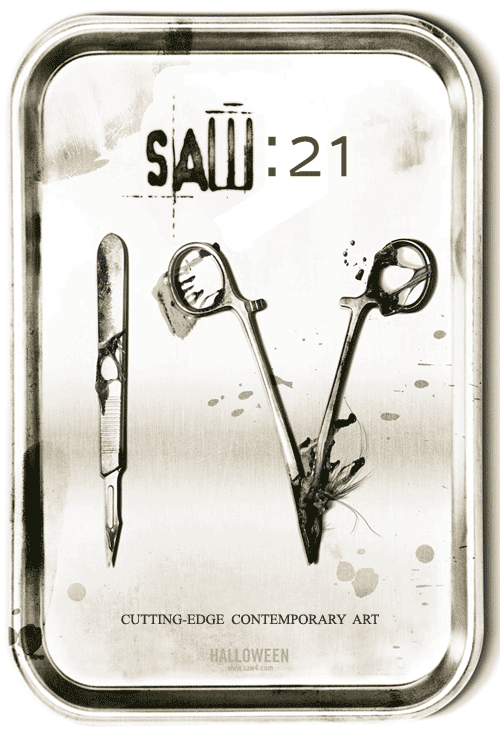
In its twenty-first season, Art21 joins forces with the Saw horror film franchise.

Artists Richard Serra, Josiah McElheny, Do-Ho Suh, and Paul Pfeiffer must solve a series of puzzles or face an extremely violent death.

Watch the trailer (more info):

You need to a flashplayer enabled browser to view this YouTube video

 saw 21 spoof movie poster

Art:21 Episode Uncovered!

October 30th, 2008

art21 spoof - tom at computer

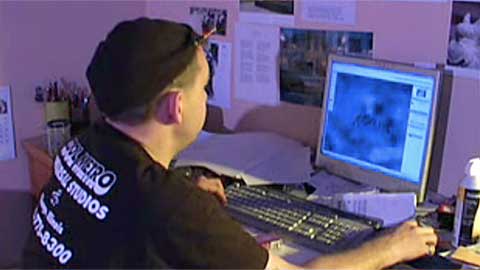
As the curator of online videos, I’ve spent the last several months digging through Art21’s archival footage, searching for interesting behind-the-scenes moments to present as Art21 Exclusives. So, you can imagine my surprise when I stumbled upon a series of eerily familiar videos on YouTube. Apparently, one of our industrious editors has been secretly releasing new videos online. I had completely forgotten we filmed these artists!

Compiled now, for the first time, is the lost episode of Art:21. But I fear there may be other lost videos out there. If you happen to find one on YouTube, please tag it with “art21″ or let us know via our YouTube channel. And as always, feel free to leave a comment below.


art21 spoof trevor “My paintings are wars,” says self-taught artist Trevor Ryan Keys Altenburg, “they’re in space…fighting.” Taking futuristic conflicts as his subject matter, Altenburg’s densely-layered acrylic paintings act as parables of contemporary violence and the military-industrial complex. While his subject matter is serious, Altenburg is quick to assert that he’s “not concerned with anything,” stressing that humor is a way to engage with many of society’s problems today.

You need to a flashplayer enabled browser to view this YouTube video


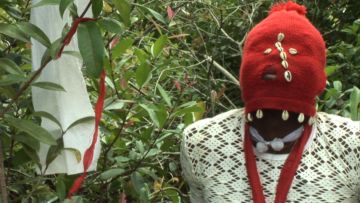
art21 spoof bjorna “Being an artist is something that’s so important to me,” says German-born sculptor Bjorna Gustavson. “When I look at color anywhere,” Gustavson asks herself, “what does color mean to me, to the world?” Categorizing all of her belongings by color into complex systems, Gustavson discerns the dormant workings of her mind while resisting being pigeon-holed by the color spectrum. “It hurts when people put me in the Purple Group. I hate it.”

You need to a flashplayer enabled browser to view this YouTube video


art21 spoof kunst “I’m quite into the aesthetic of looking like an aesthetic maker,” explains conceptual artist Kunst (aka Merrill Kazanjian). “Most of you won’t begin to understand me or my work,” Kunst asserts, in an effort to displace the knowing / not-knowing paradigm that has dominated art history since the advent of Modernism. Riding the energy waves that exist in the gap between space and time, Kunst’s work lulls the viewer into a dream-like state where anything is possible.

You need to a flashplayer enabled browser to view this YouTube video


art21 spoof tom “I don’t think there is a perfect picture,” says photographer Tom Pullin, “the perfect picture is the one that acknowledges and recognizes its imperfection.” We follow Pullin on the steps of the New York Public Library as he photographs people he meets on the street. “I guess I’m fascinated by strangers because there’s no shared history between us,” explains Pullin, who takes his artwork as an opportunity to create moments that linger in the subject’s memory.

You need to a flashplayer enabled browser to view this YouTube video

Judy Pfaff | Assistants Kate Hodges & Ryan Muller

October 30th, 2008

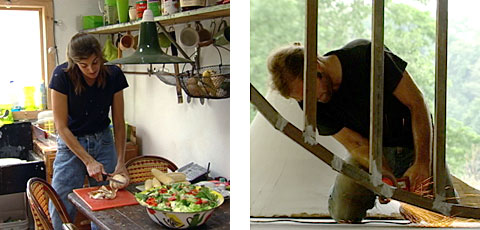
EXCLUSIVE: Assistant Kate Hodges at Judy Pfaff’s studio in Tivoli, New York.

EXCLUSIVE: Assistant Ryan Muller at Judy Pfaff’s studio in Tivoli, New York.

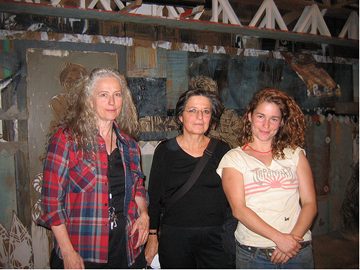
Balancing intense planning with improvisational decision-making, Judy Pfaff creates exuberant, sprawling sculptures and installations that weave landscape, architecture, and synthetic color into a tense yet organic whole. A pioneer of installation art in the 1970s, Pfaff synthesizes sculpture, painting, and architecture into dynamic environments in which space seems to expand and collapse, fluctuating between two and three dimensions.

“Art:21—Art in the Twenty-First Century,” production stills, 2007. © Art21, Inc.

SEE: More images, videos, and news for Judy Pfaff.

LEARN: Judy Pfaff is featured in the Season 4 (2007) episode Romance of the Art:21—Art in the Twenty-First Century television series on PBS.

DISCUSS: What do you think about this video? Leave a comment!

PHOTO | Art:21—Art in the Twenty-First Century, production stills, 2007. © Art21, Inc.

VIDEO | Producer: Susan Sollins & Nick Ravich. Camera: Joel Shapiro. Sound: Roger Phenix. Editor: Mark Sutton. Artwork courtesy: Judy Pfaff. Thanks: Kate Hodges & Ryan Muller.

Making Art Effable

October 29th, 2008

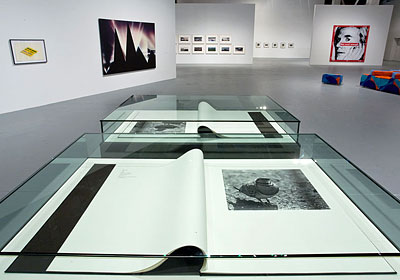
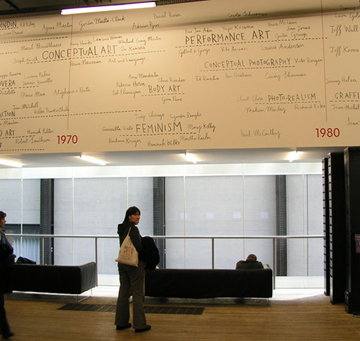
Installation view of Index: Conceptualism in California from the Permanent Collection at The Geffen Contemporary at MOCA, 2008. Photo by Brian Forrest

For the exhibition Index: Conceptualism in California,  MOCA invited four Los Angeles poets to respond to artists’ work. Though the scope of the exhibition–Index  ambitiously explores the ways in which California artists contributed to conceptual art’s development–is staggering, each poet takes a nuanced approach, emphasizing the intimate and local nature of conceptualism. Gail Wronsky imbues Cindy Bernard’s film stills with feminine crassness; Elena Karina Byrne taps into the mystery of Jack Goldstein’s and John Baldessari’s work; David St. John captures the quietness of Alexis Smith’s Asphalt Jungle; and Paul Vangelisti channels the dual urgency and monotony of Wallace Berman’s images. Podcasts of the poets reading their work can be found here, on MOCA’s podcast and audio page.

Soundings and Songs: Ann Hamilton

October 29th, 2008

Ann Hamilton, “phora 1 Ed 10 + 5 AP”, 2005. Iris print on Somerset velvet paper, 36 x 48 1/2 inches. Courtesy of Robischon Gallery.

Soundings–an exhibition of sculpture, photography, prints and video by Season 1 artist Ann Hamilton–is on view at Robischon Gallery in Denver, Colorado through November 15. The exhibition expands upon Hamilton’s works from an earlier exhibition at the Gallery, Dialog: Denver, as well as her participatory choral piece that was hosted in Denver during the Democratic National Convention.

Songs of Ascension, Hamilton’s collaborative piece with Meredith Monk, is presented at the Roy and Edna Disney/CalArts Theater (REDCAT) in Los Angeles, California through November 2. This multimedia performance, features Hamilton’s video imagery with Meredith Monk & Vocal Ensemble, plus a string quartet led by violinist Todd Reynolds, and a 20-person choir composed of members of the voice program at the Herb Alpert School of Music at CalArts. See today’s article in the Los Angeles Times and preview a video of Songs of Ascension:

You need to a flashplayer enabled browser to view this YouTube video


Hallowgreen

October 29th, 2008

dsc00859.jpg

This week’s Teaching With Contemporary Art column is written by Carolyn Sutton, Director of Arts at The Park School in Baltimore and a member of Art21′s National Education Advisory Council.

Last October, inspired by the spirit of sustainability, Betsy Leighton, Lower School Principal at The Park School of Baltimore, challenged her students to consider the environment as they thought about Halloween. She coined the phrase, Hallowgreen, and students and teachers set about collecting various recyclable materials for costumes. Cardboard, empty containers, fabric scraps, old computer parts and broken toys filled “help yourself” boxes for the students to select from. It seemed like a perfect opportunity to introduce our youngest students, in grades pre-k to 5, to the contemporary artist Nick Cave.

Nick Cave’s Soundsuits are fabulous creations, made of thrift store finds, twigs, plastic bags, discarded thcotchkes, and just about anything else that strikes his fancy. Children loved seeing his work and guessing the materials they were made from, and seeing a video presentation of people inhabiting them. They enjoyed learning about his process, too. Often, Cave’s Soundsuits are assembled by a multigenerational, multicultural group of volunteers in his Chicago neighborhood.

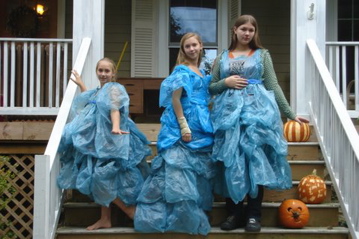
With the second Hallowgreen Challenge underway, I visited Obi Okobi’s fourth grade class at Park. The students talked about how Cave’s work influenced their thinking about artists in general: Naomi said he had stretched her thinking about what art is – that it can be much more than drawing or painting or sculpture. Olivia noted that he has the freedom to bring together two things he loves – visual art and performance – into something bigger and better. Henry commented that the pieces could be interpreted lots of ways, which the students found exciting. They were inspired by his use of materials and several talked about their own costumes using unusual materials. Connor plans to head to antique stores to look for inspiration. Atira thinks she may fashion her outfit using empty snack food wrappers. With the election in mind Naomi plans to become an election booth. Gabe wants to be a domino, and the entire class helped Meg work out possible materials to make wings for a butterfly. Last year the halls were filled with students dressed as computers, recycling bins. Max was a bubble-wrap snowman last year, and there were three lovely ladies (sisters!) dressed in gowns made entirely of blue plastic grocery bags.

While we often think of contemporary art and how our older students might respond to it, we are always pleased that our very youngest students are so enthusiastic about it, too. Nick Cave is one reason why.

image12360px.jpg

Cave, chair of the Department of Fashion Design at the School of the Art Institute of Chicago, brings together his interests in fashion, performance and sculpture while making reference to African ceremonial costumes. Watch a video of Nick Cave, produced by United States Artists:

For the Matthew Barney Fan Who Has Everything

October 28th, 2008

 barneyhaircut.jpg

Fansites may be more common for music fans or even authors but artists don’t seem to inspire the same level of adoration (or is it obsession?) that other creative professionals do. Well, then there’s Matthew Barney (Season 1).

The boyfriend of Björk and an art world superstar, Barney has a very dedicated fansite named CremasterFanatic.com.

The site features a list of Barney exhibitions, Barney-related eBay items, fan art, fan music, fan videos, fan poetry, Barney wallpapers and an active blog that posts regularly about Barney-related news and photos, including a pig roast/black metal concert at his Long Island City studio last August.

All in all, it’s a site that could probably teach Barney himself a thing or two that he didn’t know…well, not consciously anyway. And warning, a few of the fan images may be NSFW.

Coincidentally, the blog has a poll as to which Cremaster is the popular favorite and right now it appears that Cremaster 3 has a very clear lead.

Letter from London: The Contemporary Portrait

October 27th, 2008

2559019747_5456f8ce4f1.jpg

It might seem a bit old-fashioned to bemoan the demise of the portrait tradition in contemporary art, but looking at a new show of Renaissance portraits, and having read a short article on Marlene Dumas describing her as “the anti-portraitist,” I’ve been thinking about how, and if, the portrait tendency persists in art now. The National Gallery exhibition, Renaissance Faces, is a survey of portraits and their functions, from Van Eyck’s Arnolfini Portrait, with its evocation of a specific time and place (“Van Eyck Was Here” is scrawled in florid cursive on the back wall of the painting’s room, above the artist’s reflection in a convex mirror) to Raphael’s Pope Julius II, brooding on his political misfortunes, one hand gripping his throne as though fearful of losing it.

What connects these portraits is their ability to reconstitute physical presence through the stuff of paint. Portraiture is less a genre than a function of art itself. Pliny’s legendary origin of painting–the tracing on a cave wall of the projected silhouette of the departing soldier by her weeping lover–is tied into the notion that art can stand in for a physical absence. Both the physical and the visual–the temporal as well as spatial–presence is implied in the meticulousness of the painted portrait, a meticulousness bound up in the shortness of life expectancy in the Renaissance and the function of portraits as diplomatic tokens. What came persistently to mind while looking at the show was Dave Hickey’s passage in Air Guitar about Scott Burton. Hickey attempts to recall his late friend’s presence through images, and comes to this fascinating conclusion:

“I could have…looked at a photograph, of course, but photographs are nailed in the moment of their making, and when the subject is dead, this distance from the present only reminds you of that. I would have preferred an image that reminded me, persuasively, physically, that Scott had once been alive…That’s what painting used to do – what only painting can do – and does no longer, and this seemed a pity, since regardless of fashions in image-making, we continue to die at an alarming rate.”

A portrait is the visualization of presence, not of likeness, and while the rather conservative likeness tradition continues apace, and while there are artists (like Elizabeth Peyton, Dumas, and Luc Tuymans) who engage with the tradition to a certain extent, they present the image as image, not as a conceptualization of presence and absence. Lucian Freud’s muscular impasto portraits perpetuate the tradition of the great 17th-century portraitists (Velazquez, Rubens, and Rembrandt), but are locked into a groove of representation that is resolutely ahistorical.

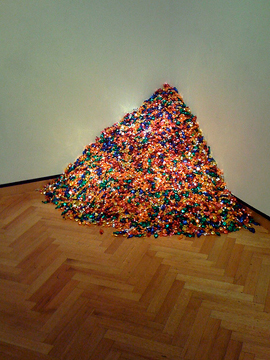
Perhaps the closest contemporary art has got to the fundamentals of portraiture is in the work of Felix Gonzalez-Torres. His 1991 Portrait of Ross in LA is, ostensibly, a pile of brightly wrapped candies piled in the corner of the gallery, to which viewers can help themselves. Replenished daily by the gallery, the candy stack weighs 175lbs, the weight at full health of Gonzalez-Torres’ deceased lover, Ross. What this work has in common with the tradition of the painted portrait is in its realization of the intertwining of the physical and visual that characterizes our experiences of other people. It’s a condition of the persistence of an idea (a sort of post-Warhol slippage between subject and form) that this function has been sidelined in contemporary art practice. It’s what sends a shot up your spine when you see Van Eyck reflected in the mirror, or consider that the painter “was here,” exactly where you stand as you read it, or feel the sweetness in your mouth long after you’ve left the gallery.