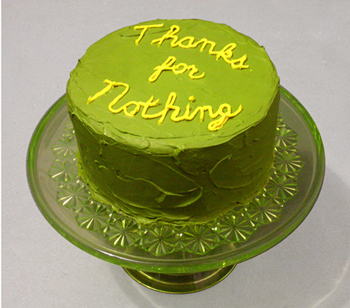
Happy Relational Thanksgetting

Today seems like a good day to practice a little relational aesthetics, which I suspect arguably has its roots in this holiday (or any holiday gathering, for that matter). Just ask Pierre Huyghe (Season 4) and Rirkrit Tiravanija for a second opinion.
Happy Thanksgiving and getting!
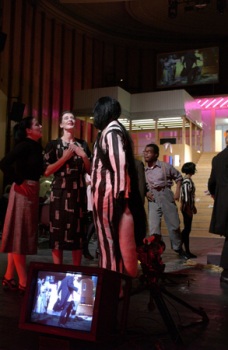
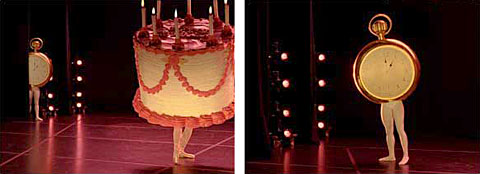
Laurie Simmons | Choreographer Helen Pickett
EXCLUSIVE: Choreographer Helen Pickett during the making of Laurie Simmons’s The Music of Regret (2006) at the Alvin Ailey Dance Studio, New York.
Laurie Simmons stages photographs and films with paper dolls, finger puppets, ventriloquist dummies, and costumed dancers as “living objects‚” animating a dollhouse world suffused with nostalgia and colored by an adult’s memories, longings, and regrets. Her work blends psychological, political and conceptual approaches to art making, transforming photography’s propensity to objectify people, especially women, into a sustained critique of the medium.

SEE: More images, videos, and news for Laurie Simmons.
LEARN: Laurie Simmons is featured in the Season 4 (2007) episode Romance of the Art:21—Art in the Twenty-First Century television series on PBS.
DISCUSS: What do you think about this video? Leave a comment!
PHOTO | Laurie Simmons, production stills from The Music of — Act III, 2006. © Laurie Simmons, courtesy the artist, Salon 94, and Sperone Westwater Gallery, New York.
VIDEO | Producer: Susan Sollins & Nick Ravich. Camera: Joel Shapiro. Sound: Roger Phenix. Editor: Mark Sutton. Artwork courtesy: Laurie Simmons. Thanks: Alvin Ailey American Dance Theater.
Public Space and Prop8

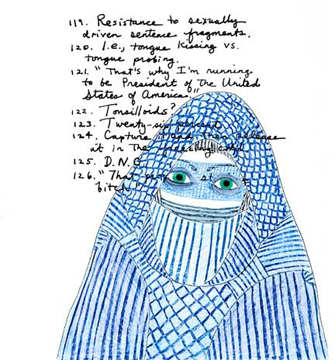
Feel Tank Chicago. Image related to their Parade of the Politically Depressed. (It happens on the street on MayDay)

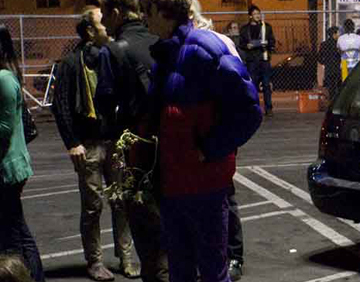
No on 8 rally. Weird Space in LA. Photo by Nancy Popp
I’ve been asking myself the following questions: what would an increased activity or access to public space do? What is the actual output (politically and culturally) of mixing and proximity, of a public life? For New Yorkers, this question might seem superfluous; for those of us in more dispersed cities, this question is the link between a truism (public space=good) and lived experience.
Over the past x number of years, there has been an interest in public space (InSITE and Just Spaces are just a few of the recent stuff here in LA). Additionally, neoliberal urban planning regimes have been recreating cities to be more “public” within a corporate rubric. I am interested in projects that bring more of the whole of the human experience to the public… emotionality in particular. Feel Tank in Chicago does this brilliantly. Check out one collective member’s great reflections on their project Pathogeographies. The piece also talks in a very detailed manner about the particular interpersonal interactions of art in public space.
Los Angeles has been seeing forceful public responses to the passing of Prop8. The marches have been huge and, what’s more, uncontrollable. I went to one in the early downtown. By the time I biked two miles back to my house, the march had gone much further then I thought. Several hours later, I heard from Sunset Boulevard (five blocks below my house) the clamor of a march. Sure enough, a spirited group of 100 or more had splintered off and were marching the long distance through Echo Park to Hollywood. Astounding. The paired horrors of Prop8 and the hope of the recent elections has generated a lot. I met Nancy Popp (who took the protest photos) at the march and we talked a bit. She and collaborators discussed the need for continued contact after mobilizations…contact being one victim of our space here. To prove the point, along Sunset Blvd, after the crowd passed to the accolades of onlookers, I overheard a conversation in Spanish repeating the lies of the yes on 8 conversation… but no one was around to dispel the myths.
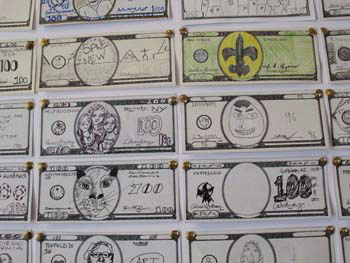
On a final note, an event at Sea and Space Explorations, A Solo Show, is an interesting way to bring 100 private spaces into the gallery. Makes for really interesting curation.
Process and Power
Contemporary art will often ask the viewer to consider process and the steps taken to create a work of art. Without consideration of process, some art is even difficult to understand. But for students studying art, whether it’s fine art or commercial design, submersion in and awareness of their own process is the key to being flexible with ideas as they emerge. It’s also the key to exploring pathways that open up because of chance “mistakes.”
More and more, I am being reminded of the work we have to do on the “front end” as teachers. This is the work that takes place before the lessons, before writing the unit, before creating assessment criteria, before gathering materials and assembling visuals. This is the work that involves organizing our inspirations and big questions into something that not only works within a curriculum framework, but simultaneously is inspiring and meaningful for the students.
Guided exploration of contemporary media, themes, big questions, “undiscovered” artists and possibilities are some of the greatest gifts we can give our students. Helping students keep sketchbooks to organize ideas and keep track of progress is also a gift that directly relates to teaching them how to reflect on their own process for making art (see Mining Ideas Part 1, Part 2 and Part 3). Through teaching with contemporary art, we open up our classes to being more directly involved with process and the power that comes with taking the extra time to become immersed in a medium, theme, question or activity.
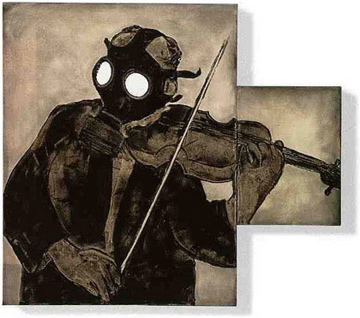
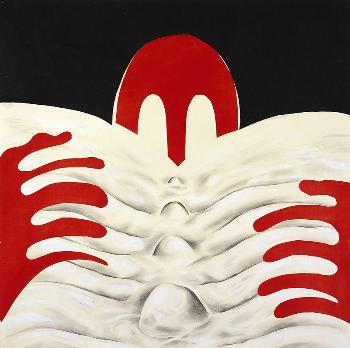
Pictured above: Ida Applebroog, “Marginalia (Isaac Stern)”, 1992
Oil on canvas, 2 panels, 35 x 39 inches overall
Photo by Dennis Cowley. Courtesy Ronald Feldman Fine Arts, New York
Psychedelic at SECCA

There is a very interesting film and video exhibition currently up at the Southeastern Center for Contemporary Art in Winston-Salem, North Carolina. Pyschedelic presents animations that are less about products of altered consciousness and more a rediscovery of one’s state of mind. Revisiting the visionary history of the psychedelic experience, the program explores “contemporary applications of a model often dismissed as a drug-induced relic of the 1960s. Using ‘trippy’ aesthetics as a point of both reference and departure, the works in Psychedelic employ fluid imagery and hypnotic color to consider familiar objects, truths and faces in an unfamiliar way.”
The four artists in the show are Carlos Amorales, Jeremy Blake, Louis Cameron and Shahzia Sikander (Season 1).
The exhibition runs through January 4, 2009. For a full program schedule, visit the SECCA website.
art twenty-one and a half
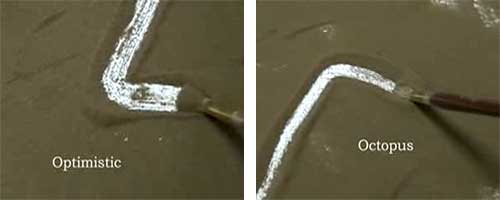
‘Tis the season for spoofs it seems. This impressive video — aptly named Art:21.5 — comes from artist Scoop Brancisco in Hawaii. Appearing as a paper bag-head, alien, robot, and Frankenstein’s monster, Scoop explains a number of works such as the iPot which, well, you need to watch the video to find out more. Scoop’s also created an imaginative, do-it-yourself adaptation of our opening graphics: he draws a white line by dragging a paint brush through what looks like powdered ice tea mix. Be sure to watch to the end for what could very well possibly be our new theme song! Could this be the best Art:21 spoof ever? Stills below.


Crowds and Power

Image via innis22mara on Flickr
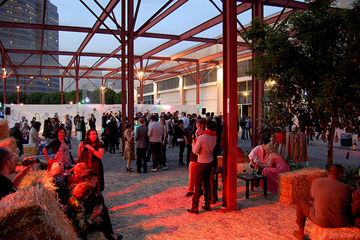
I’m away from LA this weekend, missing what, by several heated emails, is a curious event at the MOCA. Struck by a financial crisis, a public meeting is being held at the behest of the private, mostly downtown institution. Without too much info on the affair, the tidbit about the seemingly grassroots organized chat that most intrigued me was this tidbit from the LA Times blog: “MOCA Mobilization [a new Facebook group], formed by artist Cindy Bernard, currently boasts more than 200 members. Its mission is to ‘generate support for the Museum of Contemporary Art, Los Angeles…disseminate information on the current financial crisis, discuss options, and advocate for an autonomous MOCA if necessary.’”
Self-organizing a kind of museum on strike? A People’s MOCA? Think of what a fabulous moment that would be and think, how that could be be possible? How does one distill the academic work, the selective hierarchy, the collective labor of top-down management into a suddenly turned-out museum?
One wonders if the result of such a project would be half as interesting as the road to it. The terms seem far more challenging to navigate than the outcome (we do know what a MOCA looks like). I find the questions of social organizing as interesting as the performance of the completed institution…stillborn projects make a fascinating study.
Recently I had the fascinating experience of being in a near-riot at a mall (please believe me when I say I really don’t go to malls that often). For fire-code reasons, the mall was blocked off; too many people inside were celebrating (?) a christmas tree lighting. Hordes of people on the outside wanted to get in, blocked by security guards at all pedestrian entrances (this was the worst of LA malls: a block of turned-in walking city shops around Italianate town squares). I was meeting someone at a movie that had already begun and so I had no choice but to wait at the shuttered gates of the mall money pile. Upset shoppers and restaurant goers streamed up to the guards trying to work their own little deal to be let in. After walking around the whole block, I was certain there would be no entrance. Soon too, I noticed that no one in the waiting crowds was talking to one another; the sole focus of those outside was to get in, and if not then to cut deals with an unbending security staff. I imagined I was with an operative of the Center for Tactical Magic and asked myself, “if they were in this situation what would they do?” I began giving unsolicited advice to those around me, “Go home.” “They don’t need your money tonight. Read a book instead.” “Go knit your own clothes instead of shopping.” Though it was 7:30pm in front of a mall in SoCal (or because of that), my action to create a timely network of subversive power was frighteningly easy and also so frighteningly singular. It was clearly a moment when counter-narratives to the mall culture inside were very effective.
(The old book Crowds and Power by Elias Canetti is pretty amazing. Up next, if all goes up to plan is a post involving the recent Prop8 protests that have swept across the city).
Exclusive Videos Now on iTunes

In its first week on iTunes, Art21′s series of Exclusive videos debuted as the Top Video Podcast for both the overall Arts and Visual Arts categories! Sorry Martha Stewart and Jamie Oliver, H&M and Vogue — but contemporary art is taking over.
All 40 videos — which got their premiere here — are now available as FREE downloads. A new video will be added each and every week. Become a regular subscriber (link opens application) today! You can also search for “Art21″ in the iTunes Store.
Be sure to leave us a customer review, and thanks to all who’ve already downloaded videos and helped to make us #1!
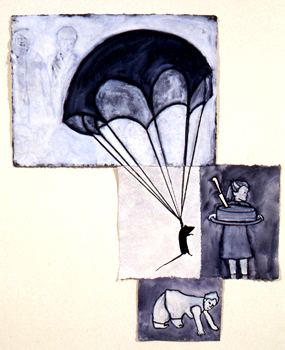
Drawing Review at Ronald Feldman

Drawing Review: 37 Years of Works on Paper opens tomorrow at Ronald Feldman Fine Arts. The more than forty artists in the exhibition were or have been represented by the gallery since 1971. The range is broad, comprising works that deal with performance and identity in the 1970s, to architecture and politics of the 1980s, to contemporary imagery based on nuclear physics, cartography, sustainability, and a few visionary flying machines thrown in to boot.
The big mix includes, among others, Joseph Beuys, Chris Burden, Buckminster Fuller, Leon Golub, Christine Hill, Ilya Kabakov, Komar and Melamid, Roxy Paine, SITE, Hannah Wilke, as well as Art21′s Eleanor Antin, Ida Applebroog, and Pepón Osorio.
Drawing Review runs through December 23rd.
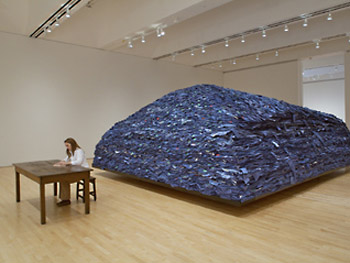
SFMOMA’s Explore Modern Art

SFMOMA recently launched their redesigned website with the initiative Explore Modern Art, an online learning environment and interactive space that integrates the museum’s collections information, calendar of public programs and events, and multimedia interpretive programs. Over the last decade, these features have produced engaging programming on 85 modern and contemporary artists, enabling visitors to learn about the contexts in which the artworks were created, see videos of the artists in their studios, hear first-person explanations of their creative processes, and view high-resolution digital images of the artworks. Explore Modern Art makes this substantial repository more accessible, user-friendly, and well, fun.
My favorite section is Making Sense of Modern Art, a lively video archive and guide to works in SFMOMA’s permanent collection, where one can go watch Ann Hamilton discuss her Indigo Blues Project, look up close at a Claude Cahun photograph, or listen to Richard Tuttle talk about the “presence of simple things.” Other Art:21 artists highlighted in this program include Matthew Barney, Louise Bourgeois, Jenny Holzer, Richard Serra, and Kara Walker.