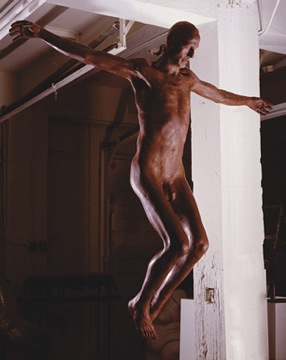
Found Art: 10 Ways to Die of Electric Shock
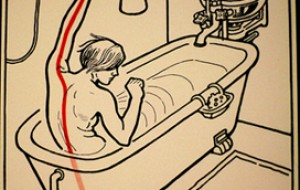
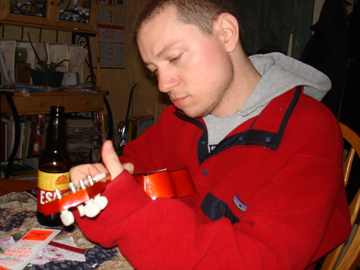
Disaffected hipster meets his maker. All images courtesy of Bre Pettis.
Since we’re talking “shock” here at Art21, I decided to plug the word into Flickr to see what it’d turn up. It was a jackpot. I discovered a set of graphic designs from a 1932 German book that featured dozens of renderings of ways in which you can die (or get seriously hurt) by electric shock. It’s freaky.
The set of images, dutifully photographed by mechanical wiz Bre Pettis during a trip to the Technisches Museum in Vienna, are irresistible. They come from Electroschutz in 132 Bildern, a pre-War tome about which I know next to nothing, and whose exact purpose eludes me. But the drawings rock (or is it shock?)—stark Raymond Pettibon-meets-Los. Bros.-Hernandez-meets Alfred Kubin-style imagery that just drips with the anticipation of something big. The red arrows over the black-and-white figures beckon clinically, like instructions: Grab lamp with frayed wiring. Put foot in tub. Electrocute. Simple, yet absurd. And totally macabre and grody.
Here’s a round-up of my 10 favorite shocking images from the set. Do not try this at home.
All I Want For Christmas
All I want for Christmas is to catch up.
The break between Christmas and the New Year provides teachers a time for catching up with family and friends, but also time to reassess how the year is going and plan important next steps for our classes. At this point, I’m in the midst of some great work with the students I teach, including a unit that asks students to create paintings interpreting the theme of power, one that asks students to visually define SELF in a variety of ways and a new unit called OTHERS where AP Studio Art students work one-on-one with models (inspired by an ongoing conversation I’m having with Eleanor Antin, which will be published here on the blog in January). Taking the time over the break to do some purposeful wandering is also a great way to refresh planning and get ready for the second semester. Get out to the exhibit you’ve been wanting to see. Get into the studio (or wherever you make your art) for a little extra time. Catch up on the Artforum, Bomb Magazine, Art in America, Aperture and Art on Paper issues that have been waiting in a neat pile. Make notes. Scribble ideas for big ideas and plans. Lay them all out a few days before going back to teach and begin to plug in artists, art, and maybe even plans for a field trip or two.
Happy Holidays!
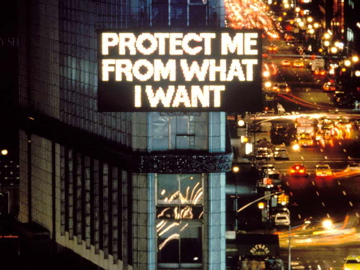
Pictured above: Jenny Holzer’s “Truisms”, 1977–79
Spectacolor electronic sign. Times Square, New York, 1986.
Best of the Art21 Blog, 2008 edition
With our blog’s redesign in February, we hoped to see the site take off this year with a slew of new features. Following are some of our favorites, all of which are here to stay.
NEW WRITERS | Trong Gia Nguyen and Nicole Caruth kept our calendars full every week with up-to-the-minute posts on every exhibition, prize, talk, and happening involving our featured artists. We soon brought additional writers into the mix, including Seth Curcio and Hrag Vartanian. Check out: Isaac and Ellen, I Left My Heart in New Orleans, Iceland of Fire, Water & Light, Pound for Pound, Inspired to Dance by Kara Walker
NEW WEEKLY COLUMNS | Letter from London – museum educator, schoolteacher, art critic, and man about town Ben Street brightened our Monday mornings and always inspired lots of viewer comments with his entertaining and perceptive column about the London art scene, from Protest Too Much to The Turbine Hall.
Teaching with Contemporary Art – Senior Education Advisor Joe Fusaro chronicles his experiences teaching contemporary art to high school students every Wednesday. In 2009, we’ll see even more of our blog real estate dedicated to contemporary art education. Recurrent themes of “finding a balance” (parts 1 and 2) and sketchbooking got the conversation going.
THE GUEST BLOG | One of our biggest new features this year. Read all about our twenty-four writers-in-residence at http://blog.art21.org/2008/12/22/art21-guest-blog-year-1/
Must-read posts: Bedding Down at the Guggenheim, A Cult, Some Vegans, A Ballet, Oh My!, CarbSmart, Bantamweight Flickr Battle!
NEW VIDEO | You’ve probably noticed by now that Art21 produces more video than our PBS series Art:21—Art in the Twenty-First Century. Now you can catch new exclusive short videos every Thursday. Find them all here. Top viewed videos: Elegy for Robert Rauschenberg, Kerry James Marshall | “Black Romantic”, Gabriel Orozco | On Photography
FLASH POINTS | Flash Points is an extended conversation about various charged topics in contemporary art. What better way to kick things off than with the art of controversy? Guest writers Jennifer Doyle, Catherine Wagley, and C-Monster, along with our regular bloggers, got things hopping. Check out Doyle’s thoughtful series of posts on difficulty and artists as “blood criminals” here.
MEL CHIN’S FUNDRED DOLLAR BILL PROJECT | We’ve worked with Season 1 artist Mel Chin for years, from 2004’s S.O.S.: Moment video to his ongoing Fundred Dollar Bill/Paydirt project. Earlier this year, we made a series of videos with Mel, regularly following his progress. Check out “Fundred” at George Jackson Academy and Paydirt, for starters.
HELP MAKE THIS ALL POSSIBLE! | While we wish it did, our blog does not run on sheer talent alone. Help us to continue this work and grow the site with a 100% tax-deductible gift to the Art21 Annual Fund.
WE WANT YOUR FEEDBACK | What would you like to see on the Art21 Blog in 2009? Let us know by leaving a comment below. Interested in joining our team as a guest blogger? Email a letter of interest, 2 writing samples, and relevant links by January 16, 2009 to blog [at] art21 [dot] org.
Krzysztof Wodiczko to Represent Poland at 2009 Venice Biennale

Krzysztof Wodiczko has been chosen to represent Poland in next year’s Venice Biennale, the 53rd International Art Exhibition. No stranger to the canals, Wodiczko also participated in the 42nd Venice Biennale in 1986, and in the Venice Architecture Biennale in 2000.
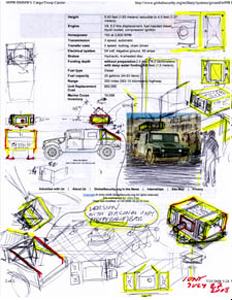
The Season 3 artist is known for his socio-political works employing large-scale public projections and interactive sculptures that expose societal injustices while seeking to empower marginalized communities. He has executed over 70 site-specific projections on public buildings and monuments in 40 cities worldwide. Recently at Dialog:City in Denver, during the 2008 Democratic Convention, Wodiczko presented the Veteran Vehicle Project, a series of interviews that looked at the complexities of re-integration for soldiers returning from the Iraq War who have subsequently experienced homelessness. For the Venice Biennale, the artist will premiere an indoor projection detailing the lives of Polish workers within Italian communities.
Wodiczko is currently featured in Cold War Modern: Design 1945-1970 at the Victoria and Albert Museum in London, featuring work made on both sides of the iron curtain during the cold war. He is also collaborating with architect Julian Bonder on a memorial in Nantes commemorating the abolition of slavery, in addition to being shortlisted for the Foyle Public Art Project in Northern Ireland.
Gay Witches, Part 3
Continued from “Gay Witches, Part 2″…
![“Ghost Boys [Massimo & Pierce]”, photo by Phillippe Christin, 2003. Courtesy of Black Sun Productions.](http://blog.art21.org/wp-content/uploads/2008/12/ghostboys1.jpg)
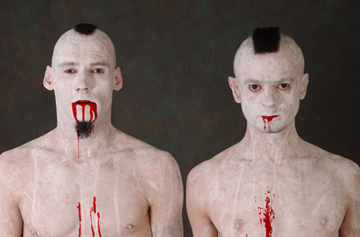
3. The work of sound, visual, and performance artists, Massimo & Pierce, aka Black Sun Productions, could easily be discussed in the What’s So Shocking About Contemporary Art? thread on this blog. Their sexually explicit performances in Europe supposedly spurred police to raid their Zurich offices in 2003, although I haven’t been able to find any archived news items on this, other than anecdotal info on the Wikipedia entry on them and in reviews of their records. Not to cast doubt on the verity of these events, but Massimo & Pierce’s origin story itself has a mythological flair. After the two former sex workers met and became romantically involved, they decided to dedicate their partnership to an artistic and magical multimedia exploration of love. The duo take pornography seriously as an art form, casting it via sex magic as a theatrical ritual of transformation and connection. They achieved some international visibility in 2002 when they toured their Plastic Spider Thing performance with Coil. The performance was akin to an SM scene between two lovers’ spider and fly spirit animals. My favorite project by Massimo & Pierce, however, is less straightforwardly engaged with the symbols and processes of magic: their musical adaptation of the poetry and lyrics of Bertolt Brecht, operettAmorale. Musically, it is a combination of cabaret atmosphere, electronic drones, and chanted vocals. They manage to inject an extra dosage of darkness and debauchery into Brecht’s famously paradoxical words without seeming redundant. It is both disturbing and quite funny, particularly the campy “Pimp Ballad.” You can listen to some of their music on their Myspace page, as well as get additional information on their many different projects and collaborations.

4. William J. O’Brien is a Chicago-based artist who works in multiple media, including painting, sculpture, drawing, fiber, and ceramics, all of which he submits to an intuitive, seemingly casual sensibility. Most of his work has a rough, totemic quality that might superficially look like the type of work gathered for the Unmonumental show at the New Museum, but is ultimately too earthy and emotional to sustain that comparison for long. Credit those qualities of earthiness and emotion to O’Brien’s feel for materials and sense of touch. My favorite amongst O’Brien’s recent work are his ceramic heads, an installation of which are pictured above; a few more examples can be seen here. They make me think of Moche portrait vessels found in ancient tombs, only expressionistically rendered. The melted and scarred likenesses pinched and gouged from clay are like faces recalled from a nightmare or past-life regression. Or maybe O’Brien is recapping the Modernist principle of truth-to-materials as a kind of animism, as if it were the faces of spirits inhabiting the clay that he ultimately coaxed from the stuff.
Crying Wolf

Here’s one of the biggest problem with controversy in contemporary art: once it sparks, people stop really looking.
I didn’t see UCLA’s Wight Biennial this year. LA Times critic Christopher Knight didn’t see it. And it’s quite possible that Diane Haithman, also of the LA Times, didn’t see it either. Nonetheless, we all felt compelled to respond to the “dust up” that occurred when a certain piece was removed from the exhibition without the artist’s consent.
Using an event or artwork that you haven’t actually experienced to talk about issues you think are important can be an immensely problematic move. But it’s a move people make all the time, especially in fields like journalism, where quick turnaround is the name of the game. And while commenting on what you haven’t experienced sometimes leads to interesting discussions, this kind of negligence is almost always bad for the art.
As controversies go, the 2008 Wight Biennial is a fairly small one, but that doesn’t mean it’s not indicative of what often happens when artwork becomes the focus of press-fueled debate. The Wight controversy, as I first encountered it in the LA Times and White Hot Magazine, went something like this…
The Wight, a bi-yearly student-curated exhibition at UCLA, is nearly installed. On September 23, artist Maya Lujan arranges her large-scale work, White Magic and Xanadu, in the gallery, hanging a black velvet mandala on the wall. The next day, she receives an email from Alex Segade, Matthias Merkel Hess, Jennifer Gradecki and Wu Ingrid Tsang, the show’s curators, asking her if the wall piece is necessary. She enters the gallery on September 25, the night of the opening, and finds that her mandala has been de-installed without her permission. A showdown of sorts ensues (and now I’m referencing White Hot’s account), in which the curators tell Lujan to either accept the removal of her wall piece or to de-install the whole work. Lujan chooses to remain in the show and, in the aftermath of this purported censorship, it is suggested that the curators were unsettled by the mandala’s resemblance to a swastika. Perhaps they removed it so as to avoid controversy.
This story could certainly be (and has been, for a handful of bloggers and art writers) the basis for some age-old conversations about censorship, the power of symbols, the artist’s freedom of expression, the license of curators, etc. But what if these are just default issues that become easy to talk about whenever art “controversies” arise? Swastikas are loaded symbols and censorship certainly has a sordid history, but what happened in a small, student-curated exhibition full of emerging artists is likely a little more complicated.
Wight curator Alex Segade said of the Times‘ coverage of the show, “I noticed the knee-jerk suggestion that the students or the department were too ‘politically correct’ to show [Lujan’s] piece. The article played right into a simplistic view of art school that simply isn’t its reality.” According to Segade, “we had explicit depictions of anal sex, a vagina smoking a cigarette, and posters of the logo for the SLA, a terrorist group, in the show.” The Wight’s curatorial committee was by no means averse to provocation, which suggests that the swastika-related censorship claim may be a slack abbreviation of the decisions made surrounding the exhibition.
“I have wondered why the work itself has not been considered on a critical level, and why other work in the show has gotten no attention at all,” Jennifer Gradecki, also a member of the curatorial committee, wrote via email. “As a student and an artist, this emphasis is disconcerting.”
I’m a big fan of what Jennifer Doyle said in her recent post on this blog, about how even the simplest works of art often contain some difficulty. Art, especially thoughtful art, should be difficult. It should take time. It should be experienced, considered and reconsidered, before it’s really done its job. The problem with the over-simplification that usually accompanies art world controversies is that the art doesn’t get its due.
here.
Gay Witches, Part 2
As promised, here is a list of some recent artists and projects, about which I am particularly enthusiastic, that explore the occult from a queer perspective.

1. Originally from Toronto, and now based in Paris, Scott Treleaven is probably best known for his occult/queercore zine This is the Salivation Army (recently compiled and co-published by Printed Matter, Inc. and Art Metropole as The Salivation Army Black Book) and his darkly erotic collages, although he has also made a number of hypnotic, Kenneth Anger-like films. His collage works usually picture young men engaged in mysterious, ritual-like activities. The pictures combine heterogeneous sources and surfaces. We might find any combination of original and found photography (some of it likely film stills), historical prints illustrating alchemical and mystical ideas, cut chiyogami paper, and atmospheric fields of watercolor, etc. Generally, his compositions possess a hieratic quality, achieved through pronounced symmetry and conspicuous framing devices. We know immediately that we are in a mythic space when looking at one of his pictures.
So, what is the nature of the spell cast by Treleaven in his collages? I have a hunch it has to do with imagining some form of ecstatic fraternity as an alternative to the forms of community that are available in contemporary society, including the gay mainstream. I am thinking of the wolves that appear so frequently in his work. They are certainly cyphers for unfettered desire, but their significance also seems to lie in their highly social nature. His boys run in packs. I’ve also noticed that the young men in his pictures either appear alone or in groups of three or more. Rarely are they arranged as a duo, which would connote more conventional ideas of romantic desire. The collaborators he has brought into the fold for his films also leads me to believe that he is trying to reimagine a queer community based on creativity and sprituality: AA Bronson, Genesis Breyer P-Orridge, and the performance art duo, Massimo & Pierce (see below), amongst others, have been featured in his films. I highly recommend Treleaven’s essay, “My Little Underground,” in Generation Hex (ed. Jason Louv, Disinformation Co. Ltd., 2005), which chronicles his search for identity and community in the occult, queer, and punk subcultures.

2. My favorite record released this past year (which can neither be rightly called a new recording or a reissue—more below on that) is Coil’s The New Backwards. For those unfamiliar with their work, Coil were a post-industrial, experimental electronic band founded in 1983. Along with Psychic TV and Chris & Cosey, they rose out of the ashes of industrial music pioneers, Throbbing Gristle. Although many collaborators have come and gone Coil were, at their core, a duo comprised of John Balance and Peter “Sleazy” Christopherson. A great archive of Coil-related info is maintained by the good folks at Brainwashed here. Describing Coil’s music is difficult as they transformed their sound regularly but, generally speaking, they offered a poetic and emotional take on electronic noise, with Balance’s warm, sometimes foreboding, voice floating through the psychedelic bedlam. Listen here.
Difficulty, Part 2: Bad Feelings

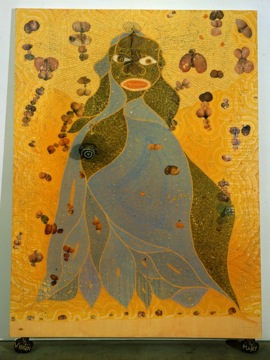
Chris Ofili, Holy Virgin Mary (1996)
I started thinking about the word “difficulty” in relation to controversial art because the things in art which grab me, even shock me, rarely line up with the scandal that art produces. The first time I saw Ofili’s Holy Virgin Mary, I was shocked by its color-saturated beauty and then totally freaked out by the beaver shot-butterflies, which I only understood as porn clippings when I was within a couple feet of the canvas. It’s a chilling and eloquent visual comment on colonial desire—on the art world’s hope of “discovering some new form of Hottentot” (in the words of Rebecca Harding Davis).
Controversial art often challenges the production and regulation of pleasure in museums and galleries. We are taught to expect very specific forms of pleasure from visual art. And the range of feeling allowed the spectator in the museum seems much narrower than that which we enjoy in other spaces. Artworks can be difficult in their affective intensity—in other words, when they describe and provoke “bad feelings” like sadness, anger, or anxiety.
Why are we prepared to accept the value of “feeling bad” when we read a novel, but not when we go to our museums? Why is it “easier” for us to watch an upsetting movie than it is to keep company with contemporary art that makes similar emotional demands on us? Continue reading »
Art21 Guest Blog, Year 1
2008 marked the inauguration of many things for Art21 and among the most notable was the introduction of our guest blog. Initially every week and now every two, we bring on a new writer—friends and colleagues, and others who come recommended to us—to add new perspectives to our content. We are thrilled to highlight our incredible cadre of writers from across the US and abroad. Click on each writer’s name for an index of all his or her posts. Many thanks to all twenty-four of them for their informative and often entertaining insights!
Interested in guest blogging for Art21 in 2009? Email a letter of interest, 2 writing samples, and relevant links by January 16, 2009 to blog [at] art21 [dot] org.
Art21 “Exclusive” Video, Year 1
What a year it’s been! We’re taking a look back at the 45 Exclusive videos that premiered here on the Art21 Blog, and subsequently on YouTube and iTunes. We hope you’ve enjoyed this new feature for 2008 and, as always, look forward to your comments.
What’s our New Year’s resolution? We’ll be introducing HD-quality content, sneak previews of Season 5 of the PBS television series, and more behind-the-scenes moments with contemporary artists such as Laylah Ali, Jenny Holzer, Oliver Herring, Jessica Stockholder, Robert Ryman and many, many more.