Women in the City – One Year Later

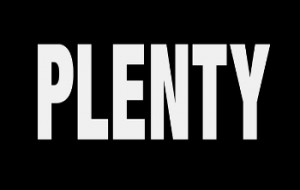
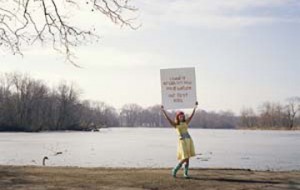
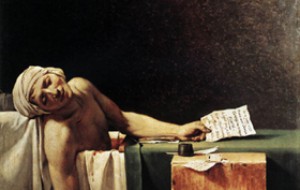
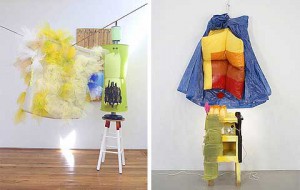
Barbara Kruger, "Plenty", 2008. Video billboard, 3 min.15 sec. looping. Courtesy of West of Rome.
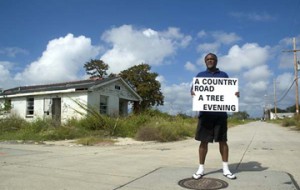
Last year, gallerist Emi Fontana curated Women in the City, a public art exhibition spread throughout the streets of Los Angeles. Works by Barbara Kruger (Season 1), Jenny Holzer (Season 4), Louise Lawler and Cindy Sherman were displayed as posters and billboards; on video screens; at a movie theater; in storefronts and gardens; and widely distributed as stickers. The project was cited in the year-end issue of Artforum as one of the best in 2008.
Tomorrow at 4pm, Fontana, Kruger, and Joanne Heyler will participate in a panel discussion about the state of public art in Los Angeles and its future. The program, moderated by Joshua Decter, will be held at The Standard in downtown L.A.
Kerry James Marshall: Visible Means of Support

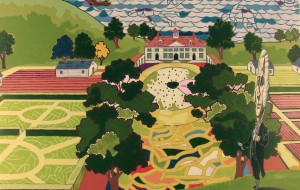
- Kerry James Marshall, “Visible Means of Support: Mount Vernon”, 2009. Acrylic latex on canvas. Courtesy of the artist; © Kerry James Marshall.
Yesterday, the San Francisco Museum of Modern Art unveiled Visible Means of Support, two new murals by Season 1 artist Kerry James Marshall. Marshall is the first to be commissioned for the museum’s Art in the Atrium program, which regularly invites artists to rework the Haas Atrium space.
Over the course of two weeks, Marshall worked with painters from San Francisco’s Precita Eyes Mural Arts Center, a San Francisco community-based arts organization, to create murals that depict Mount Vernon and Monticello, the respective estates of founding fathers George Washington and Thomas Jefferson. According to the website, “Although these cherished sites have been depicted countless times before, Marshall’s paintings [are] quite different—playfully incorporating the slaves who supported plantation life. At first glance, a number of optical tricks conceal them from view, but visitors who engage with the works will discover the otherwise invisible figures so often omitted from representations of American history.”

Installation view.
Marshall discusses the project in a cell phone audio guide that is accessible three ways: Call 415-294-3609 and follow the prompts; download the MP3 file; or listen to the image-enhanced podcast. Visible Means of Support will be on view until 2010. No admission fee is required to visit the Haas Atrium.
BOMB in the Building: Books (and Zombies) Edition!
Since Art21 rotted our little brains with their Audio Visual edition last week, we decided to retaliate with some literary mind-expanding material.
Writers who write a lot.
Hipster Runoff is Tao Lin!! Except, not. The mystery continues to confound the blogosphere.
Richard Price is a PEN/Faulker finalist for his boozy novel, Lush Life.
Literary blogger The Old Hag (Elizabeth Skurnick) has her poetry animated:
The zombie trend takes a bite out of Jane Austen and Elton John jumps on the bandwagon.
Joyce Carol Oates talks about the recent adaptation of Zombie, her novella, into a play here.
On that note, things we WISH would come back from the dead: RIP New Yorker Films!
“Sparks is the best band EVAR and if you’re gonna talk ish then you can’t be my friend anymore!!!” KCRW’s Bookworm conducts an endearing interview with his favorite band.
And lastly, a creepy Sparks video you can annoy your friends with!
Where’s all the rightwing street art?

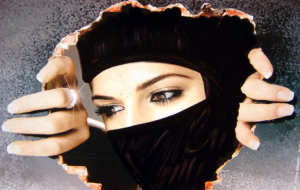
Detail of an altered ad by "Princess Hajib"
Learning of Princess Hijab—a Paris-based street artist who culturejams advertisements to include her namesake headscarf—an old question came to mind: where are all the rightwing graffiti artists, stencil afficionados, and conservative interventionists? While we see strictly political graffiti on behalf of all sides in political skirmishes worldwide, I can’t say I’ve seen particularly artful examples on the right side of the political spectrum.

Graffiti that appeared in Minneapolis just before the RNC began.
Around the time of the Republican National Convention, I pondered the question, to no avail, at my day job when a series of unsanctioned artworks started appearing around the Twin Cities. They all included the G.O.P. acronym, but it was clear this was a different GOP: “Greed Over People” or “Get Out Phascists” (which is confusing…Phish fan facists? Big Pharma fascists?). Since then I’ve noticed that while lefty street art is virtually eveywhere, from Noam Chomsky stencils to railroad cars tagged with BAILOUT, TORTURE and POVERTY, there was very little from the other end of the political spectrum (except for the brief blip in Nobama graffiti a few months back).

Freight graffiti by the "Abraham Lincoln Brigade"
When I noticed Princess Hijab’s work today, I thought I’d come across the first interesting street intervention by a person who might, just maybe, fit the bill—if not politically, then culturally. (I recognize a limitation in my thinking: naturally, there are liberal and moderate Muslims who wear headscarves.) But upon further reading, her work seems to be more about covering the shame of omnipresent (and often sexualized) ads than in offering a critique of women’s bodies. Her “hijabizing” of French ads is part of a “Jihad,” she writes, but “she acts upon her own free will. She is not involved in any lobby or movement be it political, religious, or to do with advertising. In fact, the Princess is an insomniac-punk. She is the leader of an artistic fight, nothing else.”
As for rightwing graffiti, I’m not sure why we don’t see more. Are conservatives more respectful of personal property or more fearful of the law? Is their fight in boardrooms or ballot boxes instead of boxcars and subway station walls? Or am I just not looking in the right places?
When I posed the question on Twitter last night, A’yen Tran, a Brooklyn artist I met when the Miss Rockaway Armada was in Minneapolis a few summers ago, responded that perhaps The Splasher was the closest I’d get. The Splasher achieved some notoriety two years ago for defacing New York street art with paint and leaving behind a manifesto that seemed more anti-artist than in tune with the anti-art Dadaists it referenced: “The removal of this document could result in injury, as we have mixed the wheat paste with tiny shards of glass.” “[Y]ou could argue that the Splasher had some echoes of fascism despite a pseudo surrealist facade,” Tran writes.
So, more in the spirit of crowd-sourcing than conclusion-making, what do you think? Is street art an inherently left-leaning domain, or have I not been looking hard enough?
No Room to Answer in Germany

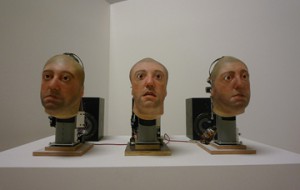
- Teresa Hubbard / Alexander Birchler, “Grand Paris Texas”, 2008. Videostill / Video still. Courtesy Württembergischer Kunstverein.
No Room to Answer: Projections, a traveling exhibition of video installations by Teresa Hubbard and Alexander Birchler (Season 3), opens at the Württembergischer Kunstverein in Stuttgart, Germany on February 28.
The exhibition marks the European premiere of Grand Paris Texas, for which Hubbard & Birchler used a documentary format to equally approach both real and imaginary spaces and situations. Six other videos will be on view: Night Shift (2005–2006); House with Pool (2004); Johnny (2004); Single Wide (2002); Eight (2001); and Detached Building(2001). Read a synopsis of each video here.
The exhibition closes May 10, 2009.
Share and Share Alike
Artists who garner the most attention in any given time period are those whose work, explicitly or implicitly, reflects the deeper political sensibilities of the era. Right now, contemporary artists to watch are those who have turned away from the traditional egocentric focus and embraced the communitarianism associated with Barack Obama’s campaign and now with his administration. Artists who project a me-me-me attitude and are consumed with obsessive careerism look shabby and regressive. While the art world rallied around commerce in the Bush years, it may zone in on community in the Obama epoch. Despite the demoralizing art market downturn, the art world has been infected with President Obama’s inclusive “Yes We Can” spirit, finally catching up with the small cadre of artists and art bloggers who were the first to adopt decentralized, community-minded art practices that fully embraced American pragmatism and ingenuity. If this shift is any indication, generosity may be the defining value of the new era. Here are a few of the artists who exemplify the shift from an inward to an outward focus.

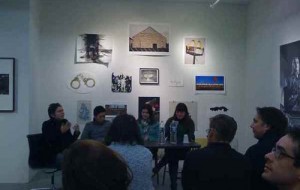
In January, Chan, second from left, participated in an informal gallery talk with members of New Orleans art collective The Front. (Photo: Hrag Vartanian)
Paul Chan
With funding from Creative Time, Paul Chan went to New Orleans and staged Waiting for Godot in New Orleans. The project evolved into a larger social production involving free art seminars, educational programs, theater workshops, and conversations with the community. As a result of Chan’s seminars and workshops, several artists organized ongoing collective projects. In January, one of the collectives, The Front, was invited to participate in Things Fall Apart, an exhibition at Edward Winkleman Gallery, curated by artist/blogger Joy Garnett. “It is fashionable today (still?) to claim that there is nothing new beyond our horizon of art, that everything worth doing has been done, “ Chan said in his project statement for Godot. “But this seems to me an altogether specious claim, for it ignores the vast undiscovered country of things that ought to be undone. In these great times, the terror of action and inaction shapes the burden of history. Perhaps the task of art today is to remake this burden anew by suspending the seemingly inexorable order of things (which gives the burden its weight) for the potential of a clearing to take place, so that we can see and feel what is in fact worthless, and what is in truth worth renewing.”

“Habitat For Artists Goes Indoors” is on view through Feb. 28. Draper built a replica of one of the sheds so visitors could sit in it and appreciate the small spaces.
Simon Draper: Habitat for Artists
Using reclaimed materials, Simon Draper created a makeshift community of studio sheds in Beacon, NY, and invited artists to use them for the summer. He and co-organizer Amy Lipton, curator for ecoartspace, a New York- and California-based non-profit organization dedicated to raising environmental awareness through the arts, encouraged each artist to adapt their shack, initially outfitted with simple openings, doors, windows, or skylights to suit their own needs. This month, Draper, Lipton, and their band of collaborators brought the project inside to Van Brunt Gallery in Beacon, NY, where artists are using the gallery as studio space, offering workshops, organizing panel discussions, and sharing their art making practices with the general public.

Kalm Report on Blip.tv
Loren Munk: James Kalm Report
Loren Munk is the mastermind behind the James Kalm Report, a video chronicle of the contemporary New York art scene. Munk, a painter himself, bikes to art shows, tiny videocam in hand, interviewing both famous artists and friends at openings around the city. Each video, featuring Munk’s stage-whispered narration, is edited and posted on BlipTV free of charge. Munk’s commitment to the local art community also includes “Brooklyn Dispatches,” a monthly column in the artist-run art journal, The Brooklyn Rail. When Munk was honored by WagMag (Williamsburg and Greenpoint Monthly Art Guide) for his contributions to the local art community, he turned the event into a conceptual performance project called “The James Kalm Artist’s Economic Stimulus Grant,” giving everyone in the audience a dollar.
What Light?

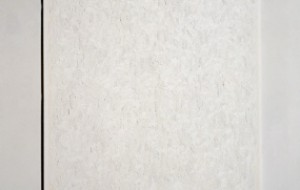
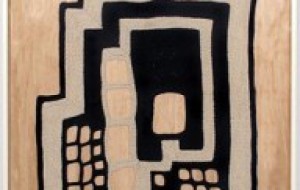
Robert Ryman, "Initial," 1989. Oil on gator board with wood, 23 3/4 x 23 inches. Private Collection, New York. Courtesy PaceWildenstein, New York.
On Monday I had the pleasure of attending the last edition of this season’s Art21′s Salon Series with Robert Ryman and Urs Raussmüller. Going into the evening, I kept thinking about the strange directions a conversation can take discussing a body of work that contains a healthy dose of white paintings. But through the conversation, Ryman and Raussmüller convinced the crowd in attendance, including myself, that they aren’t white paintings, they’re actually light paintings, and you can forget any Thomas Kinkade associations and/or wisecracks (but in case you really care, his latest work is called, Pinocchio Wishes Upon a Star. Oh yes!).
Ryman’s works are often about paint working with light on a surface and over time. It was an odd pleasure to hear two people talk about the simple joy of noticing and experiencing light through the physical product of Ryman’s efforts. In the art classroom, light is often a thing to be corrected, adjusted, fixed, sharpened, brightened or toned-down. Not nearly as often is it discussed as the subject itself. I began to wonder what paintings about light might look like in my own classroom. After recently teaching a unit where students created paintings about power, I reflected on the fact that I was, frankly, unprepared for some of the definitions of power depicted by my students. But paintings about light? Besides literal representations of bulbs and sunrises, abstract color experiments, and perhaps one or two obsessed with Kinkade, what could I expect? It’s a challenge to get some students to notice if a light is even on, much less admire the qualities of it.
But Ryman’s work, whether students love it or hate it (not to mention colleagues, spouses, friends), get the viewer to slow down. Questions will arise about the kind of white, or whether it’s a flat white. Some will ask whether the work is symbolic or if it is simply about the paint itself and what it does to or with the eye. Many will question how anyone can find white (or light) so fascinating in the first place. And just as Ryman considers the primary qualities of the paint and light, so should we consider posing these questions and offering these challenges to students.
So… what can paintings about light look like?
Chakkrit Chimnok’s banana-leaf utopia

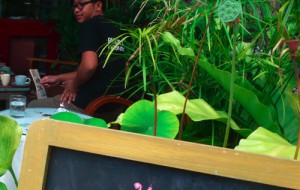
Chakkrit Chimnok at a cafe in Chiang Mai, Thailand. Photo by Paul Schmelzer
Chakkrit Chimnok dreams of a “banana world,” a utopia in which overlooked or discarded items — specifically, the ubiquitous banana leaves that litter the streets in his home city of Chiang Mai, Thailand — can become the material for a renewed world. Chimnok’s recent forays into this idea (or ideal) transformed the ever-present leaves into clothing modeled after western haute-couture.
“One day I was sitting in a banana garden, when a banana leaf fell on me,” he told me last year. He picked it up and felt it: It was smooth and flexible, unlike the dried leaves many locals get rid of by burning. Senses piqued, he began paying attention to how the leaves had different characteristics, depending on where he found them, their age and the level of humidity where they grew.

Installation at Art Space, Japan Foundation, Bangkok. Courtesy of Chakkrit Chimnok
He says he was struck by how perfect banana trees are. Both the fruit and the flowers are edible, and the leaves — as his explorations would later prove — could be made into apparel. Chimnok enrolled in a clothing-design class, taking 60 hours of instruction on sewing and pattern-making, and then set out to make functional objects, including a space suit and a dress (sized for his parents, pictured in the installation shot above), handbags, boots and tennis shoes.

Chakkrit Chimnok, "Body – Imagination – Dried Banana Leaf," 2006. Courtesy of the artist.
This functionality is questionable — as the leaves dry, they become too brittle for regular use — but he appreciates the various layers of symbolism as well. He’s taking gentle jabs at both Thai and western cultures. To often brand-conscious Thai people, he offers fashions from one of the country’s most plentiful, banal and unbranded materials. He patterns his ensembles after western styles, forgoing patongs and flip-flops for western-style skirts and shoes, in order to put the designs both within the vocabulary of fashion but also starkly opposed (the hard, crunchy leaves also stand in contrast to the silk textiles for which Thailand is best known). “We always have the sense that the west looks at us as the third world,” he told me.

Shoes by Chakkrit Chimnok. Photo by Paul Schmelzer.
While his message addresses international audiences — it was featured in the 3rd Fukuoka Asian Art Triennale 2005 and was shortlisted for the 2008 Signature Art Prize by the Singapore Art Museum — it is, in essence, local. In his artist’s statement, he writes, “Following the west is viewed as part of destruction of community culture.” His art is a celebration of the local, he says, even if it celebrates one of that environment’s more overlookable features.
But he’s not Thai-centric about it. During the project’s showing in Fukuoka, Japan, he promoted a local variation of recycling. By the end of his three-month residency, he was showing at a fashion show the 20 kimono-inspired garments he’d created — from bamboo leaves.
Letter from London: Bad Taste Explosion

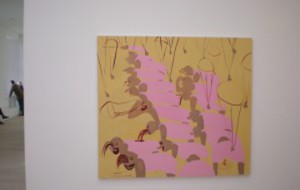
Tala Madani, "Nosefall," 2007 (photo: Ben Street)
Sometimes working in or around contemporary art can be a bit embarrassing. When the papers are splashed with the latest case of a work of art being mistaken for rubbish and thrown out, or an artist’s work being bought for $45m by a cackling oligarch, or an artist being given an award for teaching a children’s choir to sing Stalininst anthems, those of us who work in or around contemporary art are put in a position of having to defend our natural inclinations. Sometimes admitting to working in or around contemporary art can be like admitting to having a collection of He-Man figurines in their original wrapping, arranged thematically in filing cabinets in the garden shed. It can feel like an eccentricity, like breeding pigeons. This may be why an architecture of carefully-structured and neurotically-guarded cool is built around it, and why it has its own carefully-maintained technical vocabulary, and its own carefully-delineated bibliographies and reference points; it’s a retreat, a defense mechanism. It may also be why shows like the Tate’s survey of contemporary art, Altermodern, and the Whitney’s biennials, and the New Museum’s opening show Unmonumental (to name but three of many, and it’s worth noting their nomenclative kinship, with its feigned lightness, its passive-aggressive self-deprecation), feel not limitless and open but careful, tasteful, guarded.
Explosions of tastelessness are what art needs every so often, now more than ever. Looking at work by painter Tala Madani in the Saatchi Gallery’s new so-so survey of Middle Eastern art (clunkily entitled Unveiled), I was reminded of the great moments of tastelessness in art history—moments when prevailing orthodoxies were pushed head down into the grime of shameless crudeness and willful grotesqueness. Philip Guston’s (now, not then) celebrated switch from phantom abstraction to Krazy Kat slapstick at the end of the 60s is most tellingly resonant in Madani’s paintings, but the ghosts of tacksters past are all over the work: Caravaggio’s dirty-fingernailed Bacchuses with their baskets of rotten fruit, James Ensor’s carnivalesque parades of gibbering goons, even Kara Walker’s finessed filth and nimble-fingered nastiness.
As she is Iranian-American, a prerequisite of a piece on Tala Madani is that it start with an allusion to her Iranian heritage, but the really interesting thing about Madani is how her work plugs into the heritage of bad taste painting and drags it out of its burrow to face the confusing and paranoiac daylight of the early 21st century. Madani paints, on scales both huge and tiny, with a quick, slippery stroke and a restricted, fleshy pallette, scenes of middle-aged Middle Eastern men engaged in absurdist mini-dramas of violence, eroticism, and embarrassment. A hirsute, bare-chested man in a black Speedo steps gingerly into a tiered pink cake, looking around him in a comic display of belated secrecy. A barrel-chested man has his beard plaited by another, and ends up looking like a parodied Alice, complete with pink bow. Even Madani’s off-hand squiggly brushwork has a kind of embarrassment about it, as though reluctant to flesh out these grotesque characters, to give them too much life.

Tala Madani, "Diving in Cake," 2006 (photo: Ben Street)
On a large scale, Madani’s works take on a kind of heraldic abstraction, patterning ochre and off-white surfaces with repeated figurative motifs. Men (always men) on all fours in hot pink unitards are deployed across the paintings, their sketched-in parachutes the only nod to their terrorist associations. In Nosefall, a group of men crouching in what might be (judging by the parachutes) a plane on the way to a civilian target, get an attack of altitude nosebleeds and clutch their faces frustratedly; a couple turn towards the viewer, grinning sheepishly. It’s not just their deconstructed-Rubens pallette (pinks, browns, yellows) that these works share with the late Guston: both artists revel in the humor (and pathos) intrinsic to society’s bad guys, whether KKK or Taliban. Madani’s paintings wear their artistic heritage lightly—there’s an echo of golden age Matisse in the larger works, especially the mighty Moroccans —but do something rare and cherishable in ostensibly “political” art: they muddy the waters, giving certainty the slip. Neither critical nor affectionate, Madani’s paintings play an attraction-repulsion game endemic to the business of painting itself.
That evening, I actually told someone I’m a contemporary art fan without apologizing. What a relief.
Transcending protest: Looking for pragmatic or poetic art of change

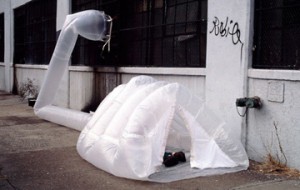
Michael Rakowitz, "paraSITE," 1998-present.
This weekend I went to an opening at The Soap Factory, a scrappy and often-excellent nonprofit art space a block or so off Minneapolis’ riverfront. The description of the work, a Clive Murphy installation called Almost Nothing, was intriguing enough to draw me there: he’d filled the entire space with a series of air-filled tubes created from black plastic garbage bags, mimicking the architectural geometry of the space—which, as its name states, was once a soap-making factory, reeking of lye.
But when I arrived, the piece immediately struck me as so much hot air. Here’s my progression of thought: it’s February in Minnesota. This building is virtually unheated. We’re facing twin catastrophes of economic downturn and human-made climate change. And this guy’s art requires electric air blowers to drone constantly on whenever the gallery’s open?
Murphy’s work is what it is—a project influenced by “radical architectural proposals from the sixties” and inflatable carnival games that examine “themes of hierarchy, inter-relationality, and meaning formation”—and I don’t knock it for that. But it isn’t what I’ve been looking for lately: contemporary art with immediacy, that pragmatically or poetically addresses the challenges we face today. Not all art needs to do that, but it’s what I’m looking for. Something more along the lines of another inflatable-bag art project: paraSITE, in which artist Michael Rakowitz collaborated with homeless people to construct temporary inflatable housing designed to leech warmth from heat outtakes from apartment buildings.
In considering “political” art—especially in a non-election year, especially facing the economic and environmental problems we do—I’m reluctantly coming to believe that art doesn’t have the power I once believed it did for bringing about social change.

Suzanne Opton's "Soldier: Birkholz" billboard
Perhaps it’s creeping cynicism. As a journalist covering the Republican National Convention in St. Paul this fall, I saw magnificent, irreverent and funny artworks – from full-fledged contemporary artworks (including Ligorano/Reese’s The State of Things, gigantic ice letters spelling out the word DEMOCRACY, which melted away on the capitol lawn as time passed, or Suzanne Opton’s Soldiers billboard series) to creative protest signs and hilarious chants by nonviolent demonstrators (“You’re hot, you’re cute, take off your riot suit!”). Still, the police crackdown was powerful, unrelenting and sometimes violent—and, if hearing from Republican delegates on the convention floor is any indicator, protesters’ messages didn’t seem to register. The art was dismissed as mere protest.
My doubts also have to do with responses to my oft-asked (and admittedly naïve) question, “Can art change the world?” As an editor at the Walker Art Center and at Adbusters Magazine, I posed the question to a number of people: critic Robert Storr; artists Rirkrit Tiravanija, Sam Durant, and Thomas Hirschhorn; Artforum editor Tim Griffin and independent curator Hou Hanru, to name a few. While they all said they hoped it had that kind of power, few wholeheartedly agreed it did.
But from some of these same people, I found hope for smaller incremental change—one heart (or mind) at a time, perhaps.
During a residency at the Walker, Art21 artist Guillermo Calzadilla told me his take. Art, unlike protest, is difficult to pin down, he said, and therein lies its power. Overt agit-prop is easy to spot, categorize, and therefore dismiss wholesale by opponents of the message it carries. But art is something… else. Something nebulous and multidimensional and hard to get one’s brain around.
Before we can dismiss it, we have to figure out what it is.