W.A.G.E. LIVE!

Image courtesy W.A.G.E.
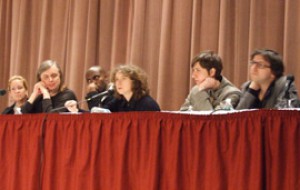
After reading Trong Gia Nyugen’s great interview with activist group Working Artists and the Greater Economy (W.A.G.E.), I become really interested in their work. I started to poke around the Internet to see if there were any upcoming live events in New York City and there is one tonight! W.A.G.E. is speaking on a panel.
Here is the information:
Arts Funding for Sustainable Creative Practice
Thursday, April 30th
7:00pm
NYU’s Barney Building
34 Stuyvesant Street at 9th Street between 3rd and 2nd Avenues
Free and open to the public
Panelists: Ruby Lerner (President, Creative Capital), Katie Hollander (Deputy Director, Creative Time), Tim Cynova (incoming Deputy Director, Fractured Atlas), Jeff Hnilicka (Founder, FEAST [Funding Emerging Art with Sustainable Tactics]), Bryce Dwyer (InCUBATE, Chicago IL), A.K. Burns (W.A.G.E. [Working Artists in the Greater Economy])
Organized and moderated by Tracy Candido, a Master’s candidate in Steinhardt’s Visual Culture Theory program and founder of Sweet Tooth of the Tiger’s Bake Sale Residency for Artists, a mini grant for artists who like to bake.
If you live in New York City, please attend and let us know what you think!
Ellen Gallagher | Projections
DOWNLOAD VIA ITUNES | SUBSCRIBE VIA RSS
EXCLUSIVE: Artist Ellen Gallagher recounts her childhood obsession with projecting films, paired with documentation of her work Murmur (2003–04) installed at Gagosian Gallery in New York.
Repetition and revision are central to Ellen Gallagher’s treatment of advertisements appropriated from popular magazines. Initially, Gallagher was drawn to the wig advertisements because of their grid-like structure. Later she realized that it was the accompanying language that attracted her, and she began to bring these ‘narratives’ into her paintings—making them function through the characters of the advertisements as a kind of chart of lost worlds. Upon closer inspection, googly eyes, reconfigured wigs, tongues, and lips of minstrel caricatures multiply in detail. Although her work has often been interpreted as an examination of race, Gallagher also suggests a more formal reading—from afar the work appears abstract and minimal, and employs grids as both structure and metaphors for experience.
VIDEO | Producer: Wesley Miller & Nick Ravich. Interview: Susan Sollins. Camera & Sound: Tom Hurwitz, Eddie Marritz, Mark Mandler, and Roger Phenix. Editor: Jenny Chiurco and Mary Ann Toman. Artwork Courtesy: Ellen Gallagher & Edgar Cleijne. Special Thanks: Gagosian Gallery, New York and Two Palms Press, New York.
For the Love of God: The Artist as Capitalist

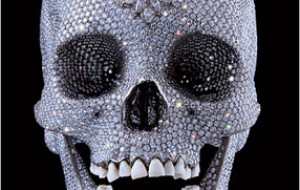
Damien Hirst, "For the Love of God," 2007. Platinum, diamonds, and human teeth.
In 2007, artist Damien Hirst exhibited a work at the White Cube gallery in London which is reputed to be the most expensive contemporary artwork ever made. Entitled For the Love of God, apparently in response to a question posed by the artist’s mother (“For the love of God, what are you going to do next?”), the work consists of 8,601 of the world’s finest diamonds encrusting the platinum cast of a human skull from the mid-1800s, complete with the skull’s original real human teeth. Financed by means of an investment of $28 million of the artist’s own money the work is reputed to have sold for $100 million, paid in cash. The artist contracted with Bond Street gem dealer Bentley & Skinner in order to acquire the collection of fine diamonds on the international market, which steadily pushed up the precious commodity’s price globally over the months of acquisition.
Inspired by Aztec turquoise mosaic skulls held in the collection of the British Museum, Hirst thought it would be great to create a diamond version, but was originally deterred by the prohibitive cost. Upon further consideration, he decided that the ludicrous expense could actually be the work’s rationale: “maybe that’s why it is a good thing to do. Death is such a heavy subject, it would be good to make something that laughed in the face of it.” This idea of laughing in the face of death resonates with the artist’s belief in the value of art collecting as something that can confer a certain kind of immortality: “I don’t see what else you can spend your money on. If you want to own things, art is a pretty good bet. Buy art, build a museum, put your name on it, let people in for free. That’s as close as you can get to immortality.” When asked to think about the work in relationship to the current controversy over African blood diamonds, Hirst declined, but did comment on the deadly potential of the object as an extreme luxury item: “That’s when you stop laughing. You might have created something that people might die because of. I guess I felt like Oppenheimer or something. What have I done? Because it’s going to need high security all its life.”
Apart from the obvious gossipy interest that this work inspires, For the Love of God provides an illustrative case study for thinking about art and value. While Hirst suggests that a certain kind of immortality may be attained by the art collector who acquires unique commodities and pulls them permanently out of circulation or makes them available for public use, Karl Marx suggests that the only immortality is held by the ways in which capital is endlessly transforming money into commodities (in this case, artworks) and back again. In For the Love of God, we can see capital’s maintenance of itself in the artwork’s surrender to circulation and indifference to form when it comes to its place in the market. Almost by a certain alchemy, formaldehyde soaked sharks and dead butterflies are transformed into expertly cut diamonds. For the Love of God has the simultaneous status of money itself (diamonds being one of the objects that expresses exchange value more perfectly than others), and of a product which is constituted by objectified labor in the form of raw material and labor as an instrument of the artist’s goals. Inasmuch as living labor is used as both a raw material and an instrument of labor in the mining of diamonds, this action works as evidence, to quote Marx, “that the capitalist desires nothing more than that the worker should expend his dosages of life power as much as possible without interruption.” Human life is a raw material in the construction of this artwork, not only in the form of the actual skull which provides its mold, but more importantly in the expenditure of life power in the often deadly process of mine working and in death resulting from armed conflict financed by the diamond trade.

Santiago Sierra, "250cm Line Tattooed on Six Paid People," 1999. Black and white photograph.
If Damien Hirst’s work incidentally acts to show us the machinations of capital in the interest of giving us an extreme example of the product of objectified labor, the work of artist Santiago Sierra intentionally uses the power of capital to harness living labor. While Hirst’s work makes no pretension of acting as a form of institutional critique, Sierra’s purports to reframe capitalist activity within the symbolic confines of the gallery in order to offer it up for analysis and criticism. One of Sierra’s most well known works is a performance project from 1999 entitled 250cm Line Tattooed on Six Paid People. Each of the unemployed men who participated was paid $30 to have a line permanently tattooed on his back. Sierra’s work presents us with the live act of the transformation of the worker’s living labor, or bodily and energetic potential capacity to work, into use value for capital. In this case, the use value of the worker is set in motion by capital in the specific scene of the art gallery—the worker mobilized as a raw material, as labor in the moment of objectifying transformation, and in that action as the art object itself. What is most striking is perhaps the worker’s absolute indifference to the specificity of his labor, which is in fact what separates and distinguishes the worker from the capitalist (or in this case, the artist). This is not the transformative decision-making process of the capitalist, nor the interested craft of the artistan or jeweler or even tattoo artist, but the bare exchange of time, energy and bodily integrity for a wage.
Getting Beyond

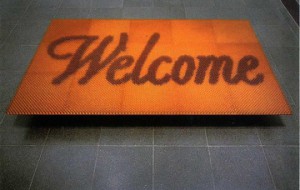
Do-Ho Suh, "Doormat: Welcome (Amber)," 1998
Last week I promised to begin addressing some of the questions that came up at the recent National Art Education Association conference in Minneapolis. One of our first questions comes from Vicky Grube, an Assistant Professor at Appalachian State University in North Carolina, who asked, “How does Art21 help teachers, especially student teachers, get beyond traditional teaching styles they’ve experienced growing up?”
Art21 provides a variety of ways for teachers to “go beyond” and take healthy risks in their teaching. At the Art21.org website, teachers can sign in and download free teaching materials, including the Learning with Art21 Guide and any of the Art21 Educator Guides for each of the first four seasons. In these guides, teachers are encouraged to use the Before and After-Viewing questions to inspire students to think critically about what they see and what they can create.
Teachers can also explore the links and huge variety of posts right here on the Art21 blog in order to share columns and guest articles with their students. For example, students can read a collection of blog posts around a single theme and develop a written or visual response to one particular piece. Teachers are encouraged to browse and share over 50 posts written for this Teaching with Contemporary Art column. They can also view a series of videos in order to analyze and compare how artists get the same message across in wildly different ways.
But perhaps I should take a step back and also consider what exactly are these “traditional” teaching styles Vicky is referring to? First of all, when I think of traditional art teachers I certainly don’t come up with exclusively negative images. I have had plenty of traditional art teachers that were absolutely phenomenal. What I think Vicky is asking about, are the teachers who rely on units and lessons, strategies and activities, that are comfortable but not always meaningful for students. Perhaps some of these teaching strategies include the drilling and killing of teaching the elements and principles of design? Perhaps other strategies include projects that mimic an artist’s style instead of learning about the artist and about the work in order to produce original ideas?
Teaching materials on Art21.org and resources right here on the blog can help teachers, especially student teachers, plan for specific ways to open up conversations in their classrooms, think about big ideas with their students, and create work that gets beyond mimicry or what’s simply become habitual.
How do you use Art21 to “go beyond” in your own teaching?
W.A.G.E. Against the Machine

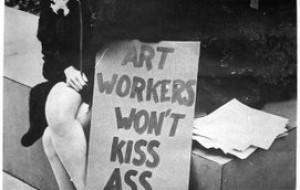
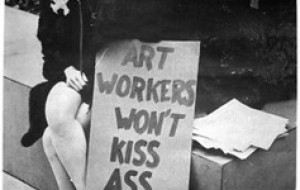
Art Workers Coalition, "Art Workers Won't Kiss Ass," 1969, primaryinformation.org, 2008
Last September, as part of Creative Time’s Democracy in America: The National Campaign event at the Park Avenue Armory, activist group Working Artists and the Greater Economy (W.A.G.E.) stumped for the rights of artists to be compensated fairly for their labor by art institutions in the United States. The economy has taken a bigger hit since then, which makes W.A.G.E.’s work even more important. The Brooklyn-based collective was formed in 2008 by artists A.L. Steiner, K8 Hardy, and A.K. Burns, and the group’s expanding membership includes artists, performers, independent curators, and all others who share their cause. W.A.G.E. cites exemplar, working models beyond our borders overseas and overhead—organizations such as the Canadian Artists’ Representation / Le Front des artistes canadiens (CARFAC), whose efforts resulted in the 1988 Canadian Artists’ Representation Copyright Collective (CARCC), which legally established a fee schedule for artists to be paid every time their work is exhibited at a gallery, museum, or institution that receives federal funds.
As a cultural worker myself, I am all for such a system that treats and compensates artists like true professionals. However, I am not totally convinced that something like CARCC could effectively work here, though something is better than nothing. CARCC’s established fee schedule affected only galleries and museums that received some kind of federal money, so commercial galleries don’t apply. And in the United States, funding for the arts is so abysmal that it seems a radical shift in the structure of the arts umbrella is truly what is needed.
Recently, I conducted an interview with W.A.G.E. via email, and gathered their thoughts on some of these issues.
TRONG G. NGUYEN: Who are the founding members of W.A.G.E., and what are your backgrounds—have you always been political activists and artists?
W.A.G.E.: Working Artists and the Greater Economy (W.A.G.E.) was formed in Brooklyn, NY in 2008. We’re a group of artists, performers and independent curators who believe that we should be paid for our labor by U.S. art institutions. The group is open to anyone who would like to join that cause, and embraces seasoned activists, non-activists and anything in-between.
TGN: Do you view W.A.G.E. as an art collective or lobbying group?
W.A.G.E.: We’re an activist and consciousness-raising group.
TGN: W.A.G.E. participated in Creative Time’s Democracy Convergence Center event last September, before the elections. Tell us more about your performance and what you hoped it would accomplish. Was it preaching to the choir, or did you felt the event actually did some good beyond the art world?
W.A.G.E.: We find that although we’re speaking to our peers, the issues we raise—and strategies we’re attempting to develop—weren’t being actively discussed in the arts community; therefore, people have responded with a huge amount of support, surprise, and relief to hear a voice that acknowledges their specific situations as artists, performers, and arts workers.
TGN: You reference the Art Workers Coalition of 1969, which criticized MoMA’s collecting practices and focused on artists “working conditions” in general. Although well-intended, a number of the artists who were initially involved have essentially become entrenched in the gallery and museum systems they previously railed against. Do you think this intrinsic hypocrisy needs to be dealt with before the system can truly be changed? And if so, how?
W.A.G.E.: This question is framed curiously, but indicative of the perception of arts workers both within and outside the arts community. W.A.G.E. finds it unnecessary to frame this as a dichotomy: one doesn’t need to be outside the system to criticize or effect change. We’re comprised of, and welcome, all artists and arts workers- regardless of income, or market notions of career status or notoriety. We’re not eschewing market success. Our cause is to counter the hypocritical assumption by U.S. public and private art institutions that artists and arts workers don’t require monetary compensation for our work. Hollis Frampton addressed this in a letter he composed to MoMA in 1973 where, among other things, he outlined the workers in all the industries he supports by merely making his film work; ironically, this includes not only film manufacturers, processing labs, print labs, etc, but also the arts administration staffers as well. As noted in his letter, he was the only one not being paid for his work. The museum offered to pay him in “love and honor.” This was 35 years ago and overall, the terms have largely remained unchanged—except for the cost of living.
Letter from London: Golden Graham

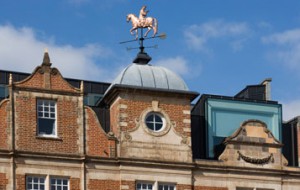
Rodney Graham's "Erasmus Weathervane" on the Whitechapel Art Gallery roof
I’m sure (as in: I’m not sure) that there is a film in which Laurel or Hardy or Buster or Harpo rides a horse backwards, isn’t there, maybe after being dropped onto the horse from a branch that suddenly snapped? And the horse bolts off? Or is that City Slickers 2: The Legend of Curly’s Gold? This sort of thing—a pleasurable and slightly frustrating rummaging through the old boxes of cultural memory, on hands and knees, pitching old photo albums and team building t-shirts back over your shoulders—happens to me pretty much every time I see something by Rodney Graham. As Shepherd Steiner put it, “it’s all so personable and relaxed it is easy to forget one is in the presence of art.” That being, I think, more or less irrefutably true, given the meticulous care (and what an underused idea in contemporary art that is) Graham lavishes on his art—both in terms of high production values and a kind of laconic, but earnest, philosophizing—Graham seems an obvious contender as a maker of public works of art. His 1986 Millenial Project for an Urban Plaza—a camera obscura set up to project an image of a sapling planted alongside it, designed to be returned to over time (so that the tree, projected upside-down, grows to eventually fill the frame)—was (as far as I know) never quite realized as planned. So it’s a heartening sight to see Graham’s copper Erasmus Weathervane atop the roof of the newly reopened Whitechapel Art Gallery, glittering and revolving and setting off all sorts of high and low cultural associations as it does, fireworks style.
In keeping with Graham’s M.O, Erasmus Weathervane is an adaptation—even an expansion—of several previous works by the artist. One is a 2002 black steel weathervane after a drawing by Derek Root, which depicts a silhouetted figure (the artist?) riding a bicycle backwards, which in turn derives from his Photokinetoscope film, which in turn probably comes from something else I/you can’t quite remember. The other is his 2005 Allegory of Folly: Study for an Equestrian Monument in the Form of a Wind Vane, one of his carefully staged self-portraits, here dressed as Renaissance theologian/humanist Erasmus, seated backwards on a training horse, brow-furrowedly reading the Vancouver phone book. So the London weathervane is a distillation of his earlier ideas, just as his ideas are distillations of somebody else’s earlier ideas. It’s easy to see this as part of a general ur-idea in Graham’s work, which is a kind of Beckettian tragicomedy of endless repetition. An uncharacteristically still day in Whitechapel had stabilized the thing when I first saw it. But imagine it wheeling around, Erasmus and his horse facing opposite ways, in a high wind, the speedy blur creating a visual illusion of coherent vantage between steed and rider, and the comic/philosophical meanings become both eloquent and effortless, which is Graham’s characteristic artistic sleight-of-hand. The mind and body are traveling literally at cross purposes. It’s a riff on the hoary old mind-body dichotomy still best summed up by Morrissey: “Does the body rule the mind or does the mind rule the body?/I dunno.”
All this is very nice and good and would be enough were it not for the additional associations that necessarily accrue to the figure of Erasmus in London. It might be coincidence, although I suspect not, that 2009 is the 500th anniversary of Erasmus’ most celebrated work, The Praise of Folly (written in London). In Rotterdam (Erasmus’ birthplace) at the beginning of this year, the Museum Boijmans-van Beuningen (note Graham-esque Christ on a donkey) staged a show of art associated with the writer, which inevitably brings to mind the painter Erasmus supported in his pretensions to work in England, Hans Holbein the Younger, who illustrated The Praise of Folly. And it was Holbein who gave the English Tudor court its aesthetic identity via his portraits of Henry VIII and his court, and 2009 is also the 500th anniversary of Henry’s accession to the throne. The Tudor court placed special emphasis on heraldry, from which weathervanes also originate: the term derives from the pennants (“fanes”) attached to the tops of knights’ lances. So these things accumulate.
What I think is really interesting about this confluence of self-referential iconography and a historically loaded place and time is the light it sheds on Graham’s body of work as a whole. Erasmus, the perennial expat, roaming from Rotterdam to Paris to London to Basel, is a dead ringer for Graham’s flaneur/cowboy stand-in in his film How I Became a Ramblin’ Man. The Praise of Folly, with its sarcastic skewering of the conceit of the powerful, has strange resonance in Graham’s work too. As paraphrased by Bertrand Russell, in Erasmus’ terms, “it is easier to imagine oneself a king than to make oneself a king in reality”; this is reminiscent of the artist’s deadpan dressing-up throughout his career. Erasmus as troubled, ironic loner is a cousin of Graham’s lonesome Robinson Crusoe in Vexation Island, perennially concussed by a falling coconut. It’s hard to imagine that Graham isn’t aware that the European student exchange organization—sending troubled, ironic loners out into the world—is called the Erasmus programme (one of Graham’s great songs is entitled Never Trust Anyone Over Thirty). And, finally (but probably not finally, Graham being Graham), take a look at this image from Holbein’s illustrated Folly. In it, a merchant, distracted by a beautiful woman, walks headlong into a market trader’s basket of bread. It is, unwittingly, a neat distillation of Graham’s great theme: the cycles of idiocy brought out by the brain and body’s co-habitation.
These things accumulate, after all.
New guest blogger: Julia Steinmetz

Thanks to Nicholas O’Brien for helping us navigate the complex and compelling world of new media (or, as he likes to put it, ‘newMedia‘). Follow his post-Art21 pursuits back on his own blog here.
Up next is Julia Steinmetz, an artist, computer nerd, designer, writer, and scholar. She co-founded the feminist art collective Toxic Titties, a Los Angeles-based group using performance, film, and video to bring a subcultural phenomenon into the frame of conceptual art. The Toxic Titties have performed, exhibited and screened their work extensively in festivals, museums, galleries, and bars around the globe. Julia’s essay critically documenting the TT’s rouge ethnography of a Vanessa Beecroft performance at the Gagosian Gallery in Beverly Hills (Beecroft Intervention, 2002) was published in the Spring 2006 issue of the journal Signs.
Julia is a Ph.D. candidate in Performance Studies at NYU’s Tisch School of the Arts, where she earned an MA in Spring 2006. She is currently researching and writing about transfeminism, contemporary feminist media art, and performance and technology. Julia also has an MFA in Photography and Media Art from the California Institute of the Arts (CalArts, 2002). She is trying to strike a balance between her art practice, research, critical writing, and teaching. She also practices yoga, hops on airplanes as much as possible, and is training for a triathlon, all of which helps keep things in perspective. Julia hopes to spend a lot more time watching television and reading US Weekly in the near future. She is currently cheating on Los Angeles and having an affair with New York.
Weekly Roundup
- Vernissage TV takes a close look at Let the Priests Tremble…(1998/2008), a large hand-printed wall installation by Season 4 artist Nancy Spero. The piece was included in Spero’s retrospective at the Centro Andaluz de Arte Contemporáneo in Sevilla, Spain.
- 9/11-9/11, an animated film by Season 1 artist Mel Chin, will screen tonight at MOMA (7pm). The piece will be screened twice, and a discussion with the artist and the audience will take place in between. Tickets are available at the Museum.
- On the occasion of the fourth Berlin Gallery Weekend (a program of 38 gallery openings in a 3-day span), c/o–Gerhardsen Gerner gallery will present works by Season 3 artist Matthew Ritchie. Read more about the exhibition, titled The Need-Fire, here.
- Ann Hamilton (Season 1) has been inducted into the American Academy of Arts and Science. Visit Artforum.com to read the full list of inductees in the visual art category.
- The Guggenheim exhibition catalogue Cai Guo-Qiang: I Want to Believe has won the 2008 George Wittenborn Memorial Book Award, which recognizes outstanding publications in visual arts and architecture. The catalogue accompanied the comprehensive exhibition of work by the Season 3 artist.
- Kara Walker and Raymond Pettibon (both Season 2) appear in the May issue of Black Book magazine.
Concerning “newMedia” as one word

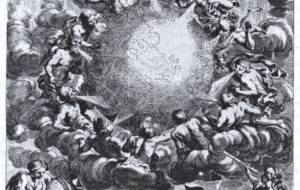
Front Page of Mundus Subterraneus by Athanasius Kircher as used in "Deep Time of the Media" by Siegfried Zielinski
For my last guest post and in response to Kelly’s question, I thought I’d address the way that I spell newMedia and my intentions behind doing so. As I mentioned in my first post; I don’t work exclusively with new technology, or even with new forms per say. However, I feel as though the content of the word addresses or is linked to concerns in newMedia art. So with this in mind, I want to take the emphasis away from the “newness” of this art form, and to readjust the focal point of this genre to be based in cultural commentary as opposed to gadgetry. Although there are some superior newMedia art pieces that implement new technologies (for instance The Dumpster by Golan Levin or Google is not the Map by Les Liens Invisibles), these project address the specific cultural implications that we are hampered with as a result of our growing integration/co-habitation with technology.
These cultural association are not something particularly new. Our relationship with technology has been a long development process, and can be traced back several hundred years. The Media Archaeology field of study has emerged in recent years in order to chart this relationship and how it has manifested itself in several time periods. Siegfried Zielinski and Erkki Huhtamo stand out as two representatives of this study and offer up alternatives to our otherwise limited notion of media art history. Jon Cates has also been tracing and tracking alternative media histories that run through Fluxus, conceptual art of the 60s, performance, and in particular, early video art based out of Chicago. In doing so, these individuals influence me (and others) to acknowledge the un-newness of newMedia culturally and historically. Oftentimes I find myself mired in gadgetry fanaticism; glorifying the new for providing solutions to problems we never really had, or giving us “new” ways to say the same old thing. This obsession—or better, preoccupation—with newness often limits the cultural productivity we could otherwise be engaging with. To recapitulate the same stale productivity in new cyberspatial ways does not justify a work. Furthermore, this speed and rate in which digitally technology is developing leaves little room for self-reflection or awareness, thus perhaps perpetuating the need for the new, and to allow our commentary on it to be so limited.

Sample photo from "Stolen Identity Project" by Andrew Schroeder
As I’ve said earlier, the ideological significance of newMedia art is vested on the metamorphosing relationship we’re experiencing with digital technology. The above image is a photography project by Andrew Schroeder that I often think of as being a good example of non-new-technology-newMedia-art. The project is a series of photographs released as a book/catalog that follow individuals that stole Schroeder’s identity in 2006. Instead of immediately reporting these individuals to the authorities he decided to tour the locations they had visited using his VISA, and take tourist-like photographs of these locations. In a strange play, he beings to tour himself, tracking himself vicariously through others passing off as him. The piece addresses the growing dissociation we’ve experienced as a result of our digital selves taking more precedence over our physical bodies. In following his captors, he isn’t concerned with who they are, or why they have done this (necessarily), but instead questions if his own identity is represented fairly by these thieves (ie, would he stay where they stayed, what would he have eaten differently in such-and-such diner, etc). The dislocation between self and identity is captured magnificently in this project, by exposing our digital privacy as containing little to no reflection on our physical identity.
Another such project that incorporates reflection on our integrated circuit as well as the media histories I have spoken about above is Sal Randolph’s Free Words project. This work incorporates using public space as a venue for distributing free literature and books. As a conceptual observation on the proliferation of mass-produced publishing, Free Words aims to undo some of the tension found in the economy of information dissemination. Using a framework that could possibly function easier on the web, Sal takes the project to the streets in order to encourage active participation with the pursuit of information/knowledge. Free Words’ “publications” are found in typical book stores across the country, and are tagged by stickers to notify interested parties. Although this project can also be viewed as an art activist piece speaking against the isolation/profiteering of the book publishing industry, I like considering this project as newMedia due to its hacking/remodeling the idea of publishing being explicitly linked to making things available to the public.
McLuhan (I know, I know) states that the translation of messages between mediums accelerates its digestions: “For the ‘message’ of any medium or technology is the change of scale or pace or pattern it introduces into human affairs.” Because the breadth and speed of our digital networked lives, we have very little time for collective conscientiousness concerning the rate at which we consume (both culture/art and otherwise). As a result, we can succumb to the shiny, glossy, and immediacy of our media culture rather than perhaps its effectiveness in communication/observation. By simply removing the proper noun quality of “New Media Art” I tend to divert the attention away from the “new” part, as well as hopefully/playfully acknowledge that the history and culture of newMedia is not necessarily exclusive to art culture. This spelling also hopes to break away from the typical implication that capitalization provides to a genre: its solidity in time and place. newMedia art history and production is intrinsically hybridized and multi-threaded. I like to think of media art history as being a rope; the more intertwined strands, the stronger it becomes.
BOMB is (back) in the building

Richard Prince, "Untitled (LuAnne)," 1983
After a hiatus, we (the folks from BOMB Magazine) are back to resume our fun and educational guest blogging. We’ll be chiming in once a month with some cool stuff that we hope you’ll like.
For those of you in New York, Rhys Chatham will be performing “Guitar Trio” tonight (April 24th) at 6pm as part of the exhibition The Pictures Generation at the Metropolitan Museum of Art. Here’s a video of a past performance if you’re not aware of, or haven’t witnessed, the awesome glory of “Guitar Trio”:
The Pictures Generation exhibition is a massive survey of a group of artists who were using photography in their work between 1974 and 1984, and includes BOMB interviewees: Richard Prince, Sarah Charlesworth, Laurie Simmons, Cindy Sherman, Barbara Kruger, and James Casebere. Kruger and Simmons have also been covered by our lovely hosts, Art21.
There’s a good explanation of who exactly the pictures generation is/was here. Also, Charlesworth and Kruger made a piece called Glossolalia specifically for BOMB’s issue 5 that includes images from many members of this group.
The new generation is shaped by its exposure to YouTube, and Kalup Linzy is one of their leaders. His show at the Studio Museum in Harlem is up until June 28th. If you’re not familiar with Linzy, here’s one of his original video pieces:
Christopher Durang’s Why Torture is Wrong, and the People Who Love Them has been extended through the first weekend of May at the Public Theater.
And in the spirit of torture, sometimes things are just better in song:
In closing, we want to encourage you to get out there and buy magazines, lots of magazines! Shockingly, even in the age of the internets, people are still starting new ones! Here are two that caught our eye: Gigantic (co-founded by intrepid former BOMB intern and current BOMBlogger Annie DeWitt), and Meatpaper (as you’d expect—a magazine dedicated to meat in all its glory).