Experimental Economies: Talking with Chicago’s InCUBATE

April 22nd, 2009
Sunday Soup at InCUBATE

Sunday Soup at InCUBATE

In the current state of financial precariousness, artists and arts administrators need to build mutually beneficial trust economies and supportive networks to rally for funding. And with arts institutions and nonprofits closing their doors and liquidating their collections in hoards, the need to demonstrate why art should be valued seems particularly vital now. However, InCUBATE, a research institute based out of Chicago that critically interrogates current models for arts funding, asks whether a revaluation of art is really what is needed.

“It’s weird to frame the question like: why is art valuable? Versus why is science valuable? Or why are the humanities valuable?” says Abigail Satinsky, who founded InCUBATE along with Roman Petruniak and Ben Schaafsma in 2007.

“If we set up the conversation all the time about how things need to be justified in economic terms then we’re running up against a fundamental problem,” Satinksy continues. “It’s important to start from the opposite end of things, and not just demand that money be thrown at whatever you think is interesting. You should figure out why it exists, who you want it to exist for, and what resources you need to make it happen and build it up. I could go off about how I think art provides us with unique ways of looking at the world, but then I would just be reinforcing the question.”

InCUBATE, which stands for the Institute of Community Understanding Between Art and the Everyday, is currently run by Satinsky, Petruniak, Bryce Dwyer, and Matthew Joynt. The group is more of a platform for asking questions than a tangible collective, although they have a space in Chicago where they present programming, an artist residency, and a regular monthly brunch where funds raised are granted out to an artist or project.

The brunch, which began as a weekly program called Sunday Soup, was initiated to streamline the process of applying for artist grants. The process is participatory, with brunch patrons voting on which project receives the grant. These are only micro-grants—never more than $200-300 at a time—but for individuals for whom the bureaucracy of grantwriting is impossible to comprehend, every little bit helps. InCUBATE has taken Sunday Soup on the road, from Creative Time’s Democracy in America exhibition to SKYDIVE, a contemporary art space in Houston. In its various incarnations, Sunday Soup is a grantmaking resource, a platform for discussion, and an art project in its own right.

The problem of sustainability is one at which InCUBATE balks. The members are explicit about the fact that they are asking these questions for themselves, and that any sense or manifestation of community that comes from it is is a bonus. “Success is often gauged by the fact that we get ‘cushy’ jobs and that we can support ourselves out of it,” says Satinsky. “We made this choice, but we also have the economic realities of our daily lives like everybody else does, and this is enriching in other ways. I don’t think [InCUBATE] should be gauged as successful by whether or not it’s a functioning institution. As soon as this becomes un-interesting to us, we’re going to stop. That’s the freedom you’re allowed by doing a project that’s for yourself. I don’t think it’s about building something that is a replicable model.”

Instead of asking how we can come up with a sustainable model for arts funding, InCUBATE asks the opposite. They want, first of all, to question why we value sustainability, whether some projects are meant to endure, and what it means to be successful as an artist or organization. The group is currently working on a project called Artist-Run Credit League, where they are asking artist spaces local to Chicago to pay into a monthly “pot.” The idea is that these spaces will throw fundraisers, the money from which gets paid into a collective account. Each month, the same spaces receive payouts, hopefully with interest if fundraisers are successful.

“We were interested in the idea that a lot of apartment galleries in Chicago are not actually organizations, are not incorporated as nonprofits, and actually don’t have plans to be in operation for a while,” explains Satinsky. “So we were trying to figure out a flexible banking structure that would be helpful to those organizations versus all the granting opportunities being geared at nonprofit organizations with five-year plans.” While this might only benefit short-term projects or spaces that will likely disappear in a year or two, InCUBATE is building a workable network of mutual support.

InCUBATE proceeds by framing questions to identify ways of being in institutions. From these questions arise key principles that can be tested in practice. These are not unbendable or categorical imperatives; rather they are modes of operating within systems in order to continue learning, growing, and having new conversations. This, notes Satinsky, is why she and her colleagues asked these questions in the first place. “If we think of InCUBATE as a really good learning tool, in terms of figuring out how the system works and how we want to operate within it, then we can go out and get jobs and implement our values and see how they work on a much larger scale than what we’re able to do. And there’s nothing wrong with that. It’s not about being oppositional; its about figuring out how the system works.”

Indie Games +/or Games as Art

April 22nd, 2009

You need to a flashplayer enabled browser to view this YouTube video
Invisible Threads, Double Happiness Jeans by Stephanie Rothenberg and Jeff Crouse

In continuing the thread (no pun intended with Double Happiness) of Play and it’s relationship to newMedia art, I thought an appropriate—perhaps unavoidable—topic would be Art Games. I can’t begin to talk about this genre without properly pointing towards the history/community of game modding and machinima. Not to say that these communities get overlooked, but I think this history/hystory and its subculture is essential in approaching the type of critical engagement certain artists putting forward with their work.

For instance, a couple of years ago JODI (browsers be warned) came to Chicago to give a retrospective-type talk at Conversations at the Edge (a screening program organized/curated mostly by Amy Beste and the department of Film, Video, and New Media at the School of the Art Institute of Chicago) and the question arose concerning the efficacy of making art games with regards to it being similar (if not identical) to other game mods developed by “fans.” JODI responded that essentially there was no difference and that their mods can be seen as either being in homage to this community or else a reflection upon different strategies of gameplay. Machinima, along with game modding culture, has inseparable roots in fandom culture/subculture; Machinima.com is surely a testament to thriving community that produces this type of work.

The rhetoric involved in game art includes a multitude of conversations; gameplay, interactivity, immersion of senses, virtual reality, and a growing (if not innate) dialog concerning cinema. Lev Manovich’s discourse on newMedia is heavily vested in the cinematic relationship in newMedia art, and points towards early cinema as being a visual and cultural gateway into the digestion and analysis of digital arts. He positions Dziga Vertov’s Man With a Movie Camera is the essential reference point in Manovich’s book as being a primary example and case of interest in mapping the emergence of newMedia as an art form. The self-reflexivity, the formalistic concerns, and interface (or HCI), are the particular elements that Manovich highlights that are relevant to the discourse surrounding Games as Art. When addressing the formal qualities of Game Art, a common solution, or route, I’ve notived artists employ involve one of two strategies of investigation; Self-reflexive machinima (see Brody Condon), or media vested in the language and history of experimental cinema (see Philip Solomon’s Last Days in a Lonely Place).

Although these works reflect on the cinematic qualities/possibilities of games as art, what has emerged as perhaps the most culturally potent engagement with this medium is how games themselves, unaltered (un-modded) or self-created, can exhibit a(A)rtistic qualities. It seems irrefutable that games as a source of entertainment are an undeniable mode of cultural production and media creation. The easy way of substantiating this is by observing how the finances of the game industry (profit/production/distribution) have surpassed the movie industry. A whole generation has grown up considering games—as opposed to “the movies”—as being the new industry to creatively delve into (as could be also evidenced by the growing number of academic institutions providing game development degrees and coursework). Games have exponentially grown to hold more and more cultural capital, and in doing so, museum/gallery society cannot refuse the force of this emergent form any longer.

You need to a flashplayer enabled browser to view this YouTube video
Cowboyana Trailer by Mark Essen

Although I’ve probably gone on a tangent, I wanted to bring up art games, and using game engines for artmaking purposes, to accentuate certain aspects of Play and interactivity in newMedia creation and engagement. The above examples of game art, or indie games, provide good examples of some of the concerns I have with this genre. Mark Essen’s Cowboyana is an interesting example of re-purposing 8-bit aesthetic into a type of cinematic gesture; connecting the nostalgia for the “Old West” with Nintendo-esque graphics. Cowboyana also conveys a critical engagement with side-scroller shoot-em-ups/run and gun (of the Contra variety) gameplay, questioning the relationship of co-operative play as well as the frenzied feeling of this sub-genre of games.

The Endless Forest – chocolate and blue deer from Tale of Tales on Vimeo.

Tale of Tales’ The Endless Forest is perhaps one of my favorite Indie games right now. A “social screensaver, [and] virtual place where you can play with your friends” (quoted from TOT website), this game/social interactive environment directly deals with the critical argument about 3D art being merely “screen saver art.” The game works when your computer goes to sleep (a wonderful use of techonological metaphors) and uses this rest period to connect you to other cyber-dreamers. In exploring this mythical space (which is designed beautifully), TEF subverts notions of gameplay being related to vegetative states, and re-contextualizes this into virtual meditative space. The format, and the execution of this project encourages “breaks” in typical computer use, by forcing users/players to play this only during states of natural “rest.” This layer of engagement changes the dynamic of game play into a casual exploration as opposed to task/goal-based games.

You need to a flashplayer enabled browser to view this YouTube video
(poor quality video) Suicide Solution by Brody Condon

Brody Condon’s Suicide Solution is perhaps one of the most intriguing and disturbing pieces of machinima that I know of. It traverses hundreds of suicides in 50 game engines over the course of 19 minutes. The piece, watched in its entirety, shifts from humor to disaffection, to abject horror. The process of self-obsessive killing reinforces notions of our digital-self being impermanent and malleable, but only through destruction and mutilation.

Invisible Threads exhibits a fascinating approach to destabilizing the connection between cyber-virtual environments and RL. In re-imagining the sweatshop through the potentially suspicious practice of crowd sourcing, we’re asked to rethink layers of media interactivity and productivity. In making “everyday” users of Second-Life into active participants in the decentralized manufacturing of paper clothing, the line between digital participation and exploitation becomes blurry. I feel like this project also asks the greater question of our willingness to put our faith of personal identity and representation into the hands of corporations (ie Second-Life being a proprietary product/service). By using the Second-Life engine and community as its production core, Invisible Threads poses the question of how games can produce cultural goods and breach/complicate our standard concept of the purpose of gaming environments.

Burn Baby Burn

April 22nd, 2009
Mark Bradford, "Burn Baby Burn", 2002

Mark Bradford, "Burn Baby Burn," 2002

As I was thinking about Art21′s recent visit to the National Art Education Association’s annual conference in Minneapolis, I came across this quote from Season 4 artist, Mark Bradford:

Once I looked out of the hair salon and became interested in the environment around me—and the language of that environment—everything that I had been trying to talk about was already there, speaking and having dialogues. I wanted to engage that material more directly. The conversations I was interested in were about community, fluidity, about a merchant dynamic, and the details that point to a genus of change. The species I use sometimes are racial, sexual, cultural, stereotypical. But the genus I’m always interested in is change.

When I reflect on the quote, it just seems obvious why Mark Bradford was an especially good fit as a keynote speaker, workshop presenter, and panel participant over this past weekend. As an artist and teacher I am intensely interested in the changing “landscape” of art education and so are many, many of the thousands of people who attended this conference. “Doing” art education without considering contemporary artists, materials, and methods is simply clinging to the habitual.

I was encouraged during the conference that the face of NAEA is changing. There were large numbers of young teachers and a contagious energy in the workshops and discussions. The Saturday afternoon workshop at the Walker Art Center, titled Teaching with Objects, Teaching with Film, brought close to 50 educators together from across the country to learn about methods for both teaching in the museum with works of art and in the classroom with video. At least two dozen participants came up to me later that day to say thank you for the work Art21 is doing! And as crowds of people tried squeezing into the late Saturday afternoon panel with Mark Bradford, Olivia Gude, William Crow and myself, I was excited to see how many in the audience truly wanted to hear the conversation we had organized in order to discuss our individual perspectives on process, inspiration, and future possibilities for art education.

During the Art Practice, Teaching Practice panel, we collected a large number of questions from the audience. While time ran out and we were only able to take one question, I’d like to let everyone know that this Teaching with Contemporary Art column will be tackling other questions that were submitted in the coming weeks.

Many thanks to ALL of you for your work and participation. If you were able to attend one of Art21′s events, let’s hear from you! Please post a comment and share your thoughts. If you were not able to attend one or more of the events, we hope to see you at next year’s conference in Baltimore with Season 5 artist, Carrie Mae Weems…

Season 5 Trailer: Sneak Peek!

April 21st, 2009

Season Five of the Peabody Award-winning television series Art:21—Art in the Twenty-First Century premieres on PBS in the United States (Fall 2009).

This trailer spotlights the artists Mary Heilmann, William Kentridge, and Yinka Shonibare MBE, offering brief glimpses of an additional eleven, dynamic and engaging contemporary artists.

Can you guess who they are? We’re not telling….just yet!

Sketches from/of Cleveland

April 21st, 2009

You need to a flashplayer enabled browser to view this YouTube video

You need to a flashplayer enabled browser to view this YouTube video

You need to a flashplayer enabled browser to view this YouTube video

I was in Cleveland this past weekend for Notacon and Blockparty two hand-in-hand conferences concerning Hacker, DIY Electronics, and early web cultures (in a cursory nutshell). I had an amazing time there, spending the long weekend with collaborators Mark Beasley, jonCates, Jake Elliott, and Tamas Kemenczy, sharing and celebrating several aspects of the Demoscene. I was delighted to have been a part of the celebration and activities, and to be able submit to the Demo Compo (which I think I got 7th place based on audience votes).

As exciting and wonderful as the conference is/was, I was immensely captivated by Cleveland as a city (which these brief videos above capture not so well). To observe the architecture of Cleveland—and other “middle sized” East Coast and Midwestern cities—is to glance at very distinct moments of growth and prosperity in the city’s history. The two main epochs for me occur through the manifestation of turn of the century ornamental Neo-Classical early skyscrapers and Brutalist architecture. The CSU building above is probably one of the better examples that I could capture on video, but the Police Headquarters/Justice Center (here is another view with the “Correctional Facility”) is also a great example of the oppressive, aggressively stark architecture of the latter surge of growth. Apparently I’m not the only one that sees the Brutalism in Cleveland, however, I’m fascinated with how these two distinct architectural histories collide into a city that is currently dealing with its slow decline due to industry shifts.

Jon, having been in Cleveland for Notacon last year, said that he noticed the city going through a process of consolidation and condensing. I noticed a distinctive presence in the city of (possibly) forced urban rejuvenation and vitality. There were re-done squares, massive public parks, as well as maintained fountains and lawns. Most importantly the architecture from the Industrial Revolution (of the slightly Neo-Classical variety) had been kept in remarkable shape; these buildings were not only occupied, but seemed in demanding use (it seemed as though the famous Cleveland Arcade was being remodeled slightly during our visit). Somehow, I want to draw a thread here between working-class/blue collar ethics for utility and the refurbishing of these old structures for new application. Although I believe America struggles with the notion of preservation and maintenance (certainly in Chicago), Cleveland seems a rare example of renovating out of necessity and habit rather than for the purpose of a gimmick or spectacle. I could certainly be stretching this point a bit far, but it could be said this restoration is Cleveland applying a kind of Hack to its urban infrastructure; in undoing the history of architecture, and re-fabricating its utility and purpose, the city mobilizes a strong statement calling upon sustainable practices as a digestive process for looking forward.

Obsolescence as Cultural Production

April 20th, 2009

You need to a flashplayer enabled browser to view this YouTube video

Thinking about this topic often reminds me of a section of Invisible Cities, where Marco Polo is describing a city to Kubla Kahn in which its center is made of the latest, most expensive and impressive pieces of technology. This city is also composed of rings around the center, each layer containing the most recent detritus of the closest inner province. Marco Polo suggests that Kubla Kahn’s entire empire is just a succession of rings that surround the center of this magnificent mythical city.

The above video is an observation of a service repairman fixing a payphone I made while waiting for the subway in Chicago. My initial thought was that this fixing was somehow a superfluous action of maintaining an obsolete mode of communication; I thought, “who uses payphones anymore?” In the age of massive telecommunications cellular networks—flooded with iPhones, G1‘s, and Blackberry’s—information (or staying within the grid) is more readily available by 3G technologies and mobile architectures than even a year ago. However, I felt as though the cyber-optimist in me was too quick to acknowledge the real-life fact that the grid does not reach as far and as wide as one would hope.

That being said, it made me want to address “obsolete” practices. Obsolescence as a mode of cultural production has many manifestations: hardware hacking, media reclaiming, data bending, etc. But I think the most compelling part of this type of practice is the politics of reclamation. In using “obsolete media,” artists and craftsmen/craftswomen alike inherently are making a statement concerning consumer electronics/economics and the growing problem of digital waste. I like to think that work of this kind makes a statement similar to the idea that, “We already have everything we need, we just don’t know it.” With works like Paul Slocum’s synthcart made from reprogramming Atarai 2600′s, and Christoph Hess’s sound performance installations/performances, we see obsolete media being performed, used, and reclaimed to create new and innovative procedures to reconsidering how to still engage with “old media.”

Obsolescence also comments on the issue of Hacking; taking something that had an original design and repurposing it for a different use (like the above projects show). The way in which we address the issues of Hacking and Hackers in mainstream media is certainly an outdated, obsolete way of thinking. Perhaps it is needless to say, but Hackers are far from the conventional stereotype of basement-dwelling malicious computer programmers that pilfer precious digital information from the government and exploit networks to steal our identities. I prefer (if it isn’t already obvious) to consider Hacking, and “The Hack,” as an appropriate metaphor for contemporary cultural production in general. McKenzie Wark uses Hackers and the act of hacking (in his A Hacker Manifesto) as an apt metaphor for an emergent class of cultural producers. Their efforts (and hopefully all our efforts), aim to undo the proprietary captivity of what he calls “vectors of information,” which ensnare us in the trap of perpetual oppression from traditional frameworks of power and capital. Hacking—and using obsolete media—speak to a need of renegotiating the terms of how we interact with our media technology. The planned obsolescence of our telecommunication gadgets (which a far beyond the point of merely being “toys”) force us into perpetual modes of consumption. Reusing/misusing technology that is no longer in maintenance provides a creative and wonderful outlet for reorganizing the methods of technological participation. It could be said that the model of consumerism that we typically abide by is obsolete; in the growing avalanche of change, we could use a bit of stability.

Perhaps this post brings me back to the idea of Play. A hack is not simply a reprogram, or a break in a system; it can circumvent the potential problems of a closed system and open it up to new possibilities. In doing so, a hack often renders the initial intended mode uninteresting and stale. In an interesting turn of creativity, hacking can reveal that the only thing obsolete about an object or an idea is our perception and our acceptance of its provisional use. Hacking destabilizes, recontextualizes, refreshes, reformats, updates, and very simply picks apart and rebuilds. Likewise, Play deals with turning something static into something viscous. It could be said that Play and hacking are interchangeable/interwoven paths and histories essential to media creation and involvement.

Letter from London: Guernica Revisited

April 20th, 2009
Goshka Macuga's installation at the Whitechapel Art Gallery

Goshka Macuga's installation at the Whitechapel Art Gallery

It seems impossible now that an institution like the Museum of Modern Art would lend, say, Les Demoiselles d’Avignon or The Red Studio at all, let alone to a small public art gallery in the east end of London. But that’s pretty much what happened in 1939, when Picasso’s huge Guernica (painted in 1937) was loaned by MoMA, after pertinacious efforts by the Communist Stepney Trade Union Council, to the Whitechapel Art Gallery in order to raise public awareness of and garner sympathy for the Republican effort in the Spanish Civil War. That a painting—and a painting that takes tragedy as its general subject, owing as much to Poussin or Rubens as anything from contemporary life—was thought to have sufficient persuasive punch to drive the message home is the stuff of an agitprop daydream (imagine that happening now!). The thing is, though, Guernica isn’t only a painting. It’s a Picasso, and the logistics of the loan itself were impressive enough to embolden the gallery’s message. Although the Whitechapel was (and remains) free to enter, the admission charge in 1939 was a pair of workman’s boots, at Picasso’s suggestion, which the gallery lined up in ranks in front of the painting as a gesture of solidarity, like a phantom army. At the end of the exhibition, the boots (a couple of hundred pairs) were then sent to the Republican fighters in Spain. The painting went back to New York, and eventually to Spain, where it is now.

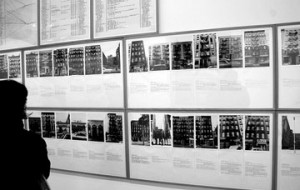
Now, as part of the redesign and expansion of the Whitechapel, Goshka Macuga (nominated for the Turner Prize last year) has brought Guernica back…sort of. In 1955, Nelson Rockefeller purchased Jacqueline de la Baume Dürrbach’s tapestry of the painting, made in collaboration with Picasso. On Rockefeller’s death in 1985, the tapestry was loaned to the United Nations building by his widow, where it still hangs outside the UN Security Council. That tapestry has returned to the Whitechapel for the duration of Macuga’s installation, where it’s been placed among archived materials pertaining not only to the original loan of the painting and the history of far-left activism in the east end, but also to the current loan of the tapestry and recent protest events around the G20 summit in London.

The “sort of” is important, though. Just as it’s sort of Guernica—and there’s a combination of amazement and disappointment at seeing the tapestry, which becomes a sad reminder of what it isn’t—the installation is sort of political. Macuga’s installation has a compelling melancholy to it, not just in its hesitance to complement the screaming rawness of Picasso’s painting (the very fact that it’s the tapestry, rather than the original, plants a pair of quotation marks around the image), but in its reminder of a gentler, more honest, more optimistic age, when apple-cheeked Dickensian Communists in Les Mis rags lined up with boots in hand to learn about the badness of war (many of whom would have fought in World War I, and wouldn’t need that spelled out for them). And there is something of the smugness of the art establishment behind Guernica‘s history. When the tapestry was covered over with a blue curtain while Colin Powell made the case for weapons of mass destruction, the art world couldn’t stop congratulating itself for having the guts to declare that war is horrible, no matter what The Man says (It’s been said that the blue curtain was hung there for ease of translation to a TV screen; whatever the reason, announcing anything in front of Guernica would be like reciting Wordsworth at a Slayer gig anyway).

Continue reading »

Weekly Round Up

April 20th, 2009
Robert Adams, "Eden, Colorado" (circa 1968-71). Courtesy the artist.

Robert Adams, "Eden, Colorado" (circa 1968-71). Courtesy the artist.

  • As part of Earth Day events, Mel Chin (Season 1) will deliver a talk this Wednesday at Blue Ridge Community College in Blue Ridge, North Carolina.  For more information, click here.
  • The China Project: Three Decades of Contemporary Chinese Art just opened at the Gallery of Modern Art in Brisbane, Australia.  Culled from the Queensland Art Gallery Collection, the show  features installations, painting, sculpture and video by over 40 of China’s foremost contemporary artists including Xu Bing and Cai Guo-Qiang (Season 3).
  • Opening tomorrow at the Metropolitan Museum of Art is The Pictures Generation, 1974-1985. The show features artists “educated in the self-reflexive and critical principles of Minimal and Conceptual art,” a list of 30 that includes  Barbara Kruger (Season 1),  Sherrie Levine, Robert Longo, Allan McCollum, Richard Prince, Cindy Sherman, and Laurie Simmons (Season 4).

A Live Feed: Art21 Tweets Mark Bradford

April 18th, 2009

blog

Art21 is presenting at the National Art Education Association’s convention in Minneapolis. We are working with Mark Bradford at this year’s convention on a couple presentations as well as shooting a new Art21 Exclusive video. We will be bringing the conference to you via a live Twitter feed, tweeting key ideas, reflections, and meditations on art and art education as well as behind the scenes of our film shoot. Please follow us this weekend and let us know what you think!

Feeling the pinch: museums and the recession

April 16th, 2009
"Recession Art" by World of Good (www.flickr.com/photos/timrich26)

"Recession Art" by World of Good (www.flickr.com/photos/timrich26)

I could preface this post with all sorts of opining about the responsibilities of museums to their constituents and staffs in the face of the ethics crises many are confronting during our pervasive recession. But Artinfo.com just published a timeline of what drastic measures museums in the US (and at least one abroad) are taking, and the laundry list speaks volumes. Museum studies students, take cautionary note.

Case in point: “as part of a $6 million cut to its annual budget, [one museum] eliminates 20 percent of its staff — 56 full-time and seven part-time positions — and reduces operating costs by $1.6 million.”

Disclaimer: we have not fact-checked each bullet point, so read on with discretion.