Inside the Artist’s Studio: Seoidín O’Sullivan

May 29th, 2009
Seoidín O'Sullivan

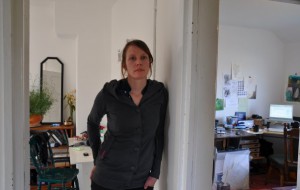
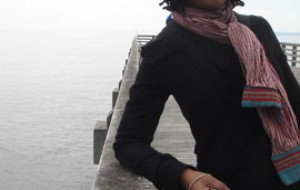
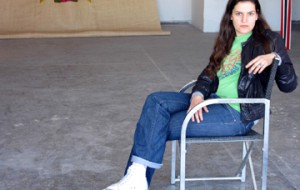
Seoidín O'Sullivan standing in her bedroom with work space on the right

Seoidín O’Sullivan is an artist based in Dublin, Ireland. Her art practice investigates sociopolitical and ecological narratives, which she represents in critically engaged and poetic ways.

Working within a group—an art community or with a fellow artist—is an essential parameter of Seoidín’s work. Her creative manifestations are tangible and serve as the departure point for our conversation. Seoidín’s energy is invested in sustaining her collaborations and projects by sharing her views, beliefs, and ideals of a creative society with an extensive community.

It gives me great pleasure to talk to Seoidín about her practice, as I have been following her work for a decade now. Seoidín opened her home to me and generously let me into her world. Read on and acquaint yourselves with this artist.

Georgia Kotretsos: What’s the main focus of your work?

Seoidín O’Sullivan: I am interested in collective dreaming and believing and issues of land ownership; collective organizing and the commons emerge. I am interested in grassroots forms of organizing, in communities feeling empowered and taking ownership and responsibility in and for their localities. I wanted to see these ideas in practice rather than as mere theory, so I created The Community Garden project. I felt so much relational art that I saw and read about was tokenistic. It seemed to coopt ideas from grassroots collectives and activism—take a photograph of this community and move on. I am interested in sustainability, so my projects are long-term and often blur the line between art and activism. Having grown up in Zambia and South Africa, I want to make a connection between a wider dialogue of North and South. Art provides a perfect space to bring these questions and projects together in creative ways. I hope through my practice to challenge the art world and market, and find and create more sustainable ways that we artists can operate. I think with the current economic collapse we are all hungry for ideas. Creative alternatives can begin to emerge.

GK: May you please walk me through your current studio set-up?

SO’S: I have a home studio and I work in other spaces during residency awards. I use a room that operates as an office, workspace, and guest bedroom. It’s where I answer emails, plan projects, apply for funding, and apply for studio residencies. The making of artworks mostly happens outside of this space. I would like to have a long-term studio space in Dublin but simply cannot afford one right now.

GK: How about your fellow Irish artists, how do they sustain a studio practice?

SO’S: A decent-size studio—which is about 6m squared!—costs €240 ($340) in Dublin. Many artists share spaces to half the cost of rent and then allocate days of usage. Or they are on unemployment assistance, which covers the basic cost of rent and living, and then they work part time to subsidize their studios. They have teaching jobs if they are lucky; otherwise waitressing and retail. Artists are creative people. They figure things out, but I’d say most of us are living precariously from month to month.

GK: Artists are indeed creative people, yet are often left to pave their own way by exclusively relying on that very quality. Is there a helping hand on the horizon besides the artist’s own?

SO’S: There are a few avenues that Irish contemporary artists go down in order to support a full-time practice. The first one is to get a gallery to take an interest in their work, thereby helping to build up their reputation. The gallery takes on the role of finding shows and increasing the commercial value of the artists’ works. The second route is to develop a more project-based practice where you are supported through public art commissions.

The Irish Arts Council, which is state-funded, is very generous in its support of artists. It runs twice-yearly bursary awards and also has a new work award and once-off award scheme. The awards are pretty competitive, as you can imagine, but once received, they do buy time to concentrate on a full-time practice for a few months. There are also some subsidized studios, which are equally competitive. In order to get them, you have to develop a good working practice, be visible, and pretty proficient in putting budgets and proposals together. It becomes a lot like running your own business; artists become technocrats and practice makes it easier.

When it comes to private funding, I think most artists look for this if they want to put on a show and need extra support. I have not heard of wealthy patrons supporting individual artists in Dublin, but I should get on Bono about that (laughs). Artists also receive tax exemption, which was recently capped for top earners. (You can ask Bono about that too; U2 moved their bank account to the Netherlands in 2006.) So there are opportunities for artists to get by and concentrate on their practice here in Ireland and be able to pay rent for a while. Then it’s back to proposals and applications. Very few artists survive off their art practice alone.

Continue reading »

Ida Applebroog | Collecting

May 29th, 2009

DOWNLOAD VIA ITUNES | SUBSCRIBE VIA RSS

EXCLUSIVE: Artist Ida Applebroog leads a tour of her personal collection of thrift store and auction finds, in her home and studio in upstate New York.

Ida Applebroog propels her paintings and drawings into the realm of installation by arranging and stacking canvases in space, exploding the frame-by-frame logic of comic-book and film narrative into three-dimensional environments. Strong themes in her work include gender and sexual identity, power struggles, and the pernicious role of mass media in desensitizing the public to violence.

Ida Applebroog is featured in the Season 3 (2005) episode Power of the Art:21—Art in the Twenty-First Century television series on PBS.

VIDEO | Producer: Wesley Miller & Nick Ravich. Interview: Susan Sollins. Camera & Sound: Mead Hunt and Merce Williams. Editor: Jenny Chiurco. Artwork Courtesy: Ida Applebroog.

Holla from Hotlanta

May 27th, 2009

Beyond Tutlanta…

tutlanta4

I’m writing from Atlanta. A newcomer, I have just learned gardenias are a sign of summer. Apparently, so are Monet’s Water Lilies, which will be temporarily transplanted from MoMA to the High Museum during what promises to be hot days ahead.

Sadly, I still know more about Atlanta’s seasonal horticulture than I do about the local art scene. So having outed my ignorance and in search of an anecdote, I invite you to join me over the course of the next two weeks in finding out what lies beyond the borders of Tutlanta.

The very notion of locality is a complicated one, and my experiences this past Saturday reveal just how fraught the label “regionalism” has become. I spent the day wandering through the Westside Art District, whose central gem is the Atlanta Contemporary Art Center, known as “the Contemporary.” While there, I was treated to a talk by Atlanta-based artist Mark Wentzel, who spoke about his commissioned installation, Morale Hazard. An intersection of moments and places of both personal and national significance, Wentzel’s triadic piece provides an apt springboard for thinking about geographic identity.

Mark Wentzel. Moral Hazard (detail). 2009

Mark Wentzel, "Morale Hazard" (detail), 2009. Courtesy the Atlanta Contemporary Art Center

The most dramatic element of the work, a 1965 powder blue Ford Mustang, hangs suspended from the ceiling, recalling Wentzel’s childhood in the Detroit area while also speaking to the function of the Contemporary’s site as a former Atlanta truck repair facility and to the current state of the U.S. auto industry (an insurance term, Morale Hazard refers to an increased indifference to risk by the insured—enabled, ironically, by insurance). As if flung forth from the upended vehicle, the Mustang’s engine crawls across the gallery space, morphing into a four-legged form, recalling the Aztec Xoloitzcuintle or an Esquincle, the Mexican hairless dog beloved by DIA star artist Diego Rivera.

Mark Wentzel. Morale Hazard (detail), 2009

Mark Wentzel, "Morale Hazard" (detail), 2009. Courtesy the Atlanta Contemporary Art Center

The third element of Morale Hazard is an Eadweard Muybridge-inspired velvety charcoal drawing gracing two walls. The eroding figure of horse and rider glides along a graph, while a pink line marks a mountainous profile of upward production. Muybridge’s famous photographs of a horse in motion (proving once and for all horses do simultaneously lift all four legs off the ground) resulted from  “an exceptionally felicitous alliance” between the photographer and former California governor, railroad baron, horse racer, and founder of a small college bearing his name, Leland Stanford. Wentzel is especially intrigued by the fact that it was Stanford who in 1869 drove the “Golden Spike” into the dusty soil at Promontory Summit, Utah, creating the first transcontinental railroad—a moment which helped render the flesh and blood Mustang moot.

Hearing Wentzel speak, I couldn’t help but think how the merger of east and west rails also signaled the end of American frontierism, famously lauded by Frederick Jackson Turner as central to American identity. Upon its “closure,” the Frontier became an imagined place for nostalgic longing, a sentiment that fanned imperialist desires. A kindred strain of nostalgia prevents the ’65 Mustang from crashing to the floor. But to whom does such nostalgia belong and what dangers might it hazard? Meccas of car culture, Detroit and Atlanta are woefully deprived of infrastructure and mass transit (although the latter’s MARTA system is not without merits); two cities where wars over civil liberties and American identity have been bitterly waged. I couldn’t help noticing 1968 is cited by Wikipedia as the first instance when the term “Morale Hazard” was used by Casualty Insurance. What hangs in the balance?

Continue reading »

Summer Reading Part 1

May 27th, 2009

Allora and Calzadilla- production still (2007).

Allora and Calzadilla- production still (2007).

As we get closer to rounding out another academic year, it’s probably a good time to think about some of the books that might make it onto our summer reading lists. While many might take detective or romance novels onto the beach, I am happy and at the same time embarrassed that I can’t get away from non-fiction. I find myself reading a lot about things that connect to teaching and art in general. I’m helpless… I love my work.

If you haven’t already got some good books on the radar, here are a few to consider as you begin getting ready for those first few sniffs of summer air… wherever you are…

Arthur Danto’s Unnatural Wonders: Essays from the Gap Between Art and Life (2005).

Jessica Hoffman Davis’ Framing Education As Art: The Octopus Has a Good Day (2005).

Maxine Greene’s Releasing the Imagination (1995).

Daniel Pink’s A Whole New Mind (2005).

Judith Olch Richards’ edited collection, Inside the Studio: Two Decades of Talks with Artists in New York (2004).

Kirk Varnedoe’s Pictures of Nothing (2006)

Please feel free to share your recommendations for inspiring reading related to teaching and contemporary art. More to come as we get closer to the official start of summer.

Weekly Roundup

May 25th, 2009

Martin Puryear, "Untitled I", 2002. Aquatint etching. Ed: 40. Courtesy of Barbara Krakow.

Martin Puryear, "Untitled I", 2002. Aquatint etching. Ed: 40. Courtesy of Barbara Krakow.

Letter from London: The Bubble with Troubles

May 25th, 2009


gillray-fashion

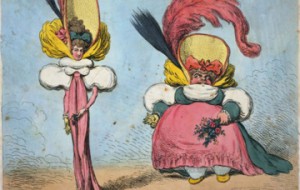
Working in contemporary art is like being part of a huge extended family of annoying extroverts. “Yes…I’m related to them,” you end up having to explain, as they pull another embarrassing stunt, “but they’re not all like that, honest.” This all became perilously clear this week, when watching the BBC documentary The Great Contemporary Art Bubble, presented by Evening Standard art critic Ben Lewis (trailer here). Right from the start, banks of scrolling digits and sharky cellos made the filmmaker’s intentions pretty clear. Digital displays, racking up vertiginously, reflected in the standard-issue contemporary art black-framed specs of the presenter. “Oh no,” I thought. It became uncannily similar to many people’s childhood experiences of watching TV with their parents: either hiding in terror behind the sofa, begging the monster to go away (Dr Who/Damien Hirst) or, mortified, wishing the ground would open up and swallow you (any Roger Moore Bond film sex scene/any contemporary art consultant). And the film is full of horrors. A Sotheby’s dealer describes contemporary art as “the lifestyle choice of our generation…fit[ting] into the spaces we now inhabit—these large, 21st-century lofts in Manhattan.” Yowch! A contemporary art consultant says that the rich “want to collect these iconic trophy objects…they want these things and they want them now.” Oof! An oleaginous auctioneer coaxes a higher bid out of a buyer, smarming, “that’s exactly the bid I was looking for.” Yikes! And everyone, everyone, refers to Damien Hirst by his first name! Like, zoiks, Scoob! HIDE!

The truth is that it’s all too easy to make fun of/find horrifying the upper eschelons of the contemporary art market, because no one is under any pretense that they’re in it for any other reason that the accumulation of status and/or capital. They don’t say that, of course. They all talk about how “passionate” they are about the art they buy, but it’s in the same way that catering companies bill themselves as “passionate about service” or taxidermists as “passionate about stuffing.” How can so many people be simultaneously passionate about a shortlist of about ten artists? Can everyone really be that into Richard Prince and Murakami? Sure enough, when asked to explain why he likes a big Prince painting, a collector says he likes the “lightness of it, and the coloration, and the forms…look at this. Look how great this is.” Even the presenter has a hard time explaining why he dislikes a Gavin Turk which pays snarky tribute to Warhol: “too close to other artists’ work.” Which is kind of like saying an impression of George W. Bush is “too accurate.”

Lewis is probably the right guy to make an expose of the workings of the contemporary art market: he looks the part (the specs, the trilby, the stubble) and has the affable curiosity of the outsider, if overfond of the faux-naive question (he’s an art journalist, so presumably it isn’t all news to him). He makes great play of his being refused access to interview some of the big cheeses in the art world, like the Tate’s Sir Nicholas Serota, and not being allowed into the big Damien Hirst Sotheby’s sale, which gives him a certain amount of outsiderish credibility, although I imagine it’s not quite as Stalinist as the voice of the snippy RSC actress, who he got to read the rejection letter, makes it sound. I’m also not completely sure that the process he describes—that astronomical sales create a media buzz, which makes people want to see the art, which obliges publically-funded institutions to buy and display it—really rings true. Works by artists like Hirst are, in fact, usually impossibly expensive for public institutions anyway, and are only usually shown on long-term loan, or are donated by benevolent collectors such as Anthony d’Offay, one of whose “Artists’ Rooms” is on display at Tate Modern at present. So the danger is nebulous at best, and it may be that the interest is more prurient than the chugging soundtrack and doomy graphics suggest. “Don’t you just love seeing where collectors live?” beams an excited Lewis at one point, and of course we do. His Cribs-style wanderings through collectors’ houses is hilarious and absurd and crying out for a spin-off (“this right here is a Damien Hirst spot painting…I never even looked at it”).

The problem is (and this is the really embarrassing thing, when it all comes down to it) that no one—neither presenter nor interviewee—wants to talk about art. Works by Koons, Prince, and Hirst (and yes, they’re almost always male and almost always white) are preemptively and anachronistically described as “masterpieces”—anachronistic in the sense that the market can, and does, work against the historical meaning of the work, imposing old master values onto contemporary art like dressing a contemporary teenager in a periwig and breeches. (Surely the whole notion of materpieces is so, like, 1560s?). What you’re left with is an enlightened “so what?” Yes, he’s my uncle, yes, he keeps pet newts and wears a silver eye-patch, and yes, I’m related to him. Adopt me now.

New guest blogger: Victoria Lichtendorf

May 25th, 2009

vlbiopic

Thanks to Kemi Ilesanmi from Creative Capital for her series of engaging interviews and artgoing tips. Up next is Victoria Lichtendorf. Victoria, a museum educator, is a recent transplant from New York to Atlanta. Her work has focused on developing arts access and outreach for local, national, and international students and teachers. During her tenure, beginning in 1999, at The Museum of Modern Art, New York, she co-founded and oversaw distance learning and Red Studio, a website for teens. Exploring challenging issues and questions provoked by engaging with modern and contemporary art, Red Studio features filmed conversations with curators and artists, podcasts, and interactives. After leaving MoMA to complete graduate work in Art History at Hunter College, Victoria has enjoyed freelance teaching and writing with both MoMA and the Whitney Museum of American Art. In 2007 she co-authored “Museums Connecting with Teens Online” in The Digital Museum edited by Herminia Din and Phyllis Hecht (Washington D.C.: AAM). She has written numerous educator guides, such as the 2008 Whitney Biennial and Picturing People: Photography in MoMA’s Collection, and had the great pleasure of collaborating with Jon Scieszka and Lane Smith on the children’s book, Seen Art? (MoMA/Viking Press Books, 2004).

An unabashed basketball fan, her hopes for a winning home team were recently dashed when the Clevelend Cavs swept the Hawks. Nevertheless, she remains engrossed in the current playoff season.

Josiah McElheny | Assistant Martha Friedman

May 22nd, 2009

DOWNLOAD VIA ITUNES | SUBSCRIBE VIA RSS

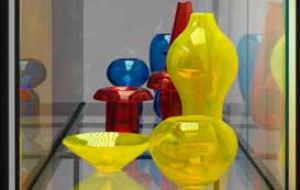
EXCLUSIVE: Watch artist Josiah McElheny and assistant Martha Friedman transform clear hand-blown glass objects into mirrored surfaces in his Brooklyn, NY studio.

Josiah McElheny creates finely crafted, handmade glass objects that he combines with photographs, text, and museological displays to evoke notions of meaning and memory. McElheny’s work takes as its subject the object, idea, and social nexus of glass. Influenced by the writings of Jorge Luis Borges, McElheny’s work often takes the form of historical fictions. Part of McElheny’s fascination with storytelling is that glassmaking is part of an oral tradition handed down generation to generation, artisan to artisan. Sculptural models of Modernist ideals, these totally reflective environments are both elegant seductions as well as parables of the vices of utopian aspirations.

Josiah McElheny is featured in the Season 3 (2005) episode Memory of the Art:21—Art in the Twenty-First Century television series on PBS.

VIDEO | Producer: Wesley Miller and Nick Ravich. Interview: Susan Sollins. Camera & Sound: Joel Shapiro and Tom Bergin. Editor: Jenny Chiurco. Artwork Courtesy: Josiah McElheny. Special Thanks: Martha Friedman.

Reflection in the Porcelain Pond

May 22nd, 2009
Pilar Tema and Ilana Percher, "Jell-O Bog," 2007.

Pilar Tena and Ilana Percher, "Jell-O Bog," 2007

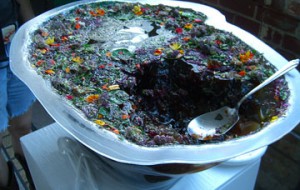
In the fine art world, the story of the thing is the stuff comprising the thing. Paint, bronze, steel, video, screenprinting, mud, written language—the work is about the medium. And it’s also about another medium, its cultural context—movies, comic books, advertising, written language, or the art gallery itself.

But the point of a piece of art is primarily its social role, rather than some physical or symbolic essence. Melting into its environment, its audience, and its constituent pigments, the modern artwork tries both to command and to disappear, leaving us with volitional interrogation, an expensive insistence of excess matter. In doing so, it comes to represent another medium—a medium of exchange.

In a market society, art’s function, content, and exchange-value are all connected by the idea of excess. Art, like the rest of us, announces its place in the world in predominantly economic terms. In the dreams and desires of the unconscious mind, as in an unfettered free market, boundaries are meaningless, and enough is never enough. As we consume and produce, the excess currency—the profit we create—is another form of what is left over when we consume. Depending on how you take “consume,” this could mean sacralized cultural fetishism. Or, on the other hand, excrement. Either way, we long to contain it or to manipulate it.

The ephemeral abstractions of high finance and the primeval repugnance and joy in bodily processes are joined in modern visual art—a talisman to the sublime force of individual will (will being a faculty, sayeth Freud, that we discover during the period we learn to control our bowels). While visual art remains far from the mainstream, mostly by choice, it is in some sense the most dramatic result of humanism, the ideological bedrock supporting the motivational matrix of our society commonly known as capitalism. A visual icon—like a flag, religious symbol, or work of art—is a deeply affecting “interpellation,” a term coined by Louis Althusser for an ideological signifier that hails me and to which I respond. It addresses me like my own face in the mirror, without any acknowledgment of the assumptions and connotations of the icon. Artwork in the last century has teased out many of the implications of the current core dogma of the First World. which I sum up below in three motifs: autonomy, transparency, and the new man.

Jacques-Louis David, "Patrocle," 1780

Jacques-Louis David, "Patrocle," 1780

Autonomy, the principle of individual freedom that insists on choice and rejects interpellation, is the hallmark of the commercial gallery, as well as the classical avant-garde. The artwork reveals the anointed maker in a way that words never could, in the retentive tableaux of Jacques-Louis David’s paintings, or in the explosive cartography of Jackson Pollock. The writings of Clement Greenberg and Dave Hickey offer lengthy modernist apologies for having anything at all to say about these ineffable things, whose solipsism admits no error. Purity is the only experience, and the market frequently rewards this work. The anal retentivity that Freud associates with the miser can simply replace one unspeakable medium of exchange with another. Damien Hirst’s preserved animals, much like the gleeful food-based artwork of Surrealist sculptor Meret Oppenheim, depict a closed statement, decay forever suspended, echoing the food-smeared African idols that have served as touchstones of authenticity since the height of European imperialism.

Piero Manzoni, "Merde d'artista (Artist's shit no.066)," 1961

Piero Manzoni, "Merde d'artista (Artist's shit no.066)," 1961

Transparency connects art to writing, but in modern times has rejected interpretation, or any other form of exegesis whose gaze turns away from the hideous fascination of the Thing itself. This oracular reading is enunciated in the symbolism of the cultural and pedagogical institution. Rosalind Krauss and Susan Sontag are noteworthy haruspices of this post-war tendency, in which images and words are allowed to taint one another as multiple expressions of a single perception, and art starts to attempt depicting the conditions of its own legibility—often using empty spaces and vast grids. National Endowment for the Arts culture-wars martyr Andres Serrano has been displaying closeup photos of stool as signifiers, much in the same way Wim Delvoye created a defecation machine, Piero Manzoni canned his offal for sale, and Marcel Duchamp anointed a urinal as artwork—all in self-aware gestures that try to realize our alchemical dream of turning filth to gold.

Continue reading »

The best is not quite over…

May 21st, 2009
"Economic Times Hit The Nat Hist Museum" by uncleboatshoes on Flickr (http://www.flickr.com/photos/uncleboatshoes)

"Economic Times Hit The Nat Hist Museum" by uncleboatshoes on Flickr (http://www.flickr.com/photos/uncleboatshoes)

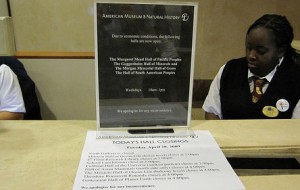
One of the first rules for the nouveau riche is to save a little for a rainy day. Unfortunately, in the doom and gloom that has come with daily announcements of museum staff layoffs, slashed exhibition budgets, and shrinking endowments, a common thread between the High Museum of Art, Kemper Museum of Contemporary Art, and the Art Gallery of Ontario, amongst many, many others, is an attempt to live beyond their means. Each institution emptied the piggy bank to take on an expansion, a downtown satellite space, or a $275 million Frank Gehry “Transformation,” respectively. And what exactly do we expect these new editions to become—international tourist destinations on the scale of the Guggenheim Bilbao? Above all, the greatest disservice trickles down to the artists, who are overshadowed in wake of the starchitect. Now without a staff to enliven them, these spaces will morph into nothing more than mausoleums of past ambitions and egos.

Most astonishing are the museums that are witnessing the current upheaval, yet seem determined to stay the course. The Isabella Stewart Gardner Museum recently laid off 12 employees while fundraising for a $140 million expansion; the Miami Art Museum has announced reduced operating costs, staff cuts, hiring freezes, and a mandate to host less temporary exhibitions, but will not let fear affect their upcoming $220 million (gorgeous) Herzog & de Meuron designed expansion; and, incredibly, the Art Institute of Chicago has taken creative solutions towards paying off their new $300 million “Modern Wing—similar to a bunch of college roommates in the winter, they’ve lowered the temperatures in the galleries to reduce their Exelon bill. Thankfully, not all institutions are living in the moment, as the St. Louis Art Museum, the Indianapolis Museum of Art, and the Austin Museum of Art have postponed groundbreaking ceremonies until the economy hits an upswing. The Parrish Art Museum, situated in the wealth of the Hamptons, set its eyes on its own Herzog & de Meuron, but director Terrie Sultan vows not to have a groundbreaking until 80% of the target has been achieved.

Is it really that catastrophic to downsize, consolidate, or collaborate with other nonprofits? How much programming must be sacrificed in the name of projecting an affluent appearance? Is it a sign of weakness for board members, trustees, and managing CEOs (the professional title that replaced Executive Director) not to have a sleek new Zaha Hadid or Renzo Piano? Sure, it’s not glamorous to endow operating costs, but without healthy nuts and bolts, the sensation of opening night will be unsustainable. We mustn’t forget that many of these generous donors who have been whispering dreams of expansion in the ears of directors are often the same hedge-fund Wall Streeters that helped propel us into this nationwide hangover. And this disingenuous promise that the new square footage be filled with revenue-generating cafes, bookstores, and rentable black box theatres—we cannot base the future of our cultural landscape on the nature of speculative retail. The greatest mistake a small-to-midsized organization can make is to grow beyond original institutional model. Perhaps this unbridled growth is just another example of the American Dream, but the ‘mom and pop’ museums seem to be weathering the storm with fewer casualties. Or, in the case of the Jacksonville Museum of Contemporary Art and Portland’s Museum of Contemporary Craft, these two smaller institutions have realigned themselves with universities to emerge from the recession on more solid footing. Eli Broad has neither the money or, I’m sure, the interest in bailing out museums across the country, and passing on costs through higher admissions in the midst of rampant unemployment is just unethical and contrary to most nonprofit missions. We all want the biggest and the best, but at what cost?

Continue reading »