Interview with Jackie Battenfield

June 30th, 2009

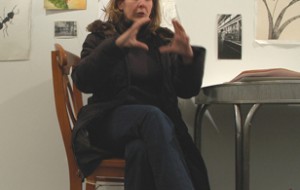
As our Flash Points topic of Art and Economics comes to a close, I sat down and spoke with Jackie Battenfield, whose first book The Artist’s Guide: How to Make a Living Doing What You Love was just published.

Jackie has supported herself from art sales for over twenty years and currently teaches career development at Creative Capital and Columbia University, helping artists flourish and sustain their creative practice while focusing on the professional skills needed to face the challenges and frustrations that all encounter in their careers. The Artist’s Guide presents valuable tactics that Jackie first learned head-on nearly 25 years ago as the founder of Brooklyn’s Rotunda Gallery, and taught for 15 years as the facilitator to the Bronx Museum of the Arts’ AIM (Artist in the Marketplace) program.  The guide offers many lessons that most artists (including myself) never even heard of in an arts program—from writing a proper artist statement, to planning budgets, to time management and exhibition negotiation.

Jackie will attend a reception and signing for The Artist’s Guide on Wednesday (July 1) at the Bronx Museum of the Arts, from 5:30-7:30pm. Click here for more information.

Letter from London: Dead as a Dada

June 30th, 2009
ghenie_hv25573

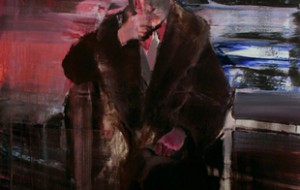
Adrian Ghenie, "Duchamp" (2009)

The problem with writing about contemporary painting is that it ends up being an excuse for a riffle through the thesaurus for the most headily baroque terms to describe the look of paint on canvas. This isn’t a problem when writers write about old paintings, because they tend not to focus on the physical presence of the work, instead treating a painting as a sort of rebus to be decoded and tacked on to a pre-existing idea. Renaissance art historians tend to look through, not at, the paintings in question. Contemporary painting has a hard time because decoding content isn’t what you’re supposed to do; you’re supposed to focus only on the physicality of the thing in front of you: at, not through. The language of at is evasive and slippery and is simply beyond the limits of the technical vocabulary of orthodox contemporary artspeak, like a caveman trying to describe the Internet. Hence the preponderance of purple prose in exhibition catalogues and press releases, laden down with nightmarish adjectival pile-ups more akin to lip-smacking restaurant reviews than anything to do with art.

Adrian Ghenie’s current show at Haunch of Venison on London presents the writer on contemporary painting with what looks like an easy premise: recognizable representational content. His suite of oil paintings collectively titled (like a Cure B-side), Darkness for an Hour, at first look visually pleasing in a loose-and-tight kind of way—neither too finicky and faux-outsiderish, nor too slappy and faux-hamfisted to put off a contemporary art cynic. Ghenie lays on the paint with just the right amount of visual splashiness to look modern and self-aware, while retaining a finessed draftsmanship in the rendering of figures which looks like an appeal to old-timey painterly virtues. To come away from the show feeling as though you’d just wandered through a needy MFA graduate resume (look! I can do abstract painting! Wait: do you like pictures of people? How about BOTH?), which I nearly did, would be understandable but unfair, because of something very rarely discussed or even considered worthy of discussion in contemporary artspeak: content.

Ghenie’s quotations of earlier paintings are there—photo-sourced multi-figure compositions recall both Michael Andrews and Larry Rivers, with areas of squeegeed abstraction out of Richter—but I suspect the references are lightly held, a resonant means of conveyance rather than allusive game playing. These are communicative, gregarious paintings that are emphatically narrative, not obliquely referential. If the heart sinks a bit at his employment of modernist art icons as protagonists (given the contemporary orthodoxy of sneering at modernism), his teasing out of mordant narratives replays well-trodden art historical episodes with a melancholy wit that’s both accessible and alien.

In his painting Duchamp (2009), everyone’s favorite conceptual art behemoth sits swamped in his fur coat, hat in hand against what looks like a railing as a broiling sea churns beyond. While the source image must have been a photograph, it’s not part of the standard repertoire of Duchampian portraiture. The wry smile and supercilious air have been replaced by a creased brow and pensive hand on the chin. His instantly recognizable face is lost in a wash of smears, like a photograph seen through running water, and Ghenie stages a battle of there and not-there, description faltering at the verge of readability. This is the artist in exile, carried across the Atlantic to lasting adoration yet strangely lost, anxious, and almost literally disembodied. In another painting, Urinal, Duchamp’s 1917 Fountain (the urinal on a pedestal) is inspected by a frock-coated officer in a gas mask in a low-lit storeroom. The title’s performance of a reverse magic spell on the found object tradition gives voice to the conceptual art elephant in the room: a urinal? As art? Why did we ever think that? It looks weird and sad, like something out of a time capsule you buried in the past and now can’t remember why.

Continue reading »

Weekly Roundup

June 29th, 2009
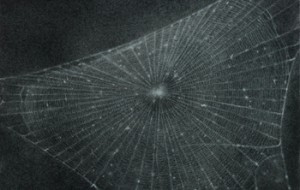
Vija Celmins, "Web #1" (1999). Courtesy Scottish National Gallery of Modern Art.

Vija Celmins, "Web #1" (1999). Courtesy Scottish National Gallery of Modern Art.

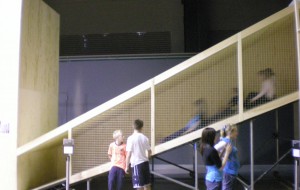
  • Allora & Calzadilla (Season 4) created a new work for Temporäre Kunsthalle Berlin that will open July 10.   Compass divides the Kunsthalle horizontally and introduces a new level to the space, reducing it to less than one third of its normal height and rendering it inaccessible to the public.  Visitors can only hear the vibrations and sounds of an a capella dancer performing a choreography above their heads in an otherwise empty, resonating chamber.
  • Last week the McNay Museum opened In Their Own Right, a  group exhibition focusing on the achievements of women printmakers from 1960 to the present. In Their Own Right showcases nearly 30 prints by contemporary women printmakers from the McNay’s collection, surveying the different trends and movements of American art over the past four decades. It includes artists such as Helen Frankenthaler,  Isca Greenfield-Sanders, Vija Celmins, April Gornik, Dorothy Hood, Yvonne Jacquette, Jane Kent, Agnes Martin, and Louise Nevelson. The show runs through August 23.
  • Tokyo’s Gallery Koyanagi will open on August 1st a two-person show of architectural works by Hiroshi Sugimoto and Junya Ishigami. On display will be architectural models, such as Ishigami’s design for the Kanagawa Institute of Technology and Sugimoto’s maquettes for the S Foundation and Go-O shrine. Did you know the Season 3 artist was an architect too?

Josiah McElheny | Beauty & Seduction

June 26th, 2009

DOWNLOAD VIA ITUNES | SUBSCRIBE VIA RSS

EXCLUSIVE: Artist Josiah McElheny discusses the intentionally problematic nature of beauty and seduction in his “Total Reflective Abstraction” (2004) installation, on view at Donald Young Gallery in Chicago, as well as works by fellow artists and architectural masterpieces such as Renaissance palaces.

Josiah McElheny creates finely crafted, handmade glass objects that he combines with photographs, text, and museological displays to evoke notions of meaning and memory. McElheny’s work takes as its subject the object, idea, and social nexus of glass. Influenced by the writings of Jorge Luis Borges, McElheny’s work often takes the form of historical fictions. Part of McElheny’s fascination with storytelling is that glassmaking is part of an oral tradition handed down generation to generation, artisan to artisan. Sculptural models of Modernist ideals, these totally reflective environments are both elegant seductions as well as parables of the vices of utopian aspirations.

Josiah McElheny is featured in the Season 3 (2005) episode Memory of the Art:21—Art in the Twenty-First Century television series on PBS.

VIDEO | Producer: Wesley Miller and Nick Ravich. Interview: Susan Sollins. Camera & Sound: Kurt Branstetter, Joel Shapiro, and Tom Bergin. Editor: Jenny Chiurco. Artwork Courtesy: Josiah McElheny. Special Thanks: Donald Young Gallery, Chicago.

Announcing Art21 Access ’09

June 26th, 2009

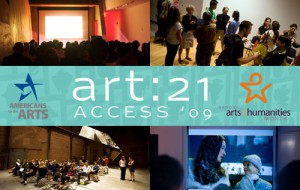
access_collage_500

Sign up for Art21’s Access ‘09 – an international screening initiative that will present your audiences with a sneak preview of a Season 5 of Art:21-Art in the 21st Century before the premiere on PBS. Art Access ’09 provides communities with resources, free of cost, to host their own public screening events, allowing audiences to explore the creative processes and ideas behind some of today’s most thought-provoking  artists.

Art21 Access ’09 depends on people’s enthusiasm to make contemporary art accessible and relevant to their own community, so we want you to organize your own preview event around the Peabody-Award winning Art:21 series. Consider this season’s artists and themes and host an event at your local museum, library, university, community-based organization, art space, or even coffee shop. Whether you plan a conversation with local artists, a panel discussion, a community-based art project, or just a screening-party, join Access ’09 to broaden and inspire a diverse exchange of ideas and perspectives. All participants will receive:

·    Preview DVD screener
·    Educator Guides
·    Postcards
·    Posters
·    Customizable press release
·    Embeddable trailer of each Season 5 episode
·    Press images
·    Digital logos for web sites

If you are interested in hosting an Art21 Access ’09 event between September 28 and October 30, 2009, please sign up here! Art21 Access ’09 is organized in collaboration with Americans for the Arts as part of National Arts and Humanities Month Get ready for another dynamic season of Art:21. We look forward to hearing about your screening plans! Check us out on Facebook and Twitter if you haven’t already!

@Platea: Art in the Web 2.0 Ethos

June 25th, 2009

Social technologies have been around for decades, but mainstream use of social media platforms has grown exponentially only over recent years. This column explores uses of social media platforms relevant to the arts community: by artists, art-based organizations, and the general audience. Leading off the column is a post from New York-based artist, An Xiao.

If there’s anything revealed about the use of social media technologies in the Iranian election, it’s that Twitter, Facebook and other social spaces online have become a new form of public space.  Like any public space, social media serve as a place to meet with friends, people watch and, as we’ve seen, even protest.  The key difference with this digital public space is one of scale and access, as users find ways to reach an international and growing user base, limited only by access to a computer or mobile phone and, to a certain extent, a common language.

One question I explore in my social media work is how this new public space can become a site for public art.  I recently founded @Platea, a global online public art collective, to explore this very issue, and to take some salient features of public art–performance, displacement and activation, engagement–and both translate and transform them into the realm of online media.

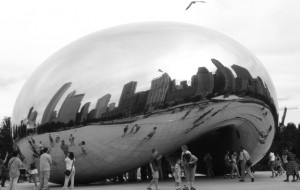
Cloud Gate by Anish Kapoor (photo by An Xiao)

Cloud Gate by Anish Kapoor (photo by An Xiao)

During the week of May 3-9, @Platea gathered more than 40 individiduals from a half dozen countries to participate in @Platea’s Project II: Co-Modify, a public performance art project.  The idea was simple. First, each performer chose a megacorporation to be “sponsored by” for the week. They then acted it out, imagining the sponsorship as defined by their company. The project was designed firstly as a commentary on the commodification of social media, and, by extension, our social lives in general, but also as a look at the possibilities of collective performance art in the realm of social media.

Continue reading »

Art Reality

June 25th, 2009
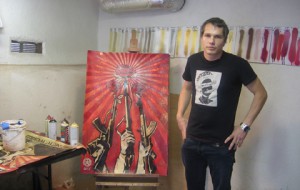
America's most famous artist, Shepard Fairey, in his studio. Photo courtesy www.latco.com

America's most famous artist, Shepard Fairey, in his studio. Photo courtesy www.lataco.com

No matter how hard I try, avoiding reality TV is a challenge. The shows are like invasive kudzu: Nanny 911, Extreme Makeover, The Housewives of New Jersey, Jon & Kate, The Price of Beauty, COPS, I’m a Celebrity Get Me Out of Here, and many, many more. This fall I’ll be avoiding American Artist, Sarah Jessica Parker’s collaboration with Magical Elves, the team behind Top Chef and Project Runway. The new show will serve a mash-up of amateur entertainers—that is, real people—engaging in old-fashioned game-show-style competition and unscripted activity. According to press reports, each episode will feature the show’s “contestants” competing in art-themed challenges from a range of disciplines—including sculpture, painting, photography and industrial design—and completing works of art that will be assessed by a panel of “top figures” in the art world, including artists, gallerists, collectors, curators, and critics.

If there are any producers out there (PBS?), here’s my suggestion for a better reality show about artists. Create a show that’s a little more verité, like an old-fashioned documentary. Forget about vetting “contestants.” Cast the net wide and choose 100 art grads from all over the country in June by random lottery. No auditions, video entries, or artist statements. Abandon any attempt to frontload charisma or talent. As the competition proceeds, to minimize the artists’ artificiality and self-consciousness (and their inclination to ham it up) they would be forbidden to reveal that they are participating in a reality TV show. Inevitably, some will be genuinely talented, some avidly self-promotional, some charismatic, some absolutely clueless—just as in real life.

Give them a list of goals to complete over the course of the viewing season. Those who fail to make the benchmarks are gradually eliminated. Here are some purposely vague goals that might be included:

  • Find suitable living/working space that they can afford
  • Get their work in three group shows
  • Contribute in some creative way to the wider art community
  • Publish three reviews (either essay or video format) of their colleagues’ art shows
  • Curate a themed group show
  • Get a grant or a teaching job
  • Arrange five studio visits with gallerists or curators
  • Get a solo show by the end of the year

Automatic ejection results if an artist:

  • Fails to make art for more than four days during the period.
  • Works longer than forty hours a week at their day job

In addition, in the early stages the artists are responsible for assembling a three-person crew to creatively document their progress on video, in any way they see fit. Before airing any of the results, a season’s worth of episodes would be prerecorded to avoid special treatment.

For me, a show like this, that creatively and realistically demonstrates the overwhelming challenges would-be artists face, would be must-see TV.

The Importance of Being Earnest

June 25th, 2009
Barron Storrey, Detail,  Lord of the Flies book cover, (1980 edition)

Barron Storey, " Lord of the Flies" book cover (detail from 1980 edition)

Making art is part of a ground level experience. The artmaking process can be sensory, visceral and seemingly fleeting, depending on the methods of record of an artist’s choosing, be it film, painting, photography, or sculpture. It’s a hands-on way to attempt to materialize the momentary into something lasting.

In response to guest blogger Thomas Micchelli’s acknowledgement of drawing as the direct route to the subconscious, I believe that the drawing process is one of the most fascinating methods that artists, as purveyors of information, employ as a platform for critical reflection.

Up now at the Society of Illustrators until June 25th, is Life After Black, an exhibition of one hundred and sixty journals made by Barron Storey, celebrated artist and teacher.

These black books envelope years of Storrey’s thoughts illustrated through the many adventures of his day-to-day life, often via the inspiration of many literary works from authors such as the Marquis de Sade or William Shakespeare, among many others (including William Golding’s novel Lord of the Flies).

Barron Storrey, "Life After Black", - Installation view at the Society of Ilustrators, 2009

Barron Storey, "Life After Black." Installation view at the Society of Ilustrators, 2009

Flipping through the plethora of pages, the viewer is presented with the visual view of Storey’s interior data bank: from personal daily notes, charts, lists, and various quotes. He doesn’t hold back.

These journals are drippingly raw, full of force in their sincerity, and intellectually gripping in their multi-layered approach to a specific narrative subject matter. His technical ability with drawing tools can be inspiring for any artist with a special love for such materials.

Joe Fusaro has encouraged, in an installment of his Teaching with Contemporary Art column, that sketchbooks are a useful way to store information, develop ideas, and actively think. Barron does this in a way that is special and unique. As one of Barron’s avid former students (and fellow classmate of mine), Jeremy Forson, recently mentioned in conversation: “For Barron, drawing really is about an adventure. Barron was always encouraging his students to go outside, on an adventure, and draw what you see. And he practices what he preaches devoutly.”

With that, I would like to end on a quote Barron Storrey excerpted from a 2007 original audio interview:

I’m not aware what’s real until I go to my journal. At this point, it has been such a part of thought process and my seeing and my experiencing of life. It is completely integrated. I carry the thing with me all the time; sometimes I go someplace and I go hours and hours and I haven’t even touched my journal. It’s with me.

Announcing Season Five of Art:21

June 24th, 2009

block_600x250

We are pleased to announce Season Five of Art:21—Art in the Twenty-First Century, premiering in October 2009 on PBS, and available on iTunes (link opens in iTunes), Hulu, and other online platforms in the United States and Canada. Meet fourteen of today’s most intriguing and thought-provoking contemporary artists as they create works that reflect important and timely issues. In its most international season to date, Art21 traveled to every continent (except Antarctica) to film artists in museums, galleries, studios and homes.

“This series provides an important glimpse into the minds and workspaces of artists who, regardless of their nationality or background, have the power to challenge the way we view the world,” says Susan Sollins, Executive Producer & Curator.

Season 5 Themes, Artists, and Air-Dates

Season Five features four one-hour episodes: Compassion, Fantasy, Transformation, and Systems. As in previous seasons, the thematic groupings serve as threads that loosely tie the artists together into a single episode.

Compassion
Wednesday, October 7 at 10:00 p.m. (ET)
This episode features three artists — William Kentridge, Doris Salcedo, and Carrie Mae Weems — whose works explore conscience and the possibility of understanding and reconciling past and present, while exposing injustice and expressing tolerance for others.

Fantasy
Wednesday, October 14 at 10:00 p.m. (ET)

This episode presents four artists — Cao Fei, Mary Heilmann, Jeff Koons, and Florian Maier-Aichen — whose hallucinatory, irreverent, and sublime works transport us to imaginary worlds and altered states of consciousness.

Transformation
Wednesday, October 21 at 10:00 p.m. (ET)
Whether satirizing society or reinventing icons of literature, art history, and popular culture, the artists in this hour — Paul McCarthy, Cindy Sherman, and Yinka Shonibare MBE — inhabit the characters they create and capture the sensibilities of our age.

Systems
Wednesday, October 28 at 10:00 p.m. (ET)
This episode features four artists — John Baldessari, Kimsooja, Allan McCollum, and Julie Mehretu — who invent new grammars and logics, finding comfort in some systems while rebelling against others in today’s supercharged, information-based society.

For more information about Season Five of Art:21Art in the Twenty-First Century please visit art21.org to read the full press release. Stay informed and join the conversation on Facebook & Twitter.

Major underwriting for Season Five of Art:21Art in the Twenty-First Century and its accompanying education programs has been provided by the National Endowment for the Arts, Agnes Gund, Bloomberg, The Nathan Cummings Foundation, the Public Broadcasting Service, The Andy Warhol Foundation for the Visual Arts, The Horace W. Goldsmith Foundation, and by individual contributions to Art21. Support for the production of “Jeff Koons” has been provided by The Broad Art Foundation; support for the production of “Kimsooja” has been provided by the Korea Foundation.

Talking with Students about Christian Marclay’s “Video Quartet”

June 24th, 2009

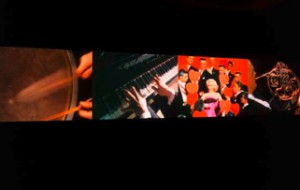
Christian Marclay, still from Video Quartet, 2002

Christian Marclay, still from "Video Quartet," 2002

With the opening of Christian Marclay’s Video Quartet at the Nasher Museum of Art at Duke University (on view through July 26, 2009), I have been thinking about how to share this 14-minute video work of art with students.

For educators, I think there is often a reluctance to discuss video art on tours. Sometimes there are logistical issues in terms of time and sequencing, while at other times, the narrative of the video poses challenges. However, works like Video Quartet—videos that can be watched for a portion of time and then discussed—offer possibilities for meaningful exchanges with students and exposure to this medium.

I developed some strategies to discuss Video Quartet after hearing a talk from educator Denise Gray. In regards to looking at video art with students, she emphasized a structured interaction, such that it includes time to experience the work, as well as the conditions in which to discuss it. The discussion portion sometimes requires you to step away from the work, or even outside of the gallery where it is being shown. These comments might be helpful for talking about video art by Art21 artists Matthew Barney, Pierre Huyghe, Mike Kelley, and Paul Pfeiffer.

Before entering the gallery showing Video Quartet, I introduce students briefly to what they will see: a collage of over 700 film clips of sounds edited together by the artist Christian Marclay to create a musical composition—a quartet. I mention that they will watch about five minutes of this 15-minute work. I also ask students to look for something specific: the various ways in which sounds are made, as well as how the image of the sound fits with the recorded sound.

A recent group of eighth graders, upon viewing part of Video Quartet, discussed “traditional music,” and how combined sounds—such as those made by car horns, feet tapping, and glasses filled with water—also create a type of music. The musical possibilities of car horns caused many of them to view the sound in new ways.

Marclay’s process to create Video Quartet was also something they wanted to discuss. While they were familiar with collage, seeing a collage made with video allowed them to think about repetition and arrangement in new ways. One student said how she thought the four screens was a really engaging choice, and another commented on how the clips on different screens competed for his attention. Through this work, Marclay also demonstrates an interest in the memory that viewers may have with some of these movies—which is something else that the students picked up on, recognizing films including Back to the Future and The Addams Family.

In addition to talking with students about this work, we plan to facilitate a drawing activity for summer K-12 tours where students draw the pattern of a sound or sounds they choose to focus on, creating an alternate image to accompany the sound and image pairing that Marclay produced. At our May Family Day, we also had stations where students could experiment with the mixing and editing process, creating their own song using an application called Super Duper Music Looper.

In our media-saturated lives, Christian Marclay reminds us to question the relationships that we are presented with—the sounds and images edited together for films. I also feel he encourages viewers to think creatively about ways in which they can change their role from being a consumer to being a producer.

Julie Thomson is the Associate Curator of Education at the Nasher Museum of Art at Duke University where she develops materials for docents and teachers to use with K-12 audiences.