Back in the Day: Mel Bochner and Marcelo Bonevardi

June 23rd, 2009
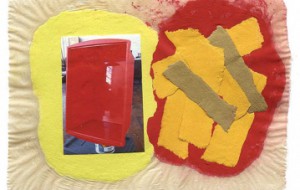
Marcelo Bonevardi, "Wall with Objects," 1966, Indan ink on paper with plaster form, 14” x 11.” Museum of Art, Rhode Island School of Design. Gift of Dr. and Mrs. Armand Versaci.

Marcelo Bonevardi, "Wall with Objects," 1966, Indan ink on paper with plaster form, 14” x 11.” Museum of Art, Rhode Island School of Design. Gift of Dr. and Mrs. Armand Versaci.

Mel Bochner’s new book, Solar System & Rest Rooms: Writings and Interviews, 1965–2007, is a compilation of his writing, both about art and as art. The book opens with thirty-five sharp, pithy reviews he wrote for Arts Magazine in the sixties. The editor paid $2.50 per review whether they were published or not, so Bochner turned in thirty each month, earning enough to pay his rent.

After reading the reviews, I wondered whatever became of the unfamiliar artists he had skewered. Consider a 1965 review of Marcelo Bonevardi’s work:

Competency, craftsmanship, and professionalism lend these large painting-constructions a certain interest. Into shallow spaces constructed behind a heavily surfaced canvas, small wooden abstract shapes are placed in the manner of meticulous Nevelson. The keyed-down color, non-referential shapes, and small esoteric numerals and arrows do not quite achieve an intended aura of mystery. If Bonevardi aspires to enigma, his all-too-familiar international vocabulary is incapable of expressing it.

Marcelo Bonevardi? For many of the artists Bochner reviews, a web search yields few results, but Bonevardi’s son Gustavo created a website for his father. Marcelo died in 1994 of cancer, and therefore won’t have to experience the disappointment of reading this review again. In any case, despite Bochner’s defensible assessment, it turns out Bonevardi fared well. “A native of Argentina, Marcelo Bonevardi spent most of his career in New York City, where he absorbed avant-garde practices and influences such as abstraction and primitivism, using them to invent a pictorial and symbolic language with which to express his deep spirituality and affinity for myth and ritual,” his website reports. “During his lifetime, Bonevardi received many honors, and his work has been collected by the leading North American and Latin American museums, including the Museum of Modern Art and the Guggenheim Museum in New York City.”

A book about his life and work, Bonevardi: Chasing Shadows, Constructing Art, which includes essays by Dore Ashton and Ronald Christ, was awarded Best Arts Book by the International 2008 Latino Book Awards. Gustavo Bonevardi, who has an architecture degree from Princeton, and John Bennett were the editors.

Gustavo and Bennett are co-founders of Proun Studio Space, which was part of the team that created “Tribute in Light” after 9/11.  Their videos have been included in the exhibitions The Un-Private House and Mies in Berlin (including the documentary Mies and Exhibition Design 1926-1945).

Marcelo also had a daughter, Cecilia, who lives in Argentina.

Continue reading »

Weekly Roundup

June 22nd, 2009

A teaser image for the "Blood of Two: Matthew Barney and Elizabeth Peyton" exhibition. Courtesy of Deste Foundation.

A teaser image for the exhibition "Blood of Two: Matthew Barney and Elizabeth Peyton." Courtesy of Deste Foundation.

  • Matthew Barney (Season 2) and Elizabeth Peyton have collaborated on a site-specific installation for the Deste Foundation in Hydra, Greece. Blood of Two is on view through September 30 in the foundation’s new project space, which used to be the local slaughterhouse. Read The Moment to learn more.
  • Works by Gabriel Orozco (Season 2) and Josiah McElheny (Season 3) are on view in the exhibition Universal Code at The Power Plant in Toronto. Timed to coincide with the International Year of Astronomy, the exhibition presents artists responses to cosmology and ideas of the universal in the current age of information. Continues through August 30, 2009.
  • The Art Newspaper reports that nearly twenty bronze sculptures in the Tasting Garden (1998), a public art project by Season 4 artist Mark Dion, have been stolen. The garden was created for the inaugural Artranspennine exhibition organized by Tate Liverpool and the Henry Moore Institute.

Letter from London: Everybody Be Cool, This Is An Art Gallery!

June 22nd, 2009
Peter Coffin's "Spiral Staircase" and Chris Martin's "Untitled" at the Saatchi Gallery

Peter Coffin's "Spiral Staircase" and Chris Martin's "Untitled" at the Saatchi Gallery

If  Abstract America, the new show of contemporary American painting and sculpture at the Saatchi Gallery, were a film, it’d be one of those earnest indie dramas made for hipster first dates, with a hand-drawn animated title sequence soundtracked by a Starbucks-endorsed acoustic guitar ballad. In other words, it’s a ruthlessly commercial venture masquerading as counter-cultural event, with the standard-issue indie cinema ironic references (80s hair metal, children’s TV, outmoded junk food) substituted for standard-issue contemporary art ironic references (hard-edge abstraction, action painting, 60s assemblage). It’s a cool show that makes you feel uncool, made by good-looking cool artists (there’s a wall of headshots in one of the galleries, like the lobby of a Chinese restaurant), all of whom I bet claim to have been, like, total nerds in high school.

If abstract art is a kind of faith—something elucidated beautifully in Kirk Varnedoe’s Pictures of Nothing—much of Abstract America is about petulant atheism, a door slammed in the face of a parent. Agathe Snow‘s troika of crucifixes, loaded with detritus (balloons, twigs, knitted spiderwebs, and a pair of—surprise!—Converse shoes), are the first thing you see in the opening room, and they’re as self-consciously ham-fisted as the description suggests. Not that you’d know that from the accompanying text, which breathlessly opines that the construction was “an intensely physical process” (which is at least hyperbole and at most tautology). The author steams up about “the performative dimension of her work,” as though assemblage-style construction were a transcendent act, and, in the mindset that Abstract America stands for, it sort of is. The text is particularly revealing of the transferral of faith that the show evidences, the santification of the artist above the work (that practice over work chestnut again). For example: the text on the work of Kristin Baker, an arch but intermittently engaging painter, salivates over her love of Formula One racing; she “paints for the thrill of the moment…her high-octane abstractions appropriate every essence of high-octane drive” (they don’t). Meanwhile, her Raft of Perseus—a sort of juddering Gericault; Raft of the Medusa via Google Image Search—is described with anachronistic romanticism as “an analogy for the loneliness and heroism of artistic pursuit.” Whether or not that’s intended ironically, it nevertheless encapsulates what’s wrong with the show’s approach. While Baker and her peers have scornfully dumped the good bits of Abstract Expressionism—joyous paint, spiritual or psychological yearning, epic ambition—they’ve kept, in the words of their supporters at least, the bad bits, the tiresome cliches of clench-jawed outsider American cool. And the words of the supporters are all. This is art that prioritizes the word; it’s conceptual first and painting second, and too often the concept clouds visual purchase. Try remembering what a painting from the ground floor looked like once you’re a few floors up and your head crowds with other images. They don’t hold.

That’s not always the art’s fault, though. The Saatchi Gallery is a vast institutional space, like a municipal swimming pool from the future, whose epic scale and boxy presentation forces staccato curatorial statements rather than a gradual eking out of links and echoes. There are some great works here trapped into airless corners. A recent Mark Bradford painting, a scree of arachnid lines scratched through a palimpsest of collaged papers, filters outsiderish obsessiveness through urban geography. A suite of Mark Grotjahn paintings, dizzying orthogonals in creamy monotone laid in layers a few milimeters thick, can be cute but play out their stonerish time-and-space theme with wonky charm. (His signatures are the best in the business). And in the top floor galleries, a room of Amy Sillman abstractions feels as though the windows have been suddenly thrown open. Muscular and confident as de Kooning in his prime, with a lovely quirky sensibility that never tips into self-conscious kookiness, her paintings offer the kind of fizzing, pinball visual excitement that provide a pretty decent argument for the primacy of abstract art, whoever and whenever you are.

I (and the gallery) have been using the word “abstraction” to describe these works, but the title is a misnomer; there’s plenty of loosely figurative work here. The majority of the work is, I suppose, about abstraction (or at least about the American abstract tradition). Any painting, figurative or not, is an abstraction of the visual world in any case, and the semantic slipperiness is apt for many of the show’s genre-hopping works. There’s a question that hangs over the show, though: why abstract art? Why now? What’s the point? “Whatever,” by the way, doesn’t count.

New guest blogger: Sharon Butler

June 22nd, 2009
sharon_butler

Sharon Butler leading a discussion about artmaking, art blogging and world making at Pocket Utopia in Bushwick, January 2009. In July, Butler will resume activities as an Artist-in-Residence at Pocket Utopia. She invites people to stop by and say hello. Photo: Hrag Vartanian.

Thanks to Thomas Micchelli for his thoughtful posts about art and artists old and new. Please follow his pursuits on his own site here.

Up next is Sharon Butler. A painter whose art practice spills beyond traditional studio and gallery situations, Sharon maintains the art blog Two Coats of Paint and is a contributing writer at The Brooklyn Rail. Her work is on view in Status Update, an exhibition about artists and social media at Yale’s Haskin Laboratories through August 1. Since 2000, she has been a faculty member in the Digital Art & Design Program at Eastern Connecticut State University. To learn more about Butler’s projects, please visit her web site at www.sharonlbutler.com.

Arturo Herrera | Powerful Images

June 19th, 2009

DOWNLOAD VIA ITUNES | SUBSCRIBE VIA RSS

EXCLUSIVE: In his Berlin studio, Arturo Herrera discusses his relationship to creating abstract collages and images. Herrera takes the process of abstraction a step further by photographing fragments of his collages, such as in the work “Untitled” (2005), a series of 80 black and white photographs. He submerges the undeveloped film in hot and cold water, coffee, and tea, creating unpredictable results when printed. Editing the photos into a grid of images, Herrera creates a work that‘s greater than it‘s individual parts.

For Arturo Herrera, abstraction is a language rooted in the practice of assembling and composing fragments. Herrera collects illustrated books, comics, and paint-by-number paintings, cutting and splicing them into new forms. He also creates his own source material by fragmenting drawings, watercolors, and shapes made by applying paint directly from the tube. Herrera collages all of these elements together, pasting them together to create a new whole.

Arturo Herrera is featured in the Season 3 (2005) episode Play of the Art:21—Art in the Twenty-First Century television series on PBS.

VIDEO | Producer: Wesley Miller and Nick Ravich. Interview: Susan Sollins. Camera & Sound: Terry Doe and Leigh Crisp. Editor: Jenny Chiurco. Artwork Courtesy: Arturo Herrera.

Dialing Back

June 18th, 2009
Opicinus de Canistris (1296–ca. 1354),  Diagram with Zodiac Symbols, folio 24r, Biblioteca Apostolica Vaticana, Vatican City, Pal. Lat. 1993

Opicinus de Canistris (1296–ca. 1354), Diagram with Zodiac Symbols, folio 24r, Biblioteca Apostolica Vaticana, Vatican City, Pal. Lat. 1993

Turning again to the oracular nature of art (see Monday’s post), it is compelling to consider that, in the Western canon, drawing as an autonomous art form first came into its own in the medieval period, embellishing the texts of the Bible and other works, both sacred and profane. If you believe, as I do, that drawing is the most direct route to the subconscious, this historical association implies a solid link between the psychological impetus of visionary art and the theological objectives harnessing its iconography. In other words, an id running wild might be reframed by its context, but it can never be tamed.

These thoughts were prompted by Pen and Parchment: Drawing in the Middle Ages at the Metropolitan Museum of Art in New York, which is easily (Francis Bacon: A Centenary Retrospective and The Pictures Generation, 1974–1984 notwithstanding) the most of-the-moment exhibition in the building. The overwhelming majority of works on display are presented in book form, rather than broken out of their original bindings. So it is hard to ignore their prima facie similarity to graphic novels and comic books, especially the simplified Matt Groening-style curves of the theatrical masks depicted in a mid-12th-century copy of Terence’s Six Comedies from Saint Albans, England.

The technical experimentation of these anonymous illustrators and scribes (often the same person), such as the variously colored contour lines in the Psychomachia and other texts written by Aurelius Prudentius Clemens, would feel as much at home in Pierogi 2000 as in Canterbury circa 1000. Not to mention the utter weirdness of the squat, schematic and anatomically inaccurate figures from the Salomon Glosseries, which were drawn in 1158 and 1165 in Prüfening, Germany. Or the text-free, comic book framing of a double-page spread from The Dialogues of the Holy Cross (1170-1180, Regensburg-Prüfening, Germany) and its detailed depictions of outrageous violence.

The most fascinating discovery of the show is the work of Opicinus de Canistris (1296-ca.1354), a priest and scribe for the Papal Curia in Avignon who, according to the wall text, “suffered from a stroke-like episode that rendered his right arm almost useless, yet he still managed to draw” and thereafter “worked obsessively to develop and convey his unique understanding of the divine order.” An actual visionary (“His illness, he felt, had brought him a vision from God…”), the large diagrammatic drawings selected from his portfolio of 52 works on 27 sheets of parchment (all made in Avignon between 1335 and 1350 and now held at the Vatican Library) bear a startling resemblance to modern outsider art. The drawings are built up rather than composed, with information overriding decoration as their primary motivation, which endows them with the same freakish, nonlinear narrative found in the most outré ‘zine art.

The crisp lines and sharp contrasts emblematic of both Opicinus de Canistris and comix artists like Eamon Espey return us to the kind of primal visual pleasure that drew us to illustrated books and comics when we were children. They also reestablish the intimate though often-denied connection between the verbal and the visual – a resetting of the dial to the image’s most basic form and function. The works on display in Pen and Parchment emerged at the turn of a millennium in the clearing between the Roman Empire and the Renaissance; graphic novels and ‘zines came into their own at the turn of a millennium after the rigors of modernism and the platitudes of postmodernism had both fallen apart. We are again back at zero, hallelujah.

Summer Reading Part 2

June 17th, 2009

Jenny Holzer, "WISH LIST BLACK," detail, 2006

Jenny Holzer, "WISH LIST BLACK," detail, 2006

Continuing with my column from May 27, I’d like to suggest a few more books related to contemporary art education that you may be inspired to buy, borrow or steal this summer (but please, steal from someone who has the book sitting on a shelf waiting to be opened, not from your local library!).

First, Julie Thompson’s suggestion to check out Paulo Freire’s Teachers as Cultural Workers – Letters to Those Who Dare Teach is an excellent one. Thank you, Julie! She also mentioned John Dewey’s Art as Experience, which is must reading if you haven’t already.

Other suggestions include:

Elliot Eisner’s The Arts and the Creation of Mind

Olivia Gude’s article, Postmodern Principles: In Search of a 21st Century Art Education (also a must!)

Anne-Celine Jaeger’s Image Makers, Image Takers: Interviews with Today’s Leading Curators, Editors and Photographers

Please continue to share your ideas for summer reading as we get closer to the official start of the season….

No Preservatives: The Clocks’ Tic Tic Tic …

June 16th, 2009

Spearheaded by Richard McCoy, a conservator at the Indianapolis Museum of Art, this site’s newest column, “No Preservatives,” seeks to define the conservator’s role in the conservation of art in the twenty-first century. Every third Tuesday of the month, McCoy will discuss current issues, approaches, and decisions surrounding contemporary conservation projects at the IMA and a host of other institutions.

Nam June Paik, 'Who's your Tree.' 1997

Nam June Paik, "Who's your Tree," 1996. Installation view at the Indianapolis Museum of Art, 1997. Accession number = 1996.321. Now and Future Purchase Fund and Robert and Ina Mohlman Art Fund. The Estate of Nam June Paik.

Last April, I heard the former US Poet Laureate, Charles Simic, give a reading at Butler University. Since then I’ve been thinking a lot about the poem “The Clocks of the Dead.” Simic introduced this poem by telling a story about how analogue clocks used to be everywhere in his house but, as we all know, by the mid-1990s many of these clocks had gone digital and, for the most part, silent. For better or worse, the domestic audiological landscape changed in a matter of a few years.

Sure, this poem could be read as a meditation on remembrance of lost loved, but there are a few lines that I think operate to produce a metaphor for some of my work as an art conservator at the Indianapolis Museum of Art .

Once there were clocks like that
In every kitchen in America.
Now the factory’s windows are all broken.
The old men on night shift are in Charon’s boat.
The day you stop, I said to the clock,
The little wheels they keep in reserve
Will have rolled away
Into many hard-to-find places.

Though I feel a little guilty excerpting just this part of the poem to make my point, I do it because some days it seems like part of my job is to examine contemporary artworks and identify the “wheels” to the “clocks” that have stopped, or work to try understand which parts of the clock will most likely stop in the near future. And due to the increasing speed of technological advances and the variety of components used in the creation of contemporary artworks, much of the time it seems like these wheels are rolling away beyond my reach at an increasing speed.

As an art conservator, I value art for what it represents and how it’s represented when on display. I value art so much that I’m working to help keep it viable now and in the future; that is, when it is designed to be kept around for that long. But that’s a whole different post.

Today, I believe the value of art is directly tied to the notion of authenticity of representation. By this I mean the accuracy of representation of an artist’s idea(s). As can be seen in the following example of Nam June Paik’s Who’s Your Tree, even when guidelines are established as to how an artwork can change over time, the concept of authenticity and correct representation is still complicated and open to some level of interpretation.

Some artists have anticipated this issue and have put guidelines in place that will describe how their works can evolve alongside technological advancements. Many art conservators have begun working within interdepartmental teams to prepare for the transition and migration of components of artworks. At the IMA, we created the “Variable Art Team” to discuss and strategize ways to ensure artworks are well-documented and ultimately represented authentically when on view. Our team is led by the conservation and curatorial departments, but has members from nearly ever department playing key roles.

One of our upcoming projects for this year is to find 34 replacement televisions for a work commissioned by IMA in 1996 by Nam June Paik. Who’s Your Tree originally consisted of 31 13” CRT televisions and 3 25” CRT televisions, three laser disc players, and the corresponding three laser discs. While you can’t see it in the image at the top of this post, this 1997 installation view shows the artwork exhibited with the 3 laser disc players (they machines are encased inside the black aluminum base). It also shows metal stanchions that are not part of the work and are no longer used in its current installation.

Nam June Paik, 'Who's Your Tree,' Installation view, 2009.

Nam June Paik, "Who's Your Tree," 1996. Installation view at the Indianapolis Museum of Art, 2009. Accession number = 1996.321. Now and Future Purchase Fund and Robert and Ina Mohlman Art Fund. The Estate of Nam June Paik.

This is how the artwork looks in the gallery today. The images on the televisions are no longer produced by laser disc players, but by 3 DVD players. The 3 video files were migrated from laser disc to DVD in the early 2000s with consent and guidance from the artist’s letter below. Of course, we are storing the original laser discs and players.

Continue reading »

Nathalie Djurberg and Paul Chan: Making Weird Worlds at Birnbaum’s Biennale

June 16th, 2009
Paul Chan, "Sade for Sade’s Sake," 2009. Three channel shadow projection. Courtesy VVORK (www.vvork.com)

Paul Chan, "Sade for Sade’s Sake," 2009. Three channel shadow projection. Courtesy VVORK (www.vvork.com)

Daniel Birnbaum’s poetic theme of the 53rd Venice Biennale, Making Worlds, is, in some sense, an anti-theme, emphasizing the plurality of art today. Birnbaum’s explanation that “we now live in a multi-centric art world” does not provide much of a compass to viewers who are trying to navigate through a maze of 77-plus pavilions containing hundreds of artworks. In fact, not only does the title fail to orient viewers, but it is also actively disorienting. In a way, there is something paradoxical about the phrase “making worlds”: “making” implies putting things together, cohering, structuring, while “worlds” implies a multiplicity of discrete parts, diffusion, discontinuity.

Come to think of it, my two favorite pieces from the shows that Birnbaum curated (at the Arsenale and the Giardini’s Palazzo delle Esposizioni) explore this notion of simultaneous cohesion and dispersion, using the destructive power of sexuality as a conceit. Paul Chan’s shadow figures in Sade for Sade’s Sake and Nathalie Djurberg’s plasticine puppets in Experimentet show bodies simultaneously merging together in various orgiastic formations while literally breaking apart and dismembering. While the violence of eroticism and the eroticism of violence are age-old themes, I believe that both artists are using this idea to explore larger issues of human struggle.

Paul Chan’s shadow projections interpret Marquis de Sade’s 120 Days of Sodom in 45-second scenes, which he refers to as “stanzas.” The violent whippings, assaults, and gangbangs literally invoke Sade, while the rhythm of the piece reflects what Gilles Deleuze described, in Coldness and Cruelty, as Sade’s “mechanistic approach [to language] imbued with the mathematical spirit.” This mathematical spirit is also reflected in the video’s interposing of geometric shapes, which Chan describes as a means to establish distance. The shadows themselves seem to be more like geometric forms than human beings, as they are reduced to the simplest contours possible. Chan describes coming to the use of shadow projections as a means to “impoverish” his work. I believe that it is this act of impoverishing that allows Sade for Sade’s Sake to function on the level of the symbolic, as opposed to simply illustrating acts of sex and violence.

Still from Nathalie Djurberg's "Experimentet," 2009. Photo by ArtObserved (www.artobserved.com)

Still from Nathalie Djurberg's "Experimentet," 2009. Courtesy ArtObserved (www.artobserved.com)

But if Chan’s shadow plays are the ultimate impoverishment of animated videos, Djurberg’s installation is as rich and lush as any moving projection can be (watch her accept the Biennale’s Silver Lion award for the most promising young artist here). While Chan’s shadow projections are created digitally, Djurberg’s hand is evident in every part of her work: in the dozens of carefully sculpted plasticine figures animated by the painstaking process of stop motion claymation, in the painterly sets of each video, and in the installation of human-sized, grotesque flower sculptures that surround the three projections. Described in the Biennale catalogue as a “surrealist Garden of Eden,” Djurberg’s set reflects the lushness of the surrounding Giardini, just as the violent austerity of Chan’s video echoes the industrial harshness of the pointedly unmodified Arsenale. One video in Experimentet shows a woman attempting to evade the advances of an older lecher, and in turn both struggle to escape the forest that begins to attack them. Another film displays a group of Catholic priests detachedly observing a parade of nude women as they erotically clamber over each other’s bodies, melting together and then clawing one other apart until only tattered bits of flesh remain. In a third video, a nude female reclines on a Victorian couch (a la psychoanalysis) in a cave of fecal stalactites, while bits of her body break off one by one and attack her. It seems that this video’s reference to the process of psychoanalysis, like Chan’s invocation of mathemeatics and vague shadows, subtly instructs the viewer to interpret these bizarre violent orgies as symbolic of broader struggles. Sure, the worlds that Djurberg and Chan are making may be horrifying and quite peculiar, but ultimately they address ideas that are profoundly universal. And isn’t that kind of beautiful?

Labyrinths

June 15th, 2009
Pablo Picasso, The King of the Minotaurs (1958). Oil on canvas.

Pablo Picasso, "The King of the Minotaurs" (1958). Oil on canvas.

The other night I was at a dinner where someone suggested that, all things being equal, what ultimately makes the difference in a body of work is the character of the artist. This might fall on most ears as a wildly dicey proposition, but in the context of the conversation it seemed plausible. An artist who is capable of making hard choices and facing unpleasant truths, especially personal ones, will develop a more substantial and exacting practice than someone who possesses a similar range of intellectual and aesthetic gifts but is too narcissistic or insecure for ruthless self-criticism.

Still, the prickly issue of an artist’s character got me thinking about the tendency to regard creative personalities, especially those at an historical remove, as glamorous and forward-thinking, if not downright heroic. This doesn’t hold up under scrutiny, of course. But it does reflect a need for consensus among artists and aficionados—whose values are assaulted daily by the dominant bottom-line culture—that they are on the right side of history.

Never mind that Cezanne, the father of modern art, broke with his childhood friend, Emile Zola, over the Dreyfus case, which was the litmus test for progressive thinkers at the end of the 19th century. The paradoxes and complexities of history include the Fascist affiliations of the Futurists and Ezra Pound, as well as the reputed, though unverified, reason for Fritz Lang’s emigration to the United States—not to escape Nazi persecution, as was the case with Arnold Schoenberg, Bertolt Brecht, and countless others, but to elude a prestigious job offer from Joseph Goebbels.

Perhaps it is a throwback to the ancient belief that the inscrutable pronouncements of the oracles were the disguised prophecies of the gods, but when an artwork thrusts us into new experiential territory, we seem atavistically susceptible to the notion that it contains the spark of the divine. And what is the divine if not all-knowing, all-loving, and all-powerful? How could the vessels through which such revelations pass, to paraphrase Stravinsky’s famous remark on The Rite of Spring, be liable to the mundane corruptions of the flesh?

Easily. Instead of retreating into misty, neoclassical visions of Apollo speaking through the Oracle of Delphi, maybe we should recast our imaginations to consider the influence of hallucinogenic vapors (as archeologists have recently conjectured) on the prophetic voice. Not to advocate artificial stimulants or to diminish the power of imagination, but to emphasize the bodily origins of prophecy which, like aesthetic innovation, define themselves by stepping outside the slipstream of their own time. Prophets and artists, both in the business of extracting undiscovered or unacknowledged truths, must peel away the strictures of social conventions in order to see the world anew. They are not necessarily good persons, but certainly uninhibited ones, compulsively groping through the intricacies of their own flawed humanity. This is why someone as self-contradictory as Picasso so dominated the art of the last century.

Mythology is replete with tales of those who challenged the supremacy of the gods or the limits of the human condition (Marsyas, Icarus, Prometheus) and paid a hideous price for their hubris. That is one metaphor of the artist—reaching for the heavens one moment, crashing and burning the next. Another can be found in Picasso’s innumerable images of the Minotaur, a figure who can navigate the labyrinthine passages between human aspirations and animal instincts, but only because he is himself a grotesque amalgam of man and beast. Picasso gives form to our inner monsters by calling out his own.