

Letter from London: Kapoortalism

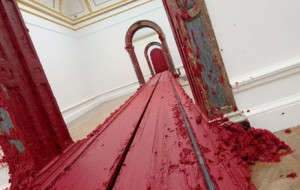
Anish Kapoor, "Svayambh," 2007. Photo: Christian Sinibaldi, The Guardian.
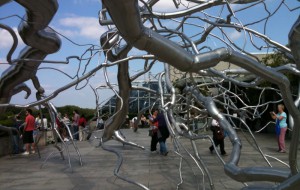
There’s a big lump of birdshit in the eye of Joshua Reynolds. The painter and founder of the Royal Academy, who once literally took a Titian painting to bits to better understand how he did what he did, stands immortalized in bronze in the Academy’s courtyard, waggling his metal brush reprehensively at a wall of giant stainless steel bubbles by Anish Kapoor, a more recent member of the Academy whose mid-career retrospective dominates the galleries of the building behind. The birdshit has landed capriciously, streaked in the sculpture’s eye, but it’s tempting to read it as clunky metaphor for Kapoor’s all-out assault on the neo-Palladian austerity of the Academy and the art-historical “standards” it represents. One in the eye for the stuffed shirts!
Kapoor has dragged, dripped and splashed thick gloops of paint all over the place, firing it out of a cannon, slathering it on doorways, and dusting it on the floors and walls. And yet there’s a kind of timid politeness about much of Kapoor’s work, a willingness to stay within the boundaries of expectation. As one woman I overheard put it, “it’s institutionalized bad manners.” Or, in the words of a snarling teenager, looking at a particularly gloopy pile of paint: “rank.”
The two big attractions of the show are, probably befitting the artist’s work as a whole, the biggest and most spectacular ones. Shooting into the Corner (2008-9) takes up two (very large) rooms of the RA. Pallets stacked high with bucket-size paint cartridges line one wall, and a cannon is positioned pointing into a second room, where a gungy Rorschach of burgundy paint (actually paint, wax, and Vaseline) has built up. There are red globs on the molding, acne on the cornicing. An intense young museum guard loads the cannon, and a fresh lump of colored stuff thunks against the wall. I think we’re meant to think about Smithson, Serra, Pollock maybe – the ‘canon’ (oof!) of modern drippers and dribblers – but the work’s insistent undertone, and that of much of the work here, is that of the single entendre: it really is a big cannon firing gooey stuff into the corner of a room. Geddit?
Art21 Access ’09 Happenings | Wednesday, September 30, 2009

For complete details on venues and programs, visit http://access.art21.org/find-an-event-near-you/
1:30pm: University of Memphis (Compassion)
8:30am: Faculty of Education, University of Ottawa (Fantasy)
8:30am: Wantagh High School (Compassion)
9:00am: Trinity Christian Academy (Compassion)
11:00am: Department of Art & Art History (Compassion)
11:00am: Department of Art & Art History (Fantasy)
12:00pm: Emory Visual Arts Dept (Compassion)
12:00pm: Munson-Williams-Proctor Arts Inst. (Compassion)
12:00pm: Potomac High School (Compassion)
12:30pm: Chaffey Art Organization (Transformation)
1:00pm: Dept of Art, University of Dallas (Transformation)
3:30pm: OLLI Osher Lifelong Learning Institute at Northwestern University School of Continuing Education (Compassion)
4:30pm: Art Department, Eastern Illinois University (Compassion)
5:30pm: Association for Visual Arts (Transformation)
6:00pm: Dr Franklin Perkins School (Compassion)
6:30pm: Professional Organization of Women in the Arts (Transformation)
6:30pm: UNC Sloane Art Library (Transformation)
7:00pm: Art Institute of Boston Library at Lesley University (Compassion)
7:00pm: LynnArts, Inc. (Compassion)
7:00pm: University of Alaska Anchorage (Compassion)
Allan McCollum at the New York Public Library Oct 6 | Ask a Question

UPDATE: Season 3 artist Josiah McElheny has been added to the event.
A Conversation with Allan McCollum and Josiah McElheny
Tuesday, October 6, 6:00 p.m
New York Public Library
South Court Auditorium, Stephen A. Schwarzman Building
Fifth Avenue at 42nd Street
FREE
As part of Art21′s Access 09 initiative celebrating Art:21—Art in the Twenty-First Century Season 5, a conversation with contemporary artist Allan McCollum will be preceded by a screening of the artist’s Art:21 segment from the episode Systems.
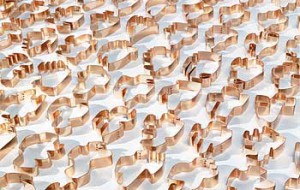
Applying strategies of mass production to hand-made objects, in the series McCollum explores the meaning of the unique work of art versus that of mass-produced objects for a society gripped by consumption. He is best known for creating large quantities of nearly identical-yet still unique-component objects which then constitute a single work of art. The event is free and open to the public. Seating is provided on a first come, first serve basis.
This event is co-presented by Art21 and The New York Public Library, The Art Collection at the Mid-Manhattan Library.
Allan McCollum is featured in the Season 5 episode Systems, premiering Wednesday, October 28, 2009 at 10:00 p.m. (ET) on PBS (check local listings).
Preview the Season 5 segment here.
Have a question for Allan McCollum? Tell us in the comments below for a chance to have it asked at the event. If so, we’ll post his response on this site.
Ottawa Without a Passport

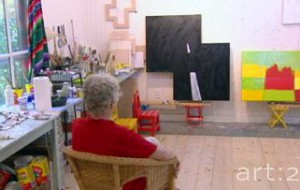
Mary Heilmann in her studio- production still
On Monday I had the pleasure of working with 26 teachers from a variety of settings in the Ottawa Area Intermediate School District… located in western Michigan. That’s right, Michigan. Shame on all of us for assuming you had to cross the border to get to Ottawa.
For a full day, we took the time to explore the possibilities of contemporary art in the classroom with children (and adults!) of all ages. We talked about the variety of exciting artists featured in the upcoming season and had the opportunity to work with the brand new season 5 Educator’s Guide, which definitely smells crispy-clean…. right off the press.
The Ottawa Area ISD works collaboratively with schools and communities to meet the educational needs of students in the Ottawa area. By pooling resources and working regionally, they provide important programs and services to eleven local K-12 school districts and all charter, parochial and private schools in the county. And it’s a big county, to say the least.
One of the main reasons the day was a success really had to do with the way teachers opened themselves up to the possibility of enhancing their curriculum through incorporating contemporary art. Many times we discussed using the resources Art21 has to offer in order to improve and add to what the teachers were presently teaching. I was so inspired by the range of interests in the group, the range of teaching experience, and the willingness to listen to one another as participants shared stories and questions related to teaching about contemporary art, working with big ideas, the work of Mary Heilmann, active viewing of film and video, and the work of Carrie Mae Weems. What an excellent day. I look forward to sharing some of their stories here on the blog in the coming months! Many thanks to Susan Loughrin at OAISD for organizing and scheduling the workshop, and many, many thanks to all of the teachers who participated.
Unconventional Residencies

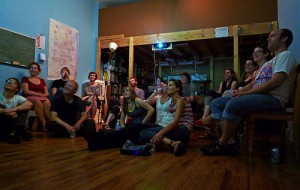
Hideous Beast, "Mini Movie Fest hosted during their InCUBATE residency," 2008. Courtesy Charlie Roderick.
Last November, the National Endowment for the Arts established a new funding category explicitly for artist communities. The NEA defines an artist community as “an organization, whether focused on a single discipline or multidisciplinary, whose sole mission is to provide artist residencies.” This unprecedented recognition of the importance residencies play in the contemporary art ecology also serves as a way for the NEA to support the activities of individual artists without the political liability of direct grants to them. The recent dust-up over an NEA conference call encouraging artists to support certain domestic policy agendas is only the most recent example of how the agency continues to be a political flashpoint.
Residencies are an important step in one path to professionalization taken by artists today. Many artists’ CVs have subheadings devoted to residencies they’ve been on, in addition to documenting their education, exhibitions they’ve shown in, and collections to which their work belongs. Residencies serve artists from every discipline, who benefit from them in a variety of ways. They provide devoted studio space and time to complete work and allow artists to operate in new contexts. They serve as postgraduate institutions where artists can continue working out ideas in a social setting. They offer facilities that an artist might not normally have access to and potential collaborators they might not ever have met. Some residencies are invite-only, and others have competitive application processes. This diversity of organizational models is what allows residencies to serve so many artists — the precise reason that funding them makes sense for the National Endowment for the Arts.
But in addition to the residency organizations currently eligible for funding by the NEA, those that run as non-profit 501(c)(3)’s, there exists a great number of unconventional residencies operating under independent organizational models and at radically different scales. They don’t have traditional boards and tend not to be eligible for public funding. Sometimes they operate out of a spare bedroom at the home of the artist or administrator in charge. Others are nomadic, and never work out of a fixed place. Some are hosted in a string of places that open and close as spaces become available. All of them nurture especially strong connections between the artist on the residency and person or persons who administrate it. With administrative duties minimized, the administrators of these residencies take especially active roles in shaping the artist’s work. What they may lack in artist’s facilities, they compensate for with an intense investment in the artist’s residency experience.
For the past two years, I’ve co-run just such a residency as a member of The Institute for Community Understanding Between Art and the Everyday (InCUBATE). In that time, we’ve hosted fourteen residents (including four collectives) out of a storefront in Chicago. InCUBATE is a research group dedicated to exploring and documenting experimental approaches to arts administration and arts funding. In addition to running the residency, we produce and participate in exhibitions, organize public programs, and co-manage the storefront with three other organizations. We accept applications from people working in any discipline to come stay in a bedroom at our storefront from one to three months and work with us on their projects. These projects are generally interdisciplinary, and produce some sort of resource available for public use. The InCUBATE residency is an opportunity for us, as young arts administrators, to both test out ideas and to collaborate with a wide variety of people whose work we’re interested in.
My own personal investment in unconventional residencies led me to the Alliance of Artists Communities in Providence, Rhode Island. I spent six weeks there this past summer researching other groups and spaces operating residencies at scales and with values similar to InCUBATE’s. Over the course of the next two weeks, I’ll be conducting interviews with some of these residencies and posting them here. I hope to show that they make up an important informal system for a host of people working in modes outside or parallel to traditional art infrastructures.
Weekly Roundup

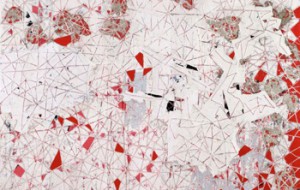
Mark Bradford, "Red Painting", 2009. Mixed media collage on canvas, 101.75 x 143.5 in. Courtesy Sikkema Jenkins & Co.
- Season 4 artist Mark Bradford has been awarded the 2009 MacArthur “Genius” Award. The MacArthur Fellows Program, as it is also known, awards unrestricted fellowships to individuals who have shown “extraordinary originality and dedication in their creative pursuits and a marked capacity for self-direction.” The Foundation recently released a YouTube video of Bradford. Watch it here.
- The Japan Art Association has announced the winners of the twenty-first Praemium Imperiale, an international arts prize that celebrates the human spirit as expressed by the world’s artists. This year’s recipients include Hiroshi Sugimoto (Season 3), Richard Long, and Zaha Hadid.
- Ear Sofa; Nose Sconces with Flowers (In Stage Setting) is the first ever tableau vivant created by Season 5 artist John Baldessari. The installation will be unveiled at Sprüth Magers London on October 12, the day before Baldessari’s retrospective opens at Tate Modern. Central to this piece is an ear-shaped sofa, on which a model sits, flanked on either side by a pair of nose-shaped wall sconces. Inspired by Art Deco aesthetics, the sofa is framed by a large decorative semi-circular arch. The gallery’s storefront window will be shrouded by a sheet of sheer stretched silk. The exhibition was developed by Baldessari in collaboration with production designer Naomi Shohan, whose credits include work on American Beauty; I Am Legend; and The Sorcerer’s Apprentice.
- Andrea Rosen Gallery’s fourth solo exhibition of work by Season 3 artist Matthew Ritchie opens October 23. Works include Line Shot, a one hour animated feature film; Haruspex, a series of collaborative drawings; and The Dawn Line, a modular structure that is part of a larger architectural, film and musical collaboration. The exhibition is held in conjunction with The Long Count, part of the Next Wave Festival at Brooklyn Academy of Music, New York.
- A new single-channel film by Catherine Sullivan (Season 4) is on view at Metro Pictures. LULU – Or: To What Ends Does the Bourgeoisie Need Despair is based on the 1978 affair between silent film star Louise Brooks and British theater critic Kenneth Tynan who was also the creator of the musical review Oh! Calcutta! Runs through October 17.
- Illusion of Childhood, an assemblage of bicycles, toys and other objects by Season 3 artist Cai Guo–Qiang is included in the exhibition Bikes Rides at the Aldrich Contemporary Art Museum. Organized with help from bicycle enthusiast David Byrne, the show features approximately thirty works from around the world, from functional cycles to bicycle-inspired sculpture and video. On view through January 2010.
- Season 5 artist Jeff Koons will curate the Dakis Joannou Collection exhibition at the New Museum that is scheduled to open late February 2010. This will be the first time Dakis Joannou, a New Museum Trustee based in Athens, shows his collection in the U.S. The collection contains major holdings of works by Koons, Kara Walker, Kiki Smith (both Season 2), Pawel Althamer, Maurizio Cattelan, Nathalie Djurberg, Urs Fischer, Robert Gober, Chris Ofili, and Charles Ray among others. Read more about the exhibition here.
New guest blogger: Bryce Dwyer

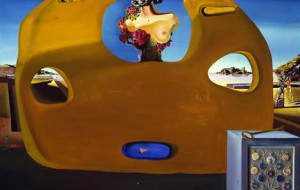
Thanks to Max Weintraub for his considerate and considerable series of posts on Sally Mann, Roxy Paine, Salvador Dali, and the Pictures Generation (don’t miss the lengthy debate that ensued in the comments on this one).
Up next through October 4 is Chicago-based Bryce Dwyer. Bryce is in the final year of the Modern Art History, Theory and Criticism and Arts Administration and Policy graduate program at the School of the Art Institute of Chicago. He spent this past summer in Providence, Rhode Island, researching unconventional residencies at the Alliance of Artists Communities and assembling an archive of AS220′s artists-in-residence program. He is one of the co-directors of the Institute for Community Understanding Between Art and the Everyday (InCUBATE), a research group dedicated to exploring and documenting experimental approaches to arts administration and arts funding. InCUBATE produces and participates in exhibitions, runs a residency program, co-manages a storefront, and puts on public programs. He recently published an essay, “Belgianness and Tactical Nationhood,” in the inaugural issue of Motherwell and, with InCUBATE, will be collaborating with Randall Szott for a public programming series called “In Search of the Mundane” at Chicago’s threewalls in October and November.
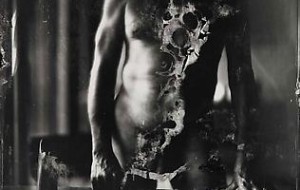
Sally Mann’s “Proud Flesh”

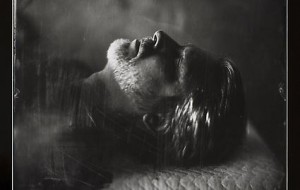
Sally Mann, "Was Ever Love," 2009. Gelatin silver print, 15 x 13 1/2 inches (38.1 x 34.3 cm), Ed. of 5. Courtesy Gagosian Gallery.
“I am not too sure whether I am dreaming or remembering, whether I have lived my life or dreamt it. Memories quite as much as dreams arouse in me the strongest feelings of the unreality and ephemerality of the world.” — Eugene Ionesco, Past Present, Present Past
There are times when Sally Mann’s photographs seem to hover in a state between private dream and shared memory, simultaneously conveying a sense of the personal and the communal within the same pictorial field. This liminal aspect is on full display in Proud Flesh, the artist’s current exhibition at Gagosian Gallery in New York. The show consists of thirty-three photographs by Mann, who has turned her photographic gaze exclusively toward her husband of four decades, Larry.
Using her signature wet-plate collodion photographic process, Mann photographed her husband over a six-year period. Shooting in close-up as he posed nude in her largely unadorned and rustic studio, the resulting images depict fragments of Larry’s naked body—and often little more—in a shallow pictorial space. The simplicity of Mann’s images is balanced by her use of the wet-plate process, which adds a warm tone to the surface of the photographs and leaves a distinctive layer of residual marks, pocks and other imperfections, all of which introduce an air of delicacy and ephemerality to these nude studies.
The outward simplicity of these photographs, however, belies a deeper complexity, for on the one hand, they are intimate studies of her husband’s naked, vulnerable body (Mann has described these images as being “like one big caress”), yet they also somehow remain familiar, accessible. What allows for these otherwise private portraits to read as familiar is, I propose, twofold.
First, Mann’s wet-plate process, and its strong associations with nineteenth-century photography, imbue her photographs of her husband’s body with a sense of a remote yet familiar past. It is as if one were regarding anonymous nineteenth-century photographic portraits in a museum or archive, where the absolute anonymity of the individuals depicted grants a certain freedom and license to the viewer’s scrutinizing gaze.
What further renders Mann’s otherwise intimate photographs readily accessible is their insistently referential, albeit elusive nature. This is to say that alongside the effects of Mann’s technical means, a sensation of vague familiarity is fostered in the photographs by the artist’s particular positioning and cropping of Larry’s naked body. The result is a series of nude studies that register as oddly familiar, referring as they do to Edward Weston’s soft-focus pictorial studies, nineteenth-century postmortem and war photography and, further, to classical tradition, specifically to the statues and statuary fragments of antiquity depicting stoic, dying figures (the titles of Mann’s photographs of her husband abound with evocative references to the antique and especially to classical myth). It is precisely these evocative associations with tradition, but yet to no one source in particular, that lends these intimate and private photographs of Mann’s husband an air of the familiar, public.
What’s Cookin at the Art21 Blog: A Weekly Index
Chill out and stay awhile. Here’s what been going on at the Art21 Blog this week:
- What are Sally Mann, Oliver Herring, Barry McGee, Bruce Nauman, James Turrell, Iñigo Manglano-Ovalle, Mark Dion, Jeff Koons, Ann Hamilton and Shahzia Sikander up to? Trong rounds-them up!
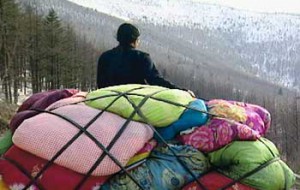
- Maelstrom at the Met | Roxy on the Roof!
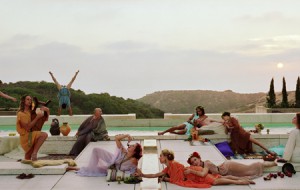
- Gastro Vision: Art of the Pub
- “All the really good ideas I ever had came to me while I was milking a cow.” – Grant Wood. What!?! Joe Fusaro talks about word games in this week’s edition to the column Teaching with Contemporary Art.
- Meet the Season 5 Artist: Allan McCollum
- Low on funds to for to help support your art project? Check out this post: Kickstarting Creative Projects: An Innovative Micro Giving Site, Part 1 of 2; For Part II of this new column visit this link.
- Harrell Fletcher Interviewed by Allan McCollum
- Art21 Video Exclusive – Arturo Herrera | Failure
Arturo Herrera | Failure
DOWNLOAD VIA ITUNES | SUBSCRIBE VIA RSS
EXCLUSIVE: In his Berlin studio, Arturo Herrera discusses the importance of accepting failure in order to be able to learn and grow as an artist.
Arturo Herrera’s work includes collage, work on paper, sculpture, relief, wall painting, photography, and felt wall-hangings. Rooted in the history of abstraction, Herrera’s playful work taps into the viewer’s unconscious, often intertwining fragments of cartoon characters with cut-out shapes and partially obscured images that evoke memory and recollection.
Arturo Herrera is featured in the Season 3 (2005) episode Play of the Art:21—Art in the Twenty-First Century television series on PBS.
VIDEO | Producer: Wesley Miller and Nick Ravich. Interview: Susan Sollins. Camera & Sound: Terry Doe and Leigh Crisp. Editor: Jenny Chiurco. Artwork Courtesy: Arturo Herrera.