Art21 Access ’09 Happenings | Wednesday, October 28, 2009

For complete details on venues and programs, visit http://access.art21.org/find-an-event-near-you/
Wednesday, October 28
8:00am Glen Rock High School (Compassion)
7:00pm Art, Resources and Teaching (A.R.T.) (Systems)
7:00pm Museum of Modern and Contemporary Art (Rijeka, Croatia) (Fantasy)
7:00pm Perpich Center for Arts Education (Compassion)
7:00pm Portland Community College (Systems)
8:00pm EMPAC (Systems)
9:00pm Northern Illinois University, School of Art (Systems)
Art21 Access ’09 Happenings | Tuesday, October 27, 2009

For complete details on venues and programs, visit http://access.art21.org/find-an-event-near-you/
Tuesday, October 27
12:00pm Roswell Museum and Art Center (Systems)
12:15pm Penn State Greater Allegheny (Systems)
5:30pm Sheldon Museum of Art (Compassion)
6:00pm Ahora el Arte tiene Mercado (Compassion)
6:00pm Sheboygan Visual Artists (Systems)
6:00pm Tennessee State University Art Galleries (Compassion)
6:00pm University of Dayton – Art Education (Transformation)
6:00pm Frost Art Museum (Transformation)
6:30pm Ulrich Museum of Art (Systems)
7:00pm Museum of Modern and Contemporary Art (Rijeka, Croatia) (Compassion)
7:30pm Eleanor D. Wilson Museum at Hollins University (Systems)
Weekly Roundup

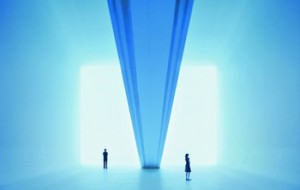
Matthew Ritchie, "Line Shot" Installation (detail), 2009. Courtesy Andrea Rosen Gallery.
- The Brooklyn Academy of Music (BAM) will host a talk with Season 3 artist Matthew Ritchie and brothers Bryce and Aaron Dessner (of indie rock band The National) on Saturday, October 31 at 6pm. The event is held in conjunction with their collaborative performance The Long Count, which opens at BAM on Wednesday, Oct 28. Ritchie’s work is currently on view at Andrea Rosen Gallery in the solo exhibition Line Shot.
- Songs of Ascension by Ann Hamilton (Season 1) and Meredith Monk (also currently at BAM) was featured in a New York Times music review last week. Read the article here.
- For Performa 09, Mike Kelley (Season 1) will present three short dance/performance pieces inspired by his film and video installation Day Is Done (2005). These performances bring to life some of the characters featured in the film, all of whom are based on found photographs of extracurricular activities from American high school yearbooks. Premiering will be Extracurricular Activity Projective Reconstruction #33 (Ladder Piece), a work involving 13 people assembled on and around a large ladder playing music on horns. Kelley’s show runs Nov 17 – Nov 19 at Judson Memorial Church. Purchase tickets here.
- Between Being Born and Dying, a site-specific installation by Barbara Kruger (Season 2), is on view at Lever House through November 21. Bloomberg.com describes the installation: “Kruger’s aphorisms are written in massive black-and-white letters all over the Lever House’s atrium, both inside and outside. They are printed on vinyl panels covering the floor, windows, walls and columns. The results are striking but disorienting. The 17-foot-tall letters are so big you can’t take it all in at once–or at all.”
- Season 2 artist Paul Pfeiffer has created a special project for the 3rd Moscow Biennale of Contemporary Art. The project opens with Vertical Corridor, in which Pfeiffer encourages the viewer to peer through a tiny peephole in the wall of the gallery. The peephole is the only access to an immense space, and questions “the validity of the spectacle … reminding the viewer that every such spectacle must bow to the limits of one’s perspective.” This is the artist’s first solo exhibition in Russia.
- Kara Walker (Season 2) will introduce a screening of the 1926 film Die Abenteuer des Prinzen Achmed (The Adventures of Prince Achmed) at the Museum of Modern Art (MoMA), New York on November 11. Directed by the German animator and film director Lotte Reiniger, it is the earliest feature-length animation still believed to exist, and considered one of the greatest animated films of all time. The program — part of MoMA’s To Save and Project festival — begins at 8pm.
- Season 2 artist Trenton Doyle Hancock will speak at James Cohan Gallery Shanghai on Tuesday, October 27 at 5pm. Two print portfolios Fix (2007) and The Ossifies Theosophied (2005) will be on display in conjunction with the event. Hancock is featured in the exhibition Young Americans at James Cohan Gallery Shanghai through November 15.
- Mirror, Mirror: Contemporary Portraits and the Fugitive Self, a new exhibition at the Brigham Young Museum of Art in Utah, features works by 32 artists, including Oliver Herring (Season 3), Rebecca Campbell, Hasan Elahi, Harrell Fletcher, Douglas Gordon, Nikki Lee, and Takashi Murakami. The exhibition explores the influence of rituals, facades, social media, and the family on the formation of individual identity. On view through May 2010.
- Art critic Tyler Green talks to MoMA curator Connie Butler (organizer of the feminist exhibition, Wack!) about Season 4 artist Nancy Spero, who passed away last week. Read the interview on Green’s blog Modern Art Notes.
- Work by Iñigo Manglano-Ovalle (Season 4) is included in the School of the Art Institute of Chicago exhibition Learning Modern: Bauhaus Legacy in Downtown Chicago. Building on the legacy of László Moholy-Nagy and Ludwig Mies van der Rohe, Learning Modern features projects by artists and architects who continue a legacy of interdisciplinary innovation for better living, while exploring the central role of experiential education in the modern vision. Continues through January 9, 2010.
- Willy Loman: The Rise and Fall, the fifth exhibition of work by Yinka Shonibare MBE (Season 5) at Stephen Friedman Gallery in London, is on view through November 20. The earliest known documentation of a fatal car crash provides a pictorial metaphor for Shonibare’s new body of photographic and sculptural work. Photographed in 1898, the image records death as a spectacle for the first time; a crowd surrounds the carcass of a motor vehicle. Shonibare has created a similar scene in the gallery, a sculptural dramatization of the death of Arthur Miller’s infamous protagonist, salesman Willy Loman. The installation suggests a parallel between Miller’s 20th century examination of greed and the human condition, and the present day.
- Now on view at the San Francisco Museum of Modern Art, Focus on Artists celebrates the museum’s 75th anniversary, and its close ties with modern and contemporary masters as demonstrated by works from their collection. SFMOMA holds a number of sculptures by Season 5 artist Doris Salcedo; pieces from her Unland (1995–98) and Untitled “Cabinet” series (1989-present) will be on view. Continues through May 23, 2010.
- On the occasion of Grey Area, a new work by Season 5 artist Julie Mehretu commissioned by the Deutsche Guggenheim, the current issue of ArtMag (the online art magazine of Deutsche Bank) focuses on artists who investigate urbanism and cultural identity. Joan Young, curator at the Guggenheim Museum, has contributed an essay about Mehretu’s recent work. Read it here.
Scenes from a Globalized Art World
I’d like to start my guest blogging with Art21 by bringing up a series of questions surrounding globalization and artistic representation. My primary research interest is in the art market and the forces that shape it. With a background in cultural studies, I tend to approach the market through multiple lenses—analyzing it through its cultural, economic, and social contexts and impacts. In the next few weeks, I hope to present some interesting talking points surrounding this very issue, explore how arts communities are built, and feature artists working in exciting, new ways.
Not only can art expose the norms and hierarchies of the existing social order, but it can give us the conceptual means to invent another, making what had once seemed utterly impossible entirely realistic.
— Michael Hardt and Antonio Negri, Artforum, October 2009.
Last week, the San Francisco Art Institute hosted a panel discussion titled, “Global Art in the Downturn.” Panelists included Hou Hanru and Carolyn Christov-Bakargiev. My first question upon coming across the announcement was, what is the definition of “global art”? This is exactly the question that was first addressed by moderator, Dominic Willsdon of SFMOMA. The agreed-upon definition during the panel discussion was that “global art” included the genres and forms of art that are more popular across the globe, and that it is work presented in biennials, art fairs, and internationally-known institutions, and publications.
There are no set terms or definitions or categories for the levels at which artwork is produced, but what became clear to me in my two years of researching art world ecosystems for my master’s thesis is that artists make conscious decisions about how they want their work to be seen and by whom. At the same time, their agency is limited or co-opted by other art world players, such as curators and dealers who control access to major institutions and exhibitions.
There is no doubt that globalization, or the more nuanced French term mondialisation, has affected the art world as a whole—from the expansion of new markets, to the ability for artists to more easily travel, explore, and present a wider range of ideas, or to the proliferation of biennials and art fairs. How, then, does defining “global art” as the work endorsed by the international art community affect how non-endorsed works or artists are read within a globalized art scene?
New guest blogger: Kelly Huang

Thanks to Nathan Townes-Anderson for his copious posting and excerpts from all walks of art history. Follow him back on his own site, Nathantown.
Up next is Kelly Huang. Kelly recently completed her master’s in Arts Administration and Policy from the School of the Art Institute of Chicago. Her thesis explored the art world ecosystems of New York and Chicago, and how those structures affect the valuation of artworks and artists. Huang is especially interested in issues of valuation, the global art market, and the relationships between for-profit and non-profit arts organizations. Before returning for her master’s degree, Huang worked as a photo editor for The Atlantic magazine in Washington, DC. There, she participated as a member of the fine arts editorial panel, which led to her overseeing an essay and slideshow on Chinese Contemporary Art by Britta Erickson. Huang has held positions at Carrie Secrist Gallery, the University of Illinois at Chicago’s Gallery 400, and The Renaissance Society. During her time as Visiting Gallery Manager at Gallery 400, Huang co-curated This Shadow is a Bit of Ideology. As a curatorial assistant at The Renaissance Society, Huang assisted on Several Silences and the accompanying catalog. Huang has recently relocated to the SF Bay Area, where she is currently working on independent curatorial and writing projects.
Letter from London: Frieze! Rock!

The Frieze Art Fair, like other kinds of trade fair, isn’t really designed for those outside of the trade it exists to buffer; it’s a bonus if you end up seeing things you like. The organizers’ great trick is to make a trade fair the hub of a weekend of frenetic cultural activity, with big-name museum retrospectives at Tate Modern, the Hayward, and the Serpentine strongarmed into a subsidiary role. Picture an agricultural show or office furniture exposition taking such a commanding presence in the wider culture and you get a sense of the strangeness of the way we experience art now (plus the fact that members of the public paid upwards of £20 to get in). To leaven the outright commercialism of the fair itself, there are the much-vaunted “fringe” events: Club Nutz, a recreation of “the world’s smallest comedy club” in Milwaukee, the SUPERFLEX collective’s series of short films about the financial crisis, experimental/spoken word radio station Resonance FM’s temporary lodgings in the midst of the fair, and Jordan Wolfson’s theoretical physicists discussing string theory at various strategic locations. For all their whimsical appeal, visitors can’t help but sense the sugaring of pills, even while nodding insiderishly at Club Nutz’s techno set played backwards, which sounded like Robocop having a migraine.
Strategically released rumors had it that gallerists were quietly confident about sales, perhaps since many plumped for sure-fire market winners. Current Turbine Hall occupant Miroslaw Balka’s rust-encrusted bric-a-brac popped up several times, as did Emin’s neon scrawls and wall-sized Gilbert and Georges. A lobby-sized Tuymans faced off against a lobby-sized Polke, as if daring collectors to make a choice. Thankfully, not all galleries played it entirely safe. Charles Ray’s hypnotic Moving Wire (1988) at Matthew Marks – aluminium wires slowly protruding from a hole in the wall, quivering under their own weight, then retracting turtleishly back – insisted on a quiet absorption impossible not to give. Jack Strange’s display of MacBooks at Limoncello, each belonging to a different friend of the artist, showed random flippings through their subjects’ iPhoto and iTunes collections, in what was ostensibly a kind of contemporary portraiture but ended up good voyeuristic fun. Art21’s very own Ida Applebroog showed a suite of scary and lush new paintings at Hauser and Wirth alongside a lovely, zinging Mary Heilmann called Some Pretty Colours. Sadly the Heilmann was drowned out by a pair of dirty socks; dumped on the floor in front of the painting, they’re a work by Christoph Buchel. Apparently they reached their asking price of $30,000, lending credence to the truism that a good sign in the art world is literally a sign of insanity in the real one.
Even in a comparatively sober year, Frieze has a carnivalesque brashness about it, and it’s interesting that the major museum shows (of which more next time) that have coincided with the fair’s brief dominance take up the circumspection that is touched upon, if briefly, in the fair itself. At Tate Modern, Miroslaw Balka’s installation in the Turbine Hall – a vast metal room on stilts, accessible by a walkway, whose interior is entirely, pitilessly black, entitled, with weird post-Jacksonian resonance, How It Is – must have been an extraordinarily enveloping experience when first encountered (in other words, in its embryonic press-view state). Sadly, its location sets up certain expectations (light-heartedness, accessibility, interactivity) established by earlier occupants of the site, and the clanging of feet on the metal floor, and the hovering blue squares of mobile phone screens, make it feel like The Buchenwald Experience.
If you’re an artist installing works in an existing museum building, you can either accept the limitations of the space and the collection, or – if you’re Damien Hirst – you can rehang entire galleries in stripy linen to show your latest works to maximum effect. His latest show, entitled, with a characteristic blend of pomposity and unwitting irony, No Love Lost, is a display of paintings made (and this has been used as a selling point, astonishingly) entirely by himself. That they’re weak ’50s Bacon rip-offs knocked out with breathtaking ineptitude is not really the point. The point is that Hirst has been able to wangle decent gallery space inside the Wallace Collection, in the historical collection’s first ever show by a living artist. It’s another example of historical collections’ craven and weak-kneed approach to contemporary art. With an eye on one of Hirst’s gloopy, gloomy skull paintings, you can look through to a Poussin. Guess who looks more conservative, small-souled, and joyless? Go on, guess.
Art21 Access ’09 Happenings | Monday, October 26, 2009

For complete details on venues and programs, visit http://access.art21.org/find-an-event-near-you/
Monday, October 26
9:00am Hallwalls Contemporary Arts Center (Compassion)
12:00pm Borough of Manhattan Community College (Transformation)
12:00pm Parsons the New School for Design (Systems)
4:30pm American University of Sharjah (Transformation)
6:00pm Honolulu Academy of Arts: Academy Art Center (Fantasy)
6:00pm Oklahoma City Museum of Art (Systems)
7:00pm Wired 4 Art (Systems)
What’s Cookin at the Art21 Blog: A Weekly Index

"Baked-Pug-tato-Dog." Source:Costumepop.com
The days are counting down. Are you dressing up for Halloween? How about your dog if you have one? Hmmm….As the wheels turn, here’s what’s been cookin’ over here at Art21:
- Excerpts from I Remember by Joe Brainard, 1975
- Reenacting an artists work: Parallel Stress – Ruth Openheim speaks briefly
- Where in the world are those Art21 artists? Round ‘em up, Nicole!
- In Memoriam: Nancy Spero (1926-2009)
- Concepts Around Interviewing Artists: A Discussion with Glenn Wharton
- In this week’s edition to the column Teaching with Contemporary Art, Joe Fusaro asks: “How do we create environments (in classrooms, studios, museums?) where students feel comfortable enough to try things differently, think differently, perhaps even act differently toward each other? What kinds of things can a teacher do to help create these kinds of spaces?” Read Shape(ing) a Safe Space.
- Florian Maier-Aichen Discusses Myth Making at the Apple Store SoHo
- Douglas Ross’s Vitrine
- The UJ3RK5
- Yours in Food: in this month’s Gastro-Vision, Nicole Caruth takes on John Baldessari
- Exclusive new video! Mary Heilmann on Inspiration
- Guest blogger Nathan Townes-Anderson interviews artist Carl Ostendarp
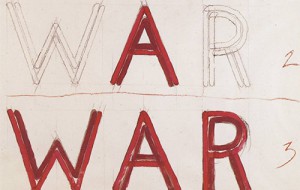
War Is Over! (Part 2)

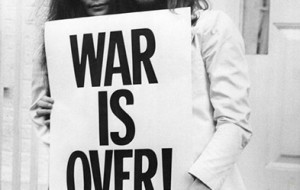
John Lennon and Yoko Ono, "War Is Over!," 2007. Exhibition postcard, 5.5" x 3.5".
WHAT! …an interview with Carl Ostendarp

Carl Ostendarp, "Pulled Up," 2009. Installation view at the RISD Museum of Art, including "Aaarrgh," 2009.
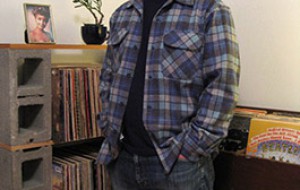
Carl Ostendarp is an artist and teacher based in Ithaca, New York. A survey of his work was shown at Elizabeth Dee Gallery in New York City in 2007. He has also created mural installations at the RISD Museum of Art in Providence in 2009 and the Museum für Moderne Kunst in Frankfurt, Germany in 2007. After admiring his work for some time, I was recently able to ask Carl some questions about his curatorial projects and his interests in music.
Nathan Townes-Anderson: What’s the last rock show you went to?
Carl Ostendarp: I saw Black Dice play not too terribly long ago. It was at an opening party for a friend’s show, crowded and LOUD. The music was great, very physical and thought-killing, but actually the best part was watching people attempting to carry on their conversations, everyone yelling “WHAT!” over and over.
NTA: Rumor is that you don’t listen to CDs too much, but prefer vinyl and tapes…any particular reasons for this?
CO: The tapes and whatever CDs I have were brought in to play during studio classes [at Cornell University]. It makes an atmosphere for the work to go on in and I try to play a fairly wide range of kinds of things and invite the students to contribute as well. It structures the time and precipitates conversations.
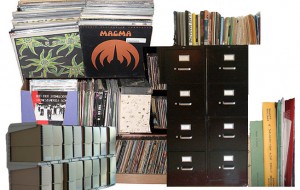
At home, I mostly play vinyl. When I lived in New York, I used to carry a High School/College collection around in milk crates from apartment to apartment, never having space to unload and play them. When my son was about to be born, I realized that I had to pass them on, so I gave them to a friend who had the room and the interest. Then, after moving to Ithaca and renting a small house, I bought a turntable and a few used discs, at first replacing old favorites. Naturally, it’s become a problem which I justify to myself by thinking of medieval Irish monks preserving civilization during the dark ages.
I like the fact that the album (the whole package) is the experience – visual and aural.
NTA: I heard you brought in some LP covers to show some students last year. Which LPs did you end up bringing?
CO: Graham McDougal, a friend and colleague, was teaching a graphic arts course and asked me to bring some records in to show his students as examples of a kind of lost visual language. I remember choosing pretty obvious things: Pedro Bells’ Funkadelic covers, Blue Cheer’s Vincebus Eruptum, Sex Pistols’ Never Mind the Bollocks, Kyuss’ Welcome to Sun Valley—about 25 things in all, pretty much what you’d expect.