


Weekly Roundup

November 30th, 2009
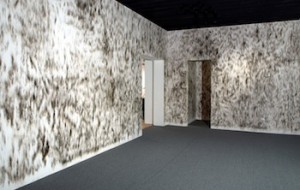
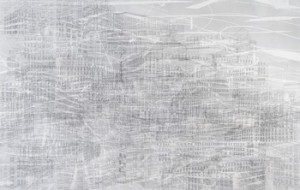
Ann Hamilton, "accountings. soot wall", 2009. Flame-licked walls, dimensions variable. Courtesy Carl Solway Gallery.

Ann Hamilton, "accountings . soot wall", 2009. Flame-licked walls, dimensions variable. Courtesy Carl Solway Gallery.

In this week’s roundup, Art21 artists play with fire, sign new books, design stained glass, collage basketballs, create new films, and pop up in Miami Beach exhibitions:

  • Carl Solway Gallery in Cincinnati is paying homage to installation art with their exhibition Walls, Ceiling & Floors, which focuses on the transformation of space through large-scale works by 15 different artists. Among them is Ohio native Ann Hamilton (Season 1) who has delicately burned walls of the space (pictured above) to “create a dense environment.” Walls, Ceiling & Floors continues through December 23.
  • The Wexner Center in Columbus, Ohio has announced that Mark Bradford (Season 4) is one of three recipients of their 2009-10 Residency Award. Bradford will develop new work for his survey exhibition Mark Bradford: You’re Nobody (Til Somebody Kills You), on view at the Wexner beginning May 8, 2010. His projects will include a new sculpture entitled Lazarus, comprised of more than 1,000 collaged basketballs; Pinocchio, a sound-based sculptural environment that explores the social experiences of a young black man growing up in L.A. in the early 1980s; and the film Mithra, which documents and reflects on his mammoth public sculpture created for Prospect.1 in New Orleans.
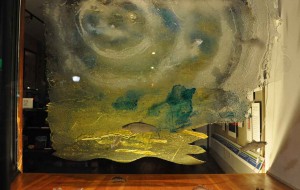
  • Kiki Smith (Season 2) has been commissioned (along with architect Deborah Gans) to design a stained glass window for the Eldridge Street Synagogue on the Lower East Side of Manhattan. Founded in 1887, the original window has been missing since the mid 1940s, when the congregation had it removed due to high maintenance costs. The new window is scheduled for completion in the spring. The New York Times is one of many media outlets to report on this commission; read more about the project on their Arts Beat blog.
  • Paste Up, a survey of early work by Barbara Kruger (Season 1), is on view at Sprueth Magers London through January 23. The title of the exhibition reflects the professional term for the works on view and underscores the influence Kruger’s experience as a magazine editorial designer had on her career.
  • Spazialismo, a group exhibition at Bitforms Gallery in New York City, takes the writings of Argentinian artist Lucio Fontana as its point of departure. Through works by Matthew Ritchie (Season 3), Mel Bochner, R. Luke DuBois, Michael Joaquin Grey, and Yael Kanarek, Fontana’s mid-twentieth century concepts of space in the modern yet natural world are explored. Spazialismo closes December 30.

If you’re in Florida this week for Art Basel Miami Beach (ABMB), here’s a few things to check out:

  • On Thurs., December 3 at noon, the Bass Museum of Art will debut Latin America’s largest private collection of contemporary art; the collection has never before been shown in the United States. Where Do We Go From Here? Selections from La Coleccion Jumex brings together familiar names on the international art circuit, such as Mike Kelley (Season 1) and Urs Fisher, with Mexican conceptualists Damian Ortega, Inaki Bonillas and Stephan Bruggeman. Visitors with a Bass Museum invitation, VIP card, exhibitor’s pass, press pass, or Bass Museum membership card can attend the opening reception on Wed., December 2, 8-10pm.
  • On Fri., December 4, catch up with Schorr at the book launch for Forest and Fields. Volume 2. Blumen. Forest and Fields is an ongoing suite of artist’s books; each volume is part diary, photo annual, palimpsest, and scrapbook. In the latest release, Schorr focuses on arrangements in landscapes and domestic and commercial settings. This program is part of ABMB Salon, an open platform for discussion with an emphasis on current themes in contemporary art. The event begins at 5pm.

Blogalogueing with EcoArtTech

November 30th, 2009
ECO ART TECH

Behold! The experiment begins!

Listen in on our first Systems vs. Networks conversation with Cary Peppermint and Christine Nadir of EcoArtTech…

PS. This is a better spelling of “blogalogueing” right? More of a hybrid of “blog” and “dialogue?” I really am trying to make this word happen.

Audio clip: Adobe Flash Player (version 9 or above) is required to play this audio clip. Download the latest version here. You also need to have JavaScript enabled in your browser.

…or listen to individual questions and answers after the jump.

Continue reading »

Virtual Artists’ Immersive Discoveries in a Virtual 3D Frontier

November 30th, 2009

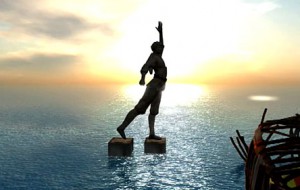
Cao Fei: RMB City. "Art in the Twenty-First Century," production still, 2009. Season 5, Episode: "Fantasy." © Art21, Inc. 2009.

Cao Fei, RMB City. Art in the Twenty-First Century, production still, 2009. Season 5, Episode: Fantasy. © Art21, Inc. 2009.

William Saroyan wrote: The role of art is to make a world which can be inhabited.

Virtual art had its debut in a cave at Twin Rivers near Lusaka, Zambia, about 35,000 years ago, with two dimensional images of Stone Age man in his elemental environment, his world. Before it became synonymous with the digital realm, virtual meant existing in the mind, especially as a product of the imagination. Virtual can refer to things that mimic their “real” equivalents and it denotes work that is realized or carried out chiefly in an electronic medium. Virtual art goes beyond these definitions in Second Life. Second Life, or SL, is an online, virtual world where the use of 3D objects called prims creates the illusion of the third dimension on the two-dimensional surface of the computer’s screen. Observers become immersed, as 3D avatars that can freely move within a world that transcends physical constraints and traditional concepts of time and space. Virtual 3D art exists beyond the surface upon which it’s created, or the screen on which it’s displayed. Virtual 3D art exists in a world that is inhabited and where the viewer, embodied as an avatar, becomes immersed.

In other words, to truly experience immersive, virtual 3D art you have to go there.

I interviewed several artists who are early adopters of the online, virtual 3D world of Second Life. Second Life art ranges from scanned copies of public-domain works to primmed 3D paintings and complex kinetic sculptures that could only exist in perceptually immersive 3D space. These artists have already experienced varying degrees of success in “first life.” DanCoyote Antonelli (DC Spensley in material space) gave me a tour of his algorithmic, interactive, and immersive SL creations that purposefully reject anything that is inherently referential to the physical world.

DanCoyote Antonelli

DanCoyote Antonelli, details from Visions of Global Justice Installation. USC Annenberg School for Communication Network Culture Project, 2008. © All rights reserved.

DanCoyote Antonelli: My earliest work is four years old and embodies the conflict between modernism and post-modernism. What comes after postmodernism? Modernist Marvel, a tongue and cheek homage to modernist architecture, is actually a user interface that guides visitors through a number of algorithmic artworks from the early 2000s in QuickTime virtual reality that are mapped onto prims. Another site-specific work, entitled Hostile Space, explores the personal space of the avatar and demonstrates hyperformalism—a term derived from the combination of the words hyper (as in hypertext) and formalism (in the platonic sense) and is being used here to describe aesthetic self-expression without anthropomorphic, or representative context.

Simply put, virtual worlds offer many of the same benefits of physically visiting an art museum or gallery space, with the extra benefit of network transportability as well as the power of scripting aesthetic and conceptually compelling behaviors that are embedded in the environment.

Continue reading »

Exploring the Makeshift Landscape

November 30th, 2009
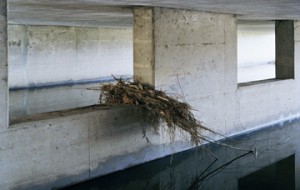
Eirik Johnson, "Untitled 2003 (#2 debris under the bridge)," 2003, from the series "Borderlands"

Eirik Johnson, Untitled 2003 (#2 debris under the bridge), 2003, from the series Borderlands

We invited photographer Eirik Johnson to write about his ongoing exploration of humankind’s environmental impact.  Works in his most recent series, Sawdust Mountain, are on view at the Henry Art Gallery through January 31, 2009. — Ed.

I have an insatiable curiosity. I think that’s why I became an artist and in particular, a photographer.  As a young boy, I would explore the urban woods near my family house in Seattle, WA.  The tangle of fir trees, bushes, and ferns were a testing ground for imaginary expeditions and fort building techniques. I liked the messiness of nature. I dug up earthworms, watched crows flock overhead, picked blackberries, felt the rain fall from the cedar branches above. Looking back now, these early childhood experiences in the landscape have become a constant source of inspiration for my creative work.

My series Borderlands sprang from a desire to look again at these urban wilds, where natural and manmade changes to the landscape conflate and create something new.  These are makeshift spaces, where flooded rivers deposited debris along freeway columns, where sweaters are tied together to mark out someone’s encampment, where a lightning sparked fire chars the view behind an office park.

Eirik Johnson, "Berkeley, CA 01," 2006, from the series "Animal Holes"

Eirik Johnson, Berkeley, CA 01, 2006, from the series Animal Holes

There is something sad about these landscapes. They are, after all, located in the neglected empty space which exists between public and private land. Yet, these spaces also offer a constant reminder of the resilience of nature.  This theme of ecology adapting to change was what inspired my next project, Animal Holes. It was on one of my urban expeditions along an old landfill in California that I came upon a warren of feral jack rabbit holes.  What caught my eye was that in burrowing their holes, the rabbits had also unearthed piles of jewel-like treasures from the landfill below.  Bits of rusted metal, rubber hose, and iridescent glass sat like offerings in front of each black hole. The animal holes embodied the idea of the makeshift landscape on a micro-scale, a sort of intimate epilogue to the Borderlands project.

Over the last four years, I have turned my attention back to the Northwest to make work specifically addressing the complicated relationship between the region’s landscape, industries that rely upon natural resources, and the communities they support.  As with my earlier projects, this work has its origins in childhood memories. When I was young, my family would hunt for mushrooms in the forests of the Cascade and Olympic Mountains. Some days we would spend afternoons along the shallows of a river watching salmon fight their way to spawning grounds upstream. These were the icons of the region: forest and salmon, pillars of Northwest identity.

Continue reading »

Inside the Artist’s Studio: Lisa Bradley

November 27th, 2009
lisastudioRSfin

Lisa Bradley at her brand new studio space in Brooklyn, NY.

Detroiter by birth and New York-raised, Lisa Bradley is an artist based in Brooklyn, NY. She earned a Bachelor’s degree in Sculpture & Extended Media from Virginia Commonwealth University in 2001, and an MFA from the School of the Art Institute of Chicago in 2004. That same year, Lisa was a studio fellow in the Whitney Independent Study Program. She received a Professional Development Fellowship from the National Endowment for the Arts in 2004, and in 2005 held a visiting professorship in sculpture at the Tyler School of Art in Philadelphia. In 2006, Lisa moved to London to collaborate with a group of UK artists, and then completed an MA in Art & Media Practice at the University of Westminster in 2007. While residing in London, she received an artist’s commission from Whitechapel Gallery, and was also artist-in-residence there from 2008-09. Bradley has recently returned to the US and currently resides between New York and London, where she is completing a PhD in Visual Culture.

Inside the Artist’s Studio has given me the opportunity to reconnect with Lisa on the occasion of her return back to the States. She is one classy young woman whose political consciousness goes hand-in-hand with her work. Lisa is not an art producer but rather an art thinker with a clear voice – a voice that she makes heard when the time is right.

I enjoyed working with Lisa on this post a lot. It is my pleasure to introduce to you, Lisa Bradley.

Georgia Kotretsos: After living and working for three years in London, you’re back in Brooklyn, NY. How did you find the art scene in London and why did you move there in the first place?

Lisa Bradley: I’d describe London’s scene as difficult to penetrate – not that I was even trying to. I was there trying to work out stuff I had going on within myself. Yet I got the sense that Americans, all Americans, were viewed as being very brash, opportunistic, and careerist. If I were any of those things, I’d be rich and famous by now!

But I think the fact that I was there, I was American, and I was an artist made people, especially other artists, wonder what I wanted. It’s a small country and maybe the size breeds defensiveness. Also, I think the UK is going through a period when it feels very “invaded”: as if everyone from everywhere else is coming to take what it has. Possibly because it did this to other countries and is experiencing the big payback! Whatever the case, I didn’t connect with very many artists there; people do want to visit your studios, but, oh no, you can’t come to theirs!

I was really hoping to collaborate with other artists, but the attempts weren’t productive because of what I felt was this fundamental “closedness.” It’s the most international city in the world, but I discovered that being “foreign” and “American” are not the same thing! It was a huge stroke of luck to connect with the curators at Whitechapel, who were excited about my work and liked my ideas. Usually opportunities like this have come through other artists, but this one didn’t. I went there to apply for a part-time job and had a conversation that led to me applying as an artist-in-residence.

I moved to London in September 2006 primarily because of my profound disappointment with the political climate in the US. Bush had somehow landed in the White House again, and things were continuing to deteriorate at a level I’d not seen in my lifetime. Then Katrina happened in August 2005. At that point, the mask was ripped off: American racism was displaying its core. The news media was using terms like “refugee” to describe American citizens whose ancestors literally had this country built upon their backs, and though I know America like the back of my hand, I was shocked. I felt powerless and furious and needed to step back from the US and look at it from a distance. In retrospect, I see that my second reason for leaving was related to that same idea of distance. I think artists really do need to move around a bit and look at things from different angles. It was immensely significant for my practice.

Continue reading »

Blogalog, Part 1: About EcoArtTech

November 26th, 2009

Cary Peppermint and Christine Nadir founded EcoArtTech as their collaborative platform for digital environmental art in 2005. They are 2009 Artist Fellowship recipients from the New York Foundation for the Arts (NYFA).

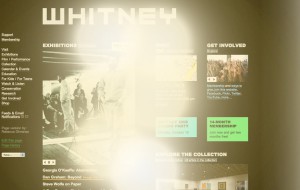
Their most recent work is a commissioned series for the Whitney Museum of American Art, the first of which can be found here. Untitled Landscape #5 disrupts the Whitney’s site at sunrise and sunset with glowing orbs who’s size and velocity is directly affected by the volume of visitations to whitney.org since the previous sunrise (for sunset) or sunset (for sunrise).

untitledlandscape5_whitney

Other recent works include Eclipse, 2009, commissioned by Turbulence.org. Eclipse is described as a “user-driven artwork-application that alters and corrupts networked photostreams of United States national and state parks based on real-time Air Quality Index (particle pollution data).” So basically, the worse the air quality at the park that day, the more distorted the picture will appear in your personal web browser. Check out these pictures below to see the work in action…

Continue reading »

Sustainable Architecture: Style vs. Substance

November 25th, 2009
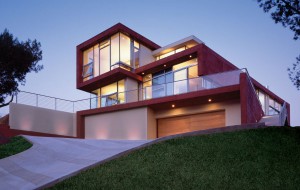
Stephen Kanner, Malibu 5 House, Malibu, CA, 2008

Stephen Kanner, Malibu 5 House, Malibu, CA, 2008

Sustainable architecture is in danger. This might sound like a surprising claim, given the fact that never before has “green” living been such a popular concept, nor has “eco-consciousness” been so en vogue. Yet the trendiness of green living is exactly what imperils it; as a trend, sustainability runs the risk of lapsing out of style, a fad that can go out of fashion as easily as it came in (if Brad Pitt’s interest in green architecture wanes, will ours?).

One of the greatest difficulties of discussing sustainable architecture is that there is no single definition of the idea to start with. Some groups characterize it as design which foregrounds energy efficiency as a concern, using passive solar design or alternative energy sources; some describe it as architecture that uses alternative materials, frequently local, recycled, or reclaimed; still others consider it to be building that highlights a general attitude of environmental consciousness. Obviously, such guidelines are fuzzy at best. My worry is that, given this laxity in defining sustainable design, we must resort to parameters most famously defined by Justice Potter Stewart in reference to pornography: when it comes to sustainable building, we might think we know it when we see it.

Take Stephen Kanner’s Malibu 5 house, for example. This 3,500-square-foot house, located in a posh Malibu neighborhood, faces the Pacific Ocean and features a number of sustainable elements—recycled materials; reduced energy consumption; passive heating and lighting using the sun as the primary source; and air conditioning from the California breeze. The roof is fitted with photovoltaic and solar panels to provide hot water and off-the-grid power. The structure’s two main volumes, both C-shaped in plan, are separated by a courtyard, and the interior spaces open on at least two sides to facilitate cross-ventilation. The home is wrapped in low-emittance, argon-filled windows to curtail heat loss and gain and to flood interiors with natural light.

So, sustainable indeed. But as much as Malibu 5 adheres to a commendable green program, it is also concerned—like much elite sustainable architecture under construction today—with announcing its sustainability through its appearance. It lets us know, with its minimalist forms, with its unornamented surfaces, with its geometric, modernist composition, that its inhabitants are as fashionable as the architecture they selected for their home (and I still can’t help but wonder what anyone does with 3,500 square feet of living space).

Continue reading »

Making It Happen

November 25th, 2009

Blogalogue Mania Sweeps the Nation!

I have “email balls.” I sit behind my computer screen, protected by a Gmail-cloak of anonymity and I email whomever, whenever, whatever. I landed my first job out of college by emailing a woman I saw on a NY street style blog to compliment her on her killer heels; three months later I was interviewing to be her personal assistant. After finishing a book I recently enjoyed, I did a quick Google search for the author’s contact info and sent a light-hearted message asking for career advice; shortly thereafter I found myself at Stumptown coffee with two espressos and the author/artist Luis Camnitzer. In short, I will email anyone, anywhere—from my cousin in communist Cuba to scholars at the tops of their fields—without fear or trepidation.

And it’s all very ironic, because in real life I’m a bundle of nerves. Most days I barely have the courage to let my Starbucks barista know that I keep asking for my tea with sweetener and she keeps making it for me without. Friends seriously jokingly call me a hamster because, like said animal, I’m small and anxious and if you picked me up you’d feel my whole body shake with worry. Thankfully, unlike said animal, I do not urinate in the same vicinity of where I sleep…but I digress. Email enables me to inhabit a bolder version of myself, opening up a number of opportunities that I might have never pursued in the flesh…and it is this facet of my personality that has factored heavily in the direction I want to take in my time here with Art21.

It all started one day, not so many moons ago, when I was riding the train into NYC and my gaze settled upon a particular advertisement poster. It might have been a poster for Reuters or Bloomberg or some other financially-minded whatever; that part doesn’t matter, because what I got from the poster was that I don’t know the difference between “systems” and “networks.” This bothered me, because I generally consider myself quite good with words, yet I could not arrive at one simple, distinguishable difference between “systems” and “networks.” Before getting off the train I made a note about my quandary (toot toot! SAT word!) and carried on with my business.

A few months later, when it came time for me to be Art21′s blogger-in-residence, I had a sudden epiphany. I had watched the Art21 Systems episode and was reminded of my still-open-ended question regarding “systems versus networks.” I began to ask a few friends what their take was on the dispute, and the reaction across the board was one of shrugged shoulders and convenient subject changes. Dismayed (but not disheartened!) by my lack of results, I carried on with more resolve, asking most everyone I knew and utilizing almost every resource available to me. Still, I had nothing.

Continue reading »

If the Shoe Fits, Pay For It

November 25th, 2009

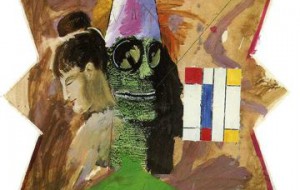
Mike Kelley, "Painting with Hawaiian Mask, Ballerina, and De Stijl Painting" 1976, Courtesy Jablonka Galerie, Cologne

Mike Kelley, "Painting with Hawaiian Mask, Ballerina, and De Stijl Painting" 1976, Courtesy Jablonka Galerie, Cologne

I taught visual art in New York City for 13 years from 1990-2003. A majority of that time was spent in middle school classrooms and most of us received something called “Teachers Choice” each year. It was basically a way to buy supplies for our classroom and was considered the main source of funding for paper, paint, clay, etc. Whatever we needed to make our classrooms functional.

When I left New York City in 2003, the Teachers Choice program was giving teachers about $220 per year for supplies (it has since skyrocketed to $260). I had a few hundred kids to teach and was expected to buy a year’s worth of supplies for less than $250. Between the standardized testing craze that was, and still is, literally sweeping public schools off their collective feet, and the fact that I had to hold a bake sale (check that… sales) to purchase some of the things I needed, I knew that the New York City Public Schools had missed the boat somehow. One of the greatest cities in the world with a colossal number of theaters, museums, galleries, concert halls and performance spaces was giving art teachers less than $250 per year to purchase art supplies for a classroom??

Last month, the Center for Arts Education released a report stating that, “In New York City, the cultural capital of the world, public school students do not enjoy equal access to an arts education. In fact, schools with the lowest graduation rates- where the arts could have the greatest impact- students have the least opportunity to participate in arts learning.”

The report goes on to state that in 2007-2008 close to one-third of all New York City schools had no certified arts teachers on staff and that there was a 63 percent decline in spending on arts supplies from the previous year.

What I find interesting about these two stories- my brief reflection on Teachers Choice and the report from the Center for Arts Education- is that both shine floodlights on the fact that funding the arts in New York City public schools is dismal at best. Don’t get me wrong, there are a few schools out there who actually devote more of their budget to the arts, beyond that of Teachers Choice and bake sales. But for the most part, a school’s budget allocation for arts programs stands at 2.9 percent on average, according to the Center for Arts Education report. That means schools devote less than 3 percent of the total money they have available each year for funding their arts curriculum and programs, if they have an arts curriculum or program at all (currently, 7 percent of elementary schools and 9 percent of middle schools in New York City have no arts education at all, which is completely out of compliance with state regulations).

The conclusion of the Center for Arts Education report makes several policy recommendations for New York City schools, including:

  • Expand course offerings in the arts
  • Ensure that all schools have certified arts teachers
  • Expand student access to the city’s cultural arts sector
  • Require adequate classroom space for arts instruction

The problem is that each of the above recommendations, as well as others, requires New York City to make hard choices about how to truly begin acknowledging and financially supporting arts education. Still, there’s a part of me, the part that wears the rose-colored glasses, that says NOW is the time, in the midst of an economic downturn, to begin making a stronger case for increased funding and compliance with state regulations. Now is the time because when the economy is in a better state money will eventually be available and we want to be ready to reinforce what art educators have been saying for a long time: The shoe does fit, and yes, we have to pay for it.

Weekly Roundup

November 23rd, 2009
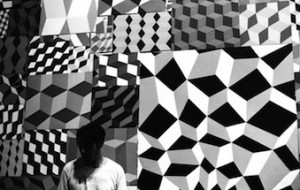
Barry McGee stands in front of one of his geometric creations at Prism Gallery. Courtesy Wallpaper.com.

Art21 artist Barry McGee stands in front of one of his geometric creations. Courtesy Wallpaper.com.

From the west to the east coast and over to Taiwan, Art21 artists are involved in a number of new and large-scale exhibitions:

  • Works by Barry McGee (Season 1) and Philip Frost are the focus of mindthegap, the inaugural exhibition of Prism, a three story gallery located on the Sunset Strip in Los Angeles. Curated by P.M. Tenore, founder of RVCA clothing company and the associated publication ANP Quarterly, the display includes embellished baseball bat and surf board sculptures, paintings, film and interactive installations. Flip through images of the show at Wallpaper.com.
  • Days and Giorni, two sound installations by Season 1 artist Bruce Nauman, are on view at The Philadelphia Museum of Art (PMA) through April 4, 2010. These works made their international debut in Bruce Nauman: Topological Gardens, the exhibition organized by PMA in conjunction with the Universitá Iuav di Venezia and the Universitá Ca’ Foscari di Venezia, to represent the United States in the 53rd Venice Biennale. Days and Giorni at PMA marks the first time in seven years that Nauman is showing new major installations in the United States. Film and video works made by the artist in the late 1960s — Dance or Exercise on the Perimeter of a Square (Square Dance); Slow Angle Walk (Beckett Walk); and Wall-Floor Positions — are also on view.
  • In more Philly news, the PMA and the Fabric Workshop and Museum (FWM) will present Fallen Blossoms, a multi-site exhibition of works by Cai Guo-Qiang (Season 3). A series of four gunpowder drawings and a sculptural installation will be on view inside the PMA in a presentation titled Light Passage. Two newly commissioned works, Time Flies Like a Weaving Shuttle and Time Scroll, will be on display at FWM. One of Cai’s signature “explosion events” has been commissioned for the exhibition and will take place at both sites on opening day, December 11.
  • Hanging Out in the Museum is Cai’s second collaboration with the Taipei Fine Arts Museum in Taiwan. The retrospective exhibition features new gunpowder drawings, and the site specific installation Cultural Melting Bath (1997), which invites audiences to join a medicinal bath located in the museum’s outdoor courtyard. Hanging Out in the Museum remains on view through February 1, 2010.
  • Cleveland Cavaliers center Shaquille O’Neal has added curatorial work to his resume. His forthcoming exhibition Size DOES Matter will explore the idea of scale in contemporary art through works by Tim Hawkinson, Paul Pfeiffer (both Season 2), Fred Wilson (Season 3), Jeff Koons, and Yinka Shonibare MBE (both Season 5), among others. Hosted by the Flag Art Foundation in New York, the exhibition is scheduled to open February 19, 2010. In Lindsay Pollock’s report for Bloomberg News, O’Neal says, “As a curator, I have a responsibility to the artists, who are my ‘teammates.’ We all have to make each other look good — no different than what I do on the court.’’
  • The new home of the Museum of Chinese in America (MOCA) — designed by Season 2 artist Maya Lin — opened to the public in September. The 14,000 square-foot space incorporates environmentally sustainable design solutions, and features a sky-lit courtyard that “harkens back to the memory of a traditional Chinese courtyard house.” Lin says, “MOCA’s new space focuses attention on individuals and families of Chinese heritage who have made their homes throughout the country, and who are very much a part of the fabric of this nation. The space was designed to show the dynamic presentation of the Chinese American story, as an integral part of the greater, and continually evolving, American story.” Read more about MOCA’s new building here.
  • Season 1 artist Richard Serra is included in the group exhibition 1969 at P.S.1 Contemporary Art Center in Long Island City, New York. Serra’s work was highlighted (along with Nauman’s) in Peter Schjeldahl’s review for The New Yorker. Schjeldahl states, “The year’s most original artists were the post-minimalists Bruce Nauman and Richard Serra…Nauman and Serra addressed a culture in which “artist” was becoming a job description, at once secure and drained of meaning. Having nothing to do, but having to do something, they made the situation clear and just a little bit dramatic.” Read the entire review here.