Performative Interventions: The Progression of 4D Art in a Virtual 3D World

December 31st, 2009

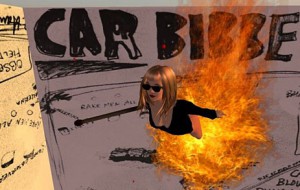
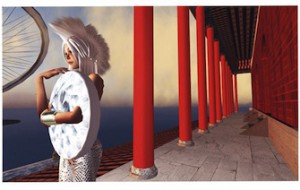
Still from the performance, "Car Bibbe 2," based on a script by Al Hansen, and featuring the avatar of Bibbe Hansen. Second Front, 2008.

Still from the performance, Car Bibbe 2, based on a script by Al Hansen, and featuring the avatar of Bibbe Hansen. Second Front, 2008. © All rights reserved.

“Time” is always present in our interaction with works of art, whether we sit to contemplate a painting, stroll past a sculpture, or watch a video piece for its entire duration or cycle. Some works of art are time-based in that the viewer must experience them through the passage of time, as with music, while others refer to time through links or references to art history, our collective human history, or the timelessness of nature.
Art:21—Art in the Twenty-First Century, Season 2, Episode: Time

Art in the twenty-first century, reflecting and defining new developments in a variety of areas, has radically extended the conventional media of time-based, or 4D work. Following Virtual Artists’ Immersive Discoveries in a Virtual 3D Frontier, I interviewed several Second Life artists who evoke time in their work.

Second Life artists are exploring how to captivate, or use the element of time to interact with an active audience. They have abandoned strict adherence to traditional hierarchies of art and embraced the virtual. In the past fifty years especially, ideas about time have shifted from passive to interactive and, currently, to perceptually immersive, via filmmaking and animation, the theatricality of performance, and virtual reality. This post highlights early visionaries in Second Life who are re-imagining how immersive 3D space can change, or transform 4D art.

Machinima (muh-sheen-eh-mah) is the convergence of filmmaking, animation and game development. It uses real-world filmmaking techniques that are applied within an interactive, immersive 3D space where characters and events can be either controlled by humans or scripts. In Second Life, the actors are avatars in the scene, and the computer (via screen capture software) doubles as the camera, recording everything that happens in the virtual world. It connotes the artistic and performative, or the collaborative action of artist and computer. [The Second Life elements from the Art:21 segment on Cao Fei were filmed using machinima methods. —Ed.]

Continue reading »

Top 10 of 2009: Entertainers Who Moonlight as Artists

December 31st, 2009
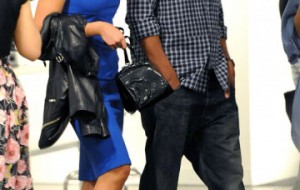
Beyonce and Jay-Z at Art Basel Miami

Singer and sometime-painter Beyoncé, with husband Jay-Z, at Art Basel Miami. Courtesy BeyonceWorld.net

In the spirit of my Los Angeles beat, I present to you the most exciting art world interlopers to come out of Hollywood in 2009:

10. Sylvester Stallone is making a comeback, and I’m not talking about Rocky XIV.  The media has been all over “Sly” since he presented a group of paintings at Art Basel Miami earlier this month.  Though he has been painting for over 30 years, the show mounted by Gmurzynska Gallery marked first public exhibition of Stallone’s art, and his squiggle-encrusted canvases were snapped up to the tune of $50,000.  Though he paints in his garage, the action star is no hobbyist.  He told the Daily Mail, “‘I’m not just painting for painting’s sake. I want to be truthful.”

Sylvester Stallone poses with one of his paintings at Miami Basel, Dec. 2, 2009. Courtesy BigPicturesPhoto.com

Sylvester Stallone poses with one of his paintings at Miami Basel, Dec. 2, 2009. Courtesy BigPicturesPhoto.com

9. Jane Seymour‘s frontier-exploring days did not end when Dr. Quinn, Medicine Woman went off the air back in 1998.  Her pioneering has continued, as she has taken on writing, jewelry design, skin care, and most notably, painting.  I always thought Dr. Quinn was kind of a rebel, and I wish that Seymour would channel that maverick spirit to bring some more edge to her Mary Cassatt knockoffs.

Jane Seymour at her easel, 2009. Courtesy LehighValleyLive.com Jane Seymour at her easel, 2009. Image Courtesy of LehighValleyLive.com

Jane Seymour at her easel, 2009. Courtesy LehighValleyLive.com

8. Starlet Kat Dennings has gained a following in the blogosphere, with her revealing, quirky musings on katdennings.com.  Sharing personal thoughts publicly is not so unusual for her ilk of young actresses – the Mileys and Britneys all seem to embrace zany candor via Twitter and personal websites. But Dennings, unlike the others, also uses her blog as a platform to present drawings and collages crafted on MS Paint. While the images are a bit too charming for their own good, it’s difficult to resist the gravitational pull of Space Grits.

7. “When Art Imitates Life” is a new company whose business model is based completely on the phenomenon that art made by mainstream celebrities sells, and their mission is to help famous hip-hop artists create visual art. For its maiden voyage,  W.A.I.L. has worked throughout 2009 with Wu Tang’s RZA to create a “massive” painting that commemorates the rapper’s 20 year music career.  But RZA believes the painting’s message reaches much further, stating that, “It didn’t begin 20 years ago…more like 200 years ago…We’re about to rewrite and change history.” On January 1, 2010, the painting Victory or Death, will be “released,” and 360 prints will be made available to the public.

Continue reading »

Gastro-Vision: The Year in Meat

December 30th, 2009

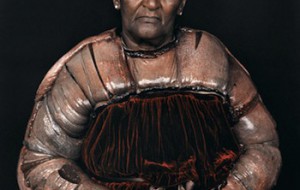
Pinar Yolacan, "Untitled (PYM4.22)," 2007, C-print, 40" x 30", edition of 6. Courtesy the Artist (via Rivington Arms).

Last year’s group exhibition Meat After Meat Joy at Daneyal Mahmood Gallery left a lasting impression on me — I still can’t shake the suffocating, putrid smell of rotting meat. As a vegetarian, I suppose my preexisting sensitivity to the content played a role in that. Be that as it may, the exhibition (a truly good show) has made me especially cognizant of all things meat this year, and there were quite a few of them. Here’s a look back at some meaty moments in 2009:

Dressed with Kill

Whereas Pinar Yolacan’s work could easily have gone unnoticed in the aforementioned exhibition, her presence was felt this year in Dress Codes, the third triennial of the International Center of Photography. Her portraits of Afro-Brazilian women were highlights of an all around impressive installation of photographs and video. Stitching together sumptuous velvets and silks with slimy gizzards and chunks of animal protein, her costumes appeared to drip from and restrain her sitters. Vile and picturesque, slaughtered and oddly seamless, her compositions give new meaning to “raw beauty.”

"Spiral Jetty Burger", 2009. Courtesy Cmonstah.

"Spiral Jetty Burger," The Laundromat Gallery, 2009. Caption: "Sadly, the Robert Smithson, by Jonathan Allmaier was less Spiral Jetty and more Paul McCarthy meets Andres Serrano. It was, nonetheless, very good.” Courtesy C-Monster.net.

Burgers en Masse

Epicurious predicts that burgers will be on the back burner in 2010, though they were haute (in art) in 2009. In August, C-Monster (once a guest blogger of Art21) captured The ‘Burger’ Group Show at The Laundromat Gallery. For this conceptual cookout artists grilled homages to Roberts Smithson and Motherwell; a high-rising whopper for Rachel Harrison; and a couple of Spanish masterpieces (with blue cheese) among other beefy works. I can’t say I would have partaken in this eat-zibit, but after scrolling through these masterful creations, seitan looked awfully boring.

Bruce High Quality Foundation, "Die Burger" (detail), 2009. Courtesy Eat Me Daily. Photo: Elizabeth Jones/Eat Me Daily.

At Art Basel Miami Beach, Eat Me Daily caught wind of the Bruce High Quality Foundation installation Die Burger: a modified video of Warhol eating sliders, and a display of Beuysian mac multiples with meat patties made of felt, cheese slices of lard, and real Burger King buns. On that note:

Continue reading »

Bringing it Back Home

December 30th, 2009

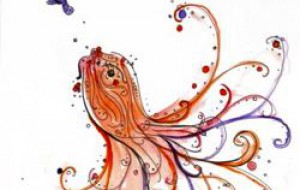
Illustration by Lauren Beltramo

December, January, May, June…. These are popular months for graduates to visit their former high schools because they are either between semesters at college or finished for the school year altogether. While it took me a while to go back to my old high school (to the tune of approximately a decade), I am fortunate to have a crew of truly interesting and dedicated students who regularly come back to visit our Art department.

Last week, right before we went on holiday break, Lauren Beltramo, one of our amazing and dedicated graduates, came by to visit with my AP Studio Art class to talk about life in her first semester at Drexel University. She shared some recent work and also gave everyone a peek at a few pieces she is exhibiting for a group show here in NY at the GAGA Arts Center next month. Students asked questions about the difference between high school art classes and college classes (length was a popular point in the discussion… you can get a lot more done in 3 hours than you can in 45 minutes, obviously), as well as the inspiration for a variety of her works.

Having students come back to team teach, share stories and successes, and continue to maintain important connections is vital to the life of all art programs- whether you teach middle school, high school or college. Having students come back to discuss the work they’re creating and the directions they’re heading not only keeps us in the loop, but also serves as an important model for current students. These students get to see and hear about what happens “after”. The months of December and January are particularly good times to tap into those graduates who are home and able to share their experiences since graduating, whether they are attending college, working at a particular job, or even “in-between” and making decisions about their own next steps in life.

Looking At Los Angeles: Against The Deluge

December 30th, 2009

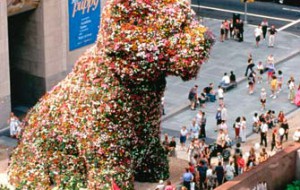
Jeff Koons, "Puppy," June 6 - September 5, 2000, steel, soil, plants, Rockefeller Center

Looking back before moving forward is such an endearing habit—like brushing your teeth before breakfast—that it’s hard to resent the sweeping, often grandiloquent judgments that accompany the end of each year (last year,  when Daniel Birnbaum called a documentary by Alexander Kluge “a labyrinth as absorbing as any great cultural work of the past century,”  I was more than willing to embrace the hyperbolic praise as truth). But now, at the close of a decade in which art often moonlighted as a  history project and calculated reticence often seemed more provocative than raw expression, looking back seems especially difficult because looking back is what much of the decade’s art tried to do.

Charged with the thorny task of reviewing ten years’ worth of art, critic Jerry Saltz came up with a strange combination of showmanship and doom. Writing in New York Magazine, he pinpointed Jeff Koons‘s towering, endearingly overstuffed Puppy (the version that debuted at Rockefeller Center in June 2000) as the decade’s turning point, an artifact from the last days of ‘the end of history.’” Appearing a year before 9/11, Koons’s sculpture was an over-ambitious attempt to make guilelessness monumental. It embodied a lighthearted moment of spectacle that would begin to lose its footing (even though as it continued to hold its own in art markets). Puppy, according to Saltz, “laid a beautiful, ghastly laurel wreath at our doorstep. If it could speak, it would say, ‘After me, the deluge.’”

But if Koons’s flower-coated monster represented the end of a certain kind of spectacle (and I think Saltz is right in suggesting that it did, though misguided, perhaps, in the esteem he awards it), then it’s the art that came after Puppy that deserves attention. The decade should belong to artists who saw the supposed deluge as a reason to stop trying to make history and start rephrasing, breaking apart, and rearranging their cultural heritage, freeing repressed fragments of meaning in hopes of informing an unknown future.

Collier Schoor, "Jens F."

Collier Schorr, "Jens F.," 2005

Collier Schorr’s Jens F. project still stands out to me as an eloquent example of this sort of rephrasing. Schorr (Season 2) restaged Andrew Wyeth’s portraits of his muse Helga, placing an adolescent boy in feminine poses, subtly turning his body in ways that seemed difficult and unnatural. She treated appropriation, not as something transgressive, but as something tenderly introspective and revealing. Another example, Elad Lassry’s self-described post-picture generation work, is fugitive in that it liberally borrows from commercial iconography. But it’s professional in its sleek, minimal distillation of the ideologies latent in each image. For Lassry and for Schorr, wading through our lineage of cultural imagery isn’t just a prerequisite to moving forward; it’s actually a way of interacting with present and future.

Kristen Morgin, "Cello #3" (detail), unfired clay, wood, wire, 2001. Courtesy Marc Selwyn Fine Art.

Fittingly enough, Los Angeles has ended the decade with its galleries and museums brimming with art that looks back. At LACMA, a whole exhibition of landscape photography from 1975—New Topographics—has been rephrased. The motivation: simply acknowledging art’s “ongoing concern for man’s use of the land.” On the second floor of Steve Turner Contemporary, Amir Zaki collected antique images, spanning from 1870-1950, of Southern California’s evolution, curating a mini-visual history. At Blum & Poe, Drew Heitzler has remixed films from the ‘60s, removing the narrative arc in order to emphasize strange movements and interactions that plot once repressed.

Continue reading »

Art21 Guest Blog Year 2

December 29th, 2009

This being the last week of 2009, it is time for our annual year in review. 2 weeks ago, we gave you a sneak preview with a guide to our second year of Art21 Exclusives. For the rest of the week, we’ll be bringing you our top picks for the year – from within the pages of this blog to real life—in exhibitions and the like around the world—courtesy of our well-traveled and art-inundated writers. But first, we kick off this week with a nod to the year’s roster of incredible guest bloggers, who enriched this site with every post. Click on each writer’s name for an index of all his or her posts. Many thanks to all twenty-six of them for their informative and often entertaining insights! Here’s to the Art21 Guest Blog Class of 2009.

Georgia KotresosDaniel QuilesNaomi BeckwithPaul SchmelzerAudrey ChanTim RidlenLila KannerNicholas O'BrienJulia SteinmetzKemi IlesanmiVictoria LichtendorfThomas MicchelliSharon ButlerJohn D'AddarioAdrian DuranDaniel FullerQuinn LatimerDehlia HannahMax WeintraubBryce DwyerNathan Townes-AndersonKelly HuangMaria SteninaNicole SansoneKelly RakowskiNova Benway

Interested in guest blogging for Art21 in 2010? Email a letter of interest, 2 writing samples, and relevant links by January 15, 2010 to blog [at] art21 [dot] org.

Continue reading »

Inhale. Exhale. Whew.

December 29th, 2009

Marisa Olson, "Assisted Living," 2008. Performance still. Courtesy the Artist.

In the New York Times video Copenhagen 101, reporter Tom Zeller asks people in Times Square what they know about the recent United Nations Climate Change Conference (UNCCC) in Copenhagen. You know how these things go—Americans are, for the most part, painfully unaware. And to tell you the truth, had Zeller approached me, I would have been as clueless as most of the folks he interviewed. Like them, I’m conscious of climate issues and try to do my part. Yet I hadn’t bothered to find out what was taking place during this critical 12-day forum with worldwide ramifications.

Upon reading more about the UNCCC, I realized not only how large and multifaceted the discourse (“climate change” and “global warming” are umbrella terms for a range of environmental and social problems), but also how scientific. To try and wrap my mind around the issues at hand, I attended two public forums: Global Warming: Artists on Climate Change at the Brooklyn Academy of Music; and the New York City Food and Climate Summit (NYCFCS). I also chatted with artist Marisa Olson who was slated to participate in New Life Copenhagen, an art festival and social experiment organized to coincide with the UNCCC; it was in our conversation that some of the dots began to connect.

Olson was invited to Copenhagen by the artist-run community Wooloo.org to engage the “social architecture” of the UNCCC, and Wooloo’s corresponding hospitality art project. Working with a team of volunteers, they prearranged free stay for more than 3,000 activists and climate campaigners in the homes of local residents. I had hoped to get a feel for what was happening in Copenhagen from Olson. However, due to unforeseen circumstances she was unable to attend. (Her friends, The Yes Men, took her place.) Still, her upcoming performance in New York City, in addition to a few earlier works, responds to the natural world far beyond the UNCCC.

In February, Olson will present Whew Age at PS122, in which she’ll play a guru-type character dressed in “somewhat weird, neon, futuristic yoga clothes.” As her self-made relaxation videos play in the background, she will lead audiences through a series of relaxation techniques and visualization exercises: “Picture yourself next to a cool melting glacier.” Inhale…exhale. Olson’s directives serve as a platform to talk about climate change — the relationship of the body to the air you breathe — as well as the role stress and anxiety, as some theorists suggest, play in our climate, and the power of positive thinking. “I don’t really think that people sitting down and meditating and saying ‘om’ for five minutes a day is going to fix things,” Olson says, “but it’s a way to have a conversation.”

Continue reading »

Weekly Roundup

December 29th, 2009

Cao Fei, "RMB City: The Fashions of China Tracy" Series, 2009. Clothes and Accessories: MAISON MARTIN MARGIELA Bracelet: Hermès Location: City Hall, RMB City, Second Life Deutsche Bank Collection.

The new year and decade are right around the corner and art spaces are gearing up for their first shows of 2010. This week’s roundup lists new and upcoming exhibitions featuring Art21 artists who envision utopia; manipulate patterns and dress; summon Baroque culture; and reflect on the intimate act of bathing.

  • Season 5 artist Cao Fei will participate in Utopia Matters: From Brotherhoods to Bauhaus at the Deutsche Guggenheim in Berlin. The show, organized by Vivien Greene, curator of 19th- and Early 20th-Century Art at the Guggenheim Museum, “examines a sequence of international case studies from the early nineteenth century through 1933, when the Bauhaus closed in Berlin and the ascendancy of Fascism and Stalinism curbed or negatively reframed artistic endeavors.” Utopia Matters also investigates the evolution of utopian ideas in modern Western artistic thought and practice.” The December issue of Art Mag, the online magazine of Deutsche Bank, takes this exhibition as its focus and features an interview with Greene, as well as an essay by Matthew Evans about Fei’s works held in the Deutsche Bank Collection. Utopia Matters opens January 23.
  • Pattern ID, a group exhibition at the Akron Art Museum, calls attention to the complexities of cultural identity. Fifteen artists –including Mark Bradford (Season 4) and Yinka Shonibare MBE (Season 5) — manipulate pattern and dress to define as well as expand their cultural identities.  Ellen Rudolph, the museum’s Curator of Exhibitions, says, “The artists use pattern and dress to take up the 21st century challenge of locating one’s place in society against the backdrop of globalization. Many of the artists in the exhibition have migrated from one culture to another, be it national, ethnic, racial, socioeconomic, political or religious. Rather than trade one identity for another, the artists in Pattern ID reveal ways in which identity can be cumulative.” On view January 23 – May 9, 2010.
  • In October 2008, the Albright-Knox Art Gallery was the only museum in the state of New York selected to receive a gift of fifty works of contemporary art from collectors Dorothy and Herbert Vogel (with the help of the National Gallery of Art, the National Endowment for the Arts, and the Institute of Museum and Library Services). Beginning January 22, audiences will be able to see this gift to the Albright-Knox Gallery in an exhibition entitled Fifty Works for Fifty States: The Dorothy and Herbert Vogel Gift. Artists include Richard Tuttle (Season 3), Koki Doktori, Edda Renouf, Larry Poons, Lynda Benglis, Richard Artschwager, and others. This gift is part of the national gifts program, which will distribute 2,500 works from the Vogels’ collection throughout the nation, with fifty works going to a single art institution in each of the fifty states.
  • Intimacy! Bathing in Art opens at Berlin’s Ahlen Art Museum on January 31. As you might have guessed from the title, the show considers artistic reflections on bathing, as well as its historical developments and contextual significance. Louise Bourgeois (Season 2), Gustave Caillebotte, Gregory Crewdson, Edgar Degas, Albrecht Dürer, Eric Fischl, David Hockney, and Bill Viola are among the 90 artists selected for this exhibition that spans from the late Middle Ages to the present day.

Art and Ecology at the University of New Mexico

December 28th, 2009

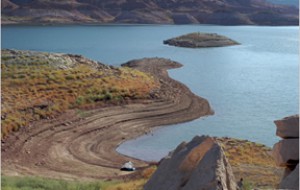
Land Arts of the American West, art site at Powell Lake, Utah

There is plenty of environmentally-minded art these days, but very few academic classes on the subject, let alone degree programs. That changed this fall when the University of New Mexico launched Art and Ecology as an outgrowth of its ten-year old program, Land Arts of the American West. In its first year, the program already includes one graduate student, dozens of undergrads and two full-time professors. UNM Art and Ecology professor Catherine Page Harris spoke with me about how the program started, its relationship with other programs at UNM, and the future of ecological art.

Matthias Merkel Hess: Was the creation of the program driven by student demand or by the faculty?

Catherine Page Harris: Art and Ecology at UNM started as a response to the needs of students who were enrolling in the Land Arts program, but didn’t have a background in ecological concerns, or in the work of ecological artists. The program’s chair, Bill Gilbert, was leading these 50-day trips and found that students needed a lot of knowledge that just wasn’t readily available. He was interested in helping them expand the experience and worked closely with former sculpture professor Basia Irland to create an early curriculum.

MMH: Are there other schools that have similar Art and Ecology programs?

CPH: The only other school I know of with an Art and Ecology program is in Falmouth, England. There was one at Dartington, England, but at the moment, I think they are no longer accepting students. A similar program is starting at West Virginia University.

MMH: In an August 2008 greenmuseum blog post, Saving Eco-Art From Death by Cliché, the writer noted that “…even at greenmuseum.org we see a lot of art that is planet-devoted but aesthetically uninspiring and unoriginal.” 

How do you encourage students to make work that does more than simply re-state known environmental concerns and is also worth looking at and thinking about?

CPH: Well, as a pedagogical strategy, I believe in an old modernist’s statement. Stravinsky wrote in his book, Poetics of Music in the Form of Six Lessons, “The more art is limited, the more it is free.” He is talking about his own choices to create a structure for himself with the 12-tone system. As I teach, I encourage students to create parameters so they no longer have to be overwhelmed by all the choices available. We also look at published work and discuss it in all contexts, aesthetic, political, emotional.

MMH:
 Does your program collaborate with other departments at the university, such as ecology or history?

CPH: Right now, we have a collaboration with the UNM’s Sevilleta Long Term Ecological Research site that is proving very fruitful, with them funding a summer program at the research station for two art undergraduates. I am also working with the Sustainable Studies Program and an environmental law professor. We also have strong ties with both landscape architecture and architecture, since I was an adjunct there for three years and, as our student body grows, we are planning cross-disciplinary courses with them.

Continue reading »

What’s Cookin at the Art21 Blog: A Weekly Index

December 27th, 2009

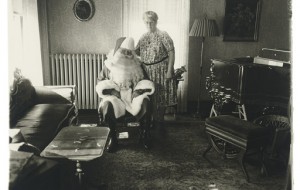
Diane Arbus, "Mr. and Mrs. Santa Claus in their living room, Albion, N.Y. 1964." Source: Christies.com

What was the conversation like over your holiday table? Satisfied or are you still hungry? Here are some more healthy vitamins for you —   it’s time to think some more: