Eve Essex and Cornelius Cardew

December 27th, 2009

Scratch Orchestra Reenactment at the Berwick

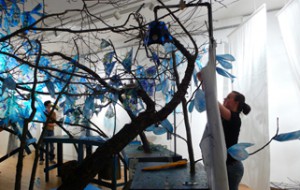
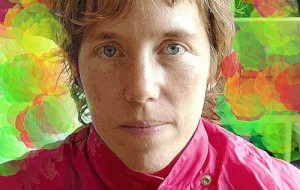
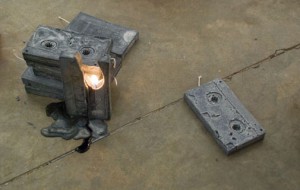
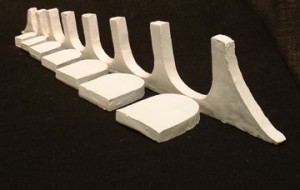
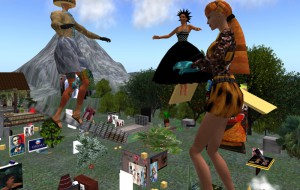
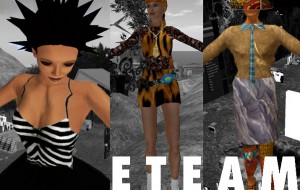
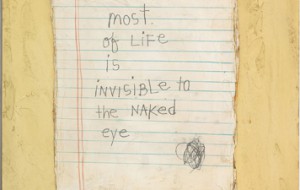
Continuing the tenuous thread I’ve begun to weave, today’s post concerns Eve Essex, an artist I’ve been interested in since she was a resident with the Berwick Research Institute in Boston, MA. One of her recent projects is a reenactment of British composer Cornelius Cardew’s Scratch Orchestra. Cardew formed the Orchestra in the 1960s, bringing together professional musicians and amateurs to play non-traditional, group-created scores as a form of social activism. Eve’s reenactments of the original Scratch Orchestra rehearsals ask participants to operate in the present and past at the same time, realizing a forty-year-old utopian vision. Is this an antidote for political apathy or a caricature of earnestness? Eve calls it “theater” — does that make it more or less genuine (or neither)? I’m interested to know if anyone else sees a relationship between this project and Stuart Sherman’s inscrutable performances, detailed in my first post.

First Scratch Orchestra Reenactment

An Original Scratch Orchestra Score

Season’s Treatings

December 23rd, 2009

Still from Tim Burton spot for MoMA, 2009

Before the holidays hit us, I thought I might suggest a few destinations, dates, and stocking stuffers for those who are as late with the shopping as I am. Below are some beautiful shows and books that are sure to please, whether you’re looking for inspiration in the classroom, in your own practice, or just a memorable gift to give or share….

Kandinsky at the Guggenheim Museum

Goeorgia O’Keeffe : Abstraction at the Whitney Museum

Tim Burton at MoMA

Yinka Shonibare MBE

Graffiti Kings: New York City Mass Transit Art of the 1970s

Looking In: Robert Frank’s “The Americans” Expanded Edition

Surface Tension: Contemporary Photographs from the Collection at the Metropolitan Museum

Happy Holidays to all! Enjoy!

Political Football

December 22nd, 2009

Flash Points contributor and University of Riverside professor Jennifer Doyle is currently spending 2 weeks in India, traveling with the Indian artist Riyas Komu. Following is the third in a series of dispatches from the road. — Ed.

Riyas Komu, "Stadium I," oil on canvas, 2007

Iraq’s victory over Saudi Arabia in the 2007 Asia Cup final is likely to hold up as one the decade’s most significant wins. The team’s victory represented a complex distillation of resistance and anger. The torture and murder of Iraqi athletes is frequently cited in the litany of horrors suffered by the Iraqi people at the hands of Saddam Hussein (see this 2003 Sports Illustrated story). Responding to allegations of torture in the country’s soccer program, in 1997, FIFA investigated the architect of Iraq’s athletics program, Uday Hussein, but spoke only with his people and wrote a report exonerating the sadist. Interest in the plight of the country’s people has long been guided by questions of political expediency. These athletes know intimately what it is to have one’s body enlisted in the service of the state, and are wary at best about having their experiences drafted into discourse defending the US invasion and occupation of Iraq. On winning the cup, while a frantic official stood next to him shouting, “No Politics! No Politics,” captain Younis Mahmoud said, simply: “I want America out of Iraq now!”

Riyas Komu, "A portrait of Younis Mahmoud" from "Occupation Stories I-IV" 2007

Drawn to the team by the Asia Cup victory and the captain’s powerful statement, in 2007, Indian artist Riyas Komu went to watch one of Iraq’s World Cup qualifying matches. At the time, these matches were played in Dubai; this was the period during which the team had been forced into exile (they’ve only recently returned to play in Iraq, with an inaugural match played against another dislocated team, Palestine). Inspired by this experience, Komu made a series of works that elliptically but powerfully tap into the contradictions that swirl around the team, and around the body as an instrument of nationalism more broadly.

Continue reading »

This Year, Give Stuart Sherman

December 22nd, 2009

You need to a flashplayer enabled browser to view this YouTube video

At a time of year when exuberant celebration meets with reflection and humanitarian impulses, it seems appropriate to devote my posts to a few artists, curators, and projects that have recently aroused this glogg of feelings in me. I wanted to simply illustrate this combination of seasonal attitudes through these projects, under the conceptual heading of “earnestness,” but I’ve been told that to be earnest is something different – more like being serious or honest, which may be part of what I’m getting at but doesn’t encompass it. So I will instead be spending these two weeks clarifying this feeling, in the course of presenting the works. My hope is that this will be a not-too-sugary holiday project. Let me know what you think.

To begin: Stuart Sherman: Nothing Up My Sleeve at Participant, Inc. in New York. This conversational group show, organized by artist Jonathan Berger, starts with Sherman, a performance artist whose idiosyncratic practice included minimalist cartoons, stints in the theater of Richard Foreman, and perhaps most famously, a series of “spectacles” – sleight-of-hand-like actions performed with exceedingly humble materials on rickety card tables, often in the parks of New York. Sherman is just one of the nodes of the show, which includes reflections on magic, deception, and spirituality through the work of James Lee Byars, Andy Kaufman, Carol Bove, Houdini, and Vaginal Davis, among others.

There is also Beginningless Thought/Endless Seeing at NYU’s 80WSE gallery, a more straightforward retrospective of Sherman’s work. In the context of my project for this blog, I’ve included a 1983 interview with Sherman by Kestutis Nakas on Your Program of Programs, which showcases Sherman’s naïve charm as a performer, with the added layer of Nakas’ good-natured lunacy. Two sides of the same coin, perhaps? Happy Solstice!

Weekly Roundup

December 21st, 2009

Kara Walker, "A Warm Summer Evening in 1863", 2008. Wool tapestry with hand cut felt silhouette figure, 5' 9" x 8' 2". Edition of 5. ©Kara Walker. Courtesy of James Cohan Gallery, Banners of Persuasion, and Sikkema Jenkins & Co.

This week in Art21 artist news we have two tapestry makers, a silk archway, the master of Cremaster, an artist who likes to do laundry, a magical sound installation, environmental issues, creative explosions, and more.

  • Opening January 8 at James Cohen Gallery, Demons, Yarns & Tales features hand-woven tapestries created by thirteen contemporary artists: Kara Walker (Season 2), Shahzia Sikander (Season 1), avaf, Peter Blake, Gary Hume, Jaime Gili, Francesca Lowe, Beatriz Milhazes, Paul Noble, Grayson Perry, Fred Tomaselli, Gavin Turk, and Julie Verhoeven. The exhibition was created by the London-based art organization, Banners of Persuasion, who commissioned each artist to design a tapestry, a medium foreign to his or her usual practice. Walker’s A Warm Summer Evening in 1863 uses an image published in Harpers Magazine during the American Civil War, captioned “The Destruction of the Coloured Orphan Asylum on 5th Avenue.” A black silhouette of a lynched female figure hangs in front of this scene. The exhibition will be on view through February 13.
  • Renaissance Unframed, an exhibition at Carolina Nitsch Project Room in New York, consists of twenty-five encaustic drawings on muslin and two companion bronze sculptures by Season 3 artist Richard Tuttle. Tuttle’s drawings “explore fabric as a medium to receive color and as a tool to direct its movement” and the bronze works “represent the antithesis of the fabric on the wall.” The fabric pieces are rotated every 2 weeks with only five works being shown at a time. The exhibition is on view through January 9.
  • On January 13, Season 2 artist Matthew Barney will speak at the Detroit Institute of Arts and discuss his newest project Khu, a performance and film loosely based on Norman Mailer’s 1983 novel, Ancient Evenings. Barney updates Mailer’s plot from an ancient Egyptian narrative to a present day account of reincarnation and rebirth set in an American landscape. Each chapter will be set in a different city and correspond to the seven stages of the soul’s departure from the body according to Egyptian mythology. The first chapter was performed in Los Angeles in 2007. The latest chapter takes place in Detroit. Barney’s lecture begins at 7pm; a (free) pass is required and can be obtained here.
  • Through January 17, work by Season 1 artist Kerry James Marshall is on view at the University of Chicago’s Smart Museum of Art in the exhibition Heartland. The show features site-specific installations and performances as well as drawing, photography, and video by artists and collaboratives working in, and in response to, Detroit, Kansas City, and other cities and rural communities across the region. Also included in the exhibition are artists Carnal Torpor, Compass Group, Cody Critcheloe, Jeremiah Day, Detroit Tree of Heaven Woodshop, Design 99, Scott Hocking, Greely Myatt, Marjetica Potrč, Julika Rudelius, Artur Silva, Deb Sokolow, and Whoop Dee Doo.
  • Gate (2005) by Season 2 artist Do-Ho Suh is now on view in the Los Angles County Museum of Art’s Korean art galleries. Made of translucent silk, the piece is a full-size rendering of one of the gates to the artist’s childhood home in Seoul. Suh’s father, the artist and scholar Suh Se-Ok, built the house based on the design of traditional Korean architecture of the 1880s.
  • Rethink: Contemporary Art & Climate Change (part of the official culture program for the United Nations Climate Change Conference) is a collaboration of the National Gallery of Denmark, Den Frie Centre of Contemporary Art, Nikolaj Copenhagen Contemporary Art Center, and Moesgård Museum. The exhibition includes more than 25 artists spread across the four venues. Each space is dedicated to a different theme: Relations, The Implicit, Kakotopia, and Information, respectively. At the Nat’l Gallery of Denmark, A Man Screaming Is Not a Dancing Bear, a 2008 film by duo Allora & Calzadilla (Season 4) presents viewers with three scenes: gently flowing images of a lush river landscape, a dilapidated interior in an abandoned house, and footage of a young man who drums rhythmically on the slats of a Venetian blind. The piece, shot in New Orleans and on the Mississippi Delta, draws attention to the remaining wreckage of Hurricane Katrina. A Man Screaming Is Not a Dancing Bear is on view through April 5. (Note: each theme/venue closes on a different day; check the website for more information.)
  • Season 2 artist Maya Lin unveiled her new video, Unchopping a Tree, in Copenhagen last week. This is the latest iteration of Lin’s larger and last memorial project, What is Missing? The video addresses deforestation prevention and sustainable reforestation to reduce carbon emissions and protect endangered species and habitats — watch it here.
  • In Roberta Smith’s review of Days and Giorni by Bruce Nauman (Season 1) — two sound installations on view at the Philadelphia Museum of Art — she writes: “Each piece consists of 14 recordings of seven people reciting the days of the week. Their voices are broadcast from 14 wafer-thin white speakers, around 23 inches square, arranged in seven facing pairs, one for each person’s voice. Each speaker is simply clipped to two wires strung tautly from floor to ceiling. It’s like paintings by Robert Ryman hanging on Fred Sandback’s string sculptures, and the effect is magical. Read more here.
  • “A countdown began two minutes out. 90 seconds. One minute. 50 seconds. 40. 30. And so on. And then: fireworks! And then: fire! The blossom burned, glowing orange against the museum and the now dusky sky, and dark smoke billowed into the air. The crowd oohed and aahed.” Click here to read more about the recent “explosion events” by Season 3 artist Cai Guo-Qiang (as reported by Kris Wilton of Artinfo.com).
  • Season 4 artist Jenny Holzer has shared her morning routine, favorite household chore, travel rituals, and more with Times Magazine. Read her witty profile here.

When Nature Takes Over

December 21st, 2009
William Christenberry, Kudzu with Storm Cloud, near Akron, Alabama, 1981.

William Christenberry, "Kudzu with Storm Cloud, near Akron, Alabama," 1981.

“It is the common mission of the entire mankind to curb global warming and save our planet.” So said China’s Prime Minister, Wen Jiabao, addressing the Copenhagen Summit on December 18. Statements like these have become standard fare. Much of the talk about climate change and green living focuses on common missions and shared responsibility to nature. But, of course, what concerns us most is not preserving nature; it’s preserving ourselves. At times, all the biodegradable cups, energy saving strategies, and carbon emission mandates seem like sacrifices (sensible, worthwhile sacrifices, but sacrifices nonetheless) to the cosmos—a mysterious entity destined to outlast us, in one way or another, even if it changes beyond all recognition.

Eugene Von Bruenchenhein, detail, "Atomic Age," 1955. Oil on board. Courtesy Kinz, Tillou + Feigen, New York. Quote from Reverend Howard Finster's sermon cards.

Eugene Von Bruenchenhein, detail, "Atomic Age," 1955. Oil on board. Courtesy Kinz, Tillou + Feigen, New York. Quote from Reverend Howard Finster's sermon cards.

Last year, the New Museum hosted a timely and much-hyped exhibition called After Nature. Presented as “a feverish examination of an extinct world that strangely resembles our own,” the exhibition was a melancholic attempt to face the fear that nature will eventually take over everything we create. A disillusioned romanticism characterized many of the show’s landscapes: Eugene Von Bruenchenhein’s Atomic Age depicted an ornate, reptilian volcano; Berlinde De Bruyckere’s Robin V depicted a frail body merging with brush. Peter Schjeldahl saw After Nature’s disillusionment as self-suffocating, writing in the New Yorker, “Desperate to eschew narcissisms of money and fame, along with academically entrenched ideology, the artists operate at psychological depths at which social attitudes can’t coalesce.”

At least one artist in After Nature managed to sidestep the malaise, however. William Christenberry, a veteran landscape photographer who grew up in pre-Civil Rights Alabama, leveled more common-sense observations at the crisis of nature in art. One of Christenberry’s contributions to the exhibit portrays an old building completely reclaimed by its surroundings. Christenberry has been visiting this building for years, and each photograph he makes of it has the same title: Building with False Brick Siding, Warsaw, Alabama. In the first photograph, taken in 1974, the false brick is fully visible, though the house certainly doesn’t look lived in and the siding has begun to peel off up near the roof. The vines growing up the right corner of the house seem almost tasteful, like green accents.

William Christenberry, "Building with False Brick Siding, Warsaw, Alabama (1974)."

William Christenberry, "Building with False Brick Siding, Warsaw, Alabama (1974)."

William Christenberry, "Building with False Brick Siding, Warsaw, Alabama (1982)."

William Christenberry, "Building with False Brick Siding, Warsaw, Alabama (1982)."

Continue reading »

New guest blogger: Nova Benway

December 21st, 2009

Thanks for Kelly Rakowski for digging in archives from the world over to find unusual patterns in everyday life. Read future posts back on her own blog, Nothing is New, here.

Up next is Nova Benway. Nova is an M.A. candidate in Curatorial Studies at Bard College. She has been a curator of the Berwick Research Institute’s artist residency program, and Program Manager at the Boston Center for the Arts. From 2002 to 2005, she was a member of Teach For America in Oakland, California.

Letter from London: Scrooged

December 21st, 2009
Shirazeh Houshiary's 1993 Tate Christmas Tree

Shirazeh Houshiary's 1993 Tate Christmas Tree

Tate Britain has just unveiled its 22nd annual Christmas Tree, designed, as usual, by a contemporary British artist. The Christmas Tree tradition at the Tate started in 1988 with Bill Woodrow’s cardboard box decorations, and has retained its position of locus for skepticism ever since. Michael Landy’s infamous tree – dumped in a bright-red bin amongst crushed beer cans and discarded packaging – looked, in 1997 (the year of Sensation at the Royal Academy), like a final, sarcastic postscript to an annus horribilis for the bastions of traditional art. The current tree, by Tacita Dean, uses a pine tree hung with beeswax candles, lit at 4pm as the sun sets, which burn out by 6, when the gallery closes. It looks like a normal Christmas tree, in other words—a “delightful, almost magical sight,” according to Martin Gayford at Bloomberg. There’s no mistaking the undertone of relief in his words.

What’s changed? Minor though the tree might seem, both institutionally (it’s generally seen as a bit of seasonal frippery on the part of the Tate) and artistically (it’s often an opportunity for artists to do a bit of festive self-mockery), there’s something here of a piece with the choice of Richard Wright as this year’s Turner Prize winner: a shift of institutional focus, maybe. Positioned in the hexagonal entrance hall in Tate Britain, a kind of public hub where exhibition tickets are purchased and directions sought, the Christmas tree is a tone-setter. Dean’s tree acts as a kind of preface, pointing into quietness rather than the sometimes predictable brashness of earlier years. Praising the tree in The Guardian, Jonathan Jones describes Dean’s work as “effortlessly going against any fashion you can think of.” I’m not sure that Dean’s elegiac analogue works (which I’m a fan of) are really so different from works by artists of a similar bent, like Rodney Graham or Rosalind Nashashibi, but never mind. Jones correctly identifies a change of tack, at least in terms of the Tate’s patronage of contemporary art.

That sense of relief – that contemporary British artists had finally “settled down,” that the Tate had stopped being silly, like a 4-year-old falling asleep after a sugar rush – characterized the coverage of the Turner Prize this year. “Publicity-grabbing stunts are refreshingly absent,” claimed Ben Hoyle in The Times, forgetting that any such “publicity stunts” are overwhelmingly orchestrated outside of the shortlist by feeble self-styled mavericks the Stuckists, hopped up on the gleeful idiocy of the tabloid press. “This year’s nominees,” Hoyle continues, “all paint, draw, or make objects that are recognisably works of art.” In actual fact, this year’s shortlist no more or less troubles the definition of art than any previous one has – apart from its continued snubbing of women artists as winners, of course. There have been only three female winners since 1984, an extraordinary situation rarely mentioned in coverage of the prize. Maybe they don’t notice.

Continue reading »

What’s Cookin at the Art21 Blog: A Weekly Index

December 18th, 2009
art-twentyfirstcenturyhearts

"Hearting Art21" Source: The Pit (a blog), 10-29-09

  • A letter from Susan Sollins, Executive Director of Art21. Please support Art21’s many educational endeavors and donate to the 2009 Annual Fund
  • Soccer. It’s a passionate and public sport that is made for and by the fans. For Yolana Sousa Kammermeier, it is also subject for her art.
  • Around the world, one click at a time | William Gedney’s photographs have the power.
  • …An upside down glass house, a floral puppy, fused bicycles and an empty white shoe box, a TV-inspired installation, two exhibitions focusing on American society, a few year-end lists, and an artist just two years shy of a century –Nicole Rounds Them Up!
  • Ethics of Conservation and the Organization of Attention…“The most radical art today is not an art that rejects history and rejects the kind of layers of history; but actually the most radical art today is about preservation. And so actually the most shocking thing you can do today is protect something.” For more, check out Richard McCoy’s interview with the artist Jorge Otero-Pailos.
  • Art21”Exclusive” Video, Year 2. What a year it’s been! We’re taking a look back at the 42 Exclusive videos that have premiered.
  • Teaching with Contemporary Art | Time to Talk. The power of conversation has the ability to facilitate a student’s course on their artmaking journey.
  • FLASH! POINT & CLICK! Flash Points Editor Rachel Craft interviewed David R. Collens, Director and Curator of Storm King Art Center, about the institution’s focus on the relationship between art and nature.
  • Lucie Rie | A ceramicist with a story to tell. Additional info here.
  • Triangle Met | Angular visions at the Metropolitan Museum of Art’s collection database.

Triangle Met

December 18th, 2009

Angular visions at the Metropolitan Museum of Art’s collection database.

1984.598.54ab

Sandals, c. 1969

204948

Iron Triangle, Germany, 19th Century

CI51.54.9

Shawl, Belgium, mid-19th century

Continue reading »