Ideas and Objects, Ideas vs. Objects
Last week I described a few upcoming classes where my high school students were taking on the question of whether or not an idea can be considered a work of art, even if an artist never actually touches the object that’s created or has a direct hand in the performance of the piece. This question led to other questions, such as:
- Does an idea have to be coupled with an action or object for it to be considered art?
- Does conceptual art need a “frame”- a museum, gallery, public art space- to declare it art?
- What is art, if it’s not getting you talking?
This last question led to a dialogue about Tino Sehgal’s recent show at the Guggenheim Museum and many of the the other surrounding questions in our Socratic Seminar. Below is a sampling of quotes from the discussions that took place last week, prior to our visit to the Whitney Museum Biennial where we viewed and discussed a few more conceptual works. What a week!
On whether an idea is art:
As long as you get the idea across, it can be art. As long as it doesn’t simply exist in your head. Tino Sehgal has a finished product. It’s just an idea, it’s not a physical object, but the idea is carried out. – Jon
But in the Sehgal exhibit, the performers are almost carrying out their own form of the idea. – Samantha
Choosing the Guggenheim was a good idea for Sehgal’s work because it became part of the statement- the spiral was part of the work and the conversation. – Matthew
You can’t put an idea in a museum. – Laurette
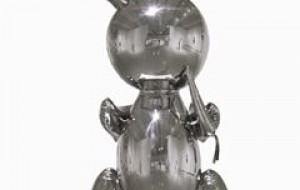
The idea of a bunny in chrome is a good idea, but talent is involved in getting it to look like a balloon.- Hannah
On conceptual art:
Every person who sees the Sehgal exhibit has a memory of it. People are paying to have this experience in a museum. It wouldn’t mean anything if it happened on the street. – Sally
I really like the idea for the Tino Sehgal exhibit. I don’t know if I’d pay $20 to see it, but I like the idea. – Laurette
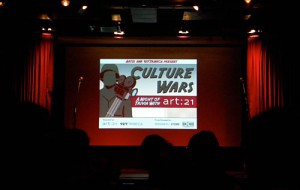
This ain’t no party, this ain’t no disco…this is Culture Wars

The stage at Culture Wars, March 24, 2010. Photo by Katherine Payne.
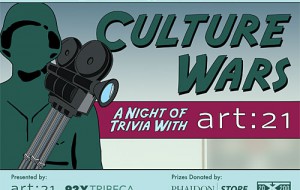
Art21 hosted the second installment of Culture Wars: A Night of Trivia with Art21 this past Wednesday, March 24. We were shocked to see over 120 participants gathered at the 92YTribeca in New York City. It was so packed that we had to bring in more chairs for the twenty-six teams who battled through four rounds of trivia.
Competition was tight, with multiple ties and tie-breakers. Teams included representatives from The Museum of Modern Art, The Metropolitan Museum of Art, the Guggenheim Museum, the Armory Show, the Jewish Museum, the Studio Museum in Harlem, the Queens Museum of Art, WNYC Culture, The Brooklyn Historical Society, La Fundación Cisneros, RxArt, NYC Arts, CUNY Grad Center, prize sponsors 20×200, and some of New York City’s most passionate art lovers.
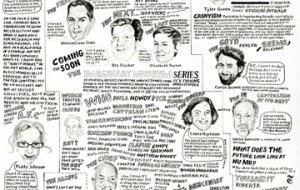
As you might be able to tell by the graphic above, the theme of the night was focused on cinema, film, and video. The rounds included Ripped from the Headlines (inspired by art, film, music, and culture current events), Last Night a VJ Saved My Life (presenting music video clips that featured either a collaboration with an artist or an artist inspired the visuals), My Andy Warhol (popular culture tribute to an icon), and Fast-Forward through the Boring Parts (the last round playing with more connections between art and film). The questions were described by Cultural Capital as “plenty obscure, as you might expect from a contemporary art trivia night.” It was also noted that that we, the hosts, coordinate our outfits. What?!! Ok, maybe. But Jonathan‘s and my outfit have nothing on RxArt — boasting pride, their team showed up to the event wearing these.
In the end, the team from the Like the Spice Gallery in Williamsburg emerged victorious, taking home prizes provided by 20×200; the Distributed Art Publishers team finished in second place, receiving prizes provided by the Phaidon Store in SoHo (ironic, right?); and BOMB Magazine edged out the MoMA team in a tie-breaker battle for third place, nabbing prizes from Art21 and the 92YTribeca.
Thanks to all who joined us that night! Big thanks to our prize sponsors at 20×200 and the Phaidon Store in SoHo, and, of course, to our lovely collaborators at the 92YTribeca.
Mark your calendars and brush up on your trivia: the next Culture Wars takes place on Wednesday, April 28.
Keep reading to see the full standings for the evening.
A history of what I do, and why I do it
There is a budding tree branch that hangs right in front of my bedroom window. The buds are uniform and pop along the tree branch every two inches. And I look out through my bedroom window, which doubles as my studio, and I look out through my studio that doubles as my dining room, and I look out through my dining room that doubles as my living room, sitting on my convertible couch and watching the changing seasons.
From one position, a person has an endless chamber of perspectives. For me, I choose to reference landscapes in which I find geographic significance. Formally distilled characters are usually arranged in my work and their relationship to land depends on whether the character is consumed by the landscape, or is running from being consumed. The characters are usually searching for something, but don’t having the institutional memory to maintain this search. A type of amnesia, or erasure of tradition and culture, is what comes to my mind. When one is asked to migrate away from his or her original space, what happens? What do they take with them? My guess is what they can hold in hand: clothing, spirit, culture, religion, and memory.
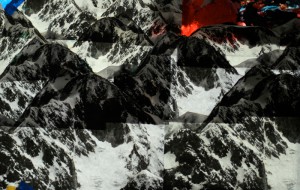
Lately I’ve used the Hindu Kush mountain range as an allegorical space for narratives that take on the role of searching. On a literal level, the Hindu Kush mountain range is a site where ethnic and political tensions arise because nobody is quite sure who, or what, belongs in that space. No one group can rationally claim ownership to that specific space, and as a result the boundaries that are carved, and decisions about who, and what, belongs in each place turn quickly to the absurd. Migrations, of culture and people, are often the result of absurd claims to an appropriated religious or culture presence in the space of places. The idea of borders, or boundaries and their translocality, or people living in liminal states, play heavily in much of my work.
I am now reading: Fear of Small Numbers: An Essay on the Geography of Anger, by Arjun Appadurai.
Weekly Roundup

Barbara Kruger, "The Globe Shrinks" (video still), 2010. Dimensions variable, Four-screen digital video installation. Courtesy Mary Boone Gallery.
- A new video installation by Season 1 artist Barbara Kruger is now on view at the Chelsea location of Mary Boone Gallery. The Globe Shrinks (2010) is a multi-channel piece that, according to the press release, “continues Kruger’s engagement with the kindness and brutality of the everyday, the collision of declaration and doubt, the duet of pictures and words, the resonance of direct address, and the unspoken in every conversation.” The Globe Shrinks continues through May 1.
- Through August 15, photographs by Kiki Smith (Season 2) are on view at Henry Art Gallery in Seattle. I Myself Have Seen It: Photography & Kiki Smith shows how photographs play a central role in the development of Smith’s work. The exhibition features hand-made composites, diaristic snapshots, video collaborations, and the artist’s unique takes on computer-based techniques. Read about the show in the California Literary Review.
- Women of the Chrysler: A 400-Year Celebration of the Arts, now on view at the Chrysler Museum of Art in Norfolk, Virginia, celebrates the role of women in the arts. Drawn entirely from the museum’s permanent collection, the show comprises more than 150 works by women painters, sculptors, photographers, silversmiths, glass artists, and printmakers. Through four chronological sections and three centerpiece installations, the exhibition traces the course of women’s ever-expanding contributions to the arts worldwide. Work by Season 5 artist Cindy Sherman is included in the section on modernist women in the age of feminism. Women of the Chrysler closes July 28.
- Galerie Lelong in New York is displaying new sculptures by Season 4 artist Ursula von Rydingsvard in the solo show ERRĀTUS. The exhibition title means “wandering” or “roaming” in Latin. Among the works on view are Blackened Word (2008), an undulating, free-standing wall that stands nearly seven-feet tall; Unraveling (2007), an elaborate wall “drawing” in cedar; and the wall piece Splayed (2009), made of cup-like shapes that protrude and drape. ERRĀTUS closes May 1.
- Mark Dion (Season 4) and Robert Williams have organized An Ordinall of Alchimy, the first in a series of exhibitions presented by the art journal and gallery space Cabinet. Artists are invited to assemble work under one condition: everything installed in the gallery must have been acquired on Ebay for a total of less than $999. When the show comes to an end, its contents are offered for sale as a single item, once again on Ebay. Dion and Williams, along with their students at the Pennsylvania artists’ colony Mildred’s Lane (Matt Bettine, Joey Cruz, Kathryn Cornelius, Gabriella D’Italia, Scott Jarrett, Aislinn Pentecost-Farren, John Wanzel, Laura E. Wertheim, and Bryan Wilson), used the invitation from Cabinet as an opportunity to explore the theme of alchemical transformation. An Ordinall of Alchimy comprises the objects they assembled. The exhibition opens March 30 at Cabinet in Brooklyn, New York.
- James Turrell, Bruce Nauman (both Season 1), and Jenny Holzer (Season 4) are included in the first Biennale for International Light Art, Open Light in Private Spaces. Staged in the eastern Ruhr metropolis, and held in conjunction with the annually designated European Capital of Culture celebration/RUHR.2010, the Biennale presents works in sixty residential and private spaces in the cities of Bergkamen, Bönen, Fröndenberg/Ruhr, Hamm, Lünen and Unna. Open Light in Private Spaces continues through May 27.
- Season 1 artist Mel Chin is in Baltimore with his Fundred Dollar Bill project. The artist will lecture about art and social reform at Maryland Institute College of Art on March 31, and present two workshops on April 1. Chin will return to Baltimore the second week of April to present at the National Art Education Association’s national convention at the Baltimore Convention Center, as well as to pick up the local Fundreds in a celebration and parade titled Fundred Extravaganza. Read more about Chin in the Baltimore City Paper.
- The Gibbes Museum of Art has announced the Short List of Finalists for the third annual Factor Prize, an annual cash prize award of $10,000 to an artist whose work demonstrates the highest level of artistic achievement in any media while contributing to a new understanding of art in the South. Sally Mann (Season 1) is among the six artists short-listed this year.
- Summer Nights, Walking, the Robert Adams (Season 4) exhibition now on view at Matthew Marks Gallery, was reviewed in the Wall Street Journal. Critic Richard B. Woodward says: “Mr. Adams is our leading photographer of landscape because he doesn’t ignore the human hand in its shaping and maintenance…His is a more realistic view of our role as custodians of the planet, even when we fail at the task, than one that yearns for wilderness in its prelapsarian state. He sees that even the suburbs, those most loathed of real-estate developments in postwar America and elsewhere, are nature preserves of a sort.”
- Calvin Tomkins has profiled Season 5 artist Julie Mehretu for The New Yorker.
- Visit PortlandArt.net to read a two-part interview with Season 4 artist Inigo Manglano-Ovalle.
New guest blogger: Baseera Khan
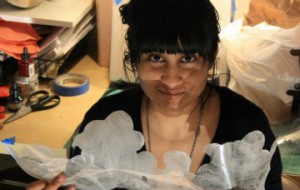
Thanks to Ivan Lozano for bringing video and performance deeper into the conversation. Up next is Baseera Khan. Baseera is a practicing artist and curator living and working in Brooklyn, New York. Khan received her BFA in Drawing/Painting at The University of North Texas in 2005. Also in 2005, she completed a one year artist-in-residence program at the University of Texas at Dallas. While in residence, Khan was awarded an Arch and Anne Gilles Kimbrough Fund through the Dallas Museum of Art. Khan has exhibited her work in galleries and museums throughout Texas and nationally. She is currently represented by the New York- and San Francisco-based Hosfelt Gallery. Khan’s work was included in the Younger Than Jesus: Artist Directory, published in 2009 by Phaidon Press Ltd. for the New Museum, New York. She is currently showing in a group exhibition at the Barbara Walters Gallery at Sarah Lawrence College. Khan is a member of the board of the South Asian Women’s Creative Collective. She also maintains a position as Assistant Curator at BRIC Contemporary Art a program of BRIC Arts | Media | Bklyn, and at BRIC Rotunda Gallery she has curated a number of public programs and exhibitions.
Deaccessioning Without Putting Your Mission up for Sale
Museums have been disposing of objects since they began acquiring them. The first documented “deaccessioning” may have involved some of the decayed remains of a Dodo bird, destroyed at the order of a keeper of the Oxford University Museum of Natural History in 1775. Fortunately, the individual assigned to the task chose to retain the Dodo’s head and a foot, which were in presentable condition. Without his disobedience, we would lack DNA evidence of the extinct creature that continues to be of use in contemporary research.
Art museums are places of particular interest for those who follow deaccessioning, because the affected works tend to be, like the last surviving Dodo, unique in at least some respects. Even multiples like etchings and engravings have subtle distinctions in quality and condition.
Disobedience in the act of deaccessioning today is as rampant as it was with regard to the 18th-century example of the Dodo—except that the untoward behavior of our time is not in service of preserving and protecting collections, but in service of monetizing them.
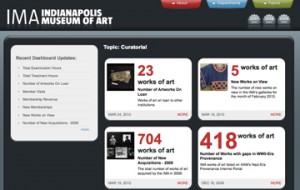
In 2007, the Indianapolis Museum of Art embarked on a considered campaign to undertake deaccessioning of those works among its 54,000 object collection that were considered insufficiently connected to the IMA’s mission. There were six possible rationales for deaccessioning articulated in the February 2008 revision of the Museum’s Collections Management policy (emphasis mine):
Kino-Eye, the video cyborg
I lightly touched on my interest in “posthumanism” and cyborg theory on my last post on John Gerrard. I was a little hesitant to write more about it because a topic like that quickly devolves into people getting cheesy images in their heads of Universal Soldier or The Jetsons. While my artwork is heavily informed by these ideas, making that aspect evident is the last thing I try to do. It’s too easy, too uninteresting. Since Donna Haraway published A Cyborg Manifesto: Science, Technology, and Socialist-Feminism in the Late Twentieth Century, there has been a lot of spilled ink on the matter, making Haraway’s Ur-text seem quaint if it isn’t understood historically. However, it still stands as one of the best introductions to a field it pioneered.
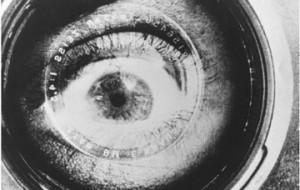
Coming from a background in film theory and history, I put Dziga Vertov‘s Kino-eye squarely in the cyborg realm: “I am an eye. I am a mechanical eye. I, a machine, I am showing you a world, the likes of which only I can see.” Cinema – defined by Gene Youngblood in his 1989 essay “Cinema and the Code” as “the art of organizing a stream of audiovisual events in time”– is for me situated in the realm of the posthuman, a means of accelerating human evolution in a nonbiological way, in a cultural and social way. Video technologies specifically I think, have best represented this shift in human cultural evolution. However, as William Gibson said, “the future is already here – it’s just not evenly distributed.”
In contemporary art, this “future” is also not evenly distributed. Ryan Trecartin is an artist that has created a body of work that avoids being The Jetsons while being completely about “the future.” In I-BE AREA, clones and avatars run around in search of personas and interchangeable identities to embody for a while. Shana Moulton‘s Cynthia in her Whispering Pines series also understands a thing or two about being one with the machine. Jon Rafman‘s Kool-Aid Man In Second Life presents a new recent version the of embodied self, separated from a physical body.
What’s Cookin at the Art21 Blog: A Weekly Index

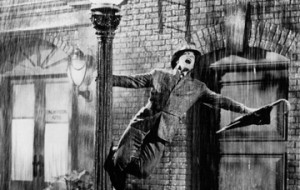
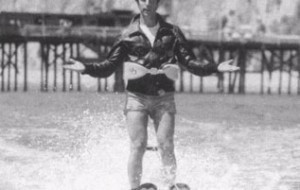
Fonzie in a scene from the Happy Days episode, "Hollywood, Part Three of Three," preparing to jump on water skis over a shark. Source: http://en.wikipedia.org/wiki/Jumping_the_shark
- What is the relationship between the cheerfulness of technology, the recognition of cyber-ecology, and the profound sorrow of human expression? In his post, blogger Ivan Lozano quotes Ollivier Dyens’s essay The Emotion of Cyber-space: Art and Cyber-Ecology, as part of his preparation to participate in a panel discussion in Arlington, VA called We Have Decided Not to Die for the Arlington Arts Center’s TRANSHUMAN CONDITIONS show, curated by Jeffrey Cudlin. Is the role of the artist destined to change?
- Can we blame the contemporary art object for being unethical? Would we blame money itself for the financial crisis? “There’s a lot of discussion and almost no consensus about the difference between ethics and morals, so let’s be broad about it: both are proposals about how to live,” Ben Street writes to us from London. Street address the question in the way he first interpreted it: can there be anything ethical about art itself, or is it perpetually at one remove from the conversation? Can art itself be, now, a proposal about how to live? Street makes some key points in his attempt to answer these question and reflects on the relationship contemporary art has to modernism. Read Ben Street’s insightful letter concerning his views on how ethics and morals in art stand in tandem with how the artist, the art object, and viewer may be aligned with an overall visual authority.
- Blogger and art dealer Edward Winkleman responds to Ben Street’s letter about ethics and morals in art in this post, The Non-Existence of Ethical Art. He remembers Oscar Wilde’s famous words, “There is no such thing as a moral or an immoral book. Books are well written, or badly written.” Winkleman agrees with Street — “to suggest that “art” can be either ethical or unethical is to personify an object.” Don’t miss reading this post and ask yourself, “How does this conversation relate to what I am currently making/thinking about in the classroom, studio, writing, or even my day at the office?”
- What are Doris Salcedo, Alfredo Jaar, Yinka Shonibare MBE, Jenny Holzer, and Allora & Calzadilla up to these days? The Weekly Round-Up includes: melancholy photographs, bronze truisms, museum interventions, a giant battleship… and much much more!
- TEACHING WITH CONTEMPORARY ART: Has contemporary art Jumped the Shark Tank? Denis Dutton may have criticized Damien Hirst’s Medicine Cabinet and Jeff Koons‘s Vacuum Cleaners as “reckless investments,” but the opportunity to use these works as a springboard for defining and redefining art with students is really quite priceless. In this post, Joe Fusaro suggests trying things out, opening the discussion by asking: Does an idea qualify as a work of art? Can an artist have an idea, instruct other people to make it, and take the credit?
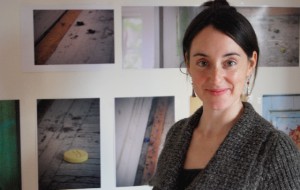
- INSIDE THE ARTIST’S STUDIO | Rachel Moore is an American artist and currently a Fulbright Fellow at the Aristotle University in Thessaloniki, Greece. She holds a BFA from Alfred University and an MFA from the School of the Art Institute of Chicago. Rachel is a co-founder of Spoke, an exhibition space in Chicago, IL. Her work explores the complexity of relationships within cultures and subcultures, as well as within both built and natural environments.
- VIDEO EXCLUSIVE: Susan Rothenberg | Emotions – Episode #099: Filmed at her home and studio in New Mexico, artist Susan Rothenberg explains how she transforms personal experiences and feelings into works that can become an “emotional moment” for the viewer. While discussing the loss of her dog, Rothenberg describes the process of recovering a memory of her pet through the act of painting.
- YOU DECIDE! Viewers choose Art21′s 100th Video Exclusive! Don’t forget to vote!
Inside the Artist’s Studio: Rachel Moore
Rachel Moore is an American artist and currently a Fulbright Fellow at the Aristotle University in Thessaloniki, Greece. She holds a BFA from Alfred University and an MFA from the School of the Art Institute of Chicago. Rachel is a co-founder of Spoke, an exhibition space in Chicago, IL.
Her work explores the complexity of relationships within cultures and subcultures, as well as within both built and natura; environments, as affected by human activity. Rachel is a charismatic and a highly creative individual who feels content and at peace with her career choices and it shows every time she looks at you straight in the eyes. Her Lucullian appetite is the force behind this inquiring artist. She paved her way by initially looking at Mona Hatoum’s, Kiki Smith’s and Bill Viola’s work. Only before graduate school did her interests shift from visual arts to architecture, design, and public and community art. Samuel Mockbee and the generous nature of his work have played a catalytic role in her development as an artist.
On the occasion of this interview, I met with Rachel at the Achilleion Café on Nikis Boulevard in Thessaloniki to discuss her work and the Fulbright experience. Read on to find out how she gets it all done.
Georgia Kotretsos: Is it possible to juggle a studio practice, curatorial projects, community projects, Spoke, and a family without ever dropping the ball? How do you do it?
Rachel Moore: I seem to function best when I’m working on many different projects simultaneously. It keeps me focused, interested, and challenged. I’ve tried to concentrate on one thing for a time, but it never happens that way. I end up adding things.
This past summer was a great example. I was finishing up the first year at Spoke, getting ready for a solo show at Traver Gallery, about to move to Greece on a Fulbright Scholarship, and I had a baby in the middle of it all. What allowed me to breathe was becoming a mother and prioritizing that time. I joke that I’m finally learning how to say no. Moving to Greece with a two-and-a-half month-old wasn’t something I questioned. It was the perfect opportunity at this point our lives. My husband, James Knittle (who’s also an artist), is able to be with her here in Greece while I work. I think that’s how we can do it. I work mostly from home, apart from daily meetings with other art professionals. I’ve had to cut some things for this year, like administrative duties with Spoke, and I’m spending less time making studio work. I do continue to draw, write, and take photographs, but my work here is focused on organizing an exhibition. Having a Fulbright is an amazing opportunity that’s allowed me to have a family and continue to work without skipping a beat.
Susan Rothenberg: Emotions
Episode #099: Filmed at her home and studio in New Mexico, artist Susan Rothenberg explains how she transforms personal experiences and feelings into works that can become an “emotional moment” for the viewer. While discussing the loss of her dog, Rothenberg describes the process of recovering a memory of her pet through the act of painting.
Susan Rothenberg’s early work—large acrylic, figurative paintings—came to prominence in the 1970s New York art world, a time and place almost completely dominated and defined by Minimalist aesthetics and theories. The first body of work for which she became known centered on life-sized images of horses. Glyph-like and iconic, these images are not so much abstracted as pared down to their most essential elements. The horses, along with fragmented body parts (heads, eyes, and hands) are almost totemic, like primitive symbols, and serve as formal elements through which Rothenberg investigated the meaning, mechanics, and essence of painting. Rothenberg’s paintings since the 1990s reflect her move from New York to New Mexico, her adoption of oil painting, and her new-found interest in using the memory of observed and experienced events (a riding accident, a near-fatal bee sting, walking the dog, a game of poker or dominoes) as an armature for creating a painting. These scenes excerpted from daily life, whether highlighting an untoward event or a moment of remembrance, come to life through Rothenberg’s thickly layered and nervous brushwork. A distinctive characteristic of these paintings is a tilted perspective in which the vantage point is located high above the ground. A common experience in the New Mexico landscape, this unexpected perspective invests the work with an eerily objective psychological edge.
The exhibition Susan Rothenberg: Moving in Place is currently on view at the Georgia O’Keeffe Museum in Santa Fe, New Mexico (through May 16, 2010). Co-organized by the Museum of Modern Art Fort Worth, the exhibition’s installation in Santa Fe showcases the relationship between O’Keeffe and Rothenberg: “each has established a significant place and artistic identity in the American Southwest, an area initially defined as a male domain in that the majority of its early Anglo visitors and inhabitants — explorers, ethnographers, photographers, traders, cattle ranchers, and cowboys — were men.”
Susan Rothenberg is featured in the Season 3 (2005) episode Memory of the Art:21—Art in the Twenty-First Century television series on PBS. Watch the full episode online via Hulu.
VIDEO | Producer: Wesley Miller & Nick Ravich. Interview: Susan Sollins. Camera: Dyanna Taylor. Sound: Jim Gallup. Editor: Paulo Padilha. Artwork Courtesy: Susan Rothenberg.