The Intangible as Object

April 26th, 2010

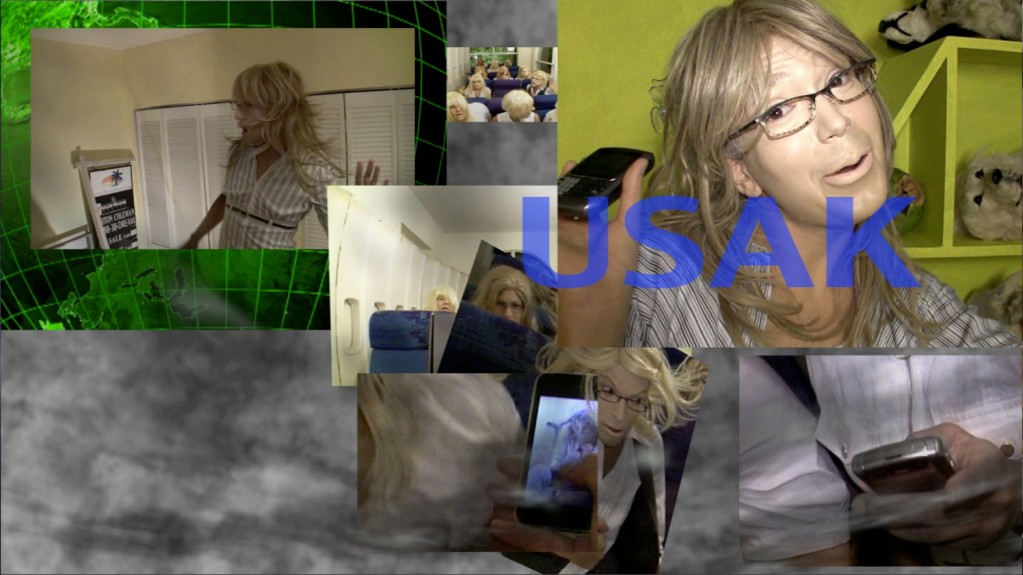
Ryan Trecartin, "K-Corea INC. K (Section A)," 2009. HD Video, 31 minutes, 20 seconds. Courtesy the artist and Elizabeth Dee, New York.

In September of last year, Kelly Klaasmeyer, the Houston art critic and Glasstire.com editor, made a pretty deft observation. Writing for the Houston Press, she noted that, “Internet content is the ‘found object’ of the 21st century.” And rightly so. While the web will almost certainly be used as a medium for decades to come, its cultural influence may inevitably become more visible and more pervasive than invoking the Internet itself. What kind of work can we expect to see from generations of young artists breastfed on social networking sites, webisodes, pornography, and video blogging?

Artists like Ryan Trecartin and Ivan Lozano might have the answer. The chaotic and gender-bending characters in Trecartin’s films use a unique vernacular of hyperglobalization consumer-speak, and his work—often jarring and non-linear—effectively captures the extent to which the web has become embedded in our lives. His videos are a complete mind-fuck and just as disturbing to watch as they are captivating.


U B U W E B – Film & Video: Ryan Trecartin – K-CoreaINC.K (section a) (2009)
- Watch more Videos at Vodpod.

Artists like Ivan Lozano are using the web not as inspiration, but as source material. His 2007 video, 21st Century Machines: A Technodrama for Future Generations, uses found footage from peer-to-peer (P2P) networks to depict a star-crossed gay cyborg love affair soured by technological incompatibility. Works like these are precisely what Klaasmeyer is describing, and they point to a seemingly immeasurable landscape of artistic possibilities.

21st CENTURY MACHINES: A TECHNODRAMA FOR FUTURE GENERATIONS from Ivan Lozano on Vimeo.

Applications such as this, where sourced Internet materials can be as much a medium as a tube of paint, make for a serious dialogue about the post-medium climate of today’s contemporary art practices. Similarly, new painting methods from emerging artists seem more prevalent than ever before (especially if we’re taking cues from this year’s heavily painterly Whitney Biennial) and much of those practices are bred from conceptual applications. Contemporary painting currently finds itself in a very interesting place, where the idea behind the work is as valuable as the work itself (a concept that will only continue to gain momentum in the current climate), and where representation and abstraction each find themselves more assertive and purposeful than ever before. Over guest blogging for the next couple of weeks, I look forward to addressing some of these issues and exploring my interests as a curator.
6 Responses to “The Intangible as Object”

  1. jonCates on April 28, 2010 4:41 pm

    1rst: its great to see art21 featuring these 2 artists

    2nd: i know both artists & their work as A. Ivan is a current MFA student in the program i teach in (the Film, Video & New Media Dept @ The School of the Art Institute of Chicago) & B. Ryan recently presented his work in our Visiting Artists Program and Conversations at the Edge series

    3rd: (&& 3 is a majik #) i have to take a few issues w/many of the assumptions @ work in this post + i want to clarify, that my focus is specifically on the post by Evan J. Garza rather than in the work of the artists

    the suggestion that there have not yet been artists working w/the nets, the web, the digital as media overlooks the last 30+ years of New Media Art as well as the last 70+ years that constitute prehystories of New Media Art. New Media Artists have for years used the nets (yes, i am intentionally pluralizing my use of the word), the web + the digital as mediums, as contexts + as content. the internet is multiple in impact for New Media Artists, functioning as art materials, distribution methods, collaborative platforms, social spaces, contested zones of theorypractices, etc… Alexei Shulgin’s Form Art of the mid-late 1990′s, the larger international net.art movement of the same period, the artware activities or Read_me + runme.org of the early to mid 2000′s are all recent examples that should be referenced @ this point

    these 2 artists (or those who write on them) may argue that they work @ intersections of Video & New Media. still, their work referenced in this post takes the form of video. Ivan in particular also works in other digital forms. additionally, Video can more more generally be understood as a common language between multiple forms or incarnations of Media Art. still, the field of Digital +/or New Media Art is a distinct & discernible area of artistic life, theorypractice, academic study, scholarship, etc… to conflate video projects or the video works of these artists w/the field of New Media overlooks certain core & key conceptechnics of New Media Art such as variability, interactivity, programmability, reprogrammability, randomness, the algorithmic, etc…

    the observation by Klaasmeyer, quoted by Garza @ the beginning of the post, about the internet as raw material is far from insightful but rather a completely banal fact of everyday life for everyOne influenced by the constant flows of the web/nets. any artist under 30 whois influenced/informed by the web/nets will tell you this. & anyOne working w/anyOne like that (such as myself) can corroborate this. since Google’s inception in 1999 + gradual/eventual eclipse of all other search engines as a default or since Youtube’s introduction in 2005 + rapid takeover of video online, this situation (of younger artists relying entirely on the web/nets as sample source +/or found material) has increasing become the case. my students are as susceptible as everyOne/anyOne else is to the technosocial myths that have been propagated by Google as it naturalizes itself as a cultural default … recently i brought the artist Robert Cauble (whois under 30) into 01 of my New Media Art classes to show his collaborative project “Alice in Wonderland or Who is Guy Debord” (from 2003). in an open discussion following his presentation, several students wanted Robert to explain how he achieved a certain section of the video component of the project. the section uses highly edited/processed recordings which sample television. Robert (under 30) was confused by the questions of the students (also in their 20s) until i explained to Robert & everyOne in the room that these students (only slightly younger than this young artist) had alrdy forgotten that television was once analog & whose recording was once outside of the domain of the restrictive DRM corporate controls now exercised via current transnational corporatist systems

    remembering New Media in the present + the prehystories of New Media in our nearby pasts is just as important for the recent futures of many/mini art whirlds, even those that are just now emerging or those that are only now recognizing their co-existences

    Reply

    Evan J. Garza Reply:

    Jon,

    Thank you so much for your comments. I was thrilled to hear about your relationships with the artists mentioned here, especially Ivan.

    I certainly didn’t mean to ignore the decades of New Media artists that preceded these two, or the digital forms they used, and I certainly hope my phrasing doesn’t suggest the same. My comments in the first paragraph refer mainly to the Internet “climate” as it currently exists (namely the pervasive nature of social media outlets and video resources) and what sort of work/art-making practices that might inspire today.

    Reply

    jonCates Reply:

    hi + thnx for yr reply

    i definitely agree w/you about the pervasiveness or perceived naturalness of the digital, Google, Youtube, etc in the lives of you artists as my story about Robert Cauble’s recent visit to my New Media class tries to articulate. + no, i dont think you were intentionally trying to slight the hystories of New Media Art but i do think that these Media Art Hystories need constant remembering. + i do feel that these are critical/crucial times when ‘contemporary’ art worlds are recognizing or otherwise reckoning w/co-existences of various other art worlds, i.e. the experimental New Media Arts of the last few decades…

    the artist Eddo Stern, a recognized New Media Artist who consistently works w/Game Cultures as content + context of his projects, recently remarked to me that many New Media Artists (ourselves included perhaps) could or even should consider themselves to simply be Pop Artists. his position was that many Digital Artists are simply working in the continuum of Pop Art + that other genre identifications (i.e. New Media Art) are therefore unnecessary. i find this to be a rly intriguing suggestion which i keep playing w/+ thinking/feeling my way through

    Reply

    Evan J. Garza Reply:

    That’s a VERY intriguing idea, especially when you consider the aforementioned pervasiveness of the digital. Caleb Larsen’s work seems to make a great argument for this theory, specifically “A Tool to Deceive and Slaughter”, 2009, in which a physical sculpture is perpetually trying to auction itself on eBay (http://atooltodeceiveandslaughter.com). If New Media is a continuum of Pop Art, I would imagine this as the quintessence of that argument.

    Ben Street Reply:

    Dear Jon -

    I’m intrigued by this, as a total outsider to the world of New Media (I’ve just upgraded to a cordless phone, for example). I’m curious about your eccentric, Prince-style grammar (“Hystery” etc) – is there a particular reason for that? Am I missing something?

    Thanks a lot,
    Ben

  2. Ross Selavy on April 28, 2010 6:17 pm

    Dear Mr. Garza,

    I was intrigued, but a bit puzzled, by your first entry. You wrote, “Contemporary painting currently finds itself in a very interesting place, where the idea behind the work is as valuable as the work itself (a concept that will only continue to gain momentum in the current climate)…” Surely you’re not suggesting that this is something unique or new? To do so would be myopic, if not just plain ignorant.

    A gambol through the forest of western art history would leave one lacerated by ideas. To cite one extreme example, the Neo-Platonic philosophy behind Botticelli’s “The Birth of Venus” was no doubt crucial to the painting’s very existence. That philosophy justified the naked paganism of the painting in 15th-century Catholic Italy. The venerable H. W. Janson wrote about “The Birth of Venus”, “Thanks to the fluidity of Neo-Platonic doctrine, the number of possible associations to be linked with our painting is almost limitless. All of them, however, like the celestial Venus herself, ‘DWELL IN THE SPHERE OF MIND’…” [emphasis mine] No philosophy, no painting – how could an idea be more valuable?

    Now, I’m sure you’re not ignorant. So I’m puzzled by your statement. What’s new?

    Reply

Trackback URI | Comments RSS

Name (required)

Email (required)

Website

Leave a Reply