Weekly Roundup

May 24th, 2010

William Kentridge, "Bicycle Kick", 2009. Official Art Poster Edition of the 2010 FIFA World Cup South Africa.

In today’s roundup: football art for South Africa, an overgrown baby in Los Angeles, an origami ship from London, body tissue in Bristol, humans behaving like pigs in Milan, flashing lights about Cambridge, and much more.

  • Seventeen internationally acclaimed artists — including William Kentridge and Julie Mehretu (both Season 5) — have made posters for the 2010 FIFA World Cup South Africa. This is only the second time in history that the World Cup is accompanied by an official licensed art project. This edition highlights art and artists from Africa. Kentridge has contributed his image Bicycle Kick (pictured above). Mehretu’s coliseum-like rendering Stadia II (2004) is also available. Prints in the 2010 FIFA World Cup South Africa Portfolio are sold individually or as a complete set. Browse the collection here.
  • Nelson’s Ship in a Bottle, a large-scale public art piece by Season 5 artist Yinka Shonibare MBE, will be installed today on the Fourth Plinth of Trafalgar Square in London. To mark this installation, Shonibare’s studio has released an exclusive origami version of his ship to Times Online; go to the link to download the cut-out and received folding instructions. (More on this historic occassion from The Guardian and BBC.)
  • Season 1 artist Barbara Kruger has created the latest cover of the London Underground’s pocket tube map. Kruger’s Untitled (Tube Map) follows earlier designs by artists Cornelia Parker, Richard Long, Liam Gillick and David Shrigley, among others. Creative Review has more on this project.
  • Ligurian Sea (1993) by Season 3 artist Hiroshi Sugimoto is on view at Southampton City Art Gallery in the U.K. through September 5. Sugimoto’s ocean image is included in the exhibition Sea Fever: From Turner to Today, a display of over 80 works by some of Britain’s best known artists. Sea Fever aims to demonstrate how the sea has been interpreted in art, from work and leisure to times of contemplation. Ligurian Sea was shown last year in the exhibition 7 Days/7 Nights at Gagosian Gallery, New York.
  • “Lingua Franca,” an exhibition and event series at Arnolfini in Bristol, looks at intermediary language, linguistic translation and the subjectivity of language. The latest exhibition in this series, titled Me, Myself, and I, features a suite of sixty drawings by Season 1 artist Louise Bourgeois that have been juxtaposed with a sprawling site specific drawing by Austrian artist Otto Zitko. Read more about Me, Myself, and I here.
  • You’ve Gone Too Far This Time, a new exhibition at Faggionato Fine Art in London, offers an anthology of approaches to the contemporary body and its material representation. Works by Kiki Smith (Season 2), George Condo, Lisa Yuskavage, Nobuyashi Araki, Yayoi Kusama, Margherita Manzelli, Thomas Schütte and Mindy Shapero are included in the show. Smith’s Untitled (1992), according to the press release, “presents five elements of the female and male body – literal bodily tissue – that hang on the wall like desiccated hides, the male organs drooling uselessly.” You’ve Gone Too Far This Time closes June 25.
  • Works by Kiki Smith are also on view at Pace Gallery in New York through June 19. Kiki Smith: Lodestar, the artist’s first major New York gallery show in eight years, features an installation of nearly thirty hand-painted stained glass panels. Smith has been working with glass for the past twenty years. She began working on this installation, titled Pilgrim, five years ago. Originally inspired by an eighteenth-century silk needlepoint by Prudence Punderson entitled The First, Second, and Last Scene of Mortality (1776-83, Connecticut Historical Society, Hartford), Pilgrim is a “cyclical journey” that alludes to “various aspects of a person’s life, presented through the images of women.” Smith has used friends and colleagues as models — not as portraits but as stand-ins for various states of a person, or a person’s wandering pilgrimage through life. Smith collaborated with architect Bill Katz, who designed the standing frames that hold the individual panels. Kiki Smith: Lodestar continues through June 19. A catalogue is available for purchase at the gallery.
  • Judy Pfaff (Season 4), Jessica Stockholder (Season 3), and Cheryl Donegan will participate in the next SkowheganTALK, a lecture series presented by the Skowhegan School of Painting & Sculpture, at the New Museum on May 29 at 3pm. Purchase tickets here.
  • Pig Island, called one of the most complex and ambitious works by Season 5 artist Paul McCarthy, is currently on view at the Palazzo Citterio in Milan. This is McCarthy’s first major solo show in an Italian institution. The artist was invited to premiere this monumental piece (along with a  selection of works created between 1970 to 2010) by the Fondazione Nicola Trussardi Foundation. Via the website “Pig Island is a carnivalesque amusement park in which human beings behave like pigs. A treasure island in reverse…a sculptural shipwreck in which pirates and their heroines throw themselves with abandon into wild revels.” McCarthy began developing this ongoing work-in-progress over seven years ago. Also on view are early works such as Ketchup Sandwich (1970) and Chair With Butt Plug (1978); and McCarthy’s brand new piece Paula Jones (2010), a selection of films realized with Damon McCarthy. Pig Island closes July 4.
  • A Voyage of Growth and Discovery — the collaborative project by Mike Kelley (Season 3) and Michael Smith that premiered at New York’s SculptureCenter last year — will be on view in Los Angeles beginning May 26. Presented by West of Rome, this exhibition marks the first Los Angeles exhibition for both artists in nearly a decade. A Voyage of Growth and Discovery includes a multi-channel video, a 30-foot sculpture, and a sound installation. The two-and-a-half hour video component  follows the existential journey of Baby Ikki, a character conceived and portrayed by Smith, as he wanders through an annual art event and temporary community in Nevada’s remote Black Rock Desert. Presented in the Farley Building, which has served as Mike Kelley’s studio since 2008, viewers will have the unique opportunity to enter into the artist’s studio and view the work in a location that is traditionally off limits to the public. A Voyage of Growth and Discovery continues through August 26.
  • Works by Season 2 artist Tim Hawkinson are on view through June 26 at Blum + Poe in Los Angeles. The exhibition comprises several large scale pieces made from such materials as garbage bags, recycled bottles and a “golden emergency blanket.” Objects on view include Orrery, a towering eight foot tall sculpture of a woman at a spinning wheel atop a platform that is itself made up of a series of rotating concentric circles depicting tire treads. In another piece, Hawkinson takes large self-portrait photos printed in the negative and collages them together to resemble a fleshy and precarious motorcycle. Suspended on an empty backdrop, Hawkinson reconfigures his body so that arms become handles, legs the spokes, and fingers multiplied and braided together to become tires. The exhibition closes June 26.
  • A house in Venice, California designed by Season 2 artist Maya Lin was recently featured in the LA Times. The property, owned by art dealer and curator Christine Nichols, is Lin’s first residential project west of the Mississippi. Read more.
  • Season 4 artist Mark Bradford also recently appeared in the LA Times; writer Christopher Miles calls Bradford a “hometown hero.” Meanwhile, The Other Paper says Bradford might be a celeb, but “he’s still approachable.”
  • Season 3 artist Krzysztof Wodiczko has created a light installation for the new police headquarters in Cambridge, Massachusetts. Lights on the building’s facade flash red, blue and green at certain times of the day and symbolize the responsiveness of the city’s police, fire and medical workers within the community. A flashing blue light represents a police response; a flashing red light is a fire response; and a flashing green light is a medical response. Read more about this city-funded installation in the Cambridge newspaper Wicked Local.

Pardon this Brief Commercial Interruption: Intro

May 24th, 2010

Hans Haacke, "MetroMobiltan," 1985. Fiberglass construction, three banners, and photomural, 11' 8" x 20' x 5'. Collection Centre Georges Pompidou, Paris.

The United States has always fostered a strange and ambiguous relationship to the arts.  In 1825, John Quincy Adams recommended that the country establish a national university, observatory, and other cultural programs and institutions.  Martin Van Buren and John C. Calhoun repudiated Adams’s proposal, calling it an imposition on states’ rights.  In doing so, they set the tone for subsequent rejections of a national cultural mandate. In the 1960s, at a UNESCO roundtable, the United States firmly maintained that it had no official cultural position, reasoning that its pluralist tradition prevented the articulation of a viable cultural policy through funding or doctrine.

With the exception of the nineteenth-century support of public architecture and the promotion of art as part of Cold War propaganda, the national government has taken no official stance on culture.  This does not mean that there have not been deliberate and instrumental uses of culture undertaken to foster particular outcomes. In the 1920s, the Commerce Department began supporting the film industry in the name of creating a new export for the international market. This initiative funded the Walt Disney Company’s production of propaganda films in the WWII era, aimed at building strategic international support for the Allied forces.  The New Deal’s Civil Works Administration and Works Progress Administration were inaugurated as a means for economic relief but ended as when the Federal Theatre Project was called before The House Un-American Activities Committee (HUAC).

You need to a flashplayer enabled browser to view this YouTube video

Walt Disney Co., Education for Death — The Making of the Nazi, 1943. Directed by Clyde Geronimi.

This ambiguity over the place of culture in society has, for all practical purposes, become the de facto cultural policy of the United States, where ambivalence is deployed as a useful strategy for avoiding controversy and navigating disparate ideologies.  The moments when strategic safeguards do fail, such as in the culture wars of the 1990’s, become flashpoints that reflect the unofficial policy.  In the 90s, in response to vexed public reactions to shows like the Brooklyn Museum’s Sensation exhibition and works by Andres Serrano, Robert Mapplethorpe and the “NEA four,” the federal government restructured the NEA and redirected funding from the support of individual artists to far less controversial programming of cultural heritage programs and events. Even though the NEA has seen some its funding restored in the past decade, wealthy individuals, private foundations and corporate partnerships now provide the lion’s share of funding for experimentation within the visual arts.

Continue reading »

New guest blogger: Erin Sickler

May 24th, 2010

Thanks to Liz K. Sheehan for her series of fantastic and thoughful posts on currencies and cartographies, science and space. Follow her pursuits back on her own site here.

Up next is Erin Sickler, an independent curator and writer based in New York City. Previously, she has worked at institutions including the Queens Museum of Art and P.S.1 Contemporary Art Center. Recent exhibitions include: Queens International 4 (Queens Museum of Art, Queens, NY 2009), Hanging Out at No Rio (ABC No Rio and Cuchifritos Gallery, New York, NY, 2009), and Apologies and Further Concessions (BRIC Rotunda Gallery, Brooklyn, NY, 2010). She is Exhibitions and Collections Manager for 601Artspace and the New York correspondent for the Swiss art magazine Kunst Bulletin. This summer, she will be a 2010 Fellow at the Smithsonian Latino Center.

Over the next two weeks, Erin will examine a variety of projects that make use of corporate models and memes as they experiment with different velocities of artistic and social engagement in the ongoing economic downturn. Beyond ideas of culture jamming, she will look at artists who employ curiosity and humor to open up all spaces, including corporate institutions and entities, as potential platforms for grassroots politics and human interaction.

(UC Crisis) Post 2: The Feeling of Embalming Education

May 21st, 2010

In a series of special posts, guest blogger alum Marc Herbst and regular contributor Catherine Wagley chronicle the University of California education crisis. Following is Herbst’s second installment. — Ed.

Anish Kapoor, "Shooting into the Corner," 2008-2009. ©Wolfgang Woessner/MAK

Creativity doesn’t occur in a vacuum. Cultural and political expression find a unique voice in relationship to context. As Dada can’t be understood without World War I,  nor Jackson Pollock without the Cold War, the creations of the University of California art professors I discussed in my last post should be understood in a field of wider aesthetic, rhetorical, and historic action.

The University of California occupation movement, which gathered Ricardo Dominguez’s and Ken Ehrlich’s productive energy, occurs in this state of affairs: budgets are tight, social services are slashed, corporations are bailed out. The priorities seem clear: profits over people.

At the turn of this decade, the inversion of that phrase, people over profits, was a clarion call for the globalization movement. Though equally radical in tactics, the emergence of the social imagination spawned by a global Internet allowed artists and activists to embody an entirely different creative frame. Emerging with the pageant-like protests of this era was a language of hope. Social space, utopia, other worlds — the globalization movement allowed for these sort of dreams.

But as California beggars itself and its crowing institutions — cutting classes, raising costs, outsourcing labor — dreamy talk just does not communicate.

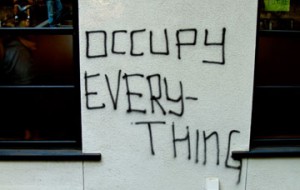
Therefore instead of “Another World is Possible,” students, faculty and staff who began occupying the central and northern California campuses of the University of California this fall say, “We Have Decided Not to Die.” “Occupy Everything, Demand Nothing.” “We Are the Crisis.” “We Want Everything, Demand Nothing.”

Thus emerges a movement out of the graveyard.

Continue reading »

Gastro-Vision: Whack! Contemporary Artists and Piñatas

May 21st, 2010

Jennifer Rubell, Andy Warhol Piñata from "Icons," 2010. Via Brooklyn Museum on Flickr.

The much-talked-about Andy Warhol piñata, created by Jennifer Rubell for last month’s Brooklyn Ball, offered a witty art spin on an old party tradition. Instead of the usual candy contents, this piñata spilled Hostess brand snack cakes, icons of American junk food culture, redolent of Warhol’s work in pop art. Given the amount of art world enthusiasm about the piece, it seems a good moment to look at piñatas as an art form. Rubell is not the first to make clever use of this sweet-filled object. What follows is by no means an exhaustive history of artist’s piñatas, but a look at some recent ones that, similar to Rubell’s, were stuffed with small treats and big concepts.

Mariana Castillo Deball, "Klein bottle piñata" as installed at the Contemporary Art Museum St. Louis, 2009. Paper mâché. Courtesy the artist. Photo: David Ulmer.

Since January, museum audiences in the United States and Europe have been taking whacks at Klein bottle piñata (2009) created by Mariana Castillo Deball for the traveling exhibition For the blind man in the dark room looking for the black cat that isn’t there, organized by the Contemporary Art Museum St. Louis. Hung in austere museum lobbies, Deball’s Piñata looks more like an semi-precious kinetic sculpture than a goodie-filled party piece. Its color and title intimate the intense blue hue developed by French artist Yves Klein, while the shape refers to the “bottle” attributed to nineteenth-century German mathematician Felix Klein. In short, the Klein bottle is a topological surface with no inside or outside. “It’s a container that has no content, or has no possibility of having content,” says the artist. Klein bottle piñata was born out of a lecture-style performance about black boxing and how greater sophistication of knowledge makes technology more cryptic for its users. “For example,” said Deball in a recent video podcast, “everyone has refrigerators, computers, and mobile phones, but nobody knows how actually these devices work. This piñata is a sort of metaphor for [how] cryptic all the objects and the things we use on a daily basis have become.”

Klein Bottle Piñata also relates to the artist’s native Mexico where these “devices,” as she calls them, are mainly used for Christmas and birthday parties. Deball suggests that getting what’s inside is only half the fun. “Sometimes the actual procedure of breaking up the piñata is much more interesting than the toys or objects you can collect…Sometimes breaking it up is the end of the game. You’re not interested any more in the presents or things you are taking out afterward.”

Continue reading »

What’s it worth? Artist and community currencies

May 21st, 2010

Marcel Duchamp, "Tzanck Check," 1919. Pen and ink on paper.

The territory of art that responds to, comments on, and intervenes in the art market is vast. There are a range of practices in contemporary art that involve currency as a literal medium (collage, sculpture, public performance, altered banknotes), but here I’m narrowing the field to consider a few individuals and local communities who create alternative currencies with the intent to circulate them as a medium of exchange.

Artists have long been interested in currency design and reproduction, both as a technical challenge and as socioeconomic experiment. In the 19th century, American trompe l’oeil masters like John Haberle (1856–1933) and William Michael Harnett (1848-1892) painted depictions of U.S. currency to demonstrate their talents as photorealists. So successful at their craft, both were issued cease-and-desist orders by the Secret Service, who feared their next step would be counterfeiting. (It wasn’t, and they didn’t.) Marcel Duchamp, ever interested in authenticity and the value of ideas, created his first hand-drawn check in 1919 to pay his dentist, Daniel Tzanck. The “Tzanck Check” displays all the markers of a legitimate check, drawn by Duchamp to imitate official printing: the unique check number, the “Pay to the Order of” line, etc. Across the middle in red is the word “ORIGINAL,” which plays on the authenticity of the check as a legal promissory note but also speaks to this check’s status as a unique art object, signed by the artist. Art historian Katy Siegel notes in Art Works: Money (2004) that the signature is both the “ultimate proof of identity” and “a promise to pay — the essence of credit. The signature…assures the buyer that the aesthetic and social value created by the artist is contained within it.” Therein lay the Tzanck Check’s “real” worth. Years later, the story goes, Duchamp bought the check back from his dentist for a sum much greater than it’s face value of $115.

J.S.G. Boggs, "$100,000 bill"

A similar relationship between market value and face value is played out in the work of J.S.G. Boggs (b. 1955), perhaps the most well-known “money artist,” who has been hand-drawing and spending his unique Boggs Notes since 1984. Like the trompe l’oeil painters before him, Boggs’s work is so convincing in detail that he has been threatened by the Secret Service for counterfeiting (he has been arrested in England and Australia), although his bills are typically illustrated only on one side, with his signature and thumbprint on the reverse. Each financial transaction is a unique performance; Boggs pays for goods and/or services with the face value of his bill, asking for any change in legal U.S. currency. He then sells that change, as well as information regarding the location of the Boggs Note, to collectors, who in turn enter into their own negotiation of value — generally paying many times the denomination. (The $100,000 notes shown above are used to pay his lawyers.)

Continue reading »

Beryl Korot: “Dachau, 1974″

May 21st, 2010

SUBSCRIBE TO EXCLUSIVE: ITUNES | YOUTUBE | BLIP.TV | ARTBABBLE
Donate Today!

SUPPORT ART21: We’re approaching the halfway point in our 100 x 100 Exclusive campaign and our online fans continue to wow us: in 58 days we’ve received 45 donations from as far as Brasilia to Madrid with 20 U.S. states in between! Many of our donors have helped us promote the cause by tweeting their support. This has proved so successful, we’re asking you to help us by following their example and spreading the word through your own social media accounts. Remember: every $1 in the tip jar helps underwrite the next series of Exclusive videos. And now without further ado, today’s video:

Episode #107: Beryl Korot narrates the process of creating one of the first multi-channel works of video art — Dachau, 1974 — a haunting document of tourists visiting the notorious Nazi concentration camp.

An early video-art pioneer and an internationally exhibited artist, Beryl Korot’s multiple-channel (and multiple-monitor) video installation works explored the relationship between programming tools as diverse as the technology of the loom and multiple-channel video. For most of the 1980s, Korot concentrated on a series of paintings that were based on a language she created that was an analogue to the Latin alphabet. Drawing on her earlier interest in weaving and video as related technologies, she made most of these paintings on hand-woven and traditional linen canvas. More recently, she has collaborated with her husband, the composer Steve Reich, on Three Tales, a documentary digital video opera in three acts that explores the way technology creates and frames our experience.

The exhibition Beryl Korot: Text/Weave/Line—Video, 1977-2010 opens at the Aldrich Contemporary Art Museum on June 27th. The exhibition presents her latest body of work as well as the 5 channel weaving/video installation Text and Commentary which premiered at the Leo Castelli Gallery in 1977.

Beryl Korot created the opening segment, featuring actress S. Epatha Merkerson, in the Season 1 (2001) episode Spirituality of the Art:21—Art in the Twenty-First Century television series on PBS. Watch the full episode online at PBS Video and Hulu, or purchase it for download from iTunes.

VIDEO | Producer: Wesley Miller & Nick Ravich. Interview: Wesley Miller. Camera & Sound: Nick Ravich. Editor: Joaquin Perez. Artwork Courtesy: Beryl Korot.

Multiple Intelligences

May 20th, 2010

Student Project; New City School; Photo courtesy of Shannah Burton.

I teach art at a school where the subject is not just a once-a-week occurrence.  New City School is a Multiple Intelligences school where art (using spatial intelligence) is used daily by teachers in every subject to help students explore, process, learn, share, and demonstrate. Howard Gardner developed the Multiple Intelligences (MI) Theory in 1983 to expand the scope of what intelligence encompasses. Gardner has now defined nine intelligences: linguistic, logical-­mathematical, interpersonal, intrapersonal, bodily-­kinesthetic, musical, naturalist, existential, and spatial.  The first two, linguistic and logical-­mathematical, are heavily favored in the vast majority of schools.

I asked Tom Hoerr, head of New City School, for his thoughts on Multiple  Intelligences as it relates to experience. He responded, “I’m  a constructivist; people learn by making meaning. MI is particularly suited for active learning because it enables each of  us to use our strengths and passions in making meaning.” I would also add that among the intelligences, the use of our spatial intelligence is particularly important in this construct.  When we make art, we make meaning, learn through experience, and construct our own understanding. Through art we can better understand math, science, literature, etc. If only someone had told me in elementary school that math is beautiful, it might have saved me from many tearful homework assignments.

Learning is not a passive process in education or in art.  John Dewey’s Art and Experience is an interesting testament to this. So how does all of this play out in art class? Here are some examples from a conceptual paper portrait project I do with my 6th graders.

Continue reading »

What Makes Us (More) Human: The Vast Middle Ground Between Art and Science

May 19th, 2010

Photo by John Hammond

Many of you may remember quite a bit of public sparring that occurred between John Hammond and myself over the “What Makes Us Human” post back in September. Since then, John and I have traded many e-mails, ideas, and insights. This week I have invited John to guest blog for the Teaching with Contemporary Art column and give us his own unique take on the relationship between art and science. John Hammond is an entrepreneur in the biotechnology and pharmaceutical development field. He was born into a family of musicians and painters, and during his young life was a professional ballet dancer and choreographer. He then attended college and graduate school, studying mathematics and physics, before heading off to medical school. He has founded a number of companies that develop new technologies for medical diagnostics and biopharmaceutical development. In his free time, he is an active participant in thrill sports such as whitewater kayaking, skiing and climbing, and is an amateur photographer and occasional writer. Enjoy! — Joe Fusaro

It’s an odd irony that our social evolution seems to be taking us closer and closer to insects. The survival of ants and bees is predicated on unyielding societal structures that define the role and function of each member.  Each life has a predetermined purpose and corresponding skill set. In return for this specialization, the colony functions with maximum efficiency. By the metric of survival, arthropods are the most successful phylum on this planet. But nothing changes for the colony; at least, not on a generational timescale. Indeed, even after countless generations, the ants that live in my kitchen now behave exactly the same way as the ants that lived in my kitchen when I was a toddler, as far as I can tell.

So why is it that our culture insists on ever greater levels of specialization? Efficiency is part of it, and this has its place. But it also has its dangers, both for the individual and the society as a whole. Taken to its logical extreme, specialization leads to total loss of individual freedom and complete stasis for society. It also leads to terminal loneliness.

As a science-loving child growing up in a family of artists, I struggled with the notion that I needed to specialize. I remember being evaluated in middle school for career interest and proclivity. My well-meaning guidance counselor sat me down and told me I should either be a musician or a scientist. “Or,” I replied, “why not both?” And so began a lifelong dialogue and contemplation of what I consider a false dichotomy: art or science.

To understand the many similarities between these two broad fields, let’s start with a simplistic notion of what separates them: Art deals in subjective truth; science deals in objective truth.

To illustrate the difference, consider the color green.  We learn in science class that the color of light is determined by wavelength. A leaf appears green because the light it reflects is a certain wavelength. However, we know from our first art classes that we can make green by mixing blue and yellow.  We can mix the two colors and paint an object that looks perfectly green to our eyes. But is this painted object actually green? Subjectively, yes; objectively, no. There is no green light reflected from this object, only a combination of yellow and blue. That fact that we see green is an artifact of our visual apparatus.

Continue reading »

Standing Ovation for Networks

May 19th, 2010

With my first year at San Francisco Art Institute done and done, I’m reminded of the big and scary (but fun!) questions I had one year ago. Last August, a few weeks before school started, I met up with my second-year classmate Donald Daedalus. He had organized a group show for our New Genres department that consisted of projects created by pairs of second-years and first-years. It was a fantastic way to kick off the school year, click with our classmates, and form some kind of department bond. Unfortunately, I was totally picked last (double last, in fact, when I found out my partner, Ian Coyle, previously selected someone else who decided to withdraw), so I had a big third-grade chip on my shoulder. Regardless, that drama is beside the point. I remember Donald and I talking about life, with my anxiety level at a high as the new MFA experience was approaching, and him asking me why I decided to go to grad school. I sipped my beer, glanced at my cell phone, and casually said, “to network, I guess.” He nodded.

I have a dictionary widget on my Mac that secondarily defines network as: a group or system of interconnected people, or, a group of people who exchange information, contacts, and experience for professional or social purposes. Networking makes me think of a cliché parent, teacher, or mentor figure egging on an impressionable student to go out there and network: “Go get ‘em son!” Or in a group of hungry twenty-somethings, there’s talk of company social hours as opportunities for networking. “Free drinks and some networking—can’t go wrong.”

Jeffrey Augustine Songco, "A Network." Courtesy the artist.

During my undergraduate years at Carnegie Mellon University, I had two networks: art school and my fraternity. My art school network was a large group of classmates and professors that has, to this day, dwindled down to two classmates (Christopher Kardambikis, William Schott) and two professors (Mary Hood, Ayanah Moor). Of course, I’m Facebook friends with everyone from the past, but there’s been a lack of information exchange since 2005, if any at all. On the other hand, my secret network of brothers from Theta Xi has stayed consistently connected because of our mass exodus from Pittsburgh to San Francisco in the last few years.

What does this brief history of my personal networking have to do with my MFA experience? My lessons learned have prepared me with networking skills for my current endeavor at SFAI. While it might be too much to ask of myself to befriend every single person at SFAI, I try to reach out to the mass as a co-chair of the Legion of Graduate Students. I also align myself closely with my peers whose work resonates with my own, especially those who are in my department.

Continue reading »