Creat(ive) Expectations

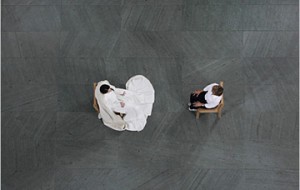
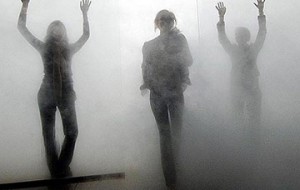
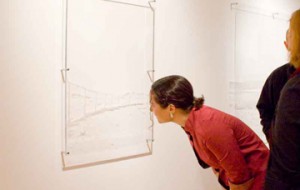
Visitors watching a performance piece in Marina Abramović's exhibition The Artist is Present, MoMA, 2010. Photo by Suzanne DeChillo/New York Times.
Earlier this spring, I ventured to MoMA with my parents who were visiting from New Hampshire for the weekend. Since I can recall, my folks have consistently supported my own artistic endeavors, and over the years, this has grown to include visiting art institutions with me, especially now that I live in New York. At the time of our visit, several exhibitions were up at MoMA, including Marina Abramović’s The Artist Is Present.
Patiently curious about Abramović’s performance, my parents attempted to take in and understand the artist’s intent and the meaning of her work. Soon afterward in the retrospective galleries, my mother and I walked between two closely facing nudes in Imponderabilia. Immediately, my mom jokingly asked if that piece was supposed to make her feel fat on purpose. Chuckling, I replied that no, of course not, but that it was attempting to make one think about how they experience the world through their body and how this relates to space and to others. In a way, from even just asking the question, she already knew this.
Yet both of my parents tend to cite their lack of formal art education and defer to the artistic authority of a museum whenever they are uncertain about an individual artwork. And why not? If museums position themselves as institutions that facilitate the interface between art and the public, shouldn’t they be experts in this arena? It’s not that my parents don’t try to interpret art and dislike what they come up with, but it’s that they put the curatorial interpretation and museum’s authority before their own. Which forced me to wonder, how do people with various backgrounds approach art in a museum in the first place?
Bravo’s Work of Art: Episode 2 Recap
In a special series of posts, Wesley Miller watches Bravo’s Work of Art: The Next Great Artist, frame by frame, and attempts to uncover what it all means through the medium of animated GIFs. This is his journey. — Ed.

GIF wall after the jump (images will take time to load). Continue reading »
Art Beyond Excerpts
Jon Scieszka and Lane Smith’s book, “Seen Art?”, starts this way:
It all started when I told my friend Art I would meet him on the corner of 5th and 53rd. I didn’t see him, so I asked a lady walking up the avenue, “Have you seen Art?”
“MoMA?” asked the lady.
“Uh…. no. He’s just a friend.”
“Just down the street in that beautiful new building. You can’t miss it.”…
But I didn’t see Art. I did see an official looking guy with a badge. “You seen Art?” I asked.
“MoMA?” said the guy.
I figured this might be a secret password. “Yes!”
“Your timing is perfect. We’re just opening.” The badge guy opened the door for me. I was in.
It should only be that easy! The boy goes on to discover that Art is more than just his friend’s name. He moves from gallery to gallery looking for Art and instead encountering paintings, sculptures, and things he can’t even recognize. When he finally finds his friend (I don’t want to ruin the ending for you), he is more than eager to share his experience.
The art of today begs to be seen. It begs to be walked into, over, and around (think Doug and Mike Starn). It begs to be examined up close… in person. But the fact of the matter is that students in grade school, college, even grad school, see art far more often in books and on screens than they do in person. As a matter of fact, a large majority of K-12 art educators all over the country take very, very few trips to see art in person with their students. Sometimes this has to do with access, sometimes it has to do with proximity, sometimes it has to do with policy, and sometimes it has to do with laziness. Regardless, it should come as no surprise that students learn a ton more when they experience actual works of art vs. looking at it on a screen. I dare say we can’t actually see (understand) art without being there. There’s a difference between looking and seeing. Seeing implies understanding. Teaching art without ever giving students the experience of seeing works of art in person, besides the ones they create themselves, is like an English teacher teaching only with excerpts and never the whole novel.
While students near big cities often have different opportunities to see art (and even look for their friend Art) in person, students in rural and suburban areas obviously have fewer opportunities to see art in museums, galleries, and public spaces. But in most places, regardless of where we live or teach, there are artists working that love to share their passion with students. We may not have MoMA right down the street, but we have local artists and the friends and colleagues of those local artists who are often are willing to share their expertise and give students firsthand experiences.
I would guess that most teachers, maybe as much as 95% of art educators across the country, take one trip per year with their classes. Many take none at all (again, for various reasons… I’m not trying to lay blame here). But the fact remains that as art educators, we must provide firsthand experiences however we can- either by getting out of the classroom or bringing artists’ works into the classroom for closer examination. Part of our work has become (continues to be?) about how to teach students to see and engage with art in ways that are not possible with a projected image on the screen.
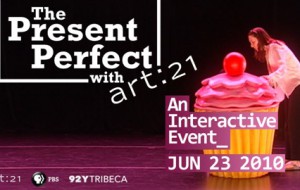
The Present Perfect: Tune In TONIGHT on PBS.org at 8 p.m. EST
Look out, Internet: The Present Perfect is here! We’re coming at you live from the 92YTribeca in New York City tonight, starting promptly at 8:00 p.m. EST. Tune in on PBS.org to watch the live stream and to join the discussion with other online viewers.
There will be conversation and there will be performance…and there will be participation from you!
Come prepared to have a conversation: Watch videos featuring Laurie Simmons and Oliver Herring beforehand, view recent work by Laurie, and catch up on audience-contributed performance projects as part of Oliver’s Three Day Weekend and The Present Perfect Weekend. Selections from the online conversation will be passed to moderator Robert MacNeil during the live event.
In addition to the in-browser chat room, we will also keep a Twitter back channel open during the event. Use #art21live on Twitter to discuss the event at the venue, on the go, or at home.
To keep the online discussion flowing, we’ve assembled a cast of moderators from across the country, including: Los Angeles-based Art21 Blog contributors, Catherine Wagley and Lily Simonson; St. Louis-based Art21 Blog Flash Points editor and Communications & Web Manager at The Pulitzer Foundation for the Arts, Rachel Craft; Washington, DC-based Online Arts Initiative Manager at PBS, Lauren Saks; and from the live audience in New York City, Art21 Manager of Education and Public Programs, Marc Mayer, and myself, Art21 Manager of Digital Media and Strategy, Jonathan Munar.
We at Art21 are excited to bring you this live interactive event, and we hope to see you online tonight!
Art Journalism in the Twenty-First Century: Where Is It Headed?
This fall, I will be beginning my final year as a Masters candidate in New Arts Journalism (NAJ) at The School of the Art Institute of Chicago (SAIC). According to SAIC, this very new arts journalism program is diverse, giving students the skills needed to attain a place as art and design journalists in an array of fields from magazines and newspapers, to radio and television, to new media outlets such as blogs and podcasts. There is a definite breadth here — an overwhelming breadth — to this mission, and this evokes feelings of sheer terror and immeasurable excitement about the future of the field.
I asked a colleague of mine, Whitney Stoepel, about some of the issues I was thinking about when composing this post. Whitney is also a year away from graduating with a Masters in New Arts Journalism from SAIC, and she and I are both learning from wonderful professors who are successful in the field of arts journalism, albeit predominantly in print mediums. While we learn from them, we also hear about the impending death of print due to the unstoppable draw and cost-effective platform that is the Internet. To my question, Whitney asked a very good one. She said, “How do you find teachers with years of experience in the field when the field itself is undergoing a complete transformation?” She continued, “We are young and we have a chance to make the new way our way. We’re not tethered to newspapers or a top-down editorial structure. We can be our own bosses. We are part of a generation that’s old enough to understand change and young enough to master the new technologies that aren’t going to stop evolving anytime soon.”
Whitney’s answer is confident and hopeful for arts journalism students like ourselves, but in this statement lies a tough road ahead — or so it seems to me. As a publishing poet, published only in print, I am feeling the death of print not only in my future as an arts journalist, but also as an artist. These two perspectives make thinking about this all the murkier, more unknown, and more overwhelming. But these perspectives also make all of this wholly invigorating, giving the passion I already possess for the arts an incentive to make them a constant element in the world through writing, marketing, and cultural enrichment.
Mehrutu’s Grey Area

Julie Mehretu, "Berliner Plätze," 2008–09. Ink and acrylic on canvas, 304.8 x 426.7 cm Commissioned by Deutsche Bank AG in consultation with the Solomon R. Guggenheim Foundation for the Deutsche Guggenheim, Berlin
In her large, complicated paintings, Ethiopian-American artist Julie Mehretu has blended everything from historic ruins to plans for sports arenas into her rich canvases in ways that make identifying individual elements sometimes difficult. She works with layers both in terms of ideas as well as of paint and other media. Beginning with a gesso base, Mehretu adds an architectural sketch along with flat colored shapes on top of it. Then comes a layer of drawings in ink and acrylic paint after which she smoothes the surface of the canvas by sanding it down. By layering, Mehretu is not only inserting visual content into her work, but she is also simultaneously losing and obscuring some information in the process.

Julie Mehretu, "Middle Grey," 2007–09 Ink and acrylic on canvas, 304.8 x 426.7 cm Commissioned by Deutsche Bank AG in consultation with the Solomon R. Guggenheim Foundation for the Deutsche Guggenheim, Berlin
The Guggenheim Museum in New York is currently exhibiting Julie Mehretu: Grey Area, composed of six semi-abstract paintings Mehretu was commissioned to make in 2007 by Deutsche Bank and the Solomon R. Guggenheim Foundation. Thanks to this commission, Mehretu was able to rent studio space in Berlin and hang her canvases together, working on them at the same time. As a result, they dialog with each other and within the theme of the show’s title, Grey Area. Though cities may be the large topic of the paintings, Berlin takes center stage. In Berliner Platz, she seemingly forgets the modern-day city and depicts the city’s buildings as they may have looked 100 years ago, effacing Berlin’s less than attractive modern history.
The Suburban: A Space for Contemporary Art in Oak Park, Illinois
Oak Park, Illinois is a very pretty and historically significant suburb that lies just outside of Chicago. Frank Lloyd Wright’s Unity Temple is located here, along with a number of his Prairie-style residential homes. It’s the proverbial “great place to raise kids” kind of suburb, known for its racial diversity and progressive political leanings. Oak Park is also home to The Suburban, one of the premiere alternative art spaces in the Chicago area. Run by the artists Michelle Grabner and Brad Killam, who — along with being married with three kids — hold faculty positions at the School of the Art Institute of Chicago and the College of Du Page, respectively. The Suburban is a latter-day Mom and Pop venture (albeit a strictly no-profit one). It mixes sophisticated contemporary art presentations with backyard BBQs, baked goods, and laid-back conversation. There’s even a swing on the side yard for the kids. In the following interview, I asked Grabner about The Suburban’s history and her and Killam’s experiences running an art space in the midst of a bustling family life.
Claudine Ise: What is The Suburban?
Michelle Grabner: It is two small galleries on our residential suburban property that are given over to artists every seven to eight weeks.
CI: What made you and Brad want to start The Suburban, and why did you want to make it a part of (or, spatially speaking, adjacent to) your home?
MG: When we moved to Oak Park in 1997, the property we purchased had this odd little out-building attached to the garage. We initially used it as a garden shed, a place to park the lawn mower. Yet despite its diminutive size, we thought that it would be better served if we employed the building as an artist’s project space. It is important to say that this kind of thinking — bringing the contemporary art world to us — was not a new adventure. Before moving to Oak Park, we were living in Milwaukee, where we organized several exhibitions and enlisted artists and writers from around the globe to participate in our exploits. Why not invite Tracey Emins, Jan Tumlir, and Elmgreen + Dragset to participate in our projects? Their interest and participation encouraged us to work with artists we thought were compelling instead of convenient.
CI: Were there a lot of other domestic spaces in Chicago when you and Brad first moved here? What were the other models for this alternative mode of exhibition presentation that inspired you?
MG: The most infamous domestic space in Oak Park, and perhaps well beyond, is Frank Lloyd Wright’s early twentieth century home and studio on Chicago Avenue. Although an older model, it is progressive and influential all the same. There was Dogmatic, a first floor and basement space in a house in the Pilsen area of Chicago. It was a space we would frequent in the late 90s. Dogmatic was a great transitional space, a bridge between Chicago’s Uncomfortable Spaces of the mid-1990s to the current model of apartment spaces. Hermetic Gallery in Milwaukee was a lab for emerging artists and a think-tank for that city’s forward looking network of artists, poets, and musicians. Beyond the Midwest, we admired Frisenwal 120 in Cologne, Bliss in Pasadena, Thomas Solomon’s Garage in Los Angeles, Matts Gallery, BANK and City Racing in London, AC Project Room in New York, and All Girls in Berlin, to name a few.
CI: One of the things I love about your space is that a lot of the projects feel like they are still in process. Like the artist is still working out ideas but is far enough along to share what they’ve come up with publicly. What are some of the things you think about when you’re considering artists for upcoming programs?
MG: The primary consideration is that the artists we invite philosophically ‘get’ The Suburban. Ideally, they also appreciate its unique frame and understand that a project here is not propped up by the same set of conditions, resources, and goals as a commercial gallery or institutional space. So I guess it is not surprising that we know all of the artists prior to their visit to Oak Park and that they know us.
Timing is Everything
London’s Hayward Gallery re-opened to the public this past Saturday with two new exhibitions. Headlining is The Edges of the World, a solo show by the Brazilian artist Ernesto Neto, who has been given the gallery’s upper rooms and outdoor sculpture gardens to exhibit his site-specific installations. Neto also features in the Hayward Gallery’s second show, a group exhibition entitled The New Decor, where the role of interior design is explored through the works of thirty contemporary artists. Together, these exhibitions form a part of the Festival Brazil season currently underway across the Southbank Centre, comprising the Hayward Gallery, Royal Festival Hall, Queen Elizabeth Hall, Purcell Room, and Poetry Library.
Having closed for six months for essential and non-essential repair and renewal, the gallery has re-opened with changes including a refurbishment of the foyer and gift shop, new entrance doors to the gallery and sculpture gardens, renewal works to the ceilings, floors and toilets, an upgrade to the ongoing maintenance systems and the building of new staff offices. Timing is everything.
For the past ten years, the Southbank Centre has been undergoing consistent and necessary redevelopment and modernization. This has resulted in both small-scale and major improvements, including new waterside frontage, the two-year refurbishment of the Royal Festival Hall itself, and a new extension building for office staff. In the two years until London plays host to the Olympic Games, the cultural legacy for the anticipated waves of increased tourism is expected to be well provided for, not least on the south bank of the River Thames, where along a couple-mile stretch of land, you can walk between the London Aquarium, the London Eye, the Southbank Centre, the British Film Institute, the National Theatre, and Tate Modern. Timing is everything.
Weekly Roundup
7,000 t-shirts, 22 paintings, two awards, a powerful pair, and one big open studio in this week’s roundup:
- Mel Chin (Season 1) has been named a finalist of the first International Award for Participatory Art. Chin and two other artists are invited to spend a research period in Bologna and develop a site specific project idea. The winning project, selected by jury, will be created in 2011. The jury includes Alfredo Jaar (Season 4), Julia Draganovic, Rudolf Frieling, and Bert Theis. In addition to the budget to accomplish the project, the winning artist will receive an award of 15,000 Euros.
- Mark Bradford (Season 4), working with the Getty Museum, has unveiled Open Studio: A Collection of Artmaking Ideas by Artists, a new project to provide free online arts activities for K-12 teachers to use in their classrooms. Open Studio is the inaugural project of the Getty Artists Program, an expanded effort to involve contemporary artists in the Museum’s Education programs. Bradford designed Open Studio to provide brief, accessible activities that don’t require a great deal of preparation or supplies. A teacher can click, print, and immediately share them with his or her class. Artists such as Kerry James Marshall (Season 1), Kara Walker (Season 2), Carrie Mae Weems (Season 5), Xu Bing, Daniel Joseph Martinez, Jon Cattapan, Catherine Opie, Graciela Iturbide, and Michael Joo have all contributed activities to the site. Marshall, for example, encourages the study of picture-making and provides a set of instructions to make and use plan and perspective grids. Bradford said: “We take a lot of things very seriously with young children – math, languages, phonics – but not art. We relegate that to something less than serious, something you do after the real work. Well, art is important. It’s always been important. And I wanted children to develop a work ethic about art, an ability to see things through and focus, just like the work ethic they would need to become a doctor or lawyer.” Open Studio is available at blogs.getty.edu/openstudio/.
- William Kentridge (Season 5) has won the Kyoto Prize. According to Artinfo, “The award, similar in status to Nobel Prize in Japan, is bestowed annually by the Inamori Foundation to recognize three visionaries in the categories of arts and philosophy, advanced technology, and basic sciences.” Kentridge will receive $550,000, an honorary diploma, and a 20-carat gold medal in a November ceremony.
- The New York Times reports that approximately 7,000 t-shirts bearing 10 different Jenny Holzer (Season 4) truisms will be dropped in Soweto, on the streets of downtown Johannesburg and at the Goodman Gallery space in South Africa through July 17. Holzer’s project, her first on the African continent, is part of the citywide exhibition series In Context (which also showcases works by Kentridge). Read a short Q &A with Holzer here.
- Works by Barry McGee (Season 1) and Claire Rojas are on view at the Bolinas Museum in California through August 1. The secluded town of Bolinas is, according to Juxtapoz magazine, “perfect” for McGee and Rojas, both “known to shy away from media and the public eye.” Go to Arrested Motion to see images of their installations Leave it Alone and Together at Last.
- Austria’s first exhibition of works by Walton Ford (Season 2) is on view at the Albertina through October. The show comprises 22 paintings made in the last ten years. Watch clips from Ford’s recent talk at the museum here.
- Crystal Bridges has acquired another new work by an Art21 artist, this time a tapestry by Kara Walker (Season 2). A Warm Summer Evening in 1863, Walker’s first tapestry, is based on an engraving originally published in Harper’s Magazine during the Civil War that documented the destruction of an orphanage for black children in New York City. “The black felt silhouette of a lynched female figure that is superimposed on the scene, her noose tied in a neat bow, is not based on a real person, but effectively telegraphs the horror of the racially motivated violence.” This piece was shown earlier this year in the James Cohan Gallery exhibition Demons, Yarns & Tales: Tapestries by Contemporary Artists.
- The work of Season 1 artist Kerry James Marshall is featured in the current issue of Afterall. Read Kobena Mercer’s article Kerry James Marshall: The Painter of Afro-Modern Life, and Terry R. Myers’s piece Kerry James Marshall’s Tempting Painting, an investigation of what’s at stake in calling an artist “a painter.”

Aaron Moulton photographed by Lars Borges
This Letter from London is, for one time only, from Berlin. — B.S.
Aaron Moulton is a curator of contemporary art and, with his wife Mette Ravnkilde Nielsen, founder of the commercial gallery FEINKOST in Berlin. FEINKOST represents nine artists, four of whom took part in the recent show Videodrome, at Autocenter. The gallery’s program pendulates between solo shows and curated group exhibitions. The effort is to recontextualize how the work of the gallery artists can be seen through topics that are current to contemporary life outside the white cube and often politically or socially engaged in their tone.
Videodrome uses director David Cronenberg’s eponymous cult classic as a point of departure in order to examine the relationship between spectator and spectacle, simulated realities, the condition of secondhand experiences in contemporary living, hardcore sex, snuff, virtual selves, cultural mash-ups, historical cut-ups, and human slips. The artists in the exhibition are: Douglas Gordon, AIDS-3D, Spartacus Chetwynd, Oliver Laric, Vuk Ćosić, Omer Fast, John Kleckner, Jorge Peris, David Levine, Daniel Baker, Joep van Liefland, Oliver Payne & Nick Relph, 0100101110101101.org, Cory Arcangel, Seth Price, Ignacio Uriarte, Anetta Mona Chişa & Lucia Tkáčová, Jeremy Shaw, Aleksandra Domanović, Daniel Kingery, Patrick Tuttofuoco, Christian Jankowski, and Arcangelo Sassolino.
Ben Street: How did the idea for the show come about?
Aaron Moulton: I wrote a text about the artist Joep van Liefland’s work about a year ago, which I felt had to be written by looking at his practice through David Cronenberg’s film Videodrome, among other things. Afterwards, I told Joep that this could easily make an exhibition and though Autocenter has a very quick turnaround time of exhibitions — 3 weeks per show — it gave me the Berlin Biennale slot, so I went for it. I organized most of the show in a week, in terms of securing projects — thanks to most of the artists being here in Berlin or otherwise being immediately interested in the idea.
BS: Tell me about the rationale behind the show.
AM: Thanks to our ever-evolving state of interfaces and platforms for mediating our selves to ourselves and others (think Facebook, Twitter, Chatroulette, Second Life, anonymous blogging, etc.), we have the potential for uncountable trajectories, replications, variations and simulations of our identity available. And just maybe those things take on a life of their own at some point. Or maybe our virtual life becomes proportionally more significant than our daily life.
Furthermore, through the cheapening of popular culture thanks to reality television, any one of us can suddenly short-cut the ranks and become a pop star. Reality TV is also somehow, whether we like it or not, a learning device related to understanding comportment or protocol in any number of scenarios that make up the human experience.
The idea is to bring viewers into a place where they might reflect on their own relationship to what they are composed of as a social being, and to hopefully destabilize that a bit. What if the work suddenly placed you under its control and made it clear that you were there for it? What if you were suddenly made conscious of these relationships you have that form some kind of composite sketch of your identity? Though we may be quite hardened to allowing ourselves to “let go,” the exhibition’s apex of sorts manifests itself whereby people have actual fun in a karaoke booth [in a work by Christian Jankowski, The Day We Met], while maybe in the back of their head [feeling] a bit creeped out. It’s all based on whether you decide to step in and play or sit back and play voyeur, and for me both results are successful.