Mary Heilmann: Abstract Painting
SUBSCRIBE TO EXCLUSIVE: RSS | ITUNES | YOUTUBE | ARTBABBLE
Episode #116: Mary Heilmann describes a breakthrough she had of combining gestural and hard-edge abstracton in a single painting, combining the legacies of Willem de Kooning and Josef Albers.
For every piece of Mary Heilmann’s work—abstract paintings, ceramics, and furniture—there is a backstory. Imbued with recollections, stories spun from her imagination, and references to music, aesthetic influences, and dreams, her paintings are like meditations or icons. Her compositions are often hybrid spatial environments that juxtapose two- and three-dimensional renderings in a single frame, join several canvases into new works, or create diptychs of paintings and photographs in the form of prints, slideshows, and videos. Heilmann sometimes installs her paintings alongside chairs and benches that she builds by hand, an open invitation for viewers to socialize and contemplate her work communally.
Mary Heilmann is featured in the Season 5 (2009) episode Fantasy of the Art in the Twenty-First Century television series on PBS. Download-to-own the full episode from iTunes.
VIDEO | Producer: Wesley Miller & Nick Ravich. Interview: Susan Sollins. Camera: Mark Falstad & Joel Shapiro. Sound: Roger Phenix. Editor: Paulo Padilha. Artwork Courtesy: Mary Heilmann. Special Thanks: Wexner Center for the Arts.
Freewaves: Video Between Their Toes
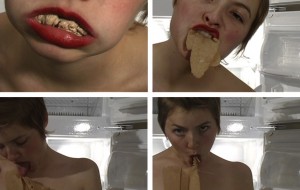
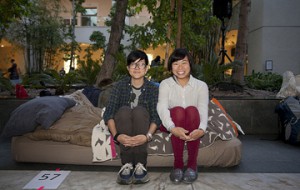
Freewaves turned 20 this year. The grassroots new media organization that began in 1989 with a gaping, loosely defined mission to show Los Angeles to itself celebrated its birthday on June 26 with Video on the Loose, a one-night festival at the Los Angeles County Museum of Art (LACMA). In the wide-open plaza that links the museum’s newly built Resnick Pavilion and Broad complex to the older Ahmanson Building, 21 monitors each displayed a video from Freewaves’ double-decade archive. They made up a surprisingly compact circle and Freewaves founder and director Anne Bray originally imagined that viewers would look over the tops of the monitors and into the faces of people watching on the circle’s opposite side. But tall monitor stands prohibited this sort of voyeuristic camaraderie. Instead, to hear over the dint of the DJ and surrounding videos, viewers gathered close to the speakers and tight circles formed around screens. This close proximity added a subtle sense of peer-pressure to the evening’s experience. You didn’t want to be the first to leave your circle, especially if others were intent.
The first time I watched Meena Nanji’s Voices of the Morning, a hauntingly rhythmic black and white film narrated by a young Muslim woman learning how to have a self, I stood beside a tall man with graying golden-blond hair. His intentness worked on me like a weight; even though the faster-moving imagery on the subsequent screen tempted me, I stayed put, acting just as focused as him (and by the video’s end, I really wasn’t acting; I returned to Voices of the Morning two more times that evening).
Social dynamics like these are, in part, what Freewaves is all about.
Gone Fishing
Teaching with Contemporary Art is taking a break this week in order to pull back, take some vacation, and get set for the return to a new school year in just a few short weeks. Please join me in some time to reflect on the past year and allow for some big ideas to begin taking shape for the new one… Enjoy!
André Leon Gray’s Eye Gumbo

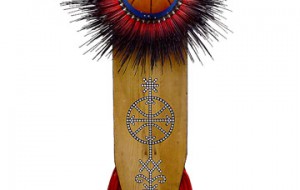
André Leon Gray, "Black Magic (It's Fantastic)," 2005. Acrylic, rhinestones, basketball, synthetic braided hair, street sweeper brush, shoe laces, headband, miniature clay pots, wood, cowrie shells on wood ironing board, 67 x 31 x 9 1/2 inches. Courtesy the artist.
One of the most striking things about the new West Building at the NC Museum of Art is its curatorial strategy. From almost any vantage point in the gallery, the experience is a hybrid one in which contemporary impressions blend with the historical, and expected categories and constraints like geography and milieu loosen their grasp.
From the entry, amidst Jaume Plensa’s Doors of Jerusalem, I, II & III, the presence of the museum’s African collection makes itself known. A recent commission by El Anatsui lurks straight ahead in a gallery flanked by similarly scaled pieces by Sean Scully, Gerhard Richter, and Anselm Kiefer.
One encounters the African gallery by way of a phased entry from the contemporary collection, via Mustafa Maluka and Ledelle Moe — whose Congregation spreads over the anterior wall — or from the main entrance, marked by a splendid Yoruba Egungun Masquerade Costume. Nestled near the center of the hall is a piece called Black Magic (It’s Fantastic), by Raleigh artist André Leon Gray. The appearance of the totem among more historical media plays on a surprising counterpoint — it first seems right at home among the alters, flags, and costumes in the gallery. Then one notices the rhinestone pattern, the basketball, the headband with the Air Jordan logo. The radiating quills encircling the ball are, upon closer inspection, a street sweeper’s brush. The assemblage is mounted on a plank — wait, an ironing board. (The piece made its world debut at the DUMBO General Store and Gallery in Brooklyn in 2005. It will be on view until April 2011 at the NC Museum of Art.)
Gray affectionately calls his mixed media assemblages, sculptures, installations, tar paintings, and drawings eye gumbo — its eclectic appeal belies its complexity in terms of materiality, origination, and potent intent. As he describes it, the work is “thickened with a roux of Black culture, marinated in social commentary and seasoned with consciousness.” Gray’s work surreptitiously coaxes its way into an audience’s psychic safe spaces, only to explode with meaning and provocation once inside. In a recent piece, emblematic iconography and shades of an easy pun become a knockout punch of historically-anchored prophecy once one gets to the work’s title, Temporary Government Housing, and realizes the piece is painted in tar. In Head Full of Doubt, nostalgic hues and the apparent comity of a schoolhouse scene yield to perennial existential questions and the lingering equation: x(N – 3/5) ≠ C. As Amy White writes: “It’s an equation about inequality, the centerpiece of which echoes the ‘three-fifths compromise’ of 1787, which pertained to the taxation and representation of nonwhite people under the Constitution of the new United States. Every time it appears in one of Gray’s works it serves as an elegiac coda. It signals the unspeakable, abbreviating the highest degree of injustice without allowing us to escape it.”
Back to School!
With the last days of July upon us, I shed a tear and take a deep breath as I prepare for my final year at San Francisco Art Institute. My classes don’t begin until the last week of August, but being the ambitious student that I am, I have several school-related activities that begin momentarily: a) TA-ing with a professor; b) organizing the student social budget with the graduate student council; and c) meetings with student groups and administration to discuss program changes (also part of my duties within the graduate student council).
I had asked Bill Powhida for some summer to-do’s back in April. Aside from wandering around galleries and working on my own art, I went against his words and, indeed, got “f***ed up.” This summer, I visited galleries in Chelsea, stayed with family and friends in New Jersey, danced up a storm at the Electric Daisy Carnival in Los Angeles, and doggie paddled in a hot tub in South Lake Tahoe. Bill mentioned that I should write a couple of art reviews, too. I never got around to writing about art, but I did get around to writing about each flavor of ice cream that I tasted from an ice cream shop that opened on the first floor of my graduate center.
“Mexican Coffee”
While it doesn’t taste like fútbol victory, the speckling of cinnamon makes it ridiculously Catholic — think Midnight Mass, Christmas morning, and immaculate conceptions.
Bravo’s Work of Art: Episode 6 Recap
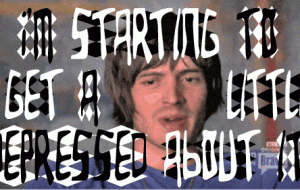
In a special series of posts, Wesley Miller watches Bravo’s Work of Art: The Next Great Artist, frame by frame, and attempts to uncover what it all means through the medium of animated GIFs. This is his journey. — Ed.

GIF wall after the jump (images will take time to load). Continue reading »
Summers at Ox-Bow
We tend to spend a lot of time talking about art in terms of “work” nowadays, but we don’t always consider how important respite and retreat can be when it comes to sustaining an artmaking practice. Artists, like all creative individuals, seek retreat for different reasons: to increase their focus and resolve; to problem-solve or brainstorm; to find new inspiration in unfamiliar surroundings; and to make new friends and and share ideas with other people. For the past 100 years, artists living in the Midwest and beyond have decamped for the Ox-Bow School of Art, located in the town of Saugutuck in Southwestern Michigan. Ox-Bow provides a unique kind of retreat that’s part art school, part summer camp, and part bohemian artist’s colony. Its idyllic 115-acre campus includes forest areas, dunes, a lagoon, and a number of charming older buildings, some of which are still used as dormitories. This summer marks Ox-Bow’s centennial. In celebration of this event, the Chicago galleries Corbett vs. Dempsey and Roots and Culture have collaborated with Ox-Bow on a joint presentation of artworks by current and former students, teachers, and staff. (The Grand Rapids Art Museum in Michigan is also featuring an exhibition of works by Ox-Bow artists as part of these Centennial events).
Ox-Bow was founded in 1910 by Frederick Fursman and Walter Marshall Clute, two Chicago artists who taught at the School of the Art Institute of Chicago, with which Ox-Bow has long been affiliated. Fursman and Clute wanted to provide artists with a reason to escape the city, and began holding art classes for their students and other artists each summer in Saugatuck, Michigan, which lies along the Kalamazoo River about 142 miles away from Chicago. At first, classes were held on a farm on the east bank of the Kalamazoo River about a mile upstream from Ox-Bow’s current location. In 1914, classes moved to the Riverside Hotel, a small inn founded by the Shriver family that soon became known as the Ox-Bow Inn. Originally built on an ox-bow-shaped bend of the Kalamazoo River, the Riverside hotel had been cut off from patrons ever since the river channel was straightened to flow directly into Lake Michigan, which dashed Saugatuck’s hopes of becoming a major Great Lakes port. Faced with a shrinking clientele, the Shrivers decided to lease the building to a group of artists for an entire summer. As Ox-Bow took on a stronger identity as a school of art over the years, Saugatuck, too, began to reinvent itself as a Midwestern resort community and artists’ enclave. Today it is known in the region as the self-proclaimed “Art Coast of Michigan.”
Weekly Roundup

Pepón Osorio, "Drowned in a Glass of Water," 2010. Photo credit: Charles Giuliano, berkshirefinearts.com.
This week in Roundup read about Pepón Osorio’s drowned art, Allora & Calzadilla getting shortlisted, Janine Antoni in motion, and a Hiroshi Sugimoto/James Turrell art counterpoint.
- Allora & Calzadilla are on the shortlist of artists to have their ideas selected for Trafalgar Square’s fourth plinth. The winning concept will take its place in Britain’s premier public art spot after Nelson’s Ship in a Bottle by Yinka Shonibare is taken down at the end of 2011. The latest proposals will be revealed in central London next month and the selected work will be announced in early 2011.
- Drowned in a Glass of Water, an installation created by Pepón Osorio was commissioned by the Williams College Museum of Art and is currently on display at 69 Union Street, North Adams, MA (a former Gateway Chevrolet Dealership) until September 7. It will then move to WCMA itself on Sept. 25.
- White Cube Hoxton Square (London) presents Kupferstichkabinett: Between Thought and Action. The exhibition looks at the “pivotal role of drawing in current practice, the exhibition features over 200 works on paper by some of the most significant artists working today” and includes the work of Bruce Nauman and Gabriel Orozco. The show closes August 28.
- Property developer Paddy McKillen’s new arts center at Chateau La Coste (France) will include structures designed by five of the world’s top architects and feature a complementary sculpture park that will include works from artists Louise Bourgeois, Richard Serra and James Turrell. As a work-in-progress, it could be 2011 before the art is finally in place at the new center.
Why Here?

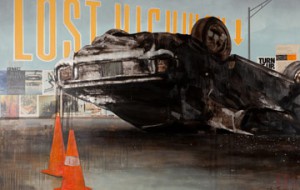
Shaun Richards, "Lost Highway," 2010. Mixed media, oil, and silver leaf on canvas, 96x132 inches. Courtesy the artist.
What does it mean to live and work as an artist in the South? It would be foolhardy to suggest there is a single, unified answer to this question. I think prevailing sentiments and themes emerge, however, through even a cursory glance at a scene like the one here in Raleigh and the Triangle (for strangers to the area, the “Triangle” is a piedmont region in North Carolina, loosely demarcated by neighboring Raleigh, Chapel Hill, and Durham). I grew up here and continue to practice here, and I maintain that there are compelling reasons to consider the changing landscape in this New South as the catalyst for some important American art.
Raleigh is perhaps not your prototypical Southern town; Wake County — in which the city is situated — has surged this decade to become the most populous county in the state, according to recently released data. And the cultural scene is, in many ways, thriving. (It’s finally feeling, at least, like our institutional and informal structures are catching up with the last two decades’ influx of people and energy.) This year alone we’ve seen the opening of the NCMA’s world-class West Building, designed by Thomas Phifer, and the long-awaited breaking of ground for CAM, Raleigh’s Contemporary Art Museum. The public presence of art here has never been stronger, in terms of both state and municipally-supported projects and private initiatives like the creative conference SPARKcon, which rules downtown Raleigh in early September. (Actually, this fall, SPARKcon will share the city’s stage with the Independent Weekly’s massive Hopscotch Music Festival, the likes of which this town has never seen.)
In the broader Triangle, exhibitions and programming at the Nasher Museum of Art at Duke University have upped the ante in regards to the presence of internationally significant contemporary work and critical discourse in the area. Aaron Greenwald has revamped the Duke Performances series in amazing ways. Full Frame and the American Dance Festival happen here. In Chapel Hill, there’s the University, which boasts the Ackland Art Museum, a top Studio Art program and another great Performing Arts series. Neighboring Carrboro is home to the Cat’s Cradle — and the continued importance of that nationally renowned club to the cultural scene here, in my opinion, cannot be overstated.
This is fertile ground for artists and practitioners. (Not to mention, rent is cheap.) But, insofar as the critical radar of contemporary art writ large only tends to register New York, L.A., and a few select places in between, it often feels as though making the choice to practice here is to accept a place outside the broader dialogue. Still, practicing here is a choice many of us happily make. Over the course of the next week, I’ll be taking a closer look at the often shrewd emotional, strategic, geographic, computational, and occasionally mystic logic behind the choice to practice in the South, particularly this New South of upper-mid North Carolina. I’ve asked a carefully crafted (yet ultimately somewhat subjective) selection of artists practicing in the Triangle to respond to the prompt: why here?
Doris Salcedo: Istanbul
SUBSCRIBE TO EXCLUSIVE: RSS | ITUNES | YOUTUBE | ARTBABBLE
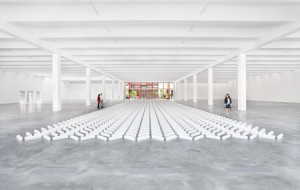
Episode #115: Doris Salcedo discusses her installation for the Istanbul Biennial, describing how she wanted to create a “topography of war” that would transcend the specificity of historical events.
Doris Salcedo’s understated sculptures and installations embody the silenced lives of the marginalized, from individual victims of violence to the disempowered of the Third World. Although elegiac in tone, her works are not memorials: Salcedo concretizes absence, oppression, and the gap between the disempowered and powerful. While abstract in form and open to interpretation, her works serve as testimonies on behalf of both victims and perpetrators. Salcedo’s work reflects a collective effort and close collaboration with a team of architects, engineers, and assistants and—as Salcedo says—with the victims of the senseless and brutal acts to which her work refers.
Doris Salcedo is featured in the Season 5 (2009) episode Compassion of the Art in the Twenty-First Century television series on PBS. Download-to-own the full episode from iTunes.
VIDEO | Producer: Wesley Miller & Nick Ravich. Interview: Susan Sollins. Camera: Bob Elfstrom. Sound: Ray Day. Editor: Paulo Padilha & Mark Sutton. Artwork Courtesy: Alexander & Bonin and Doris Salcedo.