Baldessari 2.0: Jumping the Lobster

John Baldessari,"The backs of all the trucks passed while driving from Los Angeles to Santa Barbara, California, Sunday 20, January 1963," photography, 1963. Via a-n.
Upon entering Pure Beauty at LACMA, I overheard a fellow museum-goer tell his companion, “That’s cool — it looks like a lot of my iPhone pictures.” The viewer was responding to The Backs of All the Trucks Passed While Driving from Los Angeles to Santa Barbara, California, Sunday, 20 January 1963 — the first of more than 150 works in John Baldessari’s retrospective. Navigating through the rest of the exhibit, the viewer’s words echoed in my head, slowly illuminating the underlying threads of Baldessari’s fifty-year career.
In his Art:21 interview documented in the Season 5 companion book, John Baldessari tells us: “I was getting tired of hearing the complaint, ‘My kid could do this’… And I wondered what would happen if you gave people what they wanted, something they always look at.” While the implications of the viewer’s response to The Backs of Trucks were similar to the typical complaints leveled against conceptual art (as cited by Baldessari), the tone of his remark seemed altogether different. He appeared to be pleased and excited by the idea that, he — or anyone with a simple camera — might produce similar images. By giving people “something that they always look at,” Baldessari seems to sidestep the problems faced by most conceptual artists. He consistently avoids alienating viewers, no matter how facile his approach may seem.

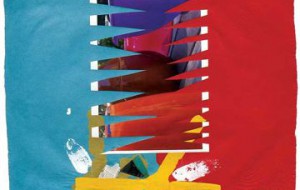
John Baldessari, "Commissioned Painting: A Painting by Patrick X. Nidorf O.S.A," 1969. Acrylic and oil on canvas, 59.25 x 45.5 inches. Courtesy John Baldessari/Via X-TRA.
Rather than drawing solely from traditional curatorial commentary, the wall labels of Pure Beauty are peppered with quotations from Baldessari. For the 1969 Commisioned Painting series, Baldessari explains that he wanted encourage the audience “to practice connoisseurship.” By repeating the element of the pointed finger, Baldessari empowers the viewer, allowing he or she to compare the different approaches to painting practiced by each commissioned artist. By drawing the viewer into the work in this way, Baldessari always firmly positions his audience as “in on” the joke, rather than as the butt of it.
Lightness

Lincoln Hancock, "A Bird, Not A Feather," mixed media, 2010. Courtesy the artist.
In a lecture delivered at Harvard in 1985 (posthumously published in Six Memos for the Next Millenium), Italo Calvino describes lightness as expressive of a certain kind of possibility in face of “the weight, the inertia, the opacity of the world.” Calvino’s talks at the Charles Eliot Norton lectures were centered on literary values, but painting — indeed, the entirety of the art experience — has always been about this for me. In art, I look for a space outside of the enumerable into which to leap.
This urge is pervasive. Art is a practice that informs life, and provides ways to elude Medusa’s gaze. Calvino takes the myth as poetic allegory: “Perseus’s strength always lies in a refusal to look directly, but not in a refusal of the reality in which he is fated to live; he carries the reality with him and accepts it as his particular burden.” So, to fly up and out of the panopticon of fixed meaning and moral surveillance is not a wanton act. It is a creative, meaningful gesture enabled precisely by an acknowledgement of its situatedness and necessary relationship to the world. As Calvino indicates, lightness entails looking at the world “from a different perspective, with a different logic and with fresh methods of cognition and verification.”
I’d read and loved Invisible Cities and If on a winter’s night a traveler, but only learned of Six Memos earlier this year — Elliott Earls mentioned the book in a piece in Emigre No. 35. (I was looking back over some of Earls’s writing, as my colleague Dan McCafferty and I had invited him to NC State for our graduate symposium on Design, Community, and the Rhetoric of Authenticity.) Calvino posits lightness, quickness, exactitude, visibility, and multiplicity as five characteristics of an art that might hold within itself room for the future. (Esther Calvino notes that Italo wanted to title the sixth lecture “Consistency.”)
This summer, as I assembled work for my second solo exhibition, I returned to Calvino’s notion of lightness. In many ways it represents the attitude I feel challenged to cultivate in my own practice. And in terms of an explicit theme, the images I created repeatedly referenced places and experiences that stand for me as exemplars of interpretive possibility. Lightness is not about fancy so much as a meaningful embrace of the distance inherent in conscious experience. We live in the world, yet we are always already free to make it anew through our creative practices.
The Wheels Are Rolling
From July 7th through July 14th Art21 hosted our second annual summer institute, Art21 Educators. Art21 Educators is an intensive, year-long professional development initiative designed to cultivate and support K-12 educators interested in bringing contemporary art, artists, and themes into their classrooms.
What made this year so special, along with the fact that we were joined by artists Ursula von Rydingsvard, Oliver Herring and Allan McCollum, was the fact that we (we, meaning the Education and Public Programs team at Art21) had a year under our belt to reflect on the program and make some changes not only to the institute itself, but also the planning for our year together.
The week started with TASK hosted by Oliver Herring, followed by introductions and our first workshop at New York University. And aside from the fact that our afternoon was punctuated with a fire alarm and having to evacuate the building in the middle of Pecha Kucha introductions, the first day was a success. Participants got to share student work and received Flip cameras to begin documenting their work in and out of the classroom, and the evening was spent at 601 Artspace, allowing Susan Sollins to welcome the group and share a new exhibit she personally curated featuring the work of Tabaimo.
Day two began with a workshop utilizing Art21 education materials. The session, titled “Artists, Form and Content”, allowed participants to view Mary Heilmann’s season 5 segment and practice ways of utilizing film in the classroom. That afternoon, after some wild technical issues and feedback worthy of a Christian Marclay installation, we discussed Olivia Gude’s articles, Postmodern Principles: In Search of 21st Century Art Education and Principles of Possibility: Considerations for a 21st-Century Art and Culture Curriculum. Participants had a wide variety of opinions on both, which made for stimulating conversation. Olivia can do that to you. Personally, I loved it.
The following day included a full morning and afternoon at MoMA to work with utilizing contemporary art and approaches to teaching in a museum. Participants viewed other Art21 segments and shared strategies for working with students in a museum context as we looked closely at Mind and Matter: Alternative Abstractions, 1940′s to Now. Afterward, all participants had the opportunity to work independently in the galleries and take some time to reflect on the institute so far before regrouping for some further discussion and sharing ideas.
During the weekend (Art21’s summer institute is scheduled from mid-week to mid-week, in order to allow participants to mentally “digest” what’s being discussed over the weekend. It also allows everyone the opportunity to see a variety of exhibitions and performances in between workshops) everyone got to attend exhibits and special events including Kiki Smith at the Brooklyn Museum, Julie Mehretu at the Guggenheim, Doug and Mike Starn at the Met, Greater New York at PS1 and a special visit to Dia: Beacon.
On Monday everyone gathered back at NYU for a presentation and special discussion with our Associate Curator, Wesley Miller, who outlined his layered approach to making films for Art21 in order to tell compelling stories about contemporary artists. Afterward each participant met with one of us to discuss planning and ideas for a unit of study that would incorporate contemporary art, essential questions, and some of the strategies learned in future lessons. To round out the day, my colleagues Jessica Hamlin and Marc Mayer presented a workshop introducing the Ning site that participants would use to document progress and share ideas after the institute, as well as the Safari Live technology we use in order to have real-time conversations with participants in the program. If that wasn’t enough, we also boarded a train to Brooklyn that afternoon to visit Ursula von Rydingsvard in her studio for two hours. When we arrived, Ursula was deeply involved in working on a small piece, and after a LONG uncomfortable 60 seconds staring at her back, she turned around and launched into a superb talk about her work and process. The day was absolutely exhilarating!
The Summer Slump
Time is slowly slipping by as the thick Michigan air hangs around my studio — stagnant and hot, a veritable swamp. It is the summer between my first and second years of my two year graduate program. The expectations I carried here have not been met exactly.

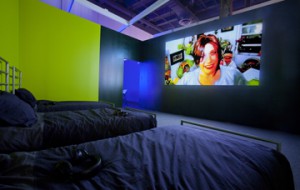
Screen shot from "A Video Conversation on our M.F.A."
Vency Yun and I talked last month about our M.F.A.s and the idea of change. We came to realize that the one thing that had changed in us the most since beginning our programs was our expectations. Both of us came to graduate school for different reasons. Vency came to find out if an art practice was what she wanted, and I came to find a community and forum for my art and ideas. Both of us got what we were looking for, but not exactly in the way that we thought. For Vency, her journey through Concordia University and abroad revealed to her the need for a different kind of art practice, one that stems from a yearning for comfort. For me, a much more diverse community is presenting itself, surprising me with a broader base of opinions and backgrounds.
Since the beginning of summer, many of my classmates have scattered across the continents, taking full advantage of the slow summer months. I am caught in the middle, the summer or the slump. Like many other students, I have taken a summer job. I am hanging out right now with a group of 20 high school art students at the Cranbrook Summer Art Institute. It is my job to entertain, feed, and counsel these pre-college teens throughout the summer. The benefits tempted me—free food, boarding, studio and pay. The only problem is time…hanging out with the kids is great, but after all of the responsibilities of the job, there is hardly any time or energy left over for my studio work.

Bonfire with the Cranbrook Summer Art Institute crew
With food, rent, and friendship all on the summer bill, studio work seems to get pushed aside. This summer I had decided to stay in Michigan, make a little money, and work in the studio (I want to be in my studio the most). I have accomplished a little bit of all of those things, yet I am still feeling like I want to do more. I have begun to see professional artists as magicians. Their ability to integrate their daily needs into a successful art practice is a mystery that leaves me in awe. After talking with my colleagues, this summer feeling — slump, really — seems to be the norm for the time in-between.
Bravo’s Work of Art: Episode 5 Recap
In a special series of posts, Wesley Miller watches Bravo’s Work of Art: The Next Great Artist, frame by frame, and attempts to uncover what it all means through the medium of animated GIFs. This is his journey. — Ed.

GIF wall after the jump (images will take time to load). Continue reading »
Last month while I was working on projects for the grand opening of 100 Acres, one of the most important international conservation symposiums took place in Amsterdam. Contemporary Art: Who Cares? Research and Practices in Contemporary Art Conservation was organized by the Netherlands Institute for Cultural Heritage (ICN), Foundation for the Conservation of Contemporary Art in the Netherlands (SBMK), and the University of Amsterdam (UvA). The symposium was an activity of the International Network for the Conservation of Contemporary Art (INCCA).

Karen te Brake-Baldock
As a way to find out what I missed, I’ve invited Karen te Brake-Baldock, a researcher at ICN and the INCCA Central Coordinator here for a discussion. Karen obtained a BA in Arts & Media Management followed by an MA in European Arts Management in 2002 from the Utrecht School of the Arts. In 2004, she started working at the ICN as assistant manager for the ground-breaking European Union project Inside Installations. She has been INCCA’s Central Coordinator since 2005.
Richard McCoy: I understand that the attendance for Contemporary Art: Who Cares? (CA: WC?) included museum directors, private collectors, conservators, artists, artists’ assistants, art historians, collection managers, conservation scientists, technicians and students for a total of over 550 professionals from 32 countries. Was this big of an attendance anticipated, or was it a bit of a surprise?

Opening Day of CA: WC? at the Royal Tropical Institute
Karen te Brake-Baldock: The symposium Program Committee (Paulien ‘t Hoen, Tatja Scholte, Vivian van Saaze, Lydia Beerkens, and I) expected a good turn out, at least as many people as we had 13 years ago for the symposium Modern Art: Who Cares?. The event was held at the Royal Tropical Institute, which has an auditorium that seats 435 people. We thought [that] with a bit of PR effort, we should be able to fill it.
However, 3 months before the event, all of the tickets were sold out and we had a waiting list of over 100 people. Something needed to be done! It was too late to change the event location so we arranged for a live television feed from the main auditorium to be set up in an adjacent room to follow the plenary lectures. In the end, around 580 people were present at one time or other. So yes, it was indeed a bit of a surprise!
RM: One of the things I found most intriguing about the symposium is that the plenary sessions seemed to focus less on conservation treatments, and more on theoretical issues related to collections development and management, and notions of public access. Do you think this approach was well-received?
KtBB: The three-day program was based upon three phases in the conservation continuum and the notion that different aspects of conservation take place during the “lifespan” of an artwork. The point of departure is the concept that contemporary conservation issues cannot be dealt with without considering the relationship to artistic and museum practices. (The term “conservation” is being used here in a broad sense.)
I think the the symposium program successfully illustrated the premise that conservation is an intrinsic aspect through the various stages in the life of an artwork. There are many factors influencing the way museum professionals work today, including the way artists work and the kind of work they produce, changes in the role museums play in society, and how the public obtains and shares information and knowledge about artworks. Conservators and other museum professionals are redefining themselves as these changes occur. Promoting discussion and reflection from different perspectives is important if we are to keep up with these changes.
Weekly Roundup
This Weekly Roundup features Kentridge’s Egyptian sketchbooks, Louise Bourgeois in The Surreal House, and Mike Kelley’s maiden voyage.
- Scheduled to coincide with the monographic retrospective devoted to the artist at the Jeu de Paume, drawings by William Kentridge will be presented in the Salle d’Actualité of the Department of Graphic Arts, alongside a selection of Egyptian drawings from the Louvre. The work will be on display until August 30.
- A current exhibition at the DHC/ART Foundation for Contemporary Art features the work of Jenny Holzer that deals with the United States-led invasion of Iraq and “holds up language as a mirror to show them and us the consequences of how words are used and misused. This analysis may be too late in some ways, but also just in time to show how language, too, can become a weapon of mass destruction.” The show closes on November 14.
- The New Topographics photo exhibition at SFMOMA offers a chance to look back in time to gauge our psychological and social distance from what we see. This exhibition is a re-creation of a pivotal 1975 exhibition held at the George Eastman House in Rochester, N.Y. and includes the work of Robert Adams who was in the original show. The exhibition is on view until October 3.
- The Barbican Art Gallery presents The Surreal House which consists of a labyrinth of chambers, designed by acclaimed young architects Carmody Groarke and features work by a host of artists, architects and film makers including Louise Bourgeois. The show continues until September 12.
Thoughts on the Practice
I spent yesterday with two of my oldest friends. At ten, Ben and Neill came over. We’d cleared our schedules to hang and create material for A Weavexx Yuxtapongo. Weavexx is the operational name of a thirteen or fourteen year-old improv music project we began in Ben’s parents‘ basement on weekends and summers off during college. The model for the Weavexx jam was always Can — the persistent Kraut rhythm provided the ground on which we’d build wacky, heinous, uncanny rock spectacles for our own expansion and enjoyment (and ultimate commitment to Maxell audiotape]. We don’t meet often to play music together anymore, but the principle still holds: spontaneous, creatively-centered interaction and collaboration for hilarity and poignance.
Yuxtapongo is Neill’s monthly cable-access show devoted to experimental video, broadcast in Raleigh, Chapel Hill, Carrboro, and Durham, North Carolina. (More on the show and project of Yuxtapongo in future posts.) Though the program has an expanding international cast of contributing artists, Neill produces much of the content each month. Collaboration and spontaneity oil the chassis. Yesterday’s shoot and editing session was a pretty brilliant example of what this kind of work scenario can be: maudlin, exhilarating, stupid, fraught, hysterical, mundane, sublime and finally, somehow, completely satisfying. Starting from nothing, we called it quits with three finished pieces of totally different video, interpolations of experience documented and remade into something I’m going to go ahead and call art.
Figuring out that the things we did in our parents’ basements qualify and stand as records of creative, intentional engagement with the world is a pretty big deal. For me at least, these unstructured, oblique, contraproductive projects were always for their own sake, manifesting zones of transcendence wherein I didn‘t have to correspond to any reflective or higher-order processes or considered decisions or plans. The immediate was the grail. The realization that I seek these spaces as part of a practice has been parcel of my fundamental appraisal of my life as an artist, which is relatively young in title even as I begin my thirty-fourth year. Practice, of course, connotes mindful intent and skillful engagement in a particular scenario. As I move forward, I look to these signposts to indicate where I might find rich ways to meet the world.
Letter from London: Young Americans

Pablo Picasso walking the dog
The “must-see show of the summer” is not, despite what the adverts on the buses might have you believe, the John Richardson-curated Picasso show at Gagosian Gallery. Not nearly as bedazzling as his last Picasso show, the 2009 Mosqueteros show at Gagosian New York, the show’s museum-like hush-hush installation is a smokescreen for quite a lot of churned-out joie-de-vivre stuff made after a boozy lunch with Cary Grant and the crown prince of Monaco. There’s more than enough great, charming work, especially the sculptures, to go around – after all, this isn’t the blue period – but after a while you get tired of being beaten about the head about how great the south of France is. The Picasso show is one of a few predictable offerings in London venues this summer – Surrealism at the Barbican, limp self-indulgence at the Hayward (Ernesto Neto), another dry-as-dust photography show at Tate Modern (Exposed), none of which should overshadow the fact that two of the most fascinating, prolific, and historically significant American artists are making their debuts in the city this summer. And they’re both dead.
That Alice Neel is one of the very great post-war portrait painters, far outstripping one-trick pony contenders like Lucian Freud, Alex Katz, Frank Auerbach, or anyone else you care to mention – compare, say, Neel’s magisterial portrait of Andy Warhol and any of Freud’s tired crusty aristocrats, each a different shade and texture of stale bread – should be cause for general celebration, but it’s only this year, twenty-six years after her death, that the first solo show of Neel is being held in London. To give some sense of how belated the show at the Whitechapel is, consider the facts. Neel was born in 1900 and came to prominence in the US in the 1970s, which means she came of age artistically in a thicket of -isms. This makes her, for art historians (watch out!) “problematic,” since her work is of no fixed aesthetic abode. Having a narrative to explain the work is the next best thing.
Female artists (like “outsider artists”) are required to have an overarching narrative (cf. Sylvia Plath, Eva Hesse, Virginia Woolf, Frida Kahlo, and so on) in order to make sense of their work – as though their creativity needed a sort of justification within a narrative of female experience. Neel’s narrative is of the batty old dame who made old-fashioned art in the face of seismic change. Her resistance is, like Freud’s, posited as enough to hang a reputation on. And yet it doesn’t take a master’s in art history to spot the difference between the portraits made by those doggedly resisting artistic change – see the appalling photo-realism dominating the ever-depressing BP Portrait Award in London – and Neel’s spare, poised works, which are every bit as conceptually and aesthetically compelling as anything produced at the time.
New guest blogger: Lincoln Hancock
Thanks to Paige Johnston for walking us through her recent travels in the Netherlands. Look out for more from her in the coming weeks.
Up next is Lincoln Hancock. Lincoln is an artist, designer, and musician with a background in philosophy and a Master’s degree in Graphic Design from North Carolina State University. Since graduating in May, Lincoln has been engaged in a series of collaborative projects running the gamut from interactive installation to formal exhibition design to writing music with a new rock group. His critical interests concern the intersection of processes, motivations, and outcomes in music, art and design; art as a social practice; and generally, the nature of cognition and aesthetic experience. He is currently prepping a video piece that will be installed in Block2, a street-level exhibition space sponsored by the City of Raleigh Arts Commission, in August. Additionally, a solo exhibition of his recent paintings and photo-based work is on display through July at 311 W. Martin St. Galleries in downtown Raleigh, NC.