Fall Previews: Trailer, Teasers, and Slideshows

August 31st, 2010

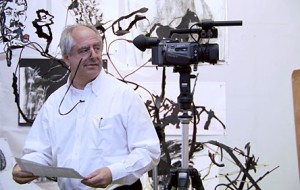
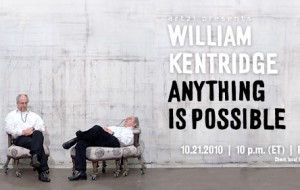
William Kentridge in his studio, Johannesburg, South Africa, 2008. William Kentridge: Anything Is Possible, production still, 2010. © Art21, Inc. 2010.

Fall preview season is upon us, so it’s time for us to throw our cards into the mix. The first trailer for William Kentridge: Anything Is Possible is now available for your viewing pleasure on the special film site (and after the break below), as well as at any of your (and our) favorite video-sharing or video-watching platforms.

On the subject of media, new image slideshows are coming later this week, each featuring thematic narratives by way of pairing artworks, photos, and exclusive production stills with selected quotes from the artist. In the meantime, catch up with the first two slideshows: In the Studio is a glimpse of the artist at work in his Johannesburg studio; and On Perception shows the range of optical trickery and techniques adapted by the artist through various projects.

Finally, we released two more teaser videos since mid-August; all four teasers can be viewed in the Media section of the film site. Catch the trailer past the break, and be sure to browse through the Media section of the film site for additional videos and images.
Continue reading »

3 Museums, 2 Days (part II of II)

August 31st, 2010

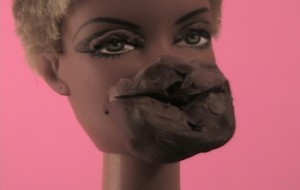
Video still from Lauren Kelley's "Big Gurl." Courtesy Artadia

II. After my visit to the New Museum, I headed uptown to the Studio Museum in Harlem. What stood out to me at the Studio Museum were a series of sculptural, photographic, and video works by Lauren Kelley, one of the museum’s 2009-2010 artists-in-residence. The photographic/sculptural works reminded me of works by Mike Kelley and (after Kelley) Catherine Sullivan and Matthew Barney. They did so for their sculpting (assembling? moulding?) of abstract plastic materials to form an abject, even alien-seeming, series of objects. A certain abject aesthetic also could be found in (Lauren) Kelley’s videos, which accompanied the sculptures and photographs of sculptural works.

In a series of three videos, all of which are animated, the artist gives us a glimpse into her middle-class African American background. In the first video, one sees a pool party circa late 70s/early 80s. The party-goers are represented by animated action figures covered in various ways by clay, somewhat like the animated figures of Nathalie Djurberg’s work. What is most refreshing about all three of the videos is how Kelley uses her materials, and how the mimetic (what resembles) is constantly foregrounding the thing-itself (the object being used to resemble). So when the figures splash in the pool, Kelley uses cellophane and bubble wrap to visualize the splashing. And when, in the second video, an airline stewardess sobs, one can see the smushed-together pieces of clay revealing a running mascara.

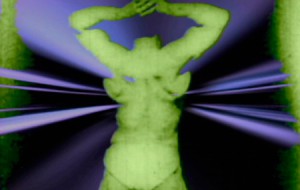
In Kelley’s videos, there is also a very effective use of traditional animation materials, such as clay, with props, such as a television set and a toy airplane. How, I was thinking during my viewing of Kelley’s videos, can one tell stories differently through animation? How, likewise, can animation be a way to encounter racism and classism, such as in the second video, which features a conflict between a black and a white airline stewardess, or an apocalyptic content, such as the third video, which features topiary animals becoming drenched in green slime, a la 80s Nickelodeon programs. Despite the fairly straightforward narratives of all three videos, the green slime was key to me, as it foregrounded an abjection I felt was present throughout Kelley’s residency works at the Studio Museum. And this abjection—stray pieces of brownish clay, or the distorted face of a crying airline stewardess—as in the work of a Djurberg (or a Fat Albert cartoon for that matter) sustained my interest and attention.

Continue reading »

Weekly Roundup

August 30th, 2010

Lari Pittman, Untitled #1.

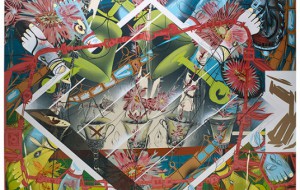
Lari Pittman, "Untitled #1," 2010 © Regen Projects.

In this week’s roundup, Lari Pittman takes over L.A., Trenton Doyle Hancock issues a call to color, Tim Hawkinson explores sustainability, Cao Fei exhibits in Poland, and more!

  • Centre Pompidou (Paris) presents the work of Gabriel Orozco. “The artist moves freely between disciplines, making art in the fields of sculpture, installation, drawing and painting. Orozco is known for his interest in the everyday object as art and his works often lie in the space between reality and artistic creation.” The work will be on display in Paris from September 15 – January 3 and it will conclude its circuit at the Tate Modern London from January 19 – April 25.

  • Lari Pittman takes over both Regen Projects and Regen Projects II in Los Angeles this month for two shows that will showcase 100 of his works on paper that highlight “a cacophony of color, the blending of figuration and abstraction, an intricate and multi-faceted surface, and an expansive and oscillating image field.”  The exhibitions are on view September 11 – October 23, 2010.

  • Cao Fei is one of several artists whose work is being presented as part of Fokus Lodz Biennale 2010 (Poland).  The main exhibition is entitled From Liberty Square to the Independence Square and additional exhibits will take place in a public square, in several locations along a major throughway from September 9 – October 10.

  • Trenton Doyle Hancock issues a call to color by encouraging visitors to bring their own morsels of color – in the form of plastic bottle caps – and drop them into his new site specific, immersive installation, A Better Promise at the Olympic Sculpture Park in Seattle.  “Nine large-scale earthbound vitrines have been placed on the floor in front of the hand sculpture. On the face of each of these nine containers, there is a teardrop cut-out where plastic bottle caps can be deposited by color. Visitors are encouraged to bring plastic bottle caps ranging in all shapes and sizes from detergent bottles, to clear water bottles to the black and white caps from drink bottles.”

Continue reading »

3 Museums, 2 Days (part I of II)

August 30th, 2010

Printed matter juxtaposed in Bidoun's Library at the New Museum. Courtesy of Bidoun.

I. This past weekend I visited three museums in New York City — New Museum on the Bowery, the Studio Museum in Harlem, and P.S.1 MoMA in Queens — if only to get back in the habit of looking at art after a summer of not attending many art events. At the New Museum, I saw the oddly appropriate threesome of Brion Gysin, Rivane Neuenschwander, and Bidoun magazine’s “library” of printed (and some electronic) matter crossing between Middle-Eastern and Western contexts.

The overlapping curation of New Museum’s exhibits was especially apparent in regards to Bidoun which, since 2003, has been a beacon for symbolic exchange and cross-cultural dialogue about Middle Eastern art, and Gysin, whose work finds purchase in Middle Eastern and North African cultural traditions and aesthetics. Among the Bidoun library, one could find materials ranging from North America and European novels depicting Middle Eastern espionage, to magazines from the region tracing events of geopolitical significance. Some of the materials were totally ridiculous, such as the series of romance novels featuring a swarthy “sheik” and his scantily dressed lovers; others represented some of the most earnest, if not loving, attempts by Western writers to encounter the “other,” such as Gilles Deleuze’s and Felix Guattari’s Nomadology, Kathy Acker’s Algeria, and Jean Genet’s Prisoner of Love. Something I found particularly compelling about Bidoun’s library was its ability to focus the viewer’s attention in specific ways, and to activate critical thinking through an assemblage of materials. By spending time with the cover designs of much of the printed matter, I was offered a window into the ways that the Middle East has been imagined (and imaged) by a Western imaginary, and vice versa. I also liked that Bidoun did not attempt to explain the materials, and left explanation — and thus interpretation — in the hands of its viewer/reader.

Continue reading »

New guest blogger: Thom Donovan

August 30th, 2010

Thanks to Meg Floryan for her series of posts on the unmistakable relationship between nature and art.

Up next is Thom Donovan. Thom lives in New York City, where he edits Wild Horses Of Fire weblog and co-edits ON Contemporary Practice. He is a participant in the Nonsite Collective and a curator for the SEGUE reading series. His criticism and poetry have been published widely in BOMB, PAJ: art + performance, Modern Painters, The Brooklyn RailPerforma07, Museo, Fanzine, EXIT, and at the Poetry Foundation’s Harriet weblog. Currently he is working on a collection of critical writings, Sovereignty and Us: Critical Objects 2005-2010, and on the Project for an Archive of the Future Anterior (with Sreshta Rit Premnath). His book The Hole is forthcoming with Displaced Press this fall. He teaches at Bard College, Baruch College, and School of Visual Arts and holds a Ph.D. in English literature from SUNY-Buffalo.

Letter from London: Public Enemy

August 30th, 2010

Brian Griffiths, "Battenberg," maquette, 2010

Public art is rubbish. Starting from that premise is the best possible pre-emptive strike against disappointment. Don’t expect public art to be any good and you’ll be surprised when it actually is. Which it never is. Which it sometimes is. Public art needs its own completely separate language of appreciation from that conventionally used for contemporary art. In a sense, public art is the closest thing we have, in experiential terms, to western religious art of the Christian era: objects and images that form part of the fabric of nearly everyone’s daily experience, noticed or not. Public art might, at best, be a ladder to thought or a rethinking of urban space (although I’m not sure why urban space needs to be rethought; it’s just that you’re always told it should be). For the most part, though, it isn’t. It doesn’t do anything. It’s just there. At best, it may provide a momentary pause between dermatology appointments or a useful meeting spot for a blind date, but it’s rarely much more than that, simply (I’d suggest) because it’s just too embarrassing to be standing stroking your chin contemplatively in a public place. Public art knows this, and tries not to make too many demands on your brain, while making an immediate visual zing that’s useful when you’re giving directions. (Now that there’s SatNav, maybe we don’t need any more public art).

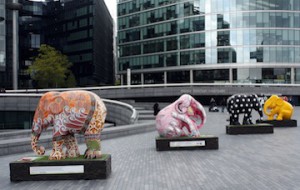
The most exemplary recent example in London was an invasion of squatting brightly coloured elephant sculptures that appeared across parks and plazas, made and sold for an elephant charity. While the charity no doubt does sterling and admirable work, as public art it was sadly symptomatic. Scant of imagination and artistic interest, it just looked a bit sad and wacky, the sort of thing Jerry Garcia might have in his downstairs toilet.

The central pitfall of public art is the word public. Public art depends upon a small proportion of people (funding bodies, government, galleries, museums, and artists themselves) making decisions on behalf of a much larger proportion of people (everyone else). If the decision-making tips more to the benefit of the former, you have Stalinist public sculpture, glowering down at the populace; to the latter, and you have a mealy-mouthed approach that loves to be loved. Both approaches talk down to their audience, in different and equally excruciating ways. But it does work, sometimes, against all the odds. My favorite public works of art from recent times, Tom Otterness’s Life Underground sculptures at the 14th Street and 8th Avenue subway station in New York, are the best possible case for the defense of public art. They can be experienced briefly, enjoyed repeatedly and contemplated leisurely. Nothing about them depends upon the theoretical safety net of the cloistered world of the contemporary art gallery, and they employ a visual language familiar to anyone who’s aware of the Doozers from Fraggle Rock. Their satirical import is pretty self-evident – i.e. creepy cash-bag-headed lobster attempts to separate parents from their child – but the breadth and burlesque of their satire is made necessary by the site itself.

Continue reading »

Gastro-Vision: Eating Your Vegetables Is a Luxury

August 30th, 2010

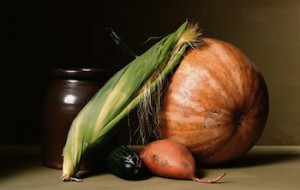
Sharon Core, "Early American, Still Life with Vegetables," 2008. C-print, 16-1/2 x 22-1/4 in. Courtesy the artist and Yancey Richardson Gallery. ©Sharon Core

Gastro-Vision launched last August with a two-part post about the trend in urban farming. Interest in sustainable and local food practices continues to spread among creative types and appears to be gaining momentum. More and more, artists are learning hands-on farming techniques and cultivating their own crops, while artspaces are starting to play host to farmers markets, composting workshops, gardening roundtables, and food residencies. The latest development: an auction of heirloom vegetables to be held at Sotheby’s New York in September.

The Art of Farming is advertised as the first event of its kind “to celebrate edible heirlooms and the art involved in their creation.” An afternoon program of gallery talks on art and food will precede an evening sale of rarities like Turkish Orange Eggplant, Pink Banana Pumpkin, and Lady Godiva Squash, all grown by farmers from the Tri-State area. This all sounds like a good idea, but the asking price of $1,000 per crate? Not so much.

The art world is known for being inaccessible and in this field, outrageous prices are par for the course. (It was Sotheby’s that recently sold the world’s most expensive Warhol portrait at $32.6 million.) Food, however, is a basic human necessity that every living person should have access to. When 49 million people in the United States alone are food insecure, meaning they are unable to afford all the food they need for an active and healthy life, it seems awfully dangerous to associate high art price tags with vegetables, no matter how uncommon they are.

Advocates of sustainable food are often criticized for being elitist, backing policies that could increase food prices, and promoting trendy foods like heirloom tomatoes that, at an average of $4 per pound, are beyond the budgets of many American consumers. If the so-called movement for sustainable, or “good” food wishes to dismantle the idea that eating local is a luxury (as I gather they do), the Sotheby’s event is not helping their case. In fact, it sends the opposite message to the broader public.

To be fair, The Art of Farming is a benefit and intended for a monied audience. It’s also, according to Riddhi Shah of Salon.com, “an event that has its heart in the right place.” The proceeds will aid two reputable sustainable agriculture organizations, and local farmers will have a well-deserved moment in the spotlight of appreciation. “Unfortunately,” Shah continues, “it’s the kind of event that furthers the notion that eating well is an exclusive preserve of the rich.” We can look at the history of art to see that picturing affluence with unusual foods is nothing new. Continue reading »

The Nature of Art: Blueprints

August 27th, 2010

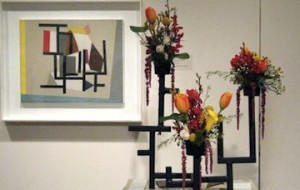
Floral design by the Hopkinton Garden Club, Flora in Winter, Worcester Art Museum, 2009. Image via the museum website. Interpretation of “Untitled” by Ilya Bolotowsky.

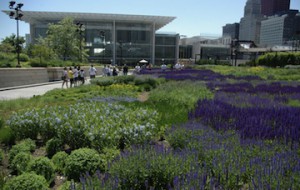
As a visitor walking around an art venue, it’s refreshing and pleasing to stumble across green spaces. Open-air and enclosed courtyards featuring lush vegetation and bubbling fountains, outdoor terraces and cafés, rooftop and sculpture gardens – these snapshots of nature have become de rigueur inclusions in the physical layout of museums and galleries. But how are these spaces used? What are new and creative ways in which museum staff are utilizing these natural areas for events, participatory programs, and exhibitions? Can we foresee the direction of their evolution? To try and answer some of these questions, I have asked Nina Simon, author of The Participatory Museum (2010) and founder of design consultancy Museum 2.0, for an insider’s take on enhancing the visitor experience in these spaces.

Meg Floryan: Art museums are often seen as cold, white-walled institutions with strictly defined areas and rules of behavior. Are you seeing these attitudes and approaches relaxing? That is, do you see it as advantageous for museum layouts to become more or less compartmentalized?

Nina Simon: I definitely see it as advantageous to design museums for diverse use — but I don’t see that being different now than it was ten or twenty years ago. The best museums have always provided people with a range of settings, flooring, and stimulus. For hundreds of years, for example, German art museums have interspersed galleries with window nooks where people could sit and rest their eyes between viewing artworks. The need for a multifaceted experience is nothing new.

MF: What are some of your personal favorite programs or exhibitions that have been staged in museum green spaces? What are your least favorite?

NS: One of my favorite museums in the world is the Louisiana Museum of Modern Art, north of Copenhagen. The museum is an incredible retreat, a fluid indoor-outdoor experience that takes you through winding galleries and rolling hills with incredible views across the sea to Sweden. There’s even a secret garden with installation works carved into the woods — a wonderland for a few intrepid visitors willing to open a nondescript side door. Yes, the Louisiana has great art, but more than that, it’s an inspiring, relaxing experience due to its natural setting and the integration of green spaces into the whole art experience.

Continue reading »

Inside the Artist’s Studio: The Studio Reader and the SAIC Summer Studio

August 27th, 2010

"The Studio Reader: On the Space of Artists," 2010. Edited by Mary Jane Jacob and Michelle Grabner. University of Chicago Press, 2010. Cover illustration: Rodney Graham, "The Gifted Amateur, November 10th, 1962" (detail), 2007. Courtesy the artist, Donald Young Gallery, Chicago; the Rennie Collection, Vancouver, Canada; the School of the Art Institute of Chicago, and the University of Chicago Press. Design by Matt Avery.

The Studio Reader: On the Space of Artists is the kind of book an artist would eat up in a single sitting. It is about the STUDIO — the spaces of artists. Edited by Mary Jane Jacob, executive director of Exhibitions and Exhibition Studies at the School of the Art Institute of Chicago and Michelle Grabner, artist, writer, and founder/director of The Suburban artist-run project space in Oak Park, Illinois. In its own words:

The Studio Reader pulls back the curtain from the art world to reveal the real activities behind artistic production. What does it mean to be in the studio? What is the space of the studio in the artist’s practice? How do studios help artists envision their agency and, beyond that, their own lives? This forward-thinking anthology features an all-star array of contributors, ranging from Svetlana Alpers, Bruce Nauman, and Robert Storr to Daniel Buren, Carolee Schneemann, and Buzz Spector, each of whom locates the studio both spatially and conceptually—at the center of an art world that careens across institutions, markets, and disciplines. A companion for anyone engaged with the spectacular sites of art at its making, The Studio Reader reconsiders this crucial space as an actual way of being that illuminates our understanding of both artists and the world they inhabit.

This book dissects the notion of the studio space and takes you on a journey of discovery. If you’re an artist, when you are done with it, you’ll feel the urge to get up and put it to work by re-orienting yourself in your familiar surroundings. If you’re a curator, a critic, or someone who indulges him/herself in studio visits regularly, The Studio Reader will inform your visits both physically and intellectually.

It is a useful tool that got me thinking quite a bit about the kind of artists’ studio visits I do here, as well as my about own studio space in Athens and the way I utilize it. In 2009, Inside the Artist’s Studio set out to discover where some of today’s art is being made. A book like The Studio Reader takes us forward on our quest.

So I have The Studio Reader in hand, back in a familiar place which almost feels like home – the School of the Art Institute of Chicago and specifically the Summer Studio residency program at the Sullivan Galleries, where I’ve been an artist-in-residence for the past two months working on a research-writing project.

The Summer Studio occupies a vast, open 20,000 sq. ft. space on the 7th floor of the Carson Pirie Scott building in downtown Chicago. The truth is that it is not the work itself that activates the Summer Studio, nor the “stuff” that fill up the space, but it is the intellectual wealth each of us brings into this communal setting. And that became evident as I studio-visited my peers throughout this two-month period. Artists do have a creative aura that’s manifested in physical space, and the space one inhabits is determined by one’s own creative ambitions or limitations. So how much room does an artist’s creative energy take and how does a residency program achieve creative balance within such a space? Well, that’s the challenge at hand.

Assistant Curator of the Sullivan Galleries Kate Zeller tells us more about the program and the way in which the studio boundaries at the Summer Studio were being pushed all summer long. In addition, she discusses the Process in Product: Work from Summer Studio exhibition (August 28 – October 2), best described as an open invitation for rethinking the “studio” in its entirety.

It is my pleasure to end the summer in the company of Mary Jane Jacob, Michelle Grabner, and Kate Zeller.

Continue reading »

Crafting a Moment

August 26th, 2010

Red waterfalls hang frozen from tarnished candelabra arms above hardened wax puddles joined permanently to a floral cloth. Dew collects on the open mouths of emptied wine bottles as cool morning air washes over the garden table and chairs occupied only hours before. Recently, two close friends and I have been getting together over dinner to talk about art and enjoy each other’s company. Every one of our meetings has been intimately set with just the three of us alone in a garden. On top of candles and wine adding to the atmosphere, the dinners were timed almost magically to correspond to the sunset, making each encounter seem unique and magical. On the morning after these get-togethers, my mind often wanders, ruminating on the conversations of the previous evening. This time I started to think about craft even before the meal ended. Not just craft as it relates to weaving and carving, but a broader definition that can include crafting an idea or situation. This summer, each setting of the table and planning of the menu was done with intention. These experiences were crafted not only to feed our appetites, but also to nurture our comfort, friendship, and conversations.

Pual Outlaw at his studio bodega at Cranbrook Academy of Art. Photo courtesy of Monica Breen.

Since moving to Cranbrook Academy of Art, relationships created in the name of art have been floating around in my periphery. Several critiques and art events I attended this last year were centered on objects and scenarios aimed at bringing people together. Just last week, two Cranbrook alumni, Paul Outlaw and Jennifer Catron, were written up in the New York Times for their newest artistic endeavor—a ­mobile fish fry truck that has made appearances in Brooklyn teaching city residents how to eat southern-style crawfish. The project creates a specific experience, combining a little of Catron and Outlaw’s spectacle with the weirdly exclusive feeling of being served out of the back of a truck. This seems to have the purpose of helping participants to bond.  With the same quirky flair, Outlaw also ran a bar called Exclusions and, a few years earlier, a bodega in his studio that served as a space for students and faculty to spend their bucks and get to know each other during his time at Cranbrook.

Continue reading »