Not Playing the Patsy

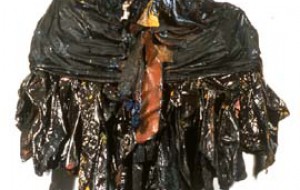
Two of my favorites in the Whitney Museum's Collecting Biennials show: Mike Kelley, "More Love Hours Than Can Ever Be Repaid" and "The Wages of Sin," both 1987
Sometimes certain quotes hit you in a way that make you think and rethink… Here’s one I came across recently from Mike Kelley in Press Play: Contemporary Artists in Conversation:
I think that the practice of art is an examination of visual communication. People have to recognize visual culture as a constructed language, a language that acquires meanings through its construction. The art viewer should not simply be a patsy who performs a set of knee-jerk responses in reaction to a set of visual conventions. Art should be more complex than that.
Kelley’s quote makes me think of two things.
First it makes me think about how often we’re in the position of playing the patsy. Rather than investigate work and come up with meaningful questions, we get sucked into a shopping mall culture of looking (vs. seeing) and deciding whether something is “good” or “interesting” (a word I’m disliking more every day since it’s often used as a cop out).
Second, it makes me think about Bruce Dorfman, a wonderful artist, teacher, and mentor I had at the Art Students League many years ago. He would talk about the difference between complexity vs. complication. Being complex can engage the viewer while being complicated can alienate. Complex work has layers to explore- layers of meaning and perhaps material. Complicated work leaves the viewer with too many questions and inevitably a shoulder shrug of indifference.
One of the challenges we face as artists and educators is to create and share work that is perhaps complex, but not too complicated. We also face the constant challenge of not playing the patsy in and out of the classroom. Modeling ways of engaging with works of art is part of a rounded art education, particularly in high school and college.
Lives and Works in Berlin: The Sommerpause Art Guide

Nothing spells houseguest season like late-August in Berlin. With school about to resume and the major art metropolises shut down for summer, the town becomes besieged by the event hungry. But with most galleries closed, museum blockbusters wrapped-up, and the usual array of talks and screenings, the question looms: what do you recommend for guests? For those art tourist hosts shrugging their shoulders, and for visitors, who may or may not have art savvy hosts, here is a cursory round-up to keep you occupied until September.
ON VIEW
Closing this Saturday is the Glasgow School of Art’s MFA International Exhibition Definition Article at Kunstraum Kreuzberg and from last year’s Glasgow graduating class is Kate V Robertson with her show, Pieces, a sculptural dialogue with art history’s generic leveraging of meaning on view at FEINKOST through September 5.

Darri Lorenzen & Lan Hungh, "3D Renderings of Hangers" (2010). Courtesy of the artists.
Chiming into the art historical debates with a carton of readymade hangers found en-route to the exhibition’s inaugural meeting, and a lot of research, is Lan Hungh and Darri Lorenzen‘s final product, RPLCMNT, on view at Savvy Contemporary until September 11.
Also not to be missed are Yinka Shonibare MBE’s masterful Victorian dandies at Friedrichswerder Church and ArtForum’s Berlin picks: Mona Hatoum’s Käthe Kollwitz Prize exhibition at the Akademie der Künste and Liam Gillick’s 1848!!! at Esther Shipper. Continue reading »
Frances Whitehead, Embedded Artist

What do artists know? A few weeks ago, I spent an afternoon at the Chicago home of Frances Whitehead talking about the philosophical and pragmatic underpinnings of this question. To be sure, the notion that artists have a specialized knowledge — a quantifiable skill set of processes, methodologies, and approaches that they carry with them into the world — makes some people, even artists themselves, a little uncomfortable. But for Whitehead — a sculptor, gardener, professor (she has been on the faculty of The School of the Art Institute of Chicago since 1985), and self-identified “designist” (a linguistic mashup of the terms artist and designer) — it’s a liberating idea that has allowed her to situate her own practice within an expanded field of inquiry that engages sustainability, public works, and the future of design.
Whitehead is an enthusiastic proponent of the idea that an artist’s cognitive tool box is unique — and uniquely valuable — not just to “the art world” but to the world at large. To this end, she’s spent the better part of a decade researching, quantifying and articulating on both personal and professional, theoretical and pragmatic levels, the question of how artists can successfully engage practitioners in other fields in order to “get a seat at the table,” as she puts it. She’s come up with a document that she calls “What do Artists Know?” that she thinks of as “a knowledge claim.” It consists of a bullet-point list of specific “skills, processes and methodologies” that many contemporary artists possess, all of which were culled from observations made by Whitehead’s colleagues in design, planning, engineering, and other non-fine art fields over the years. Continue reading »
The Nature of Art: Footprints

Renzo Piano Building Workshop, Modern Wing of the Art Institute of Chicago, 2009. Image via Flickr. Photo by Andrew Ciscel.
It’s hip to be high-minded these days. In the cultural spheres, showing awareness of environmental concerns can prove to be a savvy PR move, and architectural firms and museum committees have taken note. Eco-friendly design in natural history and science museums is not, in this day and age, surprising at all, and art centers are increasingly taking their cue from construction successes across the country. The planners, designers, builders, check-writers — all have a keen eye toward fusing the architecture with the land, and for decreasing ecological impact through cutting-edge green technology.
On the aesthetic side, there is a rising push for integrating the walls of museums with the natural elements of their physical site. Diller Scofio + Renfro’s previous projects — notably their daring design for Boston’s Institute of Contemporary Art, which takes full advantage of harbor waterfront views — seem to have paid off, as the firm is the rumored frontrunner for masterminding has been selected to design Eli Broad’s new museum. Alice Walton’s Crystal Bridges Museum of American Art, which just broke ground in Arkansas, features sweeping panoramas of the surrounding ravine, or what architect Moshe Safdie calls “responding to the essence of place.” Shigeru Ban’s proposed design for the new Aspen Art Museum will similarly react to and highlight the natural landscape setting. Continue reading »
Weekly Roundup
As summer 2010 winds down this week’s roundup gets ready for an exciting fall season when Mark Dion embarks on an expedition in Oakland, Andrea Zittel lands on the Portland Art Museum front patio, Cindy Sherman steps out in Balenciaga, and Matthew Ritchie and Trenton Doyle Hancock gear up for Super Bowl XLV and more!
- The Portland Institute for Contemporary Art presents a live, audiovisual collaboration between Charles Atlas and musician/composer William Basinski as part of the Time-Based Art Festival. “This is a rare chance to see a virtuoso performance from Atlas — a pioneer of the integration of live video with stage performance known for acclaimed collaborations with Michael Clark, Leigh Bowery and Merce Cunningham — and New York experimental media musician and composer William Basinski. — forma.org” The festival will run September 9-19.
- Miradas: Mexican Art from the Bank of America Collection, organized by the National Museum of Mexican Art in collaboration with Bank of America, includes work by Gabriel Orozco. The exhibition will be on view September 10, 2010 – January 9, 2011 and is comprised of “the most extensive corporate collections in the U.S. and takes a close look at the paintings, prints and photographs created over the past 80 years.” Continue reading »
The Nature of Art: The Bigger Picture
We’re accustomed to porticoed Greek temple-style museums, white-walled galleries, conspicuous label texts, a high level of organization, and clearly-defined thematic spaces. For those of us who are city-dwellers, we expect outdoor public art to remain confined to our meticulously landscaped parks. When art projects unexpectedly seep out of these borders — which they increasingly do — the result is often surprising and delightfully engaging, redefining our environment as the ultimate museum, and promoting creative efforts as approachable and fun exercises to be found around any corner.
Here I consider the natural world as the physical setting for art. “Natural world” need not necessarily mean, however, the untamed wild, but any site upon which humans build the basis of their lives. Cities are prime hubs for inventive initiatives: whether it be in the form of waterfalls, icebergs, or elephants on parade, art has the unique magical power to transform our mundane man-made environment into that of an urban jungle.
Some open-air art exhibitions can reflect social concerns and encourage change, as did the many eco-focused projects — from Angela Palmer’s Ghost Forest, to Mark Coreth’s Ice Bear, to Millennium ART’s CO2 Cubes — planned around last winter’s UN Climate Change Conference in Copenhagen. The event inspired a virtual explosion of art, practically converting the country into a cultural institution capable of city-wide curation, and featuring an impressive array of work both official (the RETHINK: Contemporary Art and Climate Change exhibition at the National Gallery of Denmark) and unofficial (Banksy’s I Don’t Believe in Global Warming graffiti). Other projects are less morality-based, and involve a more light-hearted, whimsical approach; notable examples include tracking designer chair envy (the Blu Dot Real Good Experiment) and Luke Jerram’s ongoing Play Me, I’m Yours venture in impromptu musical performances. Continue reading »

Furries reclining in Marnie Weber’s “Furry Womb” at “A Night of Growth and Discovery.” Image via For Your Art.
Last month, I opened my email to find a “Call For Furrie Interns.” The call came from LA artist Marnie Weber and was forwarded to me by a mutual friend who thought of me “for some reason.” Naturally, I jumped at the opportunity. I soon found myself at furrie rehearsal, amongst a group of bright-eyed and soon-to-be bushy-tailed volunteers. We each chose from a selection of 12 mascot-style animal costumes, and while I was tempted by the elephant and cow costumes, I immediately felt at home — perhaps too at home? — in head-to-toe parrot regalia.
Weber conceived the furrie performance/installation as part of A Night of Growth and Discovery — an extravaganza benefit for the Pasadena-based nonprofit, West of Rome Public Art. The happening was to take place amidst the collaborative installation by Mike Kelley (Season 3) and Michael Smith, which has been on display all summer in Kelley’s mammoth 15,500 square-foot studio. Weber’s piece would be one of several works and performances created especially for the benefit, as a complement to the Mike and Mike installation. Weber instructed us to offer our fuzzy bodies up to guests for hugs, pets, and dances, but “nothing sexual.” We were also encouraged to behave as though we were in the midst of our own ecstatic voyage of growth and discovery.

Michael Smith & Mike Kelley, “A Voyage of Growth and Discovery” (2010) West of Rome; installation, Fredrik Nilsen. Via Los Angeles Times.
The Nature of Art: On Closer Inspection

Waldemar Smirnov of the Fraunhofer Institut Angewandte Festkörperphysik, Germany, “Squaring the Circle,” 1st place winner of Materials Research Society “Science as Art” competition (2009). Image courtesy of MRS. Crystalline diamond grain anisotropically etched by spheres of molten nickel.
Popular opinion concerning the relationship between technology and the environment is of great interest to me; my own graduate research focused on its treatment in mid-century American children’s book illustration.
If you think about it, the junction between science and nature in fine art – that lovely gray area blending mechanical precision with mysticism and ambiguity – actually makes perfect sense in our current world. Contemporary art has always served as a solid podium for creative voices looking to hold a mirror to social conventions and lifestyles, to reflect the modern mind. Never have our lives been so dominated and guided by the progress of technological advancement; just note how most of us are fully armed with Steve Job’s arsenal of Apple products. We’re constantly plugged in, tuned in, streaming, uploading, and downloading, and tech offers ever-expanding platforms through which to express ideas and experiment with new ways of looking at our environment.
Perusing science and medical journals, one might think it surprising that the stunning high-definition images do not qualify as works of art. In fact, they do, at least to some, and the mounting interest in the art of such research has led to an array of contests founded to reward these aesthetic accomplishments – veritable art fairs for the scientific community. The Materials Research Society launched their Science as Art competition in 2005, offering prizes to winning entries on a biannual basis. The MRS website sums up the thinking behind such contests:
Occasionally, scientific images transcend their role as a medium for transmitting information, and contain the aesthetic qualities that transform them into objects of beauty and art.
Solid Sound
Is sound an element of design right alongside biggies like line, color, shape and texture? Teachers today are faced with the unseemly job of breaking outside “the” seven elements of design many of us grew up with, and now must educate students about a range of additional elements one really can’t skirt if you’re teaching with contemporary art.
Sound as an element of design was front and center at MASS MoCA this weekend as Wilco’s Solid Sound Festival hit North Adams, MA, and basically took over the town. What was impressive, along with the variety of bands featured, was the way sound created unique experiences as and with art throughout the museum, rather than serve as a backdrop to objects. Nels Cline’s installation on the second floor allowed visitors to sit and manipulate over a dozen electronic effects boxes and create waves of distortion, vibration, pulsation and other ations I won’t even mention here. I found myself creating a whole concert with a child across from me that couldn’t have been more than eight years old. We had a ball! But the placement of this installation next to (underneath) Tobias Putrih’s Re-projection: Hoosac made the dialogue between these works even more beautiful. The changes in volume, rhythm, and overall noise allowed for experiencing Putrih’s wall-to-wall sculpture in different aural settings depending on when you came through the gallery (for the purists at the festival, the installation was only turned on for 30-minute increments on the half hour, rather than having it running full time… and you needed a breather if you were making a lot of that kind of music).
Artists who use sound as a primary element such as Bruce Nauman and Christian Marclay allow us to consider it as an element of design that helps get an idea or experience across. Sometimes it is supported by other elements such as color or texture and sometimes it stands on its own. Becoming familiar with art and artists using sound in a wide range of settings has become part of what art educators need to consider when teaching about art today.
Life After MFA…What Next?

As summer wraps up, I’m slowly packing my bags and getting ready to move from the sunny coast of Marseille back to beautiful Montreal, where I will have to prepare for that ‘TBA’ thesis exhibition. When things are about to come to an end, I cannot help but ask myself if my MFA experience was worth it? These questions about my life, mainly, my post-MFA life, are constantly at the back of my mind. The prospect of being jobless and carreerless is something that scares me. I would honestly prefer to write about something more peppy, lively, and exciting, but the problems of a career search is a process that most MFA’ers will likely encounter at some point. Why not discuss it openly? So, here are my questions: What will happen to me after I finish my MFA? What will become of my art career? Will I even be able to have an art career? WHAT’S NEXT?

What is an MFA?