
Enjoying the Steps

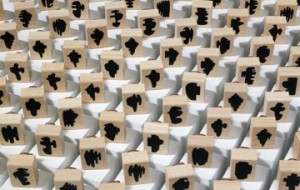
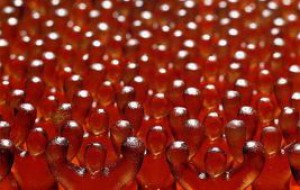
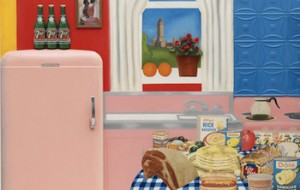
Allan McCollum, The Shapes Project: Shapes From Maine (Shapes Rubber Stamps) 2005/2008 Courtesy Friedrich Petzel Gallery
Recently I have participated in a few discussions that relate to teaching students about slowing down and examining their process in order to create quality works of art- works that are more than exercises or quick fixes to visual problems. Even this past Monday evening two of our current Art21 Educators, Cynthia Schubert and Lauren Taylor, brought up the challenge of not rushing students through units of study in order to “get to the project”. But how do we get students to enjoy process as much as creating the final product? Should we even try?
Students need to be conscious of what and how they plan in order to make good decisions. They need to be taught, through a different kind of classroom culture, that the journey is indeed important, along with the destination. Leaving a trail of breadcrumbs through sketching, keeping visual journals, taking risks with media, and having all kinds of discussion are some of the ways we can train students to decelerate and take note of the steps involved in making dynamic works of art.
But it doesn’t have to end there.
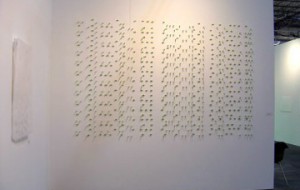
Taking a field trip to a museum, gallery, artist’s studio or public space to examine how and why certain works of art are as much about process as they are the final product is another way. Exploring a collaborative project in depth is still another. An example would certainly involve two exhibits since 2006 at Friedrich Petzel Gallery featuring The Shapes Project and Shapes from Maine by Allan McCollum. The gallery press release from 2006 states:
Working over the past few years, McCollum has designed a new system to produce unique two-dimensional “shapes.” This system allows him to make enough unique shapes for every person on the planet to have one of their own. It also allows him to keep track of the shapes, so as to insure that no two will ever be alike.
For the time being, around 214,000,000 of the shapes have been set aside for creative experimentation. These can be used for many different purposes — not only for fine art and design projects, but also for various social practices: as gifts, awards, identity markers, emblems, insignias, logos, toys, souvenirs, educational tools, and so forth. The shapes can be printed graphically as silhouettes or outlines, in any size, color or texture, using all varieties of graphics software to build, carve, or cut the shapes from wood, plastic, metal, stone, and other materials.
The basic system for making the shapes is now complete, but the project of actually constructing all of them is much too large for McCollum to finish by himself, or in his own lifetime. For this reason he is organizing it in such a way that others may continue completing them in his absence. He is also making shapes available to others, with the hope that people will come up with many interesting ways to use them.
Life After MFA…The PhD Option?
After reading my fellow blogger Oliver Wunsch’s interview with George Smith, the founder of the Institute for Doctoral Studies in Visual Arts (IDSVA), I began thinking about a PhD in Visual Culture, especially knowing that in few months I’ll be wrapping up my MFA. I’m still looking for ways in which I can make my post-MFA life practical. So I’ve been looking at my options, studying and researching them. One of the ideas that I’m currently entertaining is the pursuit of the doctorate degree where I can get feasible support from SSHRC (Social Sciences and Humanities Research Council), which offers Canadian candidates fellowships between $5,000 to $35,000 that is renewable per annum to research and create. This doesn’t sound like such a bad idea to be funded to go to school, considering the economy is still perturbed and finding meaningful work in the art world is not easy. Plus, Canada has two relatively new programs at York University and University of Western Ontario that bring together a studio practice with a theoretical component, which sounds ideal for someone like myself who writes and makes things. However, I remain hesitant about this subject matter, because I keep asking myself whether I am willing to commit to another four to five years of school? I’m certain that a PhD might make me into a more well-rounded human being, but what about experiencing the art world from a first person point of view? In this increasingly economically driven culture what will a PhD do for me? Do I need a PhD to be a better artist?
How NOT to Approach a Curator
The first year after opening Hotcakes, was a blur. Locally, the gallery was getting a ton of great press, and after being a part of the Stray Show, Thomas Blackman’s more adventurous satellite fair during Art Chicago, artists started coming out of the woodwork to show at the gallery. One to five artists, from all over the world, would contact me every day. Needless to say, it was totally overwhelming, and artists continually found new and creative ways to overstep every possible boundary.
In the beginning, I was a total pushover. Some guy would come into Hotcakes and after looking at the art for two minutes and complementing my artistic vision for ten, he’d mention that coincidently he was also an artist. That his work would fit perfectly into my very clear mission to present affordable art in a comfortable environment in order to grow a group of young art collectors in Milwaukee. I’d earnestly tell him I was excited to see his art. I’d explain that he should send me 10-20 images of his work, an artist statement, and a list of past shows, and that he could click on the “Show at Hotcakes” link on the gallery’s homepage to get a better idea of exactly what I was looking for.
Then he’d start giving me the hard sell. Say that slides didn’t do his work justice… I needed to see his paintings in person… His work was totally unique… Would change my life. That he lived just a couple blocks from the gallery, and it would only take 10 minutes. Admiration quickly turned into not so subtle statements suggesting that I was some sort of bourgeois prick who didn’t really care about artists at all. Before I knew it, I’d be sipping Two Buck Chuck out of a handmade ceramic mug in some guy’s attic, staring at 40’x10’ surrealist paintings of the astral plane that he was willing to let go for as low as $18,000 each (before my commission, of course). An hour later and only an eighth of the way through his rooftop retrospective, I would have to leave cause his three cats, that had obviously NEVER been brushed, were making my nose run so badly.
Four for Fall
Traditionally, fall is the time when galleries launch their new slate of exhibitions after a relatively slow-paced couple of summer months. Galleries tend to highlight some of the most prominent artists on their roster around this time, but it’s also common to use the Fall slot to introduce promising new up-and-comers. In Chicago, at least, all the hoopla around the fall openings (many of which took place on a single night several weeks ago) can feel a lot like a high school pep rally: the anticipatory fall preview lists and gallery guides, the minutely detailed gallery crawl maps and the inevitable “best of” Tweets that follow are ways of rousing ourselves from the complacencies of summer in order to get psyched for the upcoming art season.

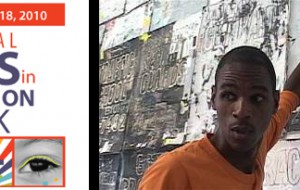
Kehinde Wiley, "Female Fellah," 2010. Oil on canvas, custom wood carved frame, 45 x 36 inches, 50.75 x 41.75 inches – framed.Courtesy Rhona Hoffman Gallery, Chicago.
All hype notwithstanding, fall invariably works its magic on me. I struggle with lazy gallery-going during the summer (and, let’s be honest here, sometimes during springtime too) yet feel a sense of urgency about seeing everything once September rolls around. I’m pleased to report that my efforts have been richly rewarded this season. There are so many interesting shows, and quite a few really excellent ones, taking place in Chicago right now there simply isn’t space to do justice to all of them here. Let’s start with exhibitions by two artists who were recently interviewed on Bad at Sports‘s podcast. Kehinde Wiley, on view through October 23 at Rhona Hoffman Gallery, presented the latest iteration of his ongoing project World Stage: a series of portraits of young men of color from various cities around the world. Here, we find Wiley focusing on anonymous men from New Delhi, Mumbai and Sri Lanka, as opposed to the well-known rappers and athletes that had occasionally peopled his portraits in the past. Found through on-site “street casting,” Wiley’s subjects pose for photographs that the artist then transforms into grandly scaled history paintings; in so doing, Wiley points out the concerted omission of men of color from art history’s “world stage.”
During Wiley’s discussion with Bad at Sports’s Duncan MacKenzie, Richard Holland, and guest interviewer Dr. Amy Mooney of Columbia College, the artist claimed that his young male subjects actively participate in their own representation through their choice of accoutrement and setting. In this way, Wiley argues, his subjects “have agency” because they can determine the roles they play in their own fictionalization. But Wiley also admits that he has the final say: “the work is manipulated through digital means…the actual painting is where it really ends.” For my part, I’m still on the fence with regards to Wiley’s paintings, which tend to feel mechanical and, overall, a bit too slickly conceptual in their execution. Yet what I liked about this particular group of paintings was the sense of vulnerability and wary discomfort with our (and presumably Wiley’s) gaze these men seem to evince through their facial expressions, despite all the Photoshop machinations Wiley puts them through by the time they get to us. There are hints of real individuals here, buried under all the digital wallpaper and decorative filigree.
Owning an Art Gallery Was Something I Fell Into
From February of 2004 to August of 2008, I was the owner and curator of Hotcakes, but owning an art gallery was really just something I fell into.
I was living in this old furniture warehouse a couple miles southwest of downtown Milwaukee that had been converted into live/work space for artists. I was paying my bills by doing freelance web design for local nonprofits and friends who were trying to start up small businesses. I set up desks in my loft, so it looked more like an office than an apartment, but it was still awkward bringing clients into a space that had a queen-sized bed in it. For months, I kept thinking that if I had a dedicated studio, I would be able to hire some interns and expand my business.
I just didn’t have enough work to justify the extra expenses of even a small commercial lease. I was also Executive Director of the Milwaukee Artist Resource Network (MARN) at the time. MARN is a nonprofit arts-service organization I founded with five other artists in May of 2000 to provide business and educational resources for literary, performing, and visual artists. In the early years, the founders worked hard to bring together all the little cliques of artists around town, advocate for artist-friendly legislation, and be the one-stop shop for Milwaukee arts information. We held networking events, exhibitions, and professional development workshops around Milwaukee, but MARN was primarily known as an online resource because of the hundreds of artists that used our website and listserv everyday.
As Executive Director of MARN, I fielded a lot of phone calls and emails from artists new to the city who were looking to connect with the local arts community, or just looking for inside information on where to live and find cheap studio space. I would often tell them about a handful of events I planned to go to over the next couple weeks, and invite them to meet me there so I could introduce them to a bunch of other artists. Milwaukee’s arts community is like a big family now, but it can seem insular to newcomers. If someone isn’t brought in and made a part of the local arts scene within their first six months in a city, there seems to be little hope of them sticking around.
At the end of the summer of 2003, a painter who grew up in Milwaukee, went to art school on the East Coast, and moved back to town, emailed me with questions about the art community. I had Susie meet me at an art show in Riverwest, the in-transition neighborhood where most of the artists in Milwaukee live, and she told me about a 1300 sq. ft. storefront studio she found nearby for only $300 a month. When she asked if I knew anybody who was looking to share studio space, I jumped at the opportunity.
Weekly Roundup
In this week’s roundup, abstraction is the theme, with James Turrrell on view in Brussels, Sally Mann preparing to push boundaries, while Allan McCollum’s work is on view as Jessica Stockholder co-curates, Mike Kelley and Arturo Herrera are keeping it real, and more.
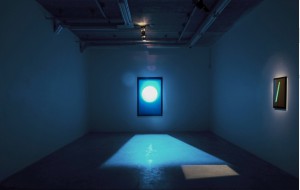
- Almine Rech Gallery (Brussels) is currently exhibiting a James Turrell retrospective that engages viewers’ visions of light, matter, color, shape and explores the role of the spectator in the gallery installation/exhibition space. The exhibition is on view until October 21.
- Allan McCollum joins several artists whose abstract artworks were selected for The Jewel Thief, a new exhibition at the Tang Teaching Museum and Art Gallery at Skidmore College. The exhibition closes on February 27, 2011. Jessica Stockholder co-curated The Jewel Thief with Ian Berry and they were interviewed about how the exhibition was organized.
- Carrie Mae Weems will join curator Deborah Willis for a discussion about the contested perspectives of African and African American beauty as part of Posing Beauty, currently on view at the Williams College Museum of Art. On October 21, the museum will host this free event at the Brooks-Rogers Recital Hall. The exhibition is on view until November 21, 2011.
- Laurie Anderson premiered her latest stage piece, Delusion, at BAM (Brooklyn), the first of 12 performances. The work launched BAM’s Next Wave Festival that was previewed by the Wall Street Journal.
New guest blogger: Mike Brenner
Thanks to Stefan Zebrowski-Rubin, who provided a generous overview of the contemporary art and artists in Montreal.
Up next is Mike Brenner. An Open Enrollment alumnus, Mike attended the Bauhaus-Universität, holds a B.F.A. from the Milwaukee Institute of Art and Design, and an M.B.A. from the University of Wisconsin-Milwaukee. Previously, he ran the Milwaukee Artist Resource Network (2000-9) and Hotcakes Gallery (2003-8). Brenner is studying to be a Brewmaster in Chicago and Munich while working to open a brewery providing local artists and musicians with employment and affordable studio space.
Making the Most of It

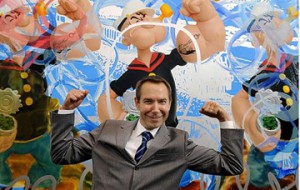
Jeff Koons at "Popeye Series" opening at Serpentine Gallery, London, 2009. Photograph courtesy the "London Evening Standard."
I’ve always thought of artists as romantic creatures. Their desires are truly unlike those of any other profession in the world. While many people work their way up in careers that they may or may not enjoy in order to have the comfort and security of a regular income, I have always viewed artists as people who do what they love — not for the money, security or status — but because their obsession with creating means that taking away their paint, brushes, and canvases would be the same as taking water from a person dying of thirst. A great modern example of this was shown in the Doctor Who episode “Vincent and the Doctor,” where the Doctor travels back to 1890 and meets a humble Vincent Van Gogh who confesses that his works have little value to anyone but himself. Fast forward (past the many intricacies of an unusually touching plot), and the Doctor brings Van Gogh to the Musée d’Orsay in 2010 so Van Gogh can hear an art historian describe him as “the greatest painter of them all.” This, to me, is the epitome of the artist’s struggle and poignantly echoes my personal belief that artists, whether their art is valuable in the art market or not, simply cannot stop creating because of an internal artistic drive that is as familiar to them as breathing.
In today’s modern world, with such a large number of outlets through which new artists can exhibit and market their work, the artist’s struggle is perhaps not as difficult as it was during the 1800s. However, it would be ignorant to claim that it doesn’t exist at all, and I know of very few artists who can dedicate 100% of their time to their work without having to supplement their income in other ways. And that’s where the magic is – in that drive that says “you’re not doing this for fame or money, you’re doing this because you can’t not do it.” But what about artists who can do it, but choose not to?
Krzysztof Wodiczko: Peace
SUBSCRIBE TO EXCLUSIVE: RSS | ITUNES | YOUTUBE | ARTBABBLE
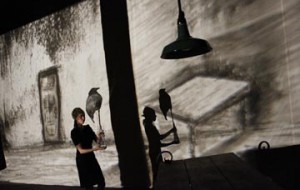
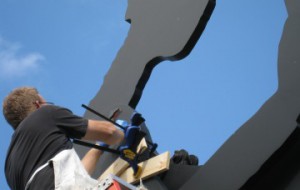
Episode #121: “You cannot work towards peace being peaceful” says artist Krzysztof Wodiczko, who explains this paradoxical position in terms of his personal experiences growing up in Poland under communist rule. Filmed at the Center for Advanced Visual Studies at MIT in Cambridge, Massachusetts, Wodiczko’s interview is punctuated by the sound of sirens from outside, the city in a state of “full alert.”
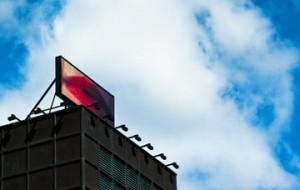
By appropriating public buildings and monuments as backdrops for projections, Krzysztof Wodiczko focuses attention on ways in which architecture and monuments reflect collective memory and history. Projecting images of community members’ hands, faces, or entire bodies onto architectural façades, and combining those images with voiced testimonies, Wodiczko disrupts our traditional understanding of the functions of public space and architecture. He challenges the silent, stark monumentality of buildings, activating them in an examination of notions of human rights, democracy, and truths about the violence, alienation, and inhumanity that underlie countless aspects of social interaction in present-day society.
Krzysztof Wodiczko is featured in the Season 3 (2005) episode Power of the Art in the Twenty-First Century television series on PBS. Watch full episodes online via PBS Video, Hulu, or iTunes (link opens application).
VIDEO | Producer: Wesley Miller & Nick Ravich. Interview: Susan Sollins. Camera: Gary Henoch. Sound: Steve Bores. Editor: Joaquin Perez . Special Thanks : Catherine Tatge, the Center for Advanced Visual Studies, and the Massachusetts Institute of Technology (MIT).
MontreART
Last August, Travel+Leisure ran the article Magnificent Montreal, in which Adam Sachs attempted to sum up Montreal, saying “it’s a college town, a dump, a city of art, placid parks, islands rigged for play and diversions, gray insular urban neighborhoods, and colorful suburbs. It is tiny by megacity standards but world-class in its weirdness, in its shifting, enduringly comfortable indigestibleness.” Many of the pronouncements are questionable – Montreal is hardly a dump (although it has some seedy areas) and its urban neighborhoods are neither gray nor insular (although they can be during our long frigid winters). Architectural historian François Dufaux, in that same article, aptly called Montreal “an imperfect America and improbable Europe.” Sachs does ultimately get it right in saying that the city defies classification.
In my conversations with the 8 artists I’ve written about in this series, Montreal shines in its vibrancy as a city that both fosters artistic production and encourages a great lifestyle. This city, with its slightly tumultuous history of linguistic divide, seems to be entering a time where there is a more effortless mélange of English and French. There is also a richness to the city because of its tight-knit integration of ethnicities (in Canada, the diversity metaphor isn’t so much a melting pot as a tapestry). Vida Simon summed it up best: “Montreal has such an inspiring texture, unlike anywhere else.”
There is a spirit to Montreal, a jouissance to life in the city often called the Paris of North America (although it also garners comparisons to Boston, Berlin, New Orleans…). Because of its diversity — linguistic and ethnic — a more liberal and tolerant attitude filters through the demeanor of Montreal’s citizens. This openness translates to the arts, as Cindy Poremba of Kokoromi Collective expressed, “people here seem to be much more open to seeing art of different types. They are willing to try things and get involved.” On the whole, there seems to be an interest and investment in the arts.