Making Sense of Interdisciplinary Practice (Art, Space + Nature=?)
Art Space + Nature is a unique, interdisciplinary course that was started in 2003. Seven years later, the course’s objectives continue to be in a flexible and formative state. Unlike most degree courses, which are classified by formalist media (i.e. sculpture, painting, printmaking, etc) Art, Space +Nature’s trans-departmental qualities make it difficult to describe. The program is run through Edinburgh College of Art’s School of Landscape Architecture and was created in collaboration with the department of Painting and Drawing. The goal of the course is for artists and architects to engage with the landscape and built environment through both research and fieldwork exercises. The program runs with minimal access to studio space, promoting students to work outside of the college and often in international contexts.
Art, Space + Nature, more commonly referred to as ASN, does not identify with a particular artistic medium; there are no required classes or reading lists. The day-to-day structure is completely determined by the current students, which consists of a diverse body of architects, landscape architects, and visual artists.
Weekly Roundup
In this week’s roundup: Kim Kardashian wears Barbara Kruger, Collier Schorr makes art about a German village, Jeff Koons works from popular archetypes, several artists are in group shows, and more.
- Barbara Kruger collaborated with W magazine to display Kim Kardashian dressed only in the art of Kruger, who worked on the front cover for the November 2010 Art Issue.
- Video installations by Arturo Herrera and Catherine Sullivan are featured in Adaptation at the Philbrook Museum of Art, which explores work by video artists who have adapted original material to create new works by re-envisioning classic literature and other forms of media. This work is on view until January 9, 2011.
- Works by Bruce Nauman, Cindy Sherman, and Yinka Shonibare MBE, among other artists, are part of Lust and Vice: The 7 Deadly Sins from Dürer to Nauman at Kunstmuseum Bern (Switzerland). The exhibition presents works of art related to the seven deadly sins from the Middle Ages to the present and is on view until February 20, 2011.
- Sculptural Paintings which features work by artist Judy Pfaff is on currently on view at Braunstein Quay until November 6.
Considering Gravity’s Loom: A Discussion with Ball-Nogues
The day after Ball-Nogues Studio’s installation, Gravity’s Loom, opened at the Indianapolis Museum of Art, I had the opportunity to talk with Benjamin Ball and Gaston Nogues about the project. As an art conservator, I’m most interested in the physical aspects of their work, how it will be represented throughout its exhibition, and how they envision visitors interacting with it.
Richard McCoy: At most museums security guards are often in a position to inform visitors about artworks before any gallery label is read. What if anything would you like IMA security guards to discuss with visitors about your piece?
Gaston Nogues: Last night at the openin,g I spoke to about six of the IMA docents. They wanted to know all of the specific details of the construction of the piece: how many pieces of string we used, how long it is in total, and so on. I think it’s good to tell people those kinds of things. We used 30 miles (about 160,000 linear feet) of string in this installation. I’m guessing that amount of string could be used to stretch completely around the beltway of Indianapolis, to tow a boat down the entire Central Canal Towpath, or stretch from here to Broad Ripple Village and back five times.
Benjamin Ball: The work is a response to the architecture of the IMA building. It picks up on some of the latent history in the Efroymson Family Entrance Pavilion; its oval shape has precedent in Baroque architecture. We saw the Pavilion as being akin to a Baroque dome. Using the dome cornice of the Stockhausen Church in Germany as an inspiration, we interpreted and applied the geometry of the cornice as painted image to the spiraling array of strings in Gravity’s Loom. Like Baroque architecture, the installation combines the effect of architecture, sculpture, painting, and decoration.
In total, there are 1824 stings and each one is slightly different. Every string has been painted and cut independently using a machine we invented and designed. The process of making the work is a kind of 21st century, 3 dimensional version of Ikat—a textile-making process that involves dying small bundles of yarns prior to them being placed in a loom and woven.
New guest blogger: Lily Rossebo
Thanks to Marissa Perel for her fantastic interviews with Jerry Saltz and David Velasco. Stay tuned for more from her in the coming weeks.
Up next is Open Enrollment alum Lily Rossebo. Lily is an artist and researcher, interested in projects that respond to place and community. While she is currently living and working in New York, Lily is interested in exploring the borders of the United States and has recently lived in Mexico, Canada and the United Kingdom.
Lily is a recent graduate of Art, Space + Nature (ASN), a post-graduate program at Edinburgh College of Art. The program encourages students to professionally integrate research, creative practice and contemporary cultural theory, through various lectures, seminars, workshops and field studies.
This past winter Lily participated in Mass// Public Space// Response, a workshop at the Berlin University of the Arts (UdK), which brought twenty- three participants together to observe, interact and intervene in unfamiliar public spaces. The workshop resulted in an exhibition at the UdK and is soon to produce a publication.
5 Questions with Temporary Services
Art21 is pleased to announce our latest column: 5 Questions (for Contemporary Practice), written by guest blog alum Thom Donovan (bio here). 5 Questions showcases the work of contemporary practitioners across the arts and other forms of culture work, such as publishing, activism, curation, education, criticism, writing, and scholarship. It will regularly present participants’ responses to a basic questionnaire, followed by elaboration, analysis, and engagement with the work of the participant. Through this column, we hope to sketch a constellation of practitioners who are shaping a discourse about art in relation to cultural politics and social responsibility. The first installment is Thom’s interview with Chicago-based artist collective Temporary Services. — Ed.
1. What inspired you to start Temporary Services?
Temporary Services started in 1998. This was a time in Chicago when a lot of not for profit and/or alternative spaces had closed or were closing. This atmosphere was due in large part to the gutting of funding to these kind of spaces from the National Endowment for the Arts in the wake of the Culture Wars. All the spaces that supported non-commercial, experimental, political, and otherwise more free ways of working no longer existed in our city. This cleared the way for new models of presenting and supporting artists’ work.
Surveying the commercial gallery situation, none of us could imagine putting our work in these spaces or that they would be an interesting means to presenting art and ideas in our city. We still feel this way about most commercial galleries.
Temporary Services started as an exhibition space in a tiny storefront on the 2800 block of North Milwaukee Avenue — a working-class area that was not a hub for art activity and where our presence was quite ambiguous. Our name, which pointed to the ephemeral nature of some of our projects, as well as the idea that art could be a services to others, blended in with other peculiar businesses and service-oriented storefronts in the neighborhood. In less than a year, the space morphed into a larger collaborative group that at one point numbered seven people. Even while we inhabited this space, we often staged projects on the sidewalk or at different sites. In 1999 we left this space, took on a new office space in downtown Chicago, and then left that space again in 2001 — always while also using other sites as needed and dictated by our ideas for each project. One of those sites was the Harold Washington Library Center, just down the street from our loop office, where we added 100 books by artists and others to the collection without permission (The Library Project).
Back then, and to this day, we were looking to try out new ways of working amongst ourselves and with others, new approaches to presenting art and creative activity, and new sites and contexts that might aid us in expanding the audience for experimental art — by ourselves and by participants in projects we organized, like the aforementioned The Library Project.
Interview with AIDS-3D
Affiliated with a vivacious current of young artists melding techie chops and ’90s graphic aesthetics, the Berlin-based duo, AIDS-3D (Daniel Keller and Nik Kosmos) popped up on the radar last year when their work was featured in the New Museum’s Younger than Jesus show. Meeting viewers in real life too, their OMG Obelisk shot them from group show obscurity to having their name dropped in nearly every Frame section announcement in this year’s pre-Frieze media blitz. Yet when viewers came to Frame last week, there seemed to be some confusion: computers? curing cancer? waterfalls? So for those of you also jonesing for an answer, here are a few.

AIDS-3D, "World Community Water Features," 2010. Cast fiberglass, Fit PC 2, and water, installation view. Courtesy the artists and Gentili Apri.
Alex Freedman: In Dispersion, Seth Price said, “what better description of the artist than an amateur inventor?” Science and art are now both hyper-professionalized fields, but much of your work pushes to find the correlations. How do you feel navigating between the two?
Aids-3D: Its admirable to aspire to that kind of role, but even if science is a frequent subject matter, we’re artists, plain and simple. With science, we are communicating some semi-educated opinions about it, reconfigured for an art audience, which is in general fairly uninformed about technology and science.

AIDS-3D & Paul B. Davis, "Miller-Urey Bong," 2010, mixed media. Courtesy the artists and Seventeen Gallery.
AF: The work you’ve produced and collaborated on this year all have a science fair feel to them — the admixing of programming, engineering, and science into aesthetically judged, functioning objects. Did you ever compete in math or science fairs?
A3D: We’ve been interested more and more in ideas of utility, and how those notions relate to the artistic process and role of the artist, and tried to execute projects that deal with our idealism, in contrast to our pragmatism as creative producers. But no, we never competed in any science fairs in school; we both intended to become artists in middle school. However, we read Science Daily as much or more than we read essays on e-flux. So it’s a main source of inspiration and excitement for us.
William Kentridge: “The Nose” Opera Curtain
SUBSCRIBE TO EXCLUSIVE: RSS | ITUNES | YOUTUBE | ARTBABBLE
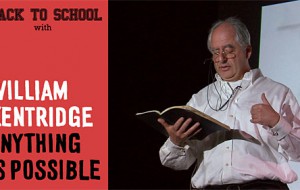
IT’S OPENING NIGHT! In celebration of Art21′s forthcoming feature film William Kentridge: Anything is Possible — premiering tonight, October 21, 2010 at 10:00 p.m. ET on PBS (check local listings) — the Exclusive series is devoting the month of October to telling stories about Kentridge’s numerous artistic collaborators whom we’ve had the distinct privilege of meeting these past few years. This is the fourth of six episodes.
Episode #125: Set designer Sabine Theunissen and scenic artist John Pitts share how the opera curtain for William Kentridge’s production of The Nose (2010) was enlarged, by hand, from a humble collage. Filmed on location at Kentridge’s studio in Johannesburg, South Africa, and at The Metropolitan Opera’s workshop in The Bronx, New York.
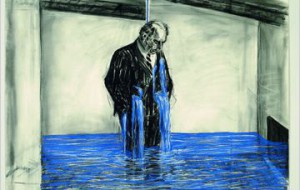
Having witnessed first-hand one of the twentieth century’s most contentious struggles—the dissolution of apartheid—William Kentridge brings the ambiguity and subtlety of personal experience to public subjects most often framed in narrowly defined terms. Using film, drawing, sculpture, animation, and performance, he transmutes sobering political events into powerful poetic allegories. Aware of myriad ways in which we construct the world by looking, Kentridge often uses optical illusions to extend his drawings-in-time into three dimensions.
William Kentridge is featured in the Season 5 (2009) episode Compassion of the Art in the Twenty-First Century television series on PBS. Watch full episodes online via PBS Video, Hulu, or iTunes (link opens application).
VIDEO | Producer: Wesley Miller & Nick Ravich. Interview: Eve Moros Ortega & Susan Sollins. Camera: Robert Elfstrom & Joel Shapiro. Sound: Tom Bergin & Ray Day. Editor: Mary Ann Toman. Artwork Courtesy: William Kentridge. Special Thanks: The Metropolitan Opera, New York; John Pitts & Sabine Theunissen. © 2010 Art21, Inc.
This program is supported, in part, by public funds from the New York City Department of Cultural Affairs in partnership with the City Council.
Moving Pictures
Chalkboards are disappearing everywhere and interactive whiteboards are taking their place (or, in some cases, chalkboards are disappearing as interactive whiteboards are simply being pasted, nailed and everything short of duct taped in front of them). The days of getting a good, healthy whiff of chalk dust up your nose is slowly becoming a thing of the past. With news like this, it’s no wonder that bulletin boards and display cases are also getting a facelift in many schools.
Now don’t get me wrong- bulletin boards can continue doing a fine job of displaying two-dimensional works of art that aren’t too heavy, or fragile, to leave in the middle of a crowded hallway (and before someone suggests it, I have to admit I’m not a big fan of Saran wrapping displays so they look like astronaut food. You’ve seen it… an entire board is covered in plastic and you feel like you’re looking at art through a clear shower curtain). Sculpture display cases can certainly continue cuddling ceramic works and small sculptures that fit within the depth and width that the teacher has to work with. But there’s SO much that can’t be placed in these venues, especially if you are teaching with contemporary art, and that’s where digital displays can help.
Recently, we traded a sculpture case for a fairly large digital display that now scrolls works by alumni and current students. Each month, or perhaps even more often in the coming semester, students and teachers will take turns to curate exhibits that can be thematic or perhaps focus on one student artist. Some digital exhibits can feature works tied together with a question, while others can feature film and animation- forms of art that never saw the bulletin board or sculpture case before! Larger-scale sculpture can also be featured and even details from installations.
Teaching with contemporary art involves finding ways to work with big questions and ideas, but it also involves creating spaces to share this work effectively with the whole school community. Trading some of your old exhibit space for a little technology-driven space can open up doors to sharing much more than before.
As autumn begins to sigh in Chicago, my second and final year as a Masters candidate in New Arts Journalism (NAJ) at The School of the Art Institute of Chicago (SAIC) begins with the reality of pondering my thesis.
For the NAJ program at SAIC, a thesis may be one of two avenues: a more academic thesis that uses journalistic practices such as research and interviewing to name only two, or it may be a creative project that is accompanied by a paper that outlines the journalistic techniques used to bring the thesis to its fruition.
As a creative artist at heart and in soul, the latter appeals to me. I desire my thesis to be a hands-on foray into a world of documentary journalism, a kind of case study of my chosen subject. This is broad, yes, but I believe theses should, in their infancy, be broad, or as I said to colleagues tonight over some Chicago thin crust, it should begin “loosey-goosey.” It should be a malleable entity that is searching for itself.
Weekly Roundup

Production still from the film "William Kentridge: Anything Is Possible." © Art21, Inc. and The Metropolitan Opera, 2010.
In this week’s roundup: William Kentridge makes several appearances, Mark Dion renovates Walden, Nancy Spero is celebrated, Louise Bourgeois draws on fabric, Kiki Smith debuts a stained glass window, Maya Lin asks us “What is Missing?” and much more.
- William Kentridge: Anything Is Possible, premieres on PBS this week. Check your local listings to find out when the program will air on your local PBS station. The program gives viewers an intimate look into the mind and creative process of William Kentridge.
- Kentridge is also on view at the Massachusetts College of Art and Design. Two exhibitions — Ambivalent Affinities and Projects — are currently on view and showcase Kentridge’s work from 1989 to present. The show closes on December 11.
- Ursula von Rydingsvard will be exhibiting her new works in handmade paper for Deckle Deckle at the Dieu Donné (NYC). The show begins October 21 and runs through December 4.
- Mark Dion and J. Morgan Puett co-founded Renovating Walden. This participatory art installation explores the meanings, readings, and misreadings spawned by Henry David Thoreau’s 1854 book Walden, or Life in the Woods. This also includes numerous special events and is on view through November 14, at Tufts University Art Gallery at the Aidekman Arts Center.