




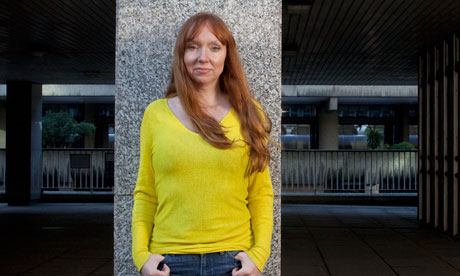
Susan Philipsz. Photograph: Karen Robinson for the Observer
The Otolith Group ought to win this year’s Turner Prize, if their installation at Tate Britain is anything to go by, which it isn’t. Tate Britain’s press department must really enjoy having to explain annually that the prize is not awarded on the installation at the Tate (it’s for any show they’ve done over that year), but it’s unavoidable that the public – or, at least, those members of the public not used to the art fair/biennial Wurlitzer (i.e, the sort of people who use the word ‘public’ as though it doesn’t apply to them) – won’t follow that the thing you’re looking at isn’t the thing that wins. That’s good news for Angela de la Cruz, though, whose room was guest curated by Stevie Wonder. Works that looked ballsy, rambunctious, and endearing at her Camden Arts Centre show this year (reviewed here), hung haphazardly, look like the underdone Steven Parrino bootlegs they’re always being accused of being. Decisive or not, the duff hang does a good painter a disservice, and if she wins it’ll look like willful pretension by the judges, because it’ll look like that particular installation won it for her, which it won’t have done. But the Tate press department won’t be in a position to explain by that point, having all emigrated to Latvia and had their names changed.
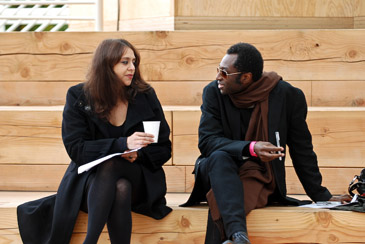
The Otolith Group are definitely not at all cool
Having not seen anything by the Otolith Group before, I can only go on their room in the Turner show, so this may be fairly unrepresentative of what they do. If I say that it features thirteen TVs showing all thirteen episodes of a late-eighties French documentary series on the legacy of Greek philosophy and that it’s the most entertaining installation in the entire show, that could well be an indictment of the remainder of the show (which is, on the whole, pretty dour), but it’s the only room that seemed to contain pretty consistent public lingering. What’s most impressive about the Otolith Group’s darkened installation – which also contains the Group’s film of Satyajit Ray’s unproduced screenplay The Alien, as well as small pools of light illuminating intimidating-looking theoretical texts – is that its unabashed nerdiness doesn’t compromise its compelling beauty and sense of intellectual wonder. Throw a copy of Relational Aesthetics in the air and you’re bound to hit a pseudonymous conceptual art collective making work about unrealized artistic projects (right?). The Otolith Group do that, but they haven’t forgotten that it has to look good, too, and it does.
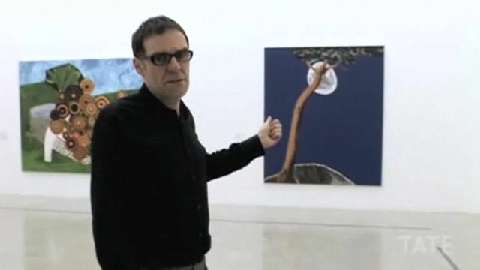
"What's this rubbish?" "That's one of yours, Dexter"
Speaking of looking good, that doesn’t remind me of Dexter Dalwood, the other painter in the show. Dalwood’s work is instructive in relation to the Otolith Group: everything can be conceptually in place (and Dalwood’s paintings are nothing if not carefully researched and steeped in art-historical nods and winks), but without some sort of visual seduction, it might as well be a post-graduate thesis on “the meta-spaces of postmodernity” pinned to the wall (some of my best friends are postgraduate students, by the way). In Burroughs in Tangiers, for example, Dalwood paints collage-style quotations of famous twentieth-century paintings within the imagined bedroom of William Burroughs, but the paintings he chooses to pinch (the greatest painting of the twentieth century and the second greatest painting of the twentieth century) just make you miss good, honest, non-cynical painting. It’s often said that Dalwood is a history painter; he is, but not in the way his supporters mean.

Angela de la Cruz: not that happy about her installation, by the looks of it
Susan Philipsz’s sound piece Lowlands takes the form of three large speakers hung close to the ground, each of which plays an acapella solo voice, and is in that way immediately reminiscent of Janet Cardiff’s magnificent Forty Part Motet. Like Cardiff, for Philipsz, solo singing means a kind of self-exposure, a very public form of intimacy. Philipsz sings three disjointed renditions of an old Scottish ballad, and it’s lovely, but the installation – spartan, industrial – saps some of the atmosphere. Philipsz is being nominated for her site-specific sound installations, played in public spaces in Glasgow and London (there is a temporary show of these pieces under bridges in central London coinciding with this show), and her display here calls up one of the central problems of the Turner Prize as a whole, which is the Tate itself. That the work of half of the shortlist is actively undermined by the architectural spaces of the gallery itself (sound bleed from the Philipsz and the Otolith Group makes the De la Cruz room hard to stay focused in; blazing artificial light kills the nuances of the latter’s work), it surely makes more sense to rethink the spaces in which the Turner Prize artists are shown. Think of all those press releases it’ll save.







Pingback: Open Enrollment: And the Nominations Are In… | Art21 Blog
Pingback: Letter from London: Terry O’Neill Award Show at Hotshoe Gallery | Art21 Blog