The Art21 Blog’s Most-Viewed Posts of 2010

The continuing rise and social influence of Facebook and Twitter may have contributed plenty to the growing readership of the Art21 Blog, but ultimately, it is quality of writing and the diverse approaches to contemporary art-related topics and issues that keeps the Art21 Blog going so strong.
First, before we get into the top 10, an honorable mention:
Honorable Mention, Teaching with Contemporary Art
Joe Fusaro’s weekly column, Teaching with Contemporary Art, continues to have a very loyal and consistently-growing readership, with the main category page being the most-viewed overall page on the Art21 Blog for 2010 (as it has been on an almost-monthly basis for the year). If you aren’t among the tens of thousands of readers that enjoy and discuss Joe’s posts, catch up and be sure to keep an eye out for more in the new year!
With that, join us past the break as we present the top 10 most-viewed posts on the Art21 blog for 2010.
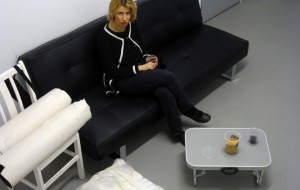
Inside the Artist’s Studio: Artemis Potamianou
Artemis Potamianou is a visual artist based in Athens, Greece. She attained a BFA Degree from the Athens School of Fine Arts in 1997 and an MFA from the Staffordshire University, Great Britain in 1999.
Last month, Fizz Gallery in downtown Athens had her 13th solo exhibition, where she showed the Re-view series of C-prints and the installation UTOPIA, You Were Always On My Mind, which took us on an art historical journey though artwork miniatures, notes, texts, and additional paraphernalia that the artist crafted herself or collected over the years.
Artemis borrows, appropriates, and steals from the art world and at a first glance, one may accuse her of embezzling when confronted with her works but that’s not the case. She collects and edits the art tools she appropriates and she further creates systems, which result in new and comprehensive creative comments. Artemis raises questions and creates hypothetical scenarios where art should, could, or would exist.
Her practice knows no limits. Artemis has curated solo exhibitions and projects for established artists in Greece and abroad such as: Candice Breitz, Joseph Kosuth, the Guerrilla Girls, David Campell, Peter Greenaway, Terry Atkinson, and many others. When she makes art, she curates and vice versa. She marries her two identities remarkably well and because she knows the tricks on both sides of the court first-hand, she is a joy to work with. To be a good artist nowadays, it takes way more than being simply an artist in the traditional sense.
Multi-faceted individuals, inquiring minds, and naturally creative thinkers like Artemis are the kind of artists I’ll focus on from March 2011 onwards on Inside the Artist’s Studio.
Please, read and acquaint yourself with Artemis’s work.
Center Field: Art in the Middle with Bad at Sports | Top 10 Chicago Art Events in 2010
Meg Onli and Claudine Ise’s list of the ten best–or at least most interesting–events in Chicago art in 2010.
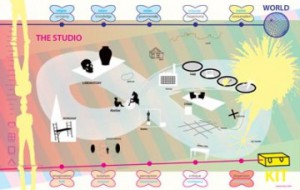
1. Best city-wide, sustained, multi-platform discussion of a single topic in contemporary art: Studio Chicago, a yearlong collaborative project focusing on the artist’s studio. Taking the form of exhibitions, talks, publications, tours, and research, Studio Chicago explored what it means to be a working artist by examining their sites of creative production. A joint venture of the Chicago Department of Cultural Affairs, Columbia College Chicago, DePaul University, Gallery 400 at UIC, Hyde Park Art Center, Museum of Contemporary Art, The School of the Art Institute of Chicago, and threewalls, Studio Chicago was an ambitious and immensely engaging way to re-think the artist’s studio over a lengthy period of time-it was a project that truly had legs.
2. Best box set of an under-appreciated artist: The Complete Mythology, Chicago-based record label Numero Group‘s collection of Syl Johnson’s tracks from before his time at Hi-Records. The box set includes 81 songs, a book, four cds, and six LPs. Numero Group has outdone themself yet again with this thoroughly researched set that pushes the boundary of what liner notes should be.
3. Best/Worst art controversy: Art Loop Open. Modeling itself after Grand Rapids’ Art Prize, Chicago’s first annual Art Loop Open contest promised a $10,000 prize to the winning art submission, which was voted on by the public. Although the intentions of sponsoring organization the Chicago Loop Alliance were good, the results weren’t: late in the game, contest officials jumped to conclusions and disqualified an artist for alleged misconduct in a move that was criticized by many, including Bad at Sports. Although the artist was reinstated a few days later, the damage was done, and the contest’s credibility was shot. Here’s hoping next year’s Art Loop Open gets its act together and its rules straightened out.
Marissa Perel’s Top 10 of 2010

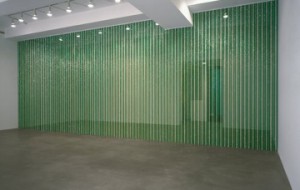
Felix Gonzalez-Torres at the Deadline, exhibition @ Musee d'Art Moderne de la Ville de Paris, image courtesy of LeFigaroPresse
1. Felix Gonzalez-Torres in Deadline, exhibition at the Musee d’ Art Moderne, Paris. October 16, 2009 – January 10, 2010. Curator Odile Burluraux said of the exhibition, “Deadline has chosen to examine a group of artists who died during the last twenty years and whose concluding works are marked by an awareness of imminent death, the urgency of the task at hand and impulse to self-transcendence.”When I got to the long corridor of Felix Gonzalez-Torres’ xeroxed birds and beaded curtain at the end, I just lost it. The impression left on the beads of visitors’ bodies as they passed through, then the swishing of the beads as bodies disappeared to the other side truly struck me. I was overcome by a feeling of fragility, loss, a sense of absence all in this one moment. It was the most powerful experience I had in the museum, and that I have ever had with Gonzalez-Torres’ work. Other artists in the show: Absalon, Gilles Aillaud, James Lee Byars, Chen Zhen, Willem de Kooning, Hans Hartung, Jorg Immendorff, Martin Kippenberger, Robert Mapplethorpe, Joan Mitchell, Hannah Villiger.
2. Smithsonian’s censorship of Fire in My Belly by David Wojnarowicz from the Hide/Seek Exhibition at the National Portrait Gallery. An inversion of my #1? Maybe. Here, the threat of the video’s absence only strengthened the attention called to it. I went to a screening of 3 versions of the video held at the School of the Art Institute of Chicago, where we also Skyped with curator Jonathan Katz. This show was denied so many times before it was accepted into the National Portrait Gallery that he was not entirely surprised of it wreaking havoc. What would Wojnarowicz’s work be if there wasn’t at least someone in the religious right gnashing his jowls to tell us it’s the work of Satan?

Jerry Saltz kissing a Wojnarowicz-face poster at the NY Wojnarowicz March Against Censorship, photo by Bradley Wester
3. Elles@centrepompidou, Women Artists in the Collections of the National Modern Art Museum, Paris, May 27, 2009 – February 21, 2011. If I was struck by lightening at that moment, I would have been ok with that – sitting in a room of projections of Marina Abramovic, Ana Mendieta, and Carolee Schneeman in their early performances. But then I wasn’t and I stepped into a Pipilotti Rist floor-to-ceiling video projection on my way to Nan Goldin’s screening room. The over-stimulation mellowed a bit when I got to Agnes Martin and Hanne Darboven, but my pleasure never subsided. I couldn’t repress a chuckle at the Guerilla Girls’ poster on my way down. Hello! 2010 = IT’S TIME TO BE A WOMAN ARTIST. DO IT! And go to the Pompidou while the show is still up.
Ali Fitzgerald’s Top 9 European Gender-Journeys of 2010
After attempting a general top 10 list of shows, I felt a mild distaste for my own artistic leanings, which, while not limited to investigations of gender and queerness, are definitely weighted by a gigantic lavender anchor.
But you know, it’s the culture wars redux and Roberta Smith has already claimed this year for the ladies, so yeah…

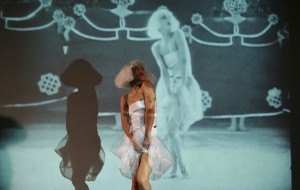
Pauline Boudry, Renate Lorenz "SALOMANIA," 2009, Ellen de Bruijne Projects
1.) Salomania, at Ellen de Brujine Projects
In an ecstatic homage to queer performance and with a kind of Vermeer lust for beauty and detail, Pauline Boudry and Renate Lorenz film gender activist Wu Ingrid Tsang and artist/choreographer Yvonne Rainier as they re-imagine the seductive dance of Salome. Encased by palm trees made of ostrich feathers, the installation feels like a rapturous look behind the scenes at the subtle mechanics of attraction.
2.) the t.A.T.u. Project, at Ellen de Brujine Projects
Jesper Nordahl’s T.a.T.U project was realized after the artist embedded himself in the Russian duos’ entourage, gaining access to a melange of characters, most notably t.A.T.u’s international promoter, whose feverish rambling seems clouded by drugs, money and the receding specter of fame. In one scene, Nordahl captures t.A.T.u. as they engage in sapphic posturing for the cameras; As the lenses drop, so do their arms, suddenly betraying their clammy schoolgirl intimacy.
3.) Community Action Center at Horton Gallery
A.K. Burns and A.L. Steiner revive some of the rough, revolutionary zeal and bushy fun of the 1970’s with their rollicking homespun queer porn and accompanying zine.
*I liked it so much I wrote a short comic about it.
Ten for ’10
Looking back over the column this past year, I thought it might be worthwhile to pick the top ten questions generated in a year’s worth of posts. Below are some of the questions that raised eyebrows, a ruckus, and/or more questions. I have also included the corresponding links. Enjoy!
10. What role does art education play in how artists form works of art later in their career? (from Art Education and Influence).
9. Is sound an element of design? (from Solid Sound).
8. How do we teach students to see and engage with art beyond computer screens? (from Art Beyond Excerpts).
7. Can a successful work of art make you angry? (from a post of the same title).
6. Is an idea a work of art? (from Ideas and Objects, Ideas vs. Objects).
5. When does an idea become a work of art? (from Jumping Right Into the Shark Tank).
4. How does censoring art affect how it is viewed? (from Teaching with David Wojnarowicz…).
3. Can a painting be about more than brushes, paint and canvas? (from Mark Bradford: Painter).
2. What do art educators need to know to do our work effectively? (from Need-to-Know…).
1. What’s worth learning in art? (from Skills Worth Teaching).
Happy New Year to all!
Baseera Khan’s Noted in 2010
The most notable word for 2010 is leak.
Aside from that, here is my list:
1. Experimental Film: Phil Solomon’ s American Falls, 55 min., commissioned by the Corcoran Gallery of Art, Washington, D.C. which screened this year at the Views from the Avant-Garde.
2. Residency Initiatives: Creative Time’s Global Residency program allows six artists to travel and research projects through the course of 2010.
3. Album: Ariel Pink’s Haunted Grafitti, Before Today.
Center Field: Sustaining Practices
Lately I have been thinking a lot about sustainability and sustenance. Not the environmental kind of sustainability–the personal and emotional kind. Chicago’s art community is rich in relationships, but like so many other ‘art worlds’ out there, it can be a bit less bountiful when it comes to monetary compensation, feedback, and consistent forms of validation. So, for our last post on this blog for the year, I asked four longtime Chicago-based cultural practitioners–independent curator and arts educator Britton Bertran, artist Duncan MacKenzie (co-founder of Bad at Sports), Caroline Picard, an artist who runs the small but highly-regarded Green Lantern Gallery and Press, and Philip von Zweck, an artist whose work often involves project-based collaborations–a few questions about how they have sustained their own practices over time, and especially after a project has run its course. How do they stay sharp and engaged and committed over the long haul? How do they keep on keepin’ on when the going gets tough? Read on to find out what this group had to say.
Claudine Ise: Describe the work that you do. What forms has the work taken? When its form has changed, what were some of the reasons for the change?
Britton Bertran: I started my “career” here in Chicago working for a well-known and very progressive not-for-profit art education organization. It was hard and fulfilling programmatic work placing ‘teaching artists’ in mostly underserved Chicago public schools. Around 2005 I decided to open my own commercial art gallery (called 40000). One of the main reasons for doing this was jettisoning the funk of non-profit work and diving in to the wild world of working with artists for profit (theirs and mine). Three years later, and a month before the great economic collapse of 2008, I closed the gallery. To this day, I am simultaneously extremely relieved for shutting down but will also ultimately regret doing so. Currently I am working for another Chicago-based art education not-for-profit with a more encompassing, less intense mission that is equally challenging. It’s very satisfying and comes with a real live paycheck. Interspersed with the jobs I have had in for the last 4 years or so, I have also had a secondary career as an independent curator and instructor in the Arts Administration department at The School of the Art Institute.
Duncan MacKenzie: The way that I work now is collaboratively, sometimes that means working on the “Bad at Sports” project and at other times that work is with an artist named Christian Kuras on an object and image-based practice. As a young artist, I was trained in several really active communal print shops, a series of film sets and a small graphic design firm. Those experiences left me with a strong drive towards communal working and a need to share broadly both the authorship and the result. This is a very different way then the traditional “heroic artist” locked in their studio wrestling with a canvas. I don’t love spending my time all alone working through a series of problems and puzzles which I’ve situated for myself. I like and need the energy colleagues bring to projects.
Caroline Picard: For the last six years I have been running a non-profit gallery and press called The Green Lantern. During that time I have continued to work independently as an artist and a writer. I think these projects inform one another–in many ways I’ve thought about the Gallery and the Press as being significant influences on my own work; particularly when the space was in my apartment, I came to think of it as a kind of studio-research. After five years the city shut down the project because I did not have, nor could I acquire, a business license (as a result of zoning). Last September I opened a second storefront space which will close in January of this year. As part of this second plan, I was trying to put together a business model which would sustain the non-profit gallery via a for-profit cafe/bar/bookstore/performance space. I couldn’t find that space, and after a continued accrued cost had to close up shop. The Press will continue and I’ll continue as its primary editor. We also have a very cool on-line indie-lit bookstore.
Philip von Zweck: From the early 90s (as a student) until relatively recently most of my projects involved either producing a form for others to fill and/or making projects for a non-art audience. For 15 years I produced a weekly radio program of live performance and sound art recordings, and I co-founded the radio art collective Blind Spot; I have an ongoing project called Temporary Allegiance which is a 25 ft flag pole that anyone can sign up to fly anything they want on for a week at a time; I ran a gallery in my living room for 3 years; for my museum show a few years ago I made a chain letter and mailed it to the museum’s mailing list. There was a set of politics I was really guided by, and adhering to them eventually caused me to feel distanced from my own practice. So a few years ago, I begun showing paintings. I’ve always painted and drawn but didn’t show them because it didn’t fit in with the other projects and those took precedence. I wouldn’t say that I have abandoned the previous set of politics; it’s just that I’ve come to a different way of thinking about them and my role as an artist.
Liz K. Sheehan’s Top 10 of 2010
Ten memorable art-related moments of 2010, in no particular order:
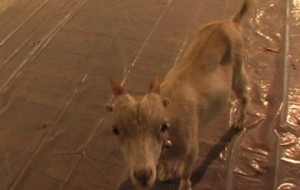
10. Best animal weirdness: William Pope.L, Small Cup, 2008, Video, 12:52 minutes, included in the 2010 DeCordova Biennial
Filmed in one of the old textile mills that dominate the central Maine city of Lewiston, where the artist teaches in Bates College’s Department of Theater and Rhetoric, Small Cup is a layered commentary on architectural symbols of power. Set in the center of the cavernous mill is a small-scale Italianate cupola (a “small cup”) that is gradually overtaken by a group of curious goats and chickens, who feed, lay and crush eggs, and defecate inside it, butting and scratching until the dome falls. Score one for the animal house – carnivalesque, disturbing and triumphant.
9. Simplest expression of a complex thought (or vice versa): Bruce Nauman, Slow Angle Walk (Beckett Walk), 1968, in the 2010 apexArt exhibition You Can’t Get There from Here but You Can Get Here from There, curated by Courtenay Finn
Nauman’s laborious and exaggerated walk, shot with a fixed camera on its side over the course of an hour, embodies the eccentricities of Samuel Beckett’s Watt. Awkward, exhausting, and ultimately mesmerizing, Slow Angle Walk perfectly illustrated the paradoxical complexity of this exhibition’s theme: the relationship between reader and text, the fictional and the real.
8. And on a similar note…Fred Sandback. I’m a sucker for Minimalism, so I’ve been happy to find him everywhere all of a sudden. ColorForms, at the Hirshhorn Museum last spring; prints and drawings in the Worcester Art Museum’s Minimalism: Logic and Structure, and the recently-opened Fred Sandback: Sculpture and Works on Paper at the Davis Museum at Wellesley College. With nothing more than stretched lengths of yarn or spare, ruled lines, Sandback managed to convey form, alter space, and shift perception.
Weekly Roundup

Pierre Huyghe, "The Host and the Cloud," 2009-2010, live experiment. Courtesy the artist and Marian Goodman Gallery, New York.
Closing out year 2010 for this week’s roundup, Pierre Huyghe and Mel Chin receive artist awards and a few upcoming shows to mark in your 2011 calendars.
- Pierre Huyghe is the 2010 winner of Smithsonian American Art Museum’s Contemporary Artist Award. Huyghe is the ninth winner of the $25,000 award, which recognizes an artist younger than 50 who has produced a significant body of work and consistently demonstrates exceptional creativity. It is intended to encourage the artist’s future development and experimentation.
- Mike Kelley has an upcoming show at the Gagosian Gallery (L.A.). This exhibition, Kelley’s first with the gallery, will consist of new large-scale sculptures and videos that expand on previous projects—the Kandor series and Extracurricular Activity Projective Reconstruction (EAPR) – combining them into one. This show also includes other works that provide moments of humor and charm throughout the installation. Kelley’s exhibition will run from January 11 – February 19, 2011.
- Ellen Gallagher has an upcoming show with the Gagosian Gallery (NYC), which will run from January 21 – February 26, 2011. More info on this exhibition is forthcoming.
- Mel Chin joins a select list of artists who have been awarded USA Fellowships for 2010. Each receives $50,000 from the national grant-making and advocacy organization United States Artists (USA), which has invested a total of $12.5 million in artists since 2006.