New guest blogger: Kevin Buist

January 31st, 2011

Thanks to Dorota Biczel for her fantastic series of writings on Polish, Peruvian, and Spanish contemporary artists (and Wojnarowicz too). Look out for more from her in the coming months.

Up next is Kevin Buist. Kevin is an artist, writer, and Director of Artist Relations for ArtPrize. He lives and works in Grand Rapids, MI. His work has been shown in numerous group and solo exhibitions. He has written about film for SpoutBlog and co-produced FilmCouch, a Webby-nominated podcast. Before helping launch ArtPrize, he ran small a non-profit gallery.

Since beginning work on ArtPrize, Kevin has been investigating the exchanges and tensions between art, design, and the social web. He and other members of the ArtPrize team track these observations on the ArtPrize Tumblr blog. His artwork can be found on the web at kevinbuist.com and he blogs at The Porcupine School of Poetry.

Inside the Artist’s Studio: Ben Durham

January 28th, 2011

Turkish and Other Delights columnist Elizabeth Wolfson is filling in for regular Inside the Artist’s Studio writer Georgia Kotretsos this month and next.  — Ed.

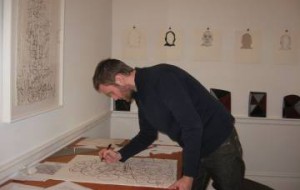
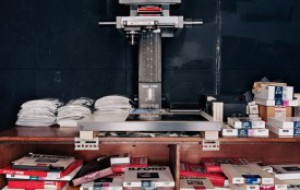
Ben Durham in his studio in Lexington, Kentucky

Ben Durham lives and works in Midway, Kentucky, just outside of his hometown of Lexington. He received a B.F.A from Washington University in St. Louis in 2004. His work has since been included in exhibitions at Country Club, Cincinnati, OH and the 21C Museum in Louisville, KY and is held in several private and public collections including that of the Whitney Museum of American Art. He has been an artist-in-residence at Cité Internationale des Arts in Paris (2010) and the Columbia College Center for Book and Paper Arts in Chicago (2009). Currently, Durham is the subject of two solo exhibitions that opened simultaneously this month at the Nicole Klagsbrun Gallery in New York City and Marc Selwyn Fine Art in Los Angeles.

Durham’s practice functions as a highly personalized exploration of the nature of memory, a close analysis of the twin processes of remembering and forgetting. The subjects of Durham’s portraits are friends, classmates and acquaintances from his childhood in Lexington. In a ritualistic daily process, Durham combs the Lexington police reports for familiar names and faces, collecting their mug shots and arrest records. Through a variety of techniques, he merges disparate bodies of knowledge—the account created by the Lexington police department, his own memories of these individuals, maps of neighborhoods related to their lives—to create new portraits and new maps that provide a more complete and complex history.

Ben Durham, "Robert," graphite text on handmade paper, 2010. Courtesy the artist and Nicole Klagsbrun Gallery, New York.

In his Text Portraits, Durham creates a written account of excavated memories of the subject, using it to create an eerily accurate portrait of the individual composed entirely of text. Often densely layered, the text wears away the paper’s surface to depict shadows, hair and eyes, while light cheeks and shoulders remain legible. In his series of Map Diptychs, lines representing the streets where the subject has lived repeat over each segment, acting as a kind of topographic skeleton underlying the subject’s silhouette on one side of the diptych, and on the other as an abstract diagram. In a third series, the Map Composites, dyed paper is sliced along the street grids of specific neighborhoods relating to each subject. These pieces are reconfigured and arranged to form a silhouette of the subject’s mug shot, creating “new combined streets and territories… a personal topography built of many maps.” Due to his thoughtful creative process and rigorous studio practice, Durham makes an ideal subject for Inside the Artist’s Studio.

Elizabeth Wolfson: Can you describe the evolution of the process utilized in the Text Portraits? How did you develop this process? What was the initial inspiration?

Ben Durham: Learning to make paper as a student at Washington University in St. Louis was the catalyst for the creation of the first Text Portrait. I viewed the papermaking process as a sort of meditative performance and, in the end, it changed the way I thought about artmaking. Quite simply, I was faced with the first blank sheet and realized no way I had worked in the past would serve the nuances and conceptual potential of the handmade paper. Before any drawing was begun, before I even knew what I wanted to draw, the paper appeared as a monumental headstone, an Anselmo stonework, a skin surface marked by a history of scars and wrinkles, an unmarked map without orientation. Honestly, before I even knew what to draw, I was perfectly aware that the sheet of paper was already the most interesting thing I had ever made.

Continue reading »

How Much Does Corn Matter? Glory and Humility in the Work of Eduardo Villanes

January 27th, 2011

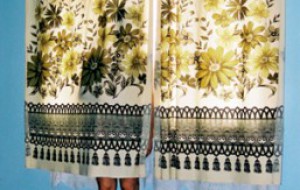
Eduardo Villanes, "Urdimbreas de Luz," detail, 2007. Courtesy the artist.

As I am grieving the disappearance of the Minimalist from the pages of the New York Times, I am also pondering Mark Bittman’s statement from his farewell column, “the continuing attack on good, sound eating and traditional farming in the United States [and elsewhere in the world, I want to add] is a political issue.”

“Relational art” and especially the stardom of Rikrit Travanija, has made food one of the hot topics of contemporary art. Food has been re-discovered and celebrated as a means of bringing people together and creating experiences of genuine sharing and fair exchange. These optimistic notions and projects tend to overlook – to paraphrase Eric Schlosser – “the dark side of the contemporary meal,” which persists even despite the efforts of the Slow Food movement or First Lady Michelle Obama. Even more rare are artistic proposals that try to engage the dangers and inequalities lurking behind what and how we eat.

Peruvian purple corn.

One of the little-known exceptions is the recent work of Peruvian artist, Eduardo Villanes (born Moscow, 1967), whose projects ponder the loss of the incredible biodiversity of his native land, the ancestral home of more than 600 varieties of potatoes and endless amount of other plant and animal species. Especially fascinating about his case is not only the content of his current enterprise, which puts genetic modification and patenting of crops by transnational corporations at the cross-hairs of attention, but also the particular tension that exists between Villanes’s recent work and his earlier proposals developed in the 1990s. This peculiar conflict offers an opportunity to consider two important issues: first of all, how we get acquainted with art, what we see, when and why we see it; and secondly, how complex and ambiguous the process of historicization of a living, producing artist can be.

Continue reading »

Looking at Los Angeles | The California Biennial: Collectives, Conversations, and Collaborations

January 27th, 2011

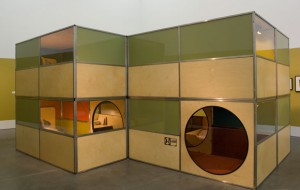
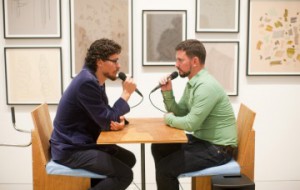
Agitprop The Third Party, 2010 Mobile interview cart: plywood, fabric, foam, amplifier, microphones, and hardware, 72 x 30 x 42 in. Installation at Orange County Museum of Art, Newport Beach, CA Photograph courtesy of Colin Young-Wolff & Orange County Museum of Art

I first experienced the California Biennial in 2008 as a participant in Mary Kelly’s Flashing Nipple Happening.   Kelly had recruited around five dozen young women to gear-up in black clothing and, using elaborate harnesses, strap blinking bicycle lights in front of our crotches and breasts.  At the opening reception, we crouched behind walls and bushes and when Kelly gave the command, we ambushed the crowd from all sides.  We were twinkling Matryoshka dolls, restaging our own restaging (from several days prior) of a 2007 restaging… of a 2005 restaging… of The Flashing Nipple Show street theater staged in protest of the 1971 Miss World pageant.  Are you caught up yet?  At the risk of sounding cliché, I have to invoke the “e” word.  I cannot begin to describe how shockingly and profoundly empowering it was to careen, glowing-breast-and-crotch-first, through a museum courtyard of Campari-drinking art “insiders.” Yet the happening was more about solidarity and galvanization less about mischievous upheaval.  We were simultaneously tying ourselves to this activist lineage, while warmly destabilizing the staid contemporary tradition of biennials.

Though the 2008 California Biennial focused loosely on politically oriented and socially engaged practices, Kelly’s was one of the only participatory works that it featured.  But in the current California Biennial, curated by Sarah Bancroft, collectives, collaborations, and interactive (a sometime taboo label) installations pop up throughout the exhibition.  While Bancroft avoids the type of overarching curatorial themes that usually get Biennial organizers into trouble, the inclusion of numerous participatory practices is noteworthy.  Perhaps the number of artists working in this way has remained steady, but they are proliferating within the walls of more traditional institutions.

Brian Dick In collaboration with Christen Sperry-Garcia The Nationwide Museum Mascot Project presents: OCMAscot, 2010 Recycled cardboard, newspaper, tissue paper, staples; piñata work by Piñata World, El Monte, California Dimensions variable Installation at Orange County Museum of Art, Newport Beach, CA Photograph courtesy of Colin Young-Wolff

Brian Dick in collaboration with Christen Sperry-Garcia, The Nationwide Museum Mascot Project presents: "OCMAscot and Glowfittie Room," 2010. Recycled cardboard, newspaper, tissue paper, staples; piñata work by Piñata World, El Monte, California. Dimensions variable. Installation at Orange County Museum of Art, Newport Beach, CA. Photograph courtesy of Colin Young-Wolff and Orange County Museum of Art.

Immediately after entering the museum, viewers can climb directly into Brian Dick & Christen Sperry-Garcia‘s Glowfittie Room, which looks like a giant piñata, and make their own “light paintings” along its walls.  If they are lucky, they will also be greeted by a giant neon papier-mâché Museum Mascot, inhabited by one of the artists.  Dick and Sperry-Garcia have made a number of these usually uncommissioned mascots for various museums throughout the country.  The articulated impulse of the work is inclusiveness as opposed to institutional critique.  But then again, the only thing more stressful and fraught than walking into a museum is walking into a giant Muppet-like creature.

Continue reading »

Flash Points: Friends and Influence

January 27th, 2011

Sigmar Polke and Blinky Palermo, Dusseldorf, 1967.

Tonight, I am sitting in a red booth at Formosa Café in Hollywood, the Cantonese restaurant Frank Sinatra reportedly frequented when heartsick over Ava Gardner. Lana Turner came here too, and danced with gangster beaus in the bar’s center aisle. My friend L. and I have both just finished a hectic work day, and we wanted to meet somewhere that had a history. We’re here not because of Frank and Lana, however, but because a red-headed painter we both know, a woman who makes fluid oil landscapes and talks about the purity of the spirit, first kissed her husband in one of these booths.

Whatever magic was hanging around when that kiss happened must still be here, because L. is telling amazing stories. She tells one about a burlesque performer named World Famous Bob who once lived in her New York apartment building. One night, Bob performed a reverse strip tease, going from exposed to fully, opulently clothed. L. had never seen vulnerability expressed so movingly before, and her description convinces me that I never have either. In fact, as the image sears its way into my brain, I decide that everything I write this week will be a thank you to L.  Not because she needs my thanks, nor because this new-found image of vulnerability will even be legible in what I put out, but because I’m pretty sure other people are the whole point: you put ideas into the world to give back to those who give to you, and you hope that, if what you say or make feels true to those you care about, it means you’ve become a slightly better friend.

Imi Knoebel, "24 Colors--For Blinky," 1977. Courtesy DIA Beacon.

Blinky Palermo and Imi Knoebel, both German, born at the tail of World War II, and students in Düsseldorf during the ‘60s, put ideas into the world for each other. Imi made one of his best known works, 24 Colors—for Blinky (1977), as a tribute to the friend he called “master of color.” Even though Palermo had died the year before and would never see 24 Colors, the installation was made more for him than the rest of us. Installed at DIA Beacon in upstate New York, it consisted of 24 individual panels, each of which evoked a colored shape totally free of right angles (Blinky loved equilateral triangles and his edges were often not-quite straight).

The colors, all right out of the tube, included green, orange and pink, in addition to the primaries. Sometimes they almost looked fluorescent, a tendency more in line with Imi’s sensibility than Blinky’s. In fact, the whole installation, while a reflection of what Blinky Imi perceived, is like nothing Blinky would have produced.

Continue reading »

When One Day Is Not Enough

January 26th, 2011

Image: paintcutpaste.com

With all of the mandatory testing that students must be put through it’s no wonder that most kids, especially in elementary grades, receive classes in visual and performing arts one day a week, or less, for about 40 minutes…. or less. But what do you do if you’re a parent or teacher who has a child that obviously wants more than once-a-week arts instruction? What do you do with kids that show multiple signs of wanting to spend more time creating works of art? With special thanks to Julie, a reader and concerned parent who inspired this post, here are some starting points….

Talk with kids seriously about their work. When students share their art, it’s not always because they want praise. Shouting, “That’s beeeeaaauutiful!” every time they create something is not doing anyone any favors. As a matter of fact, it ruins your credibility because kids know very well that not everything they create is beautiful. Rather, it’s important to ask students to talk about their work and give them a chance, as often as possible, to describe what the work is about. Talking with kids seriously about their work gets them to take their work seriously. Which leads to the next suggestion.

Asking, “What is it?” is very different from asking a bigger question such as, “What’s this about?” I don’t have much to add here. All I can say is that I’ve been asking the 2nd question for over a decade and have gotten MUCH better answers than when I was asking the first question at the start of my career. It gives students a chance to explain their decision-making and thought process. Plain and simple. It helps us help them.

Explore opportunities to make art in your neighborhood, town or city. Students making art with other kids, whether it’s at a church, school or senior citizen center, is a chance for them to come together and work on ideas, realizing different kinds of visions and sharing them with others. One word of caution: Be careful with programs that emphasize simply following directions vs. making art. While following certain kinds of instructions is important when learning how to make art, not all projects have to be about taking the same steps to get to the same result as everyone else every single time.

Continue reading »

Open Enrollment: Master of the Healing Arts

January 26th, 2011

For many years, I was set on becoming a doctor of sorts. I had done an undergraduate thesis in experimental psychology, was doing research at a hospital, and on my way to getting a clinical degree. But at some point, I realized my favorite part of working in science was not theorizing which part of the brain did what or analyzing data and making sense of chaos. No. I really enjoyed manipulating brain scans to make them look pretty. I liked how cool and futuristic EMG caps look. I loved designing posters and presentation slides so much that I submitted half-assed research papers to conferences just so I could fire up Photoshop and InDesign. So when it came time to apply to graduate school, I decided to pursue a degree in the arts.

The writer as a guinea pig for a cognitive neuroscience experiment.

At times I felt guilty about leaving the scientific world and wondered if I made the right decision. Art school could be considered a selfish venture. What good is making works of splendor when there’s so much damage in the world? There’s pain to be subdued. There are afflictions to look into. Why shouldn’t I devote my life to crunching numbers and connecting statistical dots with illnesses?

Continue reading »

Open Enrollment: Artists Are Like Rats

January 26th, 2011

Aalto University, University of Art (located at the Arabia Ceramics Factory)

“We live in an age where the artist is forgotten. He is a researcher. I see myself that way.” — David Hockney

Sometime in the afternoon on the second day of hanging a recent installation of my work at a gallery space at school, I was approached by one of my professors. He asked if the exhibition was related to my research.

I found myself unable to come up with an appropriate answer. After three cups of coffee and nary a drop of water, I was finding it hard to focus: a fluorescent light flickered in my peripheral vision. I looked at the spectrum of bold, metallic and iridescent craft papers cut into the patterns of American pinwheel quilts; I didn’t see an immediate connection between this work and the work I had been doing a few days earlier, reading feminist revisionist history in the library.

Drained but buzzed, I mumbled, “Not really, not exactly.”

Aralis Library at TAIK, seen from Eero Aarnio's 1966 Ball Chair

The beginning of my second semester as a student at Aalto University marks the halfway point of my time in Finland. As a student at this leading design center, the question of research and its relationship to my artistic work has continued as a reoccurring concern both to me and among my peers.

Continue reading »

Between Barcelona’s Soft Shoulders and Its Hard Underbelly: A Conversation with Daniela Ortiz

January 25th, 2011

Daniela Ortiz, "N-T," photograph and text, dimensions variable, 2009. Courtesy the artist.

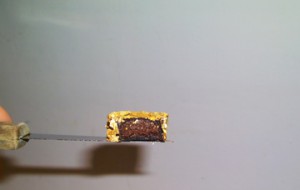
Several months ago, even before I set my foot on Catalan ground, I was captivated by a seemingly modest photograph: a chocolate candy in a golden wrapper set on a tip of the kitchen knife, which displayed a fresh bite mark, still dripping with saliva. Its caption read matter-of-factly:

I work 40 hours a week in a Spanish high-class chocolate boutique. While working on October 12, I stole three sheets of 24-karat gold and a Guanaja chocolate bonbon. I covered the chocolate with gold and ate it to celebrate the National Day of Spain.

Instantaneously, the image and the statement conjured much more than Proust’s madeleine could ever have. A simple, indulgent gesture became the present’s revenge on the past and on its own self. There we were, set up to ponder the nationalistic pride of Columbus’s discovery of the Americas and the riches and delicacies with which he gifted the Old Continent (Spain celebrates its national holiday on the anniversary of Columbus’s first landing in the New World). However, a few swift anthropophagic nibbles were about to gnaw this self-esteem away. A young immigrant retail clerk claimed what should have always belonged to her. Her body enacted the rebellion through the most direct means available: consuming the forbidden (yet, justly hers) treat.

Daniela Ortiz de Zevallos. Courtesy the artist.

This ingenious piece was conceived by a young Peruvian artist living and working in Barcelona, Daniela Ortiz de Zevallos. Even though the Spanish colonial empire was dismantled long time ago, shared linguistic and cultural heritage continue to draw scores of artists from Latin America, who seek to enhance their education or advance their professional careers, to the country. Like many of her compatriots, Ortiz arrived here to continue her art studies at the University of Barcelona (UB). Since her graduation in 2009, she has undoubtedly marked the scene here with her audacious presence, participating in more than a dozen exhibitions in 2010 and sweeping pretty much all the major fellowships and grants available. Her project 97 Housemaids was published with the Art Jove grant and recently, she was awarded the prestigious Guasch Coranty Scholarship for her new project, Service Room.

As Ortiz is orchestrating another transcontinental move, this time to Mexico City (Ortiz will begin her postgraduate studies at SOMA in Mexico City, an experimental education platform co-founded by Teresa Margolles and Yoshúa Okón among others, in just a few weeks’ time), and preparing for three solo shows that are to take place here in Spain in June, we shared a conversation about the origins and influences on her precise, taxing practice and her ambiguous status in Spain that continues to be fodder for her projects.

Continue reading »

Turkish and Other Delights: Extramücadele/Extrastruggle

January 25th, 2011

Extrastruggle, "Uluslararası Kredi Derecelendirme Kuruluşunun Türkiye'nin Kredi Notunu 'BB-'den 'BB'ye Yükseltmesinin Ardından (Following the Increase of Turkey's Credit Rating from "BB-" to "BB" by an International Credit Assessment Institution)," 2010.

Extrastruggle is an enormous project which began in 1997. It works on imaginary demands from imaginary customers. Just like a graphic designer designing a logo for a client, it designs logos for all communities under social pressure.

So begins the introduction to Extrastruggle (Extramücadele in Turkish), the “enormous project” belonging to artist Memed Erdener. A graphic designer by both training and until recently by trade, Extrastruggle uses the straightforward language of corporate design to explore the collective Turkish subconscious and express the complex, sometimes contradictory, thoughts, feelings, and needs of the country’s social minorities. “I don’t do art for or about me,” Erdener told me while walking with me through his recent exhibition, I Didn’t Do This, You Did, at Galeri NON in Istanbul’s Tophane gallery district. “It’s about us.”

Us—also to be understood, to quote one of the exhibition’s accompanying essays, written by artist Nazım Dikbaş, as “that strange crowd called everyone.” Erdener’s exhibition turned the gallery space into a stage, displaying a frozen scene from the drama of contemporary Turkish society, populated by characters and character-types both fictional and real. A totem pole of fiery red heads of Mustafa Kemal Atatürk, the founder of the modern Turkish Republic, balanced precariously atop a white star, a symbol of the Republican government. Its state of unbalance stood in sharp contrast to a second, steadier pillar positioned a few feet away, comprised of pairs of cartoonish female eyes peering out from beneath a single black veil, topped by a crescent moon, a symbol of the Ottoman tradition. In these twin sculptures, is the star an unstable foundation, the crescent a proudly worn crown? Or is the latter a pair of demonic horns, the former providing a vehicle for multiple perspectives and greater flexibility? Despite their physical proximity, the many gazes of the two totems do not meet, each refusing to acknowledge the existence of the other.

From left: Extrastruggle, "Türk Totemi (Turkish Totem)"; right: Extrastruggle, "Bir Kadın Despot (A Female Despot)"

“Extrastruggle has no political views,” the introduction concludes, “It does not take sides. It is impossible for it to do so.” Erdener’s project is an exploration of signs, of iconography, of the linguistic possibilities of graphic design when removed from the field of commercial advertising and applied to other communicative purposes. In this sense, Extrastruggle is as much an artistic experiment as a sociological investigation, the veiled girls, Atatürk portraits, and other familiar figures from Turkish politics and culture all red herrings in a body of work that is less concerned with politics than about pushing the boundaries of design.

Continue reading »