

Interesting Times
May you live in interesting times…
This ambiguously Chinese curse implies that interesting (i.e. historically significant) times are usually not peaceful ones. They are times of change and therefore, times of uncertainty, insecurity, and sometimes violence. Shakespeare’s brooding Prince of Denmark, Hamlet, would have agreed completely, lamenting “that the time is out of joint.” For him the times are all too “interesting” – his uncle killed his father and married his mother to take the throne – and unfortunately for Hamlet, his dead father’s ghost haunts him, pleading Hamlet to take revenge, curing the ailing kingdom. But time can be out of joint in another sense not relating to societal ills, but rather to experience itself. From moment to moment, our experiences are conditioned by the traces of non-present time, memories of the past and anticipation of future, which meander through our unfolding present, forging connections and producing meaning. Times may not always be interesting, but time (and space, at that) is always out of joint.
I am writing this on February 25, exactly one month after the demonstrations-turned-protests-turned-revolution began in Egypt. On January 25, I was returning to Cairo from Alexandria on a violently bouncy micro-bus via the not particularly picturesque desert between the two cities. I was to spend the rest of January in Cairo after completing a workshop lead by Alex Freedman and myself at MASS-Alexandria, a new residency program for young Egyptian artists founded by Wael Shawky. After 30 years of Mubarak’s rule, the Egyptian Revolution began the day after our workshop (aptly titled Future Tense) ended and times were certainly interesting. Marty McFly accidentally traveled 30 years back in time, forcing him to reconstruct the past so he would still be born in the future. Now, one month later, I am reconstructing my experience backwards in time, down the slippery Slip ‘N Slide® of synchronicity, attempting to make meaning out of a very strange month in my life.
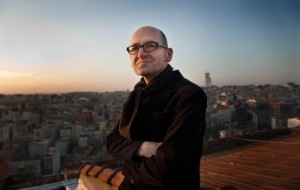
New guest blogger: Lindsay Lawson
Thanks to Thea Liberty Nichols for chronicling the artists, curators, and historians coming through the School of the Art Institute of Chicago’s Visiting Artists Program.
Up next is Lindsay Lawson. Lindsay is an artist and occasional curator and writer currently based in Berlin. She has studied at the Städelschule in Frankfurt am Main, Germany, and received her MFA from UCLA in Los Angeles. Her work incorporates a variety of media, returning often to video, while engaging and questioning incompatible states of being. She has recently exhibited at Program (Berlin), Yaffo 23 (Jerusalem), Gentili Apri (Berlin), and Thomas Solomon Gallery (Los Angeles). Her solo exhibition, American Smooth at Adds Donna in Chicago, is now on view until March 13.
Weekly Roundup

Louise Bourgeois and Alex Van Gelder, "Armed Forces," 2010. Courtesy Alex Van Gelder and Hauser & Wirth (Zürich).
In this week’s roundup, Louise Bourgeois is in two collaborative exhibitions, Walton Ford is featured in Juxtapoz, Charles Atlas presents new work, and more.
- Louise Bourgeois collaborated with Tracy Emin in Do Not Abandon Me, a current exhibition at Hauser & Wirth (London). The exchange originated with Bourgeois, who began the works by painting male and female torsos in profile on paper, mixing red, blue and black gouache pigments with water to create delicate and fluid silhouettes. Bourgeois then passed the images on to Emin. This exhibition is on view until March 12.
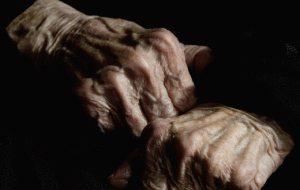
- The hands of Louise Bourgeois are the subjects of portraits taken by the artist Alex Van Gelder, who, at Bourgeois’s invitation, photographed her at her New York townhouse during the last year of her life. The resulting exhibition, Armed Forces, consists of eighteen photographic prints is on display at Hauser & Wirth (Zürich) now until May 14.
- Mark Dion‘s South Florida Wildlife Rescue Unit, a large-scale installation focusing on the Everglades and human attempts to control the South Florida ecosystem, will soon be on view at The Anchor Gallery at Miami Art Museum. Dion’s project consists of three parts, corresponding to the three major periods of Everglades history and it will be on view from March 11 through August 28.
- Charles Atlas has a solo exhibition at Vilma Gold (London). In the show, the artist meditates on his career, which now spans over forty years. Atlas presents a new three- channel video installation, Painting by Numbers, featuring a cast of characters previously visited in his installation work: namely the numbers 1 through 6. This exhibition is on view until April 10.
- Walton Ford is featured in this Juxtapoz Presents video profile:
Inside the Artist’s Studio: Brandon Anschultz
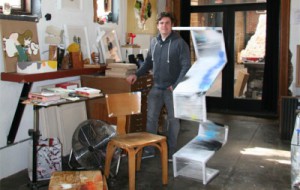
Full disclosure: I have spent many happy hours in Brandon Anschultz‘s studio, located near Lafayette Square in St. Louis, MO, drinking wine, laughing hysterically at his sharp wit, and admiring his brilliant paintings and sculptures, which line the walls and fill every available corner and surface. Thus, this is a space which is near and dear to my heart. Anschultz is an exhaustive investigator of the raw materials of art-making. The essential qualities of paint, canvas, wood, and other basic materials–their internal physics, texture, tone, and hue–take center stage, becoming the primary subject of focus instead of merely serving as the means to an end. Over the past year or so, Anschultz has been utilizing a technique in which he applies layers of paint to two raw canvases (or sometimes canvas and paper) and then presses them together, leaving them to sit for days in their sticky embrace before separating them, the strata of color revealed and a jagged, mountainous topography created by the disengagement process. Simultaneous to these two-dimensional works, he has also been making small three-dimensional objects in which mixed, vivid colors are applied to wads of sawdust. Once dry, these turn into porous, geological formations reminiscent of volcanic rock. These have a charming, tactile quality, their simultaneously naturalistic qualities and completely unnatural color palatte exuding a certain humor.
In the five years that I have known Anschultz, he has been constantly busy traveling around the country to participate in exhibitions. Since finishing his MFA at Washington University in St. Louis in 2002, he has shown in a host of galleries, alternative spaces and museums, in cities from Pullman, WA to Philadelphia and from New Orleans to Chicago. This past fall, his solo exhibition, Stick Around For Joy, was first shown at Laumeier Sculpture Park in St. Louis and then traveled to Longue Vue House and Garden in New Orleans, a historical home which has recently begun to exhibit contemporary art within the context of the preserved residential space. Also, in January he participated in a two person show at Tiger Strikes Asteroid in Philadelphia titled Due Diligence Done. In the next few months, he will open a show at The Hills in Chicago, and then spend the summer as an artist-in-residence at Cite Internationale des Artes in Paris.
Elizabeth Wolfson: What do you consider the primary concerns of your practice? What questions are you asking, either of yourself or your work? What results are you most interested in?
Brandon Anschultz: I’m asking formal questions about painting, about sculpture, about abstraction, and the act of making in general. I also think a lot about the longevity of objects and what’s specific about the moment in which they’re created. Everything is so speedy in life, I want the work to slow that down a bit. Making something that takes months and months to reach a point of stability, yet which hurdles through time in a non-stable way. I’m asking personal questions, too, but they’re less relevant. I’m most interested when the work reaches a quizzical balance or imbalance.
Wangechi Mutu
“I’m really trying to pay homage to the notion of the sublime and the abject together and using the aesthetic of rejection, or poverty, or wretchedness as a tool to talk about things that are transcendent and hopeful.” (Aimée Reed, “Interview with Wangechi Mutu,” Daily Serving, Apr. 12, 2010)
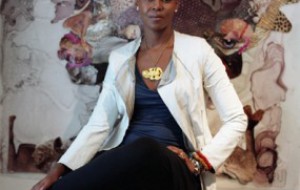
Wangechi Mutu was born in Kenya and lives and works in New York City. As the inaugural recipient of the Deutsche Bank Prize, Mutu had a large showing of her work up at the Deutsche Guggenheim this past June that included several of her signature strategically scatological collages and assemblages.
Having followed Mutu’s successes from early on in her career, it’s been dazzling to see her develop her present mode of working wherein she pieces together imagery culled from vintage medical illustrations, fashion and lifestyle magazines, pornography, and anthropological photographs and then embellishes them with glitter, paint, ribbon, and beads. Recently, for her exhibition at the Gladstone Gallery in New York, she also incorporated 3-D sculptural works as well. A close examination of Mutu’s 2D pieces reveal mylar resisting penetration from paint washes, with swirling pools of pleasing colors and curious microcosms of recognizable image fragments in unrecognizable contexts. Mutu’s work is beguiling and uncanny in the ways that it simultaneously entices and repels.
Dominated by depictions of the female figure, Mutu’s women are shape-shifting, hybridized forms whose meticulously reworked surfaces often belie their contorted postures, amputated limbs, flayed flesh, and stringy hair follicles.
By re-ordering disparate imagery of the natural world, such as bits and pieces from National Geographic, and splicing it together with mechanical imagery from Motorobike magazine, Mutu creates beings that blend all phylum of the animal kingdom together– or ones that look like they’re mostly machine-made cyborgs or out of this world aliens.
So, I think it’s sort of trying to slowly place this image up front yet again, and again, and again. A lot of work is about repetition; repeating the same thing, repeating the same image by going at it from different angles. I also think it takes a while for some things to be understood. I feel that what happens is that I have to keep continuing the work in order for it to be understood, ‘Oh, she kind of means it.’ When you are criticizing a culture from within, it is a little bit harder sometimes for people to accept it. (“Interview with Wangechi Mutu,” Daily Serving)
Looking at Los Angeles | Ephemerality and Eternity in “All of this and nothing”

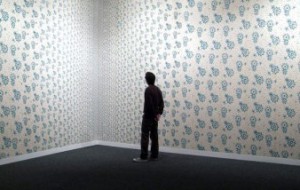
Jorge Macchi, "Vanishing Point," 2005. Acrylic paint on paper. Variable dimensions. Collection of Michael Krichman and Carmen Cuenca, San Diego. Via hammer.ucla.edu
“It’s really about the magical and the mysterious in the everyday,” says Hammer senior curator Anne Ellegood, in the online video introducing the museum’s newest exhibition, All of this and nothing. Ellegood worked alongside chief curator Douglas Fogle to select artists who use mundane moments and everyday materials to delve into complex existential explorations. The contemplative, delicate quality of most works in the show belies the diversity and complexity of the exhibition, which includes 60 works by 14 different artists from all over the globe.
Buenos Aires-based artist Jorge Macchi uses tropes of ordinary life and castoff objects to delve into ideas of entropy, eternity, and mortality. Vanishing Point is comprised of two walls, adorned with trompe l’oeil hand-painted wallpaper. The patterns get smaller and denser as they approach the corner, creating a forced perspective illusion in which the gallery seems to proceed toward infinity. In Parallel Lives (1999), Macchi smashed a mirror using a hammer and nail. The mirror remained relatively intact, but cracks radiate erratically from the point of impact. Macchi then painstakingly chiseled cracks into an identical mirror, creating precisely the same cracks as in the original mirror. For Monoblock, Macchi extracted death notice pages from the paper, cutting out the rectangles of information about each individual and leaving only the symbol of his or her religion – typically a crucifix or star of David. The pages are layered upon one another, peeking through one another’s cutout windows. Devoid of text, the yellowed stack of papers, hanging vertically on the wall behind a glass frame, has the feeling of an architectural rendering. Each empty rectangle hangs like a vacant room. Out of context, all the tiny crosses and stars swell with mystery.

Fernando Ortega, "N. Clavipes Meets S. Erard, Movement 3," 2008. Photographic print. Courtesy the artist and kurimanzutto, Mexico City. Via hammer.ucla.edu
On the other side of Macchi’s faux-wallpapered partition, Mexico City’s Fernando Ortega gracefully wrestles with similar ideas of chance, emptiness, and temporality. In 2008, Ortega offered a skeletal harp frame, sans strings, to a single spider. With some nudging, the spider eventually spun a web in the negative space of the harp, restringing the instrument with its delicate web. Generally a symbol of heavenly divinity, the harp stands in contrast to the web and spider – which typically signify musty neglect in the most benign sense, and familiars of the spooky occult in darker interpretations.
Tobias Putrih

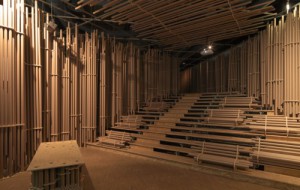
Tobias Putrih, "View of Siska International," 2010. Mixed media installation. Installation view at Espace 315, Centre Pompidou, Paris. Photo credit: Georges Meguerditchian. Courtesy the artist and Meulensteen Gallery, New York
“I don’t think art is about consistency. It’s about complexity … The key question for me is how to make an object that expresses its own self-doubt, questions its own existence.” — Tobias Putrih, in Tobias Putrih 99-07 (JRP/Ringier, 2007)
Tobias Putrih isn’t a filmmaker, but several of his site-specific installations have re-imaged cinema interiors through the creation of life-size environments, where actual films are projected for viewers to sit and watch. One of the things I respond to the most is Putrih’s usage of every day, ephemeral materials such as paper, cardboard, tape, twist ties, and plastic foam to create, among other things, usable structures. Putrih also uses these materials to create maquettes, many of them also cinemas, but the small-scale models often represent structures that would be impossible to construct or use.
Born in Kranj, Slovenia, Putrih represented his native country at the 52nd Venice Biennale in 2007. He now lives and works in New York and his fascination with process and the endless series of permutations that are possible when designing and constructing something is ongoing. Putrih recognizes that vision and experimentation are required to produce both functional structures and provisional objects, and has noted as much by saying:
“Blueprints, maquettes, models—these are all representational forms that describe the structure and proposed function of something. I’m interested in these forms as substitutes through which we can explore the potentials of an idea. It is much easier for me to justify the production of an object if I can insist that it is not a finished thing but rather just a proposal for an object or architectural space that will probably never be built… for me to float an idea in a provisional form that can easily be remade or disposed of makes sense, because such makeshift objects still beg questions about their own existence.” (in Tobias Putrih 99-07)

Tobias Putrih, "View of Siska International," 2010. Mixed media installation. Installation view at Espace 315, Centre Pompidou, Paris. Photo credit: Georges Meguerditchian. Courtesy the artist and Meulensteen Gallery, New York
In riffing off of works by artistic and architectural titans such as Robert Smithson and Buckminster Fuller, Putrih has also revealed that his influences and inspiration aren’t solely confined to the fine arts, and include physics, science fiction and anthropology.
I like how several of his works have a collaborative component to them, with viewers often invited to construct models of their own or inhabit built environments. And like several of the other speakers from VAP’s Spring series of lectures (Muñoz, Bartana) Putrih is fascinated by experimental utopias and this permeates his work; “art and design (are) manipulative but also potentially therapeutic and socially ameliorative practices” (in Tobias Putrih 99-07).

Tobias Putrih, "View of Siska International," 2010. Mixed media installation. Installation view at Espace 315, Centre Pompidou, Paris. Photo credit: Georges Meguerditchian. Courtesy the artist and Meulensteen Gallery, New York
I’m really looking forward to hearing Putrih articulate some of the tension between the functional and the imaginative in his work when VAP welcomes him to speak in person soon. Please join us if you’ll be in Chicago!
Turkish and Other Delights | biriken
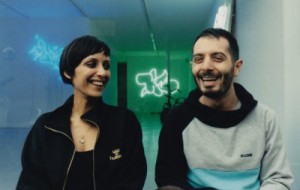
biriken is the five year old interdisciplinary, collaborative project of Melis Tezkan and Okan Urun. Working at the intersection of performance art, installation art, and traditional theater practice, Tezkan and Urun exploit their divergent backgrounds—she studied media and communication and has worked extensively in video production, while he studied theater and acting—to create performative works that, in the Brechtian tradition, draw attention to the constructed nature of reality both within and outside of the performance space. In their projects, live performance mixes freely with projected video, looped audio, and/or textual elements, leveling the playing field between sensory experiences and representational techniques. “We use actors and video at the same time,” Ukun explains. “The actor for us is not more important than the video, or the video than the actor. The text is not more important than another element. Everything is important or not important. This co-existence of the video and the actor and the text—we hope—is less theatrical, less hierarchical.”
Though they first met as teenagers growing up in Istanbul, attending the same “weekend school” (the classes Turkish high school students take to prepare for college), biriken was actually born in Paris, where Tezkan and Urun reconnected as graduate students attending La Sorbonne, where he studied theater and acting and she continues to work towards her doctorate in aesthetics. After months spend discussing their art and their shared social, political, and intellectual concerns, “we said, ‘okay, instead of talking let’s do something together, and do something different,’” recalls Tezkan. This was in 2005. In 2006, when they collaborated on their first project, Simdi bizim evin yerinde cukur var (“Now there is a hole where once stood our house”), they realized they needed a name. In Turkish “biriken” means “accumulated” or “built-up.” “This was the idea—instead of talking, accumulating ideas,” they would create art out of their built-up thoughts and plans.
As it happens, this concept of working with a mass of accumulated materials applies not only to the duo’s use of their amassed conversations and schemes, but also their practice of drawing on the cultural baggage of their generation. “Our generation is the MTV generation,” says Urun. “It’s also our common point with the world. I think sometimes I feel more comfortable talking about something common then trying to explain local things to everyone.” Thus their projects are littered with references culled from across the pop cultural landscape of the past thirty years. For example, in Now there is a hole where once stood our house, Stacey Q’s 1985 hit single “Two of Hearts” provides the soundtrack to Urun’s live performance, in which he maniacally shifts between Jazzercise-style and Flashdance era dance moves and moments of intense, almost paranoid introspection. A projected video of Urun, jogging through the streets of Paris, fills the wall behind him; downstage, two small television sets show a live feed from a video camera set up on stage that records his movements about the stage.
Graffiti in the Classroom
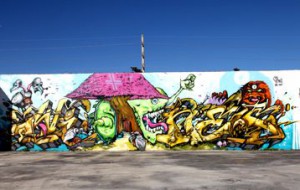
Students often have lots of interest and questions about graffiti, graffiti art and street art. My response usually includes the fact that I love graffiti art and street art, especially if the artist takes their time to make something that’s really well designed (and in some cases has permission to create it). From my perspective, you can’t make a quality work of art in a few seconds while simultaneously looking over your shoulder for the cops. That’s where I draw the line between art and vandalism. Vandalism includes tagging/defacing a space that the artist knows will have to be washed off immediately (store windows, front doors of businesses, subway token booths, etc.). Fortunately, most graffiti artists create works in spots that can linger for a while. And some linger for a long, long time, which is great if they are well done, whether they exist as an artist’s tag or as a painting that includes the artist’s tag.
Barry McGee and the late Margaret Kilgallen are featured in season 1 and address the idea of graffiti as an art form- an art form where you see the artist’s hand in the work vs. things like billboards, which Margaret Kilgallen calls “mind garbage”. Barry McGee goes on to make the point that graffiti can simply be painted over with a roller- something you cannot do with a really bad commercial jingle that stays in your head.
There are literally tons of books and sites that help us teach about graffiti as an art form, even Banksy’s Exit Through the Gift Shop has been nominated for an Oscar at this point, but three resources I want to point out this week include two websites- The Dirt Floor and Brooklyn Street Art- and the film Bomb It.
Open Enrollment: An Afternoon with Miina Äkkijyrkkä
As if I am perched above on a watchtower, I am peering out the window of Café Java in the Lasipalatsi plaza with my friend and Finnish translator, Marjukka. The second story window affords a panoramic view of pedestrians on the street below. Ironically, I am skipping my Finnish language course today to spend the afternoon interviewing the inimitable artist, Miina Äkkijyrkkä .
When she arrives, Miina Äkkijyrkkä is dressed head to toe in animal fur. She is wearing a dark brown floor-length fur coat and a bright red fur hat. Bypassing introductions, Miina tells Marjukka in Finnish that the café is too loud. Within seconds we are whisked away, down the street to Kosmos, an elegant restaurant designed by the architect Alvar Aalto in 1924. The restaurant, formerly a popular haunt among artists and writers, today proudly showcases an Äkkijyrkkä sculpture called Bisse Baby, 2002 in the front window.
As we talked in a quiet corner booth, Miina gesticulated grandly. She pulled at our tablecloth and circled her hands in the air, making amusing sound effects such as a flushing toilet. Her face was expressive, her voice, distinct—low and gravelly. One time, she whispered to us and once, she nearly cried. With one watch on each hand and her wild white hair, I began to understand her reputation as one of Finland’s most colorful personalities in the art world.
There are many reasons why I wanted to meet with Miina Äkkijyrkkä (b. 1949, néé Riitta Loiva, though she has also used the alias Liina Lång). For nearly four decades, Miina has made a career almost exclusively based on the image of the cow. Her love for the cows is the foundation for her work as a sculptor and a cattle-raiser. Her steadfast commitment to Finnish cattle at once evinces her sincerity, validates her work,—and frequently, spins a web of controversy around her.