



“William Kentridge: Anything Is Possible” Wins A Peabody!

March 31st, 2011

Art21 is honored to be among the recipients of the 70th Annual Peabody Awards—the premiere international prize in electronic media—for its film, William Kentridge: Anything Is Possible.

The Peabody board recognized William Kentridge: Anything Is Possible as “a veritable all-access pass to [William Kentridge's] mind and work process” given to Art21 by an artist whom they describe as “creativity personified” and “a one-man seminar.”

“The Peabody Awards were established with deep respect for the critical role played by electronic media in contemporary society and culture,” said Horace Newcomb, director of the Peabody Awards. “The annual announcement of the recipients continues in that spirit to recognize work that sets the highest standards for the media industries.”

Visit the Peabody Awards site for the full list of this year’s recipients.

This is the second Peabody award for Art21. The non-profit organization received its first Peabody award for the fourth season (2007) of the biennial PBS television series, Art in the Twenty-First Century. To date, Art21 has produced five seasons of the Art in the Twenty-First Century series, featuring 86 artists in total. Art21 is currently in production for the sixth season of the series, tentatively scheduled to premiere in Spring 2012.

William Kentridge: Anything Is Possible is currently available for purchase on DVD through ShopPBS and other retailers. The film is also available to watch instantly through your browser at PBS Video and on the film site, as well as through the PBS Mobile app available for iOS-powered devices.

Wrapping Up Art21 at NAEA 2011

March 30th, 2011

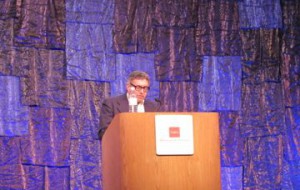
Mark Dion gets set to give the keynote speech to over 3,500 attendees at the NAEA annual conference in Seattle on March 18th.

It was suggested that perhaps the TWCA column could provide a a wrap-up of the National Art Education Association’s annual conference in pictures this year, and while I would like to take a crack at it, so much went on that I can’t help but include a recent summary of the conference written by my colleague, Jessica Hamlin:

This year’s annual NAEA conference in Seattle, WA boasted over 3,700 participating art teachers, museum educators, academics and student teachers in attendance. The theme of Imagination, Creativity, and Innovation was intended as an opportunity to see connections across the arts disciplines in terms of the role of art education. Mark Dion’s participation was a natural extension of this theme and an attempt to contribute new ways of thinking about art education in light of contemporary artistic practice.

Over the course of three days, Art21 presented a series of incredibly well attended (and often packed) presentations, workshops, and sessions featuring Mark Dion and other Art21 initiatives.

During the conference’s opening keynote speech, approximately 3,500 participants watched Mark Dion’s Season Four Art in the Twenty-First Century segment featuring his Seattle-based installation the Neukom Vivarium in anticipation of his comments. In his keynote speech, Mark discussed his interests and work in relation to the categories of archeology, museum collections, natural follies, and his educational project Mildred’s Lane. At the very end Mark presented a passionate stance on not only the significance of, but the urgency for, art education that develops informed, creative and critical citizens. Many in the audience were literally moved to tears. Continue reading »

Living in the Present

March 30th, 2011

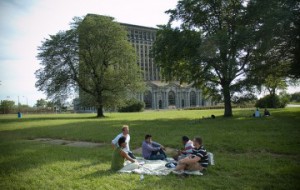
A group of Detroiters gathers on the lawn in front of Michigan Central Train Station, image courtesy of Imagination Station.

The abandoned buildings in Detroit have an air of nostalgia and a visceral seductiveness. When encountered for the first-time, they can be overwhelming. No building represents the affects of ruin shock better than the infamous Michigan Central Train Station. Images of the ruins of Detroit–especially Michigan Central Station–have come to [mis]represent the city in the mass media. Erected in 1914, the building was at one time the fourth largest building in Detroit. Built to sustain the growing population of people flocking to the city, Michigan Central is a trace of what Detroit used to be.

One of the first duos to gain recognition for this type of work is the collaborative duo of Yves Marchand and Romain Meffre,  young French photographers who began documenting the abandoned buildings of Detroit in 2005. The fruit of their labor, Ruins of Detroit, is a large expensive book of photographs with an introduction by Thomas Sugrue, famed American historian, professor, and author of Origins of the Urban Crisis: Race and Inequality in Post-War Detroit. Photographic excerpts from Ruins of Detroit were digitally published in the aforementioned New York Times photo essay, as part of “Assignment Detroit.” Titled “Detroit’s Beautiful, Horrible Decline,” Marchand’s and Meffre’s images documented a sample of run-down and dilapidated buildings.

In Freud’s essay, “Notes on the Mystic Writing Pad,” the author elucidates a psychoanalytically-informed theory that memories are traces forever imprinted onto the individual’s psyche. Michigan Central Station, which closed its doors in 1988, is a relic of a history past, concrete evidence of a former time, forever imprinted in the minds of Detroiters. The building itself is a trace, proof that the city was a bustling metropolis. The sheer magnitude of the structure leaves a mark of its past on the present landscape, and entices eager viewers to visit and photograph it. Imprints of another time and moments forever frozen.

One could shift his or her gaze across the street and encounter a different representation of Detroit, a response to neighborhood disintegration: the site-specific, community-based Imagination Station.

Continue reading »

Open Enrollment | Los Angeles: Nice Meeting You Again and Again

March 30th, 2011

This week began with Dean Rochelle Steiner of the USC Roski School of Fine Arts signing off on my thesis and me paying the publishing and binding fee. My thesis is officially complete! The other component of the program is a co-curated student exhibition… more on this and how it can serve as a model for a reality show in an upcoming post. Anyway, as graduation nears, the exhaustive question, “What do you plan to do next?” has began to rear its ugly head and is typically met with some of my performatively ambivalent responses:

“Nothing.”

“Go to med school.”

and a heavy favorite, “Not become a curator.”

Given the atmosphere of anxiety among those in my cohort, our graduation date of Friday the 13th of May seems appropriate.  But in all seriousness, at the present moment I’m exhausted and currently trying to leave the mental head space of my thesis (for those wondering, it was on feminist art critical methodologies and social practice — that is as much of an elaboration on it that I can muster right now). The question of “What to do next?” also brings forward the where component. I expect that out of the 12 graduates of my program this year, at least 2/3 of us will stay in Los Angeles. Matriculation in a Los Angeles graduate level art program (as is the case elsewhere, I’m sure) is as much a measure of your accomplishments as it is a test of your networking abilities so to me, it seems improbable to pack up and leave right now.

Continue reading »

Open Enrollment | BFA and MFA Shows: The New Collector’s Market?

March 30th, 2011

Last Friday, I got off the subway and felt the crisp, eight o’clock Chicago evening air and saw something I was not expecting: a line around The School of the Art Institute’s (SAIC) gallery building. The lines snaked along busy State Street, winding down and around the side street. Puffs of cigarette smoke and ringing cellphones surrounded everyone waiting to get into the building to see the 2011 SAIC BFA show.

The cigarette smoke and cell phone jingles were primarily coming from art students, but this year, I saw more people off the street than I would usually see at BFA shows. I asked those around me what brought them there, and what compelled them to stand in a cold Chicago night to get into a show of undergraduate artwork.

A couple who appeared to be in their late fifties to early sixties stood behind me with another couple who also appeared to be about their age. I asked them if they knew an artist in the show, and they replied simply, “No. We come here every year to buy art.” They went on to tell me they desired this venue for collecting because it was affordable, but even more importantly, it was completely refreshing and undigested.

Continue reading »

Center Field | Protest Songs and Lullabies: Susan Philipsz in Chicago

March 29th, 2011

What does it mean to sing a protest song as if it were a lullaby? It’s a question I often ask myself. My five-year-old daughter has trouble falling asleep at night, so most evenings, my husband stays with her until she drifts off to never never land. He has a little trick he uses to help her relax: he sings her a song by the Cowboy Junkies called “Mining for Gold.” The song was written by the Canadian folk musician James Gordon, who in turn based it on a traditional song called “Taku Miners.” Yet it’s Margo Timmins’s swelling a cappella version that has made this song such a memorable one (compare it, for example, with this rendition of “Taku Miners,” which, following the original, is set to the bouncy tune of “Darling Clementine”).

Although I guess it’s not technically a protest song, Timmins’s “Mining” does express that complex blend of pride, stoicism, and human yearning from which protest often springs. Margo, Michael, and Peter Timmins are the great-grandchildren of a well-known Canadian mining prospector, so no doubt they were thinking of their own family’s heritage when they chose to cover the song for The Trinity Sessions. My husband and I realize that it’s kind of weird to sing our kid to sleep with a song about men dying of silicosis, but then again the lyrics to “Rock-a-Bye Baby” are pretty disturbing too. Still, the question of why someone would sing a protest song as if it were a lullaby was very much on my mind during several recent encounters with the work of Scottish artist Susan Philipsz. She has three installations on view right now in Chicago: We Shall Be All and Internationale at the Museum of Contemporary Art and Pledge at the Jane Addams Hull-House Museum on the University of Illinois, Chicago campus. The winner of this year’s Turner Prize, Philipsz is widely acclaimed for her use of sound — and more specifically of voice — in works of art that engage the history and culture of protest. Almost all of Philipsz’s installations rely on her own, untrained vocals to weave densely allusive tapestries that commemorate the experiences of those struggling for a better world — something we don’t normally associate with the soothing nature of lullabies.

Commissioned by the MCA, Phillipsz’s We Shall Be All references Chicago’s labor movement and its legacy of social reform in the context of worldwide struggles for worker’s rights. I think it’s partly the fact that public-sector labor unions are so much in the news nowadays, due to the efforts of numerous GOP legislators to quash the collective bargaining power of those unions (or even its mere visual representation) that lends such a sharp sting to Philipsz’s Chicago presentations. Consisting of several speakers and a projection screen arranged within a completely darkened room, We Shall Be All takes its title from Melvyn Dubofsky’s We Shall Be All: A History of the Industrial Workers of the World. This book provides the definitive history of the Industrial Workers of the World (IWW), the Chicago-born labor association whose influence was especially strong during the years before World War I. In particular, Philipsz’s piece alludes to the 1886 Haymarket Massacre in Chicago, whose anniversary is commemorated on May 1st of each year in honor of International Workers Rights.

Continue reading »

We Almost Lost Detroit

March 28th, 2011

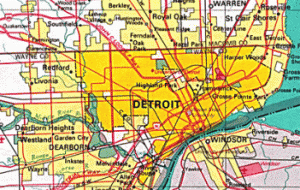
I was in Detroit this weekend catching up with my family and friends and was able to look at the city with fresh eyes. Distance is necessary to have criticality, which brings with it a discerning tone. For the next two weeks, I will be blogging about the city, pairing my new perspective with over two years of research and accumulated information, as well as my first-hand experience of working as a creative in the city.

My journey begins on the southwest side of Detroit and continues to the suburbs of Grosse Pointe, back to the Eastside, Hamtramck, downtown, and vicinity. The amalgam of all this shall be a selection of artists and projects that work to develop sustainability and creativity, whilst encouraging community.

It stands out on a highway, like a creature from another time. It inspires the babies’ questions, “What’s that?” For their mothers as they ride. But no one stopped to think about the babies or how they would survive, and we almost lost Detroit this time.

The lyrics above are taken from a 1966 song by Gil Scott Heron and Brian Jackson, written in response to the partial meltdown of the Enrico Fermi Nuclear Power Plant located halfway between Detroit and Toledo, OH. The plant is so enormous that the affects of the meltdown—had it not been contained—would have left both cities in ruin. Heron’s lyrics are a prolific metaphor for the tumultuous events of recent times.

Continue reading »

New guest blogger: Allison Glenn

March 28th, 2011

Thanks, Joe Grimm, for stopping by our blog for the past two weeks. Up next is Allison Glenn. Allison is a dual MA candidate in Modern Art History, Theory and Criticism & Arts Administration and Policy at the School of the Art Institute of Chicago, and a graduate of Wayne State University in Detroit, MI, where she studied Photography and Urban Studies. She is currently investigating new approaches to programming exhibitions in mid-level, non-collecting contemporary art institutions, including assessing the impact of temporary and site-specific exhibitions, satellite spaces, and initiatives that reach beyond the institutional space.

Letter from London: The Price is Right

March 28th, 2011

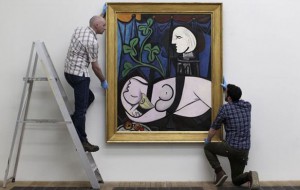
Picasso's "Nude, Green Leaves, and Bust" (1932) at Tate Modern. Image Andy Paradise/PA.

Funny how very expensive paintings become metaphors of themselves. The 45-million-dollar Duccio bought by the Met in 2005 shows the incarnate deity supported with infinite care by his reverentially gazing mother, in prophecy of the object’s later veneration by acquisitive museum trustees. Similarly, Raphael’s Madonna of the Pinks, picked up by the National Gallery in 2004 for a mere 35 million pounds, predicts its own historical afterlife as object of enraptured awe: the Madonna both supports and frames the child, holding it and owning it. Actaeon unveils the nude Diana at her bath, like a museum director pulling a curtain cord at a press conference, in a Titian bought by the National Gallery for roughly the GDP of Belgium in 2008. In all of these works, the looked-upon object of attention is, like a work of art, something between divine and physical, capable of redeeming (Christ) or cursing (Diana) the life of the observer. It’s all in the viewer’s use of what he or she beholds. Look how, in Duccio’s painting, Christ returns the touch, or how Diana’s body, the whole shebang, is stretched out for Actaeon’s grateful view. These paintings dramatize rapture at the sight of a beautiful thing.

Titian's "Diana and Actaeon" at the National Gallery. Photograph: Dominic Lipinski/PA.

It’s remarkable how often these performances of revealed beauty take center stage in major museum acquisitions of works of art. (Because we’re worth it, they seem to say, justifying themselves to a skeptical public.) Once an artwork is sold, it is changed permanently. The purchase itself seems part of the painting’s meaning, its reason for being. Very expensive contemporary art does this too: big, shiny objects by Hirst, Koons, or Murakami are themselves performances of expensiveness, in which the painted observer (Mary, Actaeon) is substituted for the gaze of the valuer, auctioneer, purchaser. Rapture is implied.

Continue reading »

Weekly Roundup

March 28th, 2011
Concert for Japan

Laurie Anderson and Phillip Glass. Concert for Japan 2011. Image courtesy of the Japan Society.

In this week’s roundup, Laurie Anderson performs for Japan aid, Maya Lin is honored, several artists are keeping it real in London, work by An-My Lê and Richard Serra soon to come at The Met, and much more.

  • Laurie Anderson and several others will perform at a Japan Society concert to benefit the Japan Earthquake Relief Fund.  Concert for Japan will be a 12-hour marathon event on Saturday, April 9, in New York City to benefit organizations that directly help people affected by the earthquake and tsunamis that struck Japan.
  • Maya Lin is the winner of an architecture medal presented by The University of Virginia and the Thomas Jefferson Foundation.  The Thomas Jefferson Medals recognize the achievements of those who excel in areas in which Jefferson did significant work.
  • Do Ho Suh, Kimsooja, and Mark Bradford are part of a group of artists whose work is included in The Spirituality of Place at the Savannah College of Art and Design’s Gutstein Gallery.  The show focuses on artists working in a variety of media who explore the sense, spirit and memory of place and reinterpret it poetically through their art.  This exhibition closes on April 17.

Continue reading »