Looking at Los Angeles | Vija Celmins’s Visions of Violence

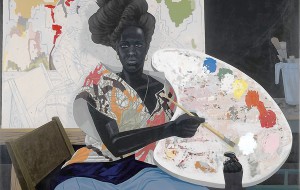
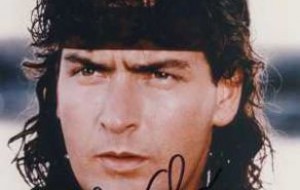
Vija Celmins, "Time Magazine Cover," 1965. Oil on canvas, 22x16 in.. Private Collection c/o Ms. Laura Bechter. Courtesy LACMA.
Last Saturday, March 19—the day that the US began air strikes in Libya—I passed an anti-war demonstration while driving to LACMA to see Vija Celmins: Television and Disaster, 1964-1966. It was a few minutes before I realized that it was also the anniversary of the war in Iraq and these protests had been organized across the country on March 19 for the past eight years. I almost considered canceling my obligations for the day to indulge my political leanings and join the throngs of protestors.

Protestors in Los Angeles on March 19, 2011. Photo by Travis Wilkerson, image courtesy answercoalition.org.
I rationalized my decision to continue with my day as planned, telling myself that I would be showing solidarity by visiting Celmins’s show. Each of the 20-odd pieces in the exhibition capture moments of either horrific destruction or potential destruction—frozen first by photography, and then re-captured by Celmins’ careful hand. The intersection of art and politics is rarely successful, and often artists who attempt it fall into the realm of didacticism and propaganda, or worse, aestheticizing violence. But Celmins’s images of conflict and destruction, painted during the Vietnam War, avoid these pitfalls while retaining their own kind of force and power.

Bruce Nauman, "Violins Violence Silence," 1981-1982. Neon tubing with clear glass tubing suspension frame, 60 1/2 x 66 1/2 x 6 inches. Oliver-Hoffmann Family Collection, Chicago Courtesy Leo Castelli Gallery, New York, © Bruce Nauman/Artists Rights Society (ARS), New York.
Critic and teacher Kathryn Hixson is the one person I’ve had in my life who felt like a mentor in the deepest sense. She was wickedly funny, challenging, and yet warm. When she passed away this last fall, she left me feeling unmoored — I realized how very much I relied on her presence, her feedback.
A year ago, she helped curate a group show in Chicago, KILLING TIME, that I was fortunate to participate in. Next month, all of the artists involved are showing work together again. Kathryn’s last critical project was research into the role of comedic aggression in art; so we’ve decided to call the new exhibition NO JOKE.
In conjunction with the show, we will be holding a reading on Sunday April 10, of Kathryn’s writings. For this event, through the gracious generosity of Kathryn’s sister Irene Hixson Roderick, I was able to obtain some fragments of her research for what was to be her PhD dissertation (and, no doubt, a kickass book). The working title was It’s Not “Why?” but “How Long?”: Comedic Aggression in Visual Art of the 1970s. Here’s an excerpt from an early draft of her introduction:
Another consistency that emerges surprisingly is the almost universal interest in the human body: its presentation and representation in artworks. Andy Warhol’s Elvis and Carl Andre’s Lever may represent two poles of ways of dealing with the figure: Elvis is an image of an image of a Hollywood/music/TV icon, while Andre removes almost all materiality or image from the Lever to leave the viewer with his or her own body: its location, sensory input, spatial context. The events of 1968, the Civil Rights Movement, Vietnam, Woodstock, and feminist protest had, each in its own way, concentrated a hard focus on the human body as a site of protest, conflict, and as a powerful force in social space. Each individual’s real physical body was a site for action—drafted, danced, protested, de-brassiered, body-bagged. Each person’s body had the potential for social impact, in a riot, political rally, conscious-raising group, or concert hall. Across the arts, from Nauman’s stomping in the studio to Robbe-Grillet’s post-existential Realism, to Francois Truffaut’s auteurism to Kenneth Anger’s structuralist films, the human body in action (or not) is held under the tightest of scrutiny, and is critical to the content of the work. This presentation and representation of the body is fundamentally different from that of Abstract Expressionism that left a field of action with paint, or presented a chance to transcend the body. It is also a different type of ‘realism’: less the symbolic potential of AbEx or commodity embrace of Pop or severe existentialism of Minimalism. In the post-minimal feminist conceptual mélange of the 1970s is a new realism based on the lived body, not its imagined fiction. And it is this new realism that allows for the infusion of the media image as part and parcel of bodily reality.
Lots of Questions and Lots of Coffee: NAEA 2011
As I mentioned last week, Art21’s Education and Public Programs team recently took to Seattle for the National Art Education Association’s annual conference. Over 3,000 educators from across the country came to think about and discuss teaching visual art in today’s schools, classrooms and studios. They also came to take part in an enormous number of workshops offered by the association as well as experience a variety of events we had the pleasure to facilitate, including Mark Dion’s keynote address, a day with Mark at the Neukom Vivarium, a panel discussion about teaching with the Neukom Vivarium, a session detailing the Art21 Educators program, and a team-taught workshop between museum educators and Art21 at the Seattle Art Museum. Sleepless in Seattle, indeed!
As we raced from event to event, there seemed to be some recurring questions that participants were talking about. Those that took center stage included:
- What is the best response to the most recent national attack on art education (and education in general)?
- How can NAEA begin to counter an essentially defensive posture that the organization has taken with regard to the question above?
- How can we as art educators spend less time justifying our existence and more time taking leadership roles in our schools, districts and states, in order to help people understand what we really do?
It was abundantly clear that many participants had begun to think long and hard about whether art education should literally be (or should I say, continue to be?) at the service of other subjects. For example, many elementary art teachers mentioned not wanting to be known as a “prep” for general education teachers, yet this is how many people employed in schools view their work. These teachers, like so many of us, have curriculum they are passionate about and questions they want to explore with their students, yet art education on the elementary level often serves as a programming benefit vs. a rich learning experience the whole school should understand and cultivate.
It was also crystal clear that teachers everywhere are facing huge budget cuts and losses to staff, which has influenced an atmosphere of let’s take what we can get even though we all know very well that taking what we can get doesn’t exactly “advance our profession”. Many teachers are angry, and justifiably so, at the nonsense going on in Wisconsin and other states. Education, and particularly art education, is an easy target for a new form of teetotalism- one that includes abstinence from common sense and a reluctance to think broadly.
Other questions that came up during my time at the conference included:
- How can art educators begin to plan curriculum for a post-studio world? What implications exist as artists continue to move out of working within a studio environment? How does this affect how we plan curriculum and teach about making works of art?
- Where does art education and museum education meet, and how can the two work together more effectively?
- What can a new wave of interdisciplinary thinking and teaching really look and sound like?
- Can art and science be a lot closer to coexistence than we think? (Many thanks to our super-session panelists for making a good case for this, even though, as Mark Dion pointed out, humor, irony and metaphor are tools that scientists just don’t have).
I invite you to weigh in on any of the questions above so that we may continue the conversation and perhaps share some of our ideas with NAEA, our colleagues, and even those shaping educational policy.
Open Enrollment | I Do Art, Here’s My Card: A Trip to SXSW
I have a pretty set routine that very delicately balances work and school, sandwiching meals and sleep somewhere in the nooks and crannies of my schedule. So my friends and colleagues were pretty caught off guard when I told them I was hitting up South by Southwest (SXSW) for spring break this year.
The lure of a festival that combines my three great passions — interactive media, film and music — was just too great to ignore, but I wasn’t sure if I could afford either the time or the cost. Though I started planning months in advance, I was ready at any moment to cancel the flight and refused to pack until the night before. It didn’t really sink in until I got off the plane, touched down in Austin, Texas, and shed my winter coat.
In order to waive the registration fees for a badge that lets me attend interactive and film events, I had to volunteer over 60 hours during the festival. Basically, I worked the equivalent of a full-time and a part-time job during my supposed vacation. But shaking hands with Bill Plympton after his panel on the plight of the indie animator made it all worth it. Not even awkwardly handing him a twenty for his autograph on a sketch of a cow could ruin that magical moment.
Open Enrollment | What up, Internet? Saxophonist Throws Mad Wrenches in Capitalism’s Machinations
I’m happy to report that I’m alive. I made it through my first conference presentation as part of The Now Museum Graduate Student Symposium last Sunday at the New Museum. The heavyweights (Terry Smith, Massimiliano Gioni, Annie Fletcher, Okwui Enwezor, Ute Meta Bauer, et al) were out to play for three days beforehand. In the presence of such giants, I was fully expecting to faint (no!) or vomit (please, no!) or vomit-then-faint (at least I’d end up unconscious) as I finally took my place at the podium. In the end, the only lasting effect was a slight loss of enamel (turns out, I’m a pre-game tooth grinder) and I was able to speak semi-coherently and, I hope, with some passion about my subject of artist-educators and hierarchies of “the contemporary.” Thanks, Professor Bishop and my fellow speakers, for a lot of moral support. It turned out to be, actually, kind of fun.

Rika Burnham and Artists Teaching Inc. performing at Wave Hill in the 1970s, a case study focus of my early PhD research.
In light of the public short shrift that the general teaching profession often experiences (Wisconsin being the current epicenter of this debate), I was excited to speak about artist-educators in museums. My paper at The Now Museum suggested that radical museum education practice of the last 40 years – I focused on just two artist-led case studies from the 1970s, Arts Awareness and Artists Teaching Inc. — offers important precedents for the recent history of contemporary art, the current proliferation of the terms “discursive practice” and “pedagogy,” and especially the current obsession with taking the rubrics of art education as art practice (BHQF), much like artists of Institutional Critique through New Institutionalism have taken exhibitionality as their essential point of departure.
In fact, Janelle’s superb article on the Bruce High Quality Foundation points in the direction of the next chapter of my research: #class, San Francisco’s Independent School and supposed “radical democratization” of art education. Critical histories of contemporary art (most recently, Curating and the Educational Turn) have bypassed museum education as a source of contemporaneity both inside and outside of institutions. It was my goal to suggest that “those who can” don’t always enter the museum space with their work in the format of an exhibition, as a curator, or “in a limousine painted as a school bus.”
Turkish and Other Delights | Burak Arıkan
Burak Arıkan is a busy guy. When we met in Istanbul two months ago to discuss his work, he had recently returned to the city from a net art conference in Sao Paulo, Brazil, was preparing to leave for a human rights conference in Senegal the next day, and already had upcoming trips to China and Mongolia scheduled. In addition to his own art practice, which explores the aesthetics of data and networks as a creative medium, Arıkan conducts workshops, teaching students both how to conceptualize their own visual networks and to use the complex programs that render those networks visible, and is also active with various human rights organizations in Turkey. Most recently, he has been busy preparing new work for the Hüseyin Alptekin retrospective that will serve as the inaugural exhibition at SALT, opening on April 9th, that uses his visual mapping technique to explore aspects of Alptekin’s work and biography.
Arıkan’s work takes many forms and extends all the way down from the final, exhibited objects–digital prints, videos–to the hand-crafted electronics and complex software programs that generate those objects. For nearly seven years, his primary project been capturing and making visible the social, political, and economic networks in which all people are embedded and which provide the basic infrastructure of human society. Sometimes the subject of these works are specific communities, such as 2010′s “Antakya Bienniel Artists Network,” which, by mapping the dynamics between individual artists participating in that exhibitions–who had exhibited in the past with whom, how many exhibitions they had participated in over the course of their careers–created a portrait of both that event and the Turkish contemporary art community generally.
Henry Flynt’s Weird Philosophy
I first became a fan of Henry Flynt when I heard his incredible zonked hillbilly fiddle jams. Since I grew up in North Georgia as the son of an avid old time fiddle player, these distorted longform country-Americana-cum-raga freakouts hit some sort of deep mysterious sweet spot for me. It was only later that I learned discovered the online trove (henryflynt.org) of his oddball philosophical writings.
There’s more here than anyone could ever digest, but I’ve been making a go of it. In “The Meaning Of My Avant-Garde Hillbilly and Blues Music,” he talks about the value of ethnic musics over and above “serious culture” (this coming from a guy who, with Tony Conrad and Jack Smith, organized picket lines in opposition to Lincoln Center, MOMA, and Karlheinz Stockhausen).
For a white Southerner, this meant hillbilly music, although he doesn’t claim that the music somehow came naturally to him:
I had to learn the music of my native region of the U.S. as an assumed identity. I never had significant social contact with the people who created the musical language I use. The only ‘hillbillies’ and ‘rednecks’ I fraternized with were my relatives, who would not appreciate those labels, and were not musical.
In his 1962 essay “My New Concept of General Acognitive Culture,” he declares that (in addition to Serious Culture) the practice of mathematics “should be repudiated” — except that it might still be kept around because of its “entertainment, recreational value.” You can see him doing just that in another essay, where he proves that 1=2.
Perhaps the most under-acknowledged piece of writing here is the 1963 essay where, long before Lippard or LeWitt, he coins the term Concept Art: “an art of which the material is “concepts,” as the material of for ex. music is sound.” On this tip, I have a crackpot theory that conceptual art is properly understand as a development emerging from the practice of music composition rather than from, say, painting or sculpture. But that’s another blog post for another day.
Weekly Roundup
In this week’s roundup, Louise Bourgeois’s art arrives in Latin America, Margaret Kilgallen and Barry McGee are part of a major street art exhibition, Tim Hawkinson plans to build a 41-foot guardian in San Francisco, and more.
- Louise Bourgeois is being presented for the first time in Latin America at Fundación Proa (Buenos Aires) and Instituto Tomie Ohtake (Sao Paulo). Louise Bourgeois: The Return of the Repressed, a comprehensive overview covering 60 years of artistic production, from her early beginnings until 2009. In the curator’s words, “All the works have been selected to highlight the enduring presence of psychoanalysis as a motivational force and a site of exploration in her life and work.” The exhibition will be on view March 19 — June 19.
- Margaret Kilgallen, Barry McGee, and several other artists are part of Art in the Streets, the first major U.S. museum exhibition of the history of graffiti and street art. The show originates at MOCA in Los Angeles and will be at the Brooklyn Museum in 2012. A highlight of the exhibition will be a Los Angeles version of Street Market, a re-creation of an urban street complete with overturned trucks by Barry McGee, Todd James, and Steve Powers. The MOCA exhibition will be on view from April 17 — August 8.
- Eleanor Antin collaborates with artists, musicians, and scholars to present Igor Stravinsky’s “The Soldier’s Tale,” which is part of the UCSD chamber music series, Camera Lucida, now in its third season. Stravinsky’s rarely played piece is a collaboration between UCSD and the San Diego Symphony. The performance will take place on Monday, April 11, at 8pm.
Ben Russell at threewalls
For some time now, Ben Russell has been tearing it up in the world of experimental cinema, but with his new solo exhibition, he is establishing himself as a force to be reckoned with in the gallery as well. Uh-Oh It’s Magic, showing currently at threewalls in Chicago’s West Loop, takes an ambiguous stance toward magic and belief. Some of Russell’s most engaging proclivities are on display: it’s a show with immediate visual appeal, in which large and heavy concerns are deftly balanced by a kind of wry, deflationary humor and spiked with plenty of sensual pleasure.
The show begins with an ante-chamber or foyer in which the front room of the threewalls gallery is entirely painted in chroma-key green. At the opening, attendees floated in a green space, drinking green alcohol and listening to the sound of a spooky ascending figure (sampled from the Cars song, “Magic”) as it revolved on a green 7-inch record spinning atop a green pedestal. On the walls are small found photographs printed dead in the center of large expanses of white paper, surrounded by chroma-key blue frames. Through the use of chroma-key, Russell points toward the magic of cinema, tranforming this anterior space into a no-space which could be any-space.
The rest of the show works with film and projected light more directly. A system constructed from 16mm film projectors, prisms, and mirrors traces a perfect pentagram in the air for a fraction of a second if and only if all of the elements come into perfect synchronicity (a rare occurrence, like the stars aligning in the heavens). A film loop juxtaposes the scene of an ancient Icelandic witch-drowning pool with an image of Russell trying, in vain, to levitate.
Another video installation focuses on animist magicians in Mali, with two similar but disjunct sets of imagery projected on opposite sides of the same hanging surface; the differences between the two views amplifies the question of the trustworthiness of the artist who, like the Seven Dogon Magicians depicted, is in some part a sincere seeker of truth/beauty/magic, but also in some degree a huckster, a charlatan, a peddler of snake-oil. All in all, a very compelling show, highly recommended.
Gastro-Vision | On Soup
Rare is the occasion when people talk about food in art without someone uttering (or at least thinking) the name Rirkrit Tiravanija. Known as “the artist who cooks,” Tiravanija began to eschew objects in favor of ingestion in 1990 with his installation-slash-performance Pad Thai, for which he cooked and served the dish to visitors of Paula Allen Gallery in New York. Two years later, he created Untitled (Free), a makeshift kitchen featuring the artist’s Thai curry, self-served by gallery-goers day after day. Tiravanija’s latest installation Fear Eats the Soul at Gavin Brown’s Enterprise serves up bowls of soup every Thursday, Friday, and Saturday through April 16. Like an open invitation to dine at a world famous restaurant free of charge, you would be a fool not to take advantage of this opportunity if you’re in New York.

Rirkrit Tiravanija, "Fear Eats the Soul (Chicken Tortilla Soup )," 2011. Courtesy Gavin Brown's Enterprise.
On the Friday afternoon that I visited Tiravanija’s soup kitchen, it had the feeling of a friendly neighborhood eatery; I was surprised to be greeted by other visitors upon entering the space. “Would you like a bowl of soup?” asked Tiravanija’s assistant and quickly I accepted. While I selected condiments for my soup, New York magazine’s senior art critic Jerry Saltz introduced himself, recommended a squeeze of lime, and shared his reasons for passing on cilantro. Three or so spoonfuls later, I realized two things: one, Saltz was right about that delightful zing of lime; and two, in my eagerness to try the artist’s cooking, I had failed to ask if the soup was vegetarian! Not only was it made of chicken broth, but my spoon had yet to encounter Peep-sized chunks of meat in this thick brown abyss–also known as Chicken Tortilla Soup. On one hand, I was saddened that my diet would keep me from having the full “Tiravanija experience.” On the other hand, I knew that the soup was just a catalyst for social interaction. I settled for tortilla chips and art world chatter.