Art in the Streets: Untamed Expression and the Clash of Cultures
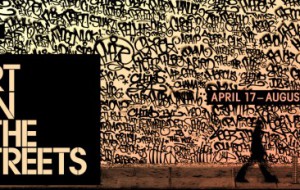
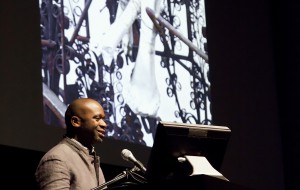
While in California, I made a pit stop to see Art in the Streets at MOCA in Los Angeles. Art in the Streets is the first major historical exhibition of graffiti and street art organized by a major American cultural institution. Opening this year in LA, it will travel to the Brooklyn Museum in 2012. Days after opening to the public, the LA show came under fire from local law enforcement for spawning a rash of tagging near the museum. Public areas outside the venue have become targets for taggers who want to leave their mark. The museum says this response was anticipated and will be cleaned up. In a show of support, local street artists say the exhibition is giving a boost to neighboring businesses. The overall opinion in the local art community is that the controversy surrounding the show is a good thing because it focuses attention on the lack of creative outlets for artists in the city. On the other hand, many street artists are still questioning the decision by MOCA director and show curator Jeffrey Deitch to whitewash a mural by Italian artist Blu late last year. These events and debates pose questions of whether or not graffiti and street art have a place in the mainstream art world, or even in the grand narrative of art history. My affirmative responses to these questions will be addressed as I go along.
To walk into the Geffen Contemporary in LA’s Little Tokyo neighborhood is to enter the realm of pure unadulterated street art. It is also to experience what is now a thriving knowledge culture that merges specialized forms of representation: alphabets, drawings, paintings (graffiti), films/videos, pop culture artifacts from times long past, and so on. One word that came to mind after seeing the show was “overwhelming.” I was struck by the urban detritus, hip-hop bricolage, bright colors, lights, and sounds in the various galleries on the lower level. This work emerged from a culture that has grown through the creation and application of art forms that are heavily layered, rich in imagery and metaphor. Most of the artists selected for Art in the Streets have used urban environments as their canvas. Many had been excluded from displaying their work inside of major art museums and galleries and opted to create their art outside of the doors that were previously closed to them. In an interview for Juxtapoz magazine the curators of this landmark exhibition, including longtime supporter Jeffrey Deitch, discuss this development:
[I] love this difference between graffiti and street art from more mainstream museum art. If you get into a museum or gallery in that world, it is after this long process of going to the right art school, with the right teacher, the right assistant job for a famous artist, the right recommendations, a review in the right art magazine, and finally the endorsement, and you can then show your work in a little gallery. We are dealing with artists that had nothing to do with these obstacles.
Hiroshi Sugimoto: Becoming an Artist
SUBSCRIBE TO EXCLUSIVE: RSS | ITUNES | YOUTUBE | ARTBABBLE
Episode #141: Filmed in his New York studio, artist Hiroshi Sugimoto recounts his student days studying Western philosophy (Hegel, Kant, Marx) in Tokyo, encountering Oriental philosophy (such as Zen Buddhism) in California, and his interest in the history of Modernism—all schools of thought that demonstrate “the human ability to see things in a different way.”
Central to Hiroshi Sugimoto’s work is the idea that photography is a time machine, a method of preserving and picturing memory and time. Sugimoto sees with the eye of the sculptor, painter, architect, and philosopher. He creates images that seem to convey his subjects’ essence, whether architectural, sculptural, painterly, or of the natural world.
Hiroshi Sugimoto is featured in the Season 3 (2007) episode Memory of the Art in the Twenty-First Century television series on PBS. Watch full episodes online for free via PBS Video or Hulu, as a paid download via iTunes (link opens application), or as part of a Netflix streaming subscription.
CCREDITS | Producer: Wesley Miller & Nick Ravich. Interview: Susan Sollins. Camera: Mead Hunt. Sound: Merce Williams. Editor: Mary Ann Toman. Artwork Courtesy: Hiroshi Sugimoto. Video: © 2011, Art21, Inc. All rights reserved.
Notes on Nostalgia
The Romantic subject, who emerged roughly two hundred years ago as the prototype of the modern subject, who looks at a beautiful vista to see not the landscape but “an earlier instantiation of the self.”
– Ulrich Baer
Products barely years old already bear the time-stamp of progress. Which is a more convoluted way of saying technology is rapidly changing, outmoding the inefficient and making useful objects historical artifacts before their time. Hardly a luddite, I love computers, gaming devices, streaming cinema, as well as cell phones and the multitude of new ways our time here is being recorded and distributed. It is the rapid romanticization of the obsolete I find so confounding.
I received my photographic education at an awkward technological moment, resulting in an acquisition and practice of techniques already expired. About a year ago, I was showing a friend and fellow photographer an image I had made and was rather proud of. “So beautiful,” she marveled as I puffed with pride. She continued, “Look at that grain! Film is just so beautiful, isn’t it?” Taken aback by her focus on format rather than content, I didn’t know how to respond.

Nostalgia is a comparative act and photographs have, for almost two centuries, remained its quintessential agents. Images enable us to look upon what has been or is being represented and immediately create a space for comparison. In between a fiction and a truth — the present moment and the one depicted. They are not simple either/or distinctions. The comparisons brought on by nostalgia are more exaggerated and complex manifesting in an ongoing state of distorted reality. “Unlike melancholia, which confines itself to the places of individual consciousness, nostalgia is about the relationship between individual biography and the biography of groups or nations, between personal and collective memory,” writes Svetlana Boym.
Looking at Los Angeles | Flat Affect

William Leavitt, "Spectral Analysis," 1977/2010, set for performance . Photo by Brian Forrest. Courtesy the artist and MOCA.
As I was walking through William Leavitt: Theater Objects, the LA-based artist’s first museum retrospective, a MOCA security guard stopped me.
“Are you a writer?”
It took me a moment to register the question. “I write about art sometimes.”
He looked pleased. “I noticed you writing a lot in that notebook, taking notes.”
“I think I’m going to write about this show.”
He appeared even more pleased. “You should write about the security guard. Say ‘the security guard was really nice.’” We both laughed, and I agreed to his request.
The security guard was really nice. He didn’t even tell me to stop using my pen, and force me to switch to a stubby MOCA pencil (I had that much more standard conversation with another museum guard in a different part of the exhibit a few minutes later).
I wanted to present our dialogue partially to keep my word. But the temporary breakdown in boundaries between us seemed like such an anomaly, that I was immediately inclined to believe the interaction was a response to Leavitt’s work. We were standing next to Cutaway View, which, like Leavitt’s other installations, is a decontextualized domestic interior–essentially a stage set–with walls that are actually theater flats, propped up by exposed lumber. A potted plant rests in the corner, and an unremarkable painting framed horse painting hangs on the gray wall.
Catching Up

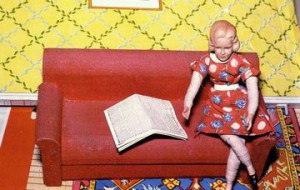
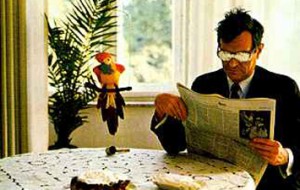
Laurie Simmons, "Woman/ Red Couch/ Newspaper", 1978 courtesy the artist and Sperone Westwater Gallery
This week I’d like to share a quick update on some recent Art21 Education news and highlights ….
First of all, we are all set to announce our new group of Art21 Educators for this summer. Sixteen teachers from all over the country will join us in New York City from July 6-13 and then embark on what has been described as an intense, year-long professional development initiative. Stay tuned for a full report and some introductions to our new teachers right here on the blog! It should also be mentioned that our current group of Art21 Educators from this past year are busy teaching units of study they developed last summer and sharing their progress with the entire group in monthly online meetings. Very exciting and inspiring stuff!
Last week from April 19-21 I was honored to serve as the Artist-Educator in Residence at Massachusetts College of Art and Design. During the visit I got the opportunity to sit in on some exceptional classes, meet several students during informal studio visits, and even take part in a faculty meeting for the Art Education department before presenting a two-hour workshop on facilitating discussion using Art21 films.
Art21 recently partnered with the Jacob Burns Film Center’s Media Arts Lab to offer a two-part workshop series incorporating our new film, William Kentridge: Anything Is Possible. The second workshop, scheduled for June 4 at the Media Arts Lab, will also include a small exhibit featuring student works inspired by the film.
Finally, School Arts magazine recently published an article by yours truly about ideas for teaching with Mark Dion’s work. Check it out in the print version of the April issue!
Open Enrollment | Desecrated Priorities
It’s the last two weeks of the semester and I should be focusing all my time and energy on finishing final projects and worrying about what to submit to the upcoming school show, but instead I packed my bags and headed upstate to perform at a gamelan concert in Oneonta, NY.
Considering how behind I am on my work, I shouldn’t have left. I barely made a deadline last week and presented a half-finished video collage based on La Tentation de St. Antoine by Georges Méliès, a seasonably appropriate homework for Easter. The original film, made in 1898, was a brilliant piece of cinematic wizardry in which actors performing before a painted set would appear and disappear through clever choreography and editing. In my version, I worked with Geetha Pedapati to play every character and animated the scenes through digital means.
Susceptible / Silent / Suggestion
When the war came along, I decided to use only quiet sounds… There seemed to be no truth, no good, in anything big in society. But quiet sounds were like loneliness, or love, or friendship.
— John Cage
There are so many ways to form a sentence or express a thought. And there are so many thoughts to have! What should I think or believe this day? And then, which of these thoughts should I tell others? I often find myself considering a crisis of the authentic, the un/utter-able, the overlooked, even, and the quiet. Which is to say I usually find myself considering. I make photographs but often wish I wrote songs, or produced television. Editing images is not like piecing together a well-crafted interview, or cogent Op/Ed piece. It’s the difference between argument and suggestion.
I’m far more susceptible to suggestion, how about you?
The Internet is the perfect platform for us to go on discussing the ever-expanding ways in which we can have a conversation. Experts agree language is changing, as various historians remind us it has and will. But I finished grad school a number of years ago and I’ve grown weary of talking about talking. So I think I will just speak, regardless the medium.
When I was twenty I wanted to be Susan Sontag. It was in her work I first encountered the thoughts I wanted to posses. Where I first discovered the possibility of tearing down walls with words. I wrote furiously thereafter, formulated opinions and arguments based on chapters read and patterns found. I always thought I would grow into a me-shaped hole in the universe complete with accessories: my words, my ideas.
What I never anticipated is that there is not a book in existence that contains the point I am trying to make.

Rebecca (Marks) Leopold, "Library of the Ever & Anon," Chromogenic print, 2010. Courtesy the artist.
I’ve known Daniel Tucker for about five years now and I’ve always thought of him as a true Chicago artist, somewhere in between artist, organizer, writer, and administrator and always interested in collaboration and bringing in multiple perspectives to any given situation. For anyone that’s worked with him, they know that Daniel’s candor can be both disarming and challenging. When one gets involved in Daniel’s projects, like I have in the past, he’s straightforward and conscientious in his process. Is that a Chicago thing? I’ve come to think of it that way, probably because of him.
He’s done a lot of amazing work, like founding AREA Chicago six years ago and then, when he wanted to move on, gracefully stepping back from the project to be taken on by new energetic group of organizers. What I love about AREA (which stands for Art Research Education Activism and is a publication about culture and politics in Chicago) is that it gives voice to what people are actually doing to transform their city, not a theoretical discourse about what might be possible. And there’s big changes happening on the ground here, with Rahm Emanuel handily winning the mayoral election after Daley decided he was done. I’m new to Chicago but I know that this is a really, really big deal.
And so Daniel is using this opportunity to create a platforming project called “Visions for Chicago” for Chicagoans to articulate what they want to happen next. Starting in November 2010 and lasting through the beginning of the mayoral term in May 2011, Daniel is giving out hundreds of handmade election-style yard signs to politically-engaged Chicagoans throughout the city to tell their own vision for the future. Photographs of the signs and their makers will be published in a book by Green Lantern Press to be released May 16, 2011 at 6pm at the Jane Addams Hull House Museum. We talked about how the project started for him and where it’s going.
Abigail Satinsky: Let’s start out with a bit of a background question. You have a lot of experience making work in public space and an interest in graffiti. How does this all fit together for you?
Daniel Tucker: Since I was a teenager, I’ve been interested in the political conflicts surrounding people’s access to and definition of public space. That drew me to be a graffiti writer, which was really my introduction to art making and all of the considerations of concept, audience, context, and formal design that come along with art making. And that stuff is really particular and important when you think about graffiti, street art, or more antagonistic forms of public art. Pretty soon after my initial interest in graffiti and its sub-cultural (think hip-hop and punk rock youth culture) as well as aesthetic traditions (bubble letters, characters, and “wild styles” as well as the more recent “artschool” graffiti that involves putting lots of objects and forms not traditionally associated with hip-hop graffiti into public space), I began to get bored with the general questions associated with making work in public and wanted to deal more with content.
New guest blogger: Rebecca Leopold
Thanks to our regular writer Alex Freedman for her fantastic posts for the guest blog. Look out for more from her in our Lives and Works in Berlin column.
Up next is Rebecca (Marks) Leopold, an artist and writer who resides in Brooklyn and spends an inordinate amount of time in her native Philadelphia. Producing mostly photo-based works, she is interested in the various intersections between technology, memory, history and landscape. She has exhibited work in New York, New Jersey, New Mexico, as well as other former colonies. A double graduate of Bard College, she holds an MFA in Advanced Photographic Studies. For more info go to: http://www.rebeccaleopold.com.
iheartnewhistoriographies: Conversing with Laurel Ptak

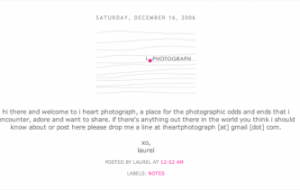
iheartphotograph, screenshot, December 16, 2006
I met Laurel Ptak three years ago back when she was coordinating Aperture’s educational programming and I was their intern terrible. Running into her a few weeks ago in one of those typical everyone knows everyone New York moments, I thought I’d catch up with her as she puts the finishing touches on her MA in Curatorial Studies from Bard about her blog I Heart Photograph. Launched in late 2006, and one of New York’s first blogs to showcase young artists’ hybridizing excavation of photography’s borders, I Heart Photograph has morphed into a venerable index of young photographers and their websites. But within minutes of chatting we were off questioning the methodological means of historicizing art which doesn’t fit into art history’s 30-year rule, and the ways in which we can begin borrowing lessons from curating and digital networks to pursue new means of historiographic argumentation. And while our trail of thoughts poses more questions than answers, it’s one of those conversations that forgoes the pop topic hits to conspire on where to go from here.
Alex Freedman: Tell me about iheartphotograph’s beginnings.
Laurel Ptak: It started from a desire to really explore the margins of contemporary photographic practice and take my own stab at re-authoring its discourse. It opened up a space for me to explore questions that I didn’t find good answers to in my “real world” engagement with the medium. What were photographers doing that went unseen on the walls/pages of the normal art channels? How were younger image makers tinkering with the medium in new and unexpected ways? What were photographers producing or thinking about in other parts of the world? I also thought of it as a kind of critical curatorial practice. I appreciated the way that the Internet allowed the distribution of artworks to function outside of more typical market-driven concerns that seem to prevail here in NYC. I had worked in the ‘culture industry’ here for some years and was frustrated with it on a lot of levels. IHP was in some ways my stab at wondering how things could function differently. Could one open up space for images as ideas more than commodities? Could their immateriality complicate how images circulated in other ‘real world’ circumstances?