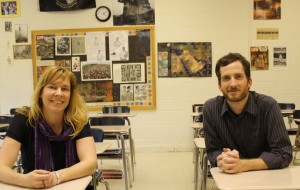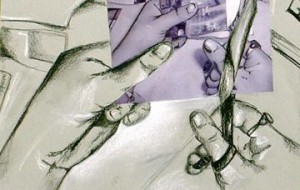

When I asked Anne Wilson if I could interview her for Art21, she sent me a preview copy of her book, Anne Wilson: Wind/Rewind/Weave—a catalogue published collaboratively by White Walls and The Knoxville Museum of Art. It was a good place to start. In the second essay, curator Chris Molinski writes, “Anne Wilson: Wind/Rewind/Weave consists of three distinct projects: Wind Up: Walking the Warp (2008), Rewinds (2010), and Local Industry (2010). These projects represent the work of 2,100 community volunteers, seventy-nine weavers, and dozens of studio assistants working in glass, thread, video, sound and live performance.” While Wilson’s work is significant for its individual, sculptural, and material aesthetic, it is also reliant on the energy of others. not simply because those others are invested in her practice for its own sake, but because her practice speaks to larger questions embedded in textiles.
Quilting and weaving are inherited skills that have been part of the human experience for eons. The textile industry employs massive numbers of people and is now located primarily overseas. These aspects are simultaneously present in all three projects. In Sites of Production, another essay in the catalogue, Julia Bryan-Wilson asks, “Stop reading for one second and look down. What are you wearing?” Because everybody wears clothes, and those clothes come from somewhere. People make them. Wilson’s work touches on the migration of industry, locating the exhibition in Knoxville, Tennessee, within the southeastern U.S. most identified with histories of industrial textile production as well as hand weaving traditions. A history of settlement schools in the Appalachian mountains allowed women to raise extra income through hand weaving. According to Philis Alvic in her catalogue contribution, those women were in charge of how they spent that money. Here, too, we see how Wilson highlights issues of power and gender and history: the tradition of knowledge, the empowerment of skill-sharing and making. In Walking the Warp, she also addresses labor conditions, engaging the repetitive work of weaving: what it takes to walk a warp as a performance: how often the performers take breaks, what they do, how their bodies are on the one hand restricted by the demands of their task, and how those restrictions create opportunities for freedom at such times when breaks are had.
Everything Wilson does is precise and deliberate; she creates an aesthetic experience autonomous to the conceptual framework she is working within. For that reason, there is light and air in the space her practice occupies; it is evident in the catalogue, already rich with various interacting themes and interpretations as well as textual excerpts from the artist herself, photographs of the work, and visual excerpts from a gathered archive of weaving samples from all over the world. The book reinforced what has always been an intuitive impression of mine, namely that while Wilson establishes a formal connection with the viewer, her work is supported by a meaty conceptual framework both critical and optimistic. My knowledge of Wilson’s work was concentrated on her more recent projects, beginning in 2008 when I saw her show at Rhona Hoffman Gallery. I wanted to find out more about what led up to this point, and how she locates her practice within contemporary and material culture.
Caroline Picard: How do you think about scale?
Anne Wilson: In terms of scale, and the implication of larger worlds suggested my work, I’d like to first talk about how I came to work this way in the first place, with horizontal fields.
In the Fall of 2000, I had a solo exhibition at the Museum of Contemporary Art Chicago. In addition to a range of other works utilizing found cloth and hair, I made a large sculpture called Feast that occupied its own exhibition space. Feast was a huge table, 22′ in length, and the stitched holes and tears from table linen — a vocabulary of parts stitched over 10 years — were placed back onto the horizontal table surface creating a kind of abstract topography. In developing Feast, I wanted to investigate aspects of perception, the optical imagination and relational ideas extending from the body and social space. I became interested in new ideas suggested by the horizontal format; ideas to do with mapping, navigation, architecture, and landscape. Also the power of a raking view—looking both down and across at a field of complex activity. This was the first piece that proposed this dual scale, suggesting both micro and macro worlds.
Weekly Roundup
In this week’s roundup, Doris Salcedo evokes memorials, Cao Fei explores play time, several artists are celebrated and more.
- Doris Salcedo: Plegaria Muda unveils the newest sculptural work by Doris Salcedo in the turbine hall of Moderna Museet Malmö (Sweden). The show contains multiple references and as an installation, Plegaria Muda can evoke associations of a memorial or a collective burial site. It springs out of a three-year-long research of the ghettoes of South East Los Angeles, but is also a direct answer to repeated atrocities committed by groupings within the Colombian army between 2003 and 2009. This exhibition closes September 4.
- Cao Fei‘s Play Time is the artist’s fourth solo exhibition at Lombard Freid Projects (New York City). Play Time returns to Cao Fei’s previous interest in the convergence of fantasy and reality and premieres her latest works. She continues to utilize different types of media including video, photography and sculptural installations that evoke childhood games, story telling and TV programs that have a profound influence on children. This show closes June 25.
- John Baldessari will be presented with the 2011 Alumni Achievement Award at the Scholastic Art & Writing Awards ceremony at Carnegie Hall on Tuesday, May 31. The Scholastic Art & Writing Awards provides early recognition and support for teenagers, many who go on to become some of the country’s most important artists.
Inside the Artist’s Studio | Gregory Sholette

Gregory Sholette, "Dark Matter, Art and Politics in the Age of Enterprise Culture," Pluto Press, 2011
Gregory Sholette is a New York-based artist, writer, and founding member of Political Art Documentation/Distribution (PAD/D: 1980-1988), and REPOhistory (1989-2000). A graduate of The Cooper Union (BFA 1979), The University of California, San Diego (MFA 1995), and the Whitney Independent Studies Program in Critical Theory, his recent publications include Dark Matter: Art and Politics in an Age of Enterprise Culture (Pluto Press, 2011); Collectivism After Modernism: The Art of Social Imagination after 1945 (with Blake Stimson for University of Minnesota, 2007); and The Interventionists: A Users Manual for the Creative Disruption of Everyday Life (with Nato Thompson for MassMoCA/MIT Press, 2004, 2006, 2008), as well as a special issue of the journal Third Text, co-edited with theorist Gene Ray on the theme “Whither Tactical Media.”
Sholette recently completed the installation Mole Light: God Is Truth, Light His Shadow for Plato’s Cave, Brooklyn, New York, and the collaborative project, Imaginary Archive, at Enjoy Public Art Gallery in Wellington, New Zealand.

Gregory Sholette and collaborators, "The Imaginary Archive and Wellington Collaboratorium," Enjoy Public Art Gallery, Wellington, New Zealand, 2010
Sholette is Assistant Professor of Sculpture at Queens College, City University of New York (CUNY), a visiting faculty member at Harvard University, and teaches an annual seminar in theory and social practice for the CCC post-graduate research program at Geneva University of Art and Design.

Gregory Sholette, "Mole Light: God Is Truth, Light His Shadow," still, Plato's Cave, Brooklyn, New York, 2010
Audio clip: Adobe Flash Player (version 9 or above) is required to play this audio clip. Download the latest version here. You also need to have JavaScript enabled in your browser.
Gregory Sholette speaks about “God Is Truth and Light His Shadow” at Plato’s Cave, NY, 2010
Being familiar with the angle of Sholette’s work, I picked up Dark Matter and read the Preface and Acknowledgments. Yet before I was done with page 1, I got up to sharpen a pencil. You want to give this book the appropriate attention; it will alert your conscious while enlightening you on the structure of our creative universe. Dark Matter is a metaphor for “amateur, informal, unofficial, autonomous, activist, non-institutional, self-organized practices – all work made and circulated in the shadows of the formal art world, some of which might be said to emulate cultural dark matter by rejecting art world demands of visibility, and much of which has no choice but to be invisible,” in Sholette’s words. The mechanics, tactics, and power of art activism and politicized practices are unveiled with direct references, drawing out the behind-the-scenes of the art world within today’s economic landscape.
It’s an honor to present Gregory Sholette to you today. Sharpen a pencil and pick up Dark Matter.
Looking at Los Angeles | Nicole Eisenman and Wynne Greenwood

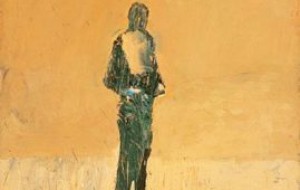
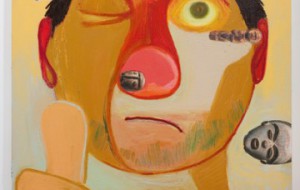
Nicole Eisenman, "Guy Artist," 2011. Oil and collage on canvas, 76x60 inches. Courtesy Susanne Vielmetter Los Angeles Projects.
Digging through Nicole Eisenman’s current show at Susanne Vielmetter Los Angeles Projects, one begins to understand why it’s so perfect that the artist presents us with 77 different titles for the show. And by the way, if you need to liven up your day, I strongly encourage you to read the entire list, found at the bottom of the press release, as they bounce from goofy (I Love K-Fed) to satirical and heavy (For My Dead Father). Likewise, the show bubbles with humor and satire, while consistently driving at big questions. Facing the entryway are three tall portraits, titled Guy Racer, Guy Artist, and Guy Capitalist. Breathing fluidly in Vielmetter’s large gallery, the portraits are comical but at the same time impossibly lonely. The mammoth scale of the faces and viscerally gloppy swaths of paint easily envelope each viewer, and the bulging cartoon eyes on each face feel at once attentive and detached. Guy Artist squints one eye and holds up his thumb, in the classic figure drawing maneuver of sighting, while the capitalist’s assemblaged coin-eyes remain vacant. Collaged photos of African masks float sideways across the series, dwarfed by the pale Guy faces; embedded allusions to Primitivism, Cubism, and perhaps beyond art history.
Indeed Eisenman’s masterful paint handling channels an incredible range of artists, from Goya to Picasso. Yet Eisenman’s voice is entirely distinctive, buoyed by her art historical influences, rather than tethered by them.
Art21 Educators 2011-2012: Jethro Gillespie and James Rees
This week is the third installment of introductions to the new cohort of Art21 Educators, featuring each of the eight pairs of educators. Last week, we featured Jack Watson and Holly Loranger from Chapel Hill, NC. Today, we are pleased to introduce Jethro Gillespie and James Rees from Spanish Fork, Utah. They both serve on the board of the Utah Art Education Association; James has previously served as the UAEA President.
Jethro Gillespie has been teaching for the last four years. Before joining the faculty of Maple Mountain High School, Jethro taught at a junior high school for two years.
Jethro teaches a range of 2D and 3D visual art courses, bringing aspects of his artistic practice into the classroom. He holds a BFA in Printmaking and is attending the Art Education graduate program at Brigham Young University. He learned about our program from his professor Mark Graham, who is completing his own year in the Art21 Educators program this June. Jethro has been long familiar with Art21 films and has incorporated segments from all five seasons of Art in Twenty-First Century into his teaching. He says, “[the series] is a fantastic source for secondary art teachers to be able to tap into contemporary art.”
Jethro employs a thematic-based approach to teaching and he emphasizes the importance of letting students be in charge, allowing them to generate and explore their own ideas. For Jethro, contemporary art is “an appropriate and powerful agent for 21st-century learning styles in schools . . . Teaching with contemporary art allows students to come up with meaningful, divergent solutions to problems, instead of prescribed, rote, or recipe-like exercises.”
As part of his video biography, Jethro describes an artist lecture that he recently attended and how it has inspired his own pedagogical philosophy:
Glenn Ligon, Ai Weiwei and The Art Cops
Three things this week…
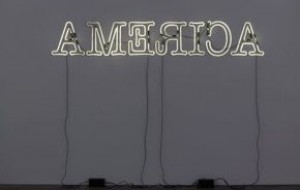
Maika Pollack recently wrote a wonderful review in The New York Observer about the current Glenn Ligon show at the Whitney Museum. As I visited the galleries about a week ago I kept coming back to questions around ways to teach about race and even perhaps making sociopolitical statements through the use of beauty. I mean, really, this is a beautiful show and it should be seen by teachers and students, as hard as that may be in late spring with the proverbial “testing period” hanging over everyone like an anvil. Yinka Shonibare MBE came to mind immediately. Not since Shonibare’s participation in the group exhibit, Ahistoric Occasion, just a few years ago at Mass MoCA, had I been confronted with work that was so simultaneously tough and gorgeous. The mammoth work, “Hands”, greets viewers stepping from the elevator- an obvious protest image (in this case, from the Million Man March) that needs no wall text to explain its connection to dissent. The text pieces in the adjoining room quietly pelt visitors with quotes about being black in America. Legible passages at the top of each work become muted and ambiguous as they return to the floor- much like fireworks as they explode and disappear. Even the installation, “To Disembark”, inspired by the story of Henry “Box” Brown, a former slave in a Virginia tobacco factory who literally arranged to be mailed in a wooden crate to Philadelphia in order to escape slavery, pulls you toward each piece in order to hear artists such as Billie Holiday and KRS-One. By the time you come full circle and are confronted with Ligon’s recent neon works, including “Rückenfigur”, America is literally turning away and facing the other direction. Being black in America- past and present- is shared through music, text, painting, installation and sculpture. It isn’t pretty, but the initial beauty of this show is what gets us to consider the works thoughtfully in the first place.
This brings me to my second item for the week, since we’re discussing turning away and facing the other direction.
Judith Dobrzynski (Real Clear Arts) and Lee Rosenbaum (Culture Grrl), among many others, have taken a stand regarding the Milwaukee Art Museum’s upcoming Summer of China show. Both authors, as well as this one, feel that museums have to begin making some kind of statement about the two-month detention (kidnapping) of Ai Weiwei. Museums that put together shows at this point with art on loan from China, without making any kind of attempt to address the issue surrounding Ai Weiwei, run the risk of appearing indifferent to the whole situation. Mary Louise Schumacher really sums it up in her May 20th Journal Sentinel piece which got Judith and Lee going in the first place.
Finally, a public service announcement… of sorts.
A few posts back I took on the idea of teaching graffiti in the classroom. Just thought everyone might enjoy this follow-up from The Art Cops. Priceless. Also kind of wondering what these two would dig up on a trip to China. I mean, why stop in L.A.?
New guest blogger: Din Heagney
Thanks to Amy Whitaker for her series of posts on all things art and economics. Up next on the guest blog is Din Heagney.
Din is an Australian writer, editor, and curator, currently dividing his time between New York and Shanghai. He is a graduate of RMIT University and is the former Director of Platform. Din has written for galleries including Gertrude, West Space, and the National Gallery of Australia. He has edited books including Portraits From a Land Without People and Making Space, along with independent art publications such as un Magazine. Din is a regular contributor to The Art Life, and is researching a critical writing project, The Foreign Art Office, supported by the Australia Council. Din hopes to finish his debut novel of art fiction, Nightmares & Cheesecake, any day now…
The Space Outside Your Head: Some Concluding Thoughts
Over the course of writing this blog, I have learned that many of my posts are about art and economics. More broadly, they are about creativity and friendship, and how those things—and their social and public value—co-exist in a market economy.
So a few concluding thoughts on economics, authorship, the art of soccer, the structure of education, and the future of museums…
The first post, Monday Painter/Sunday Banker, generated a number of extended replies—from people I would call colleague-friends. Two bear mention.
The first came from a distinguished, emeritus economics professor I used to work for as a research fellow. No stranger to econometrics, regulatory industries, or wry and joyful erudition, he provided the technical answer to the “what if we did away with all the banks” question:
I can’t get away from the fun you could have with “do away with the banks.” By the middle of the 19th century, John Stuart Mill had put in place that banks make the money supply and MV=PT, where M=money stock. V = the velocity. P=the price index. And T= the physical volume of trade (or PT is current dollar GDP). If there are no banks then M=zero and the equation (economy) collapses, as in 2009.
When I asked if I could reprint his answer, giving him credit, he demurred, saying the credit was mine. It got me thinking. Credit is an open question for the category of colleague-friend—and the broader category of “the author.” I happen to be of the camp that credit is not zero sum (meaning that it is not like a tennis match where one person gains and another loses, so if the win is +1 and the loss is -1, they sum to zero). I think that if you are working in really good teams, you give others credit, they give you credit, and a rising tide lifts all boats. More than one person can win. This is not a failsafe method, but maybe a risk worth taking.
Support Art21: Join the Circle of Excellence
Today, May 23, Art21 will receive the George Foster Peabody Award for its feature film, William Kentridge: Anything Is Possible. The Peabody Award is widely considered the most prestigious in the realm of broadcast media. It is determined through a single criterion – excellence – and the award itself, therefore, has become synonymous with the term. This is Art21’s second Peabody Award – a feat rarely achieved and a great honor.
To celebrate this momentous event, the Art21 board has developed a special Circle of Excellence, a group that generously supports Art21 for its accomplishments and achievements. This spring, we are combining Art21’s Annual Appeal with the Circle of Excellence, and invite you to join this wonderful group in its commemoration of this distinctive achievement.
We hope that you will choose to give generously to the Circle of Excellence today. Donate here.
Art21 is a 501(c)(3) nonprofit organization. Your gift to Art21 is entirely tax-deductible to the full extent of the law.
Department of Audience Participation: Wall Label Winners
I hesitate to say that exactly one person replied to the wall label writing contest, and one to the Mad Lib. I could wonder about flaws in the design of the experiment or give a P.E. class pep talk on needing to be “in it to win it.” Instead, here they are:
1. As submitted by one of my more gracious Southern friends, a brilliant writer and party hostess, pen name Franny Davenport:
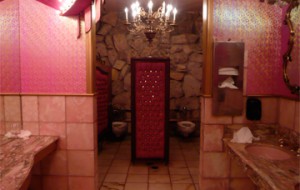
“Marie Antoinette Takes A Dump”
Interior by Dorothy Draper, 1968
marble, linoleum, leather, gilt, porcelain
Private residence of Larry Flynt
A classic example of Dorothy Draper’s Modern Baroque style.
2. As submitted by Art21 reader Amber Harper-Slaboszewicz:
John Smith’s work has always been interested in geography. Operating at the forefront of the Duende-ist movement, he became fascinated with bottles, striving to reinvent our very concept of freedom. His sumptuous, burly brushstrokes evoke Albuquerque in the 1980‘s. Although Clement Greenberg wrote that his work was utter drivel, mountain bikers have been moved enough by his reconception of touch and semantics that they rhyme.
In this painting Nelson Mandela sits in a quiet chair looking at the viewer glibly. Over his/her shoulder looms a beagle peering at him ferociously.
Well done, Amber and Franny!
If you still want to try on your own, here is the full Mad Lib: