Pop Culture Pirate [interview w/Elisa Kreisinger]
Elisa Kreisinger is a video remix artist, writer, curator, and educator whose work often addresses feminist, queer, and social issues. While there is a long history of appropriation-based political critique in the arts, and though many of these works long to invoke social change, they are often prevented from doing so, locked up and stowed away in the closed stacks of proprietary institutions while occasionally finding their way to a gallery wall or microcinema screen to preach to the choir.
Unlike these works, Kreisinger’s practice involves inhabiting pop cultural spaces such as YouTube and other online communities, offering radical social critique to a mass audience. Her concerns are realized in myriad ways, through writings, workshops, as well as via online tutorials and curation.
The Lexicon of Alisha Kerlin

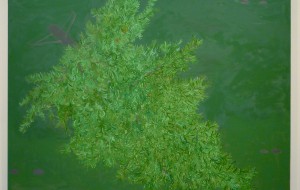
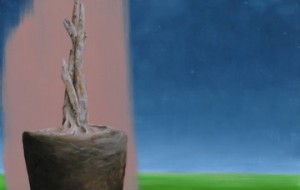
Alisha Kerlin, "A State of Mind in Which Someone Is Or Seems To Be Unaware Of Their Immediate Surroundings," 2011
I’ve held my own definition of literacy for some time now: that becoming increasingly literate is essentially seeing the world with increasing nuance. Greater literacy means grasping the many shades of difference that might be attached to any one object or idea. Knowledge, on the other hand, is the way we make useful all of that nuance, organizing it and making connections between it. In this way, literacy and knowledge are codependent yet somewhat counterproductive forces of language. Literacy expands while knowledge consolidates. To me, one of art’s great uses is its ability to restructure the paths that knowledge builds between information without abolishing the delicate nodes of nuance whose recognition come at the price of careful observation and imagination.
I didn’t immediately connect Alisha Kerlin’s paintings with this idea of nuance and knowledge. My first impressions were of solitude and the isolated objecthood they depicted. And these things certainly exist in the work. In fact, Kerlin’s words for the press release of her current show echoed my own thoughts by giving direct prominence to the ‘solitude’ of the playing cards, the carrot, or the tree in her paintings. But the isolation she imposes on her subjects gets far greater mileage than a simple feeling of aloneness, and goes beyond a metaphor for the long-laboring studio artist (or the lonely painting on the wall).
It is precisely the solitude in her work that allows layers of nuance to move around and reconnect in unexpected ways. In their isolation, Kerlin’s paintings function much more closely to the slippery, meaning-stuffed, ever-evolving nature of language itself. They read like entries in a lexicon, but not so much a dictionary, more like a thesaurus, in which the identity of the central component is in a swirl with its tangential comparative other selves. The title of her current show at Zach Feuer in Manhattan, Perceptible by Comparison, certainly points to this idea. Through an applied solitude, the paintings, the things depicted in the paintings, and the viewer alike are loosened of their normal connections to one another and to their own selfhood and enter a kind of drift or hovering. What follows seems to be a desire to mark out the undefined and unnatural place of the rectangular painted surface and to reconnect meaning between the various parts. Such was my reaction to Kerlin’s paintings of measuring tapes stretching across amorphous fields of paint, or subtly plotted gestures that often appear in the corners of her paintings. Absent normal associations, we feel the need to reorient ourselves by plotting a new set of guides.
Teaching About Poverty and Homelessness
This past Saturday, New York Times columnist Charles M. Blow wrote an op-ed piece called Them That’s Not Shall Lose which highlighted, as James Baldwin put it, how expensive it is to be poor in this country, not to mention in a country where half our members of congress are actual millionaires. In a series of poll questions included with the article, only 9% of those surveyed making over 75K per year had trouble paying for medical care for themselves or their family. On the other hand, 51% making less than 30K per year had trouble paying medical expenses. Only 11% making over 75K had any problems paying their mortgage or rent while close to 50% making less than 30K had trouble doing so. And this poll only included those who actually have jobs.
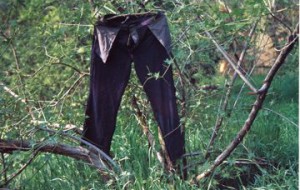
As I visited Mass MoCA this past weekend for the second year of Wilco’s Solid Sound Festival I came across three photographs by Anthony Hernandez, part of a wonderful group exhibition called The Workers, which documented the physical traces of homelessness along the freeway between Los Angeles and Santa Monica. Instead of photographing the homeless, Hernandez makes us look closely into an undistorted life, literally on the road. The pants hanging to dry in the tree branches and scavenged materials fashioned into a work space from Landscapes for the Homeless had me thinking about Blow’s op-ed piece and illustrated (in a simultaneously beautiful and alarming way) how grueling homelessness and poverty can be.
Utilizing Mass MoCA texts on the artists featured in The Workers, much like utilizing texts and resources provided by Art21, allowed me to approach the work in a meaningful way that shared its context- immediately offering me an opportunity to compare what I was seeing to what I just read that morning in the newspaper. Pairing up news, commentary and social issues with contemporary art that illustrates it in unique ways is another opportunity for us to share new art and artists that are both exciting AND relevant. Mr. Blow and Mr. Hernandez should talk!
Work Smarter, Not Harder [an interview w/Evan Roth]
Evan Roth is a prolific producer whose activities take on many different forms, including teaching, collaborating, engineering, collecting gifs, analyzing graffiti, enriching the public domain, developing tools of empowerment and raising awareness of issues pertaining to the open-web and free speech. His work is most comfortable where the interests of activists, artists, and general web meanderers intersect.
No Preservatives | Preservation, Perfection, and Patina: Eleonora Nagy Discusses Conserving Judd’s Art
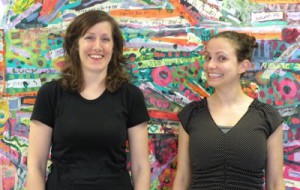
In this two-part blog post, I’ll be looking at the care and fabrication of Donald Judd’s artworks and furniture. Today, I explore the conservation of his artworks with Eleonora Nagy and next Wednesday, I’ll explore the fabrication of Judd’s furniture with fabricator Jeff Jamieson.
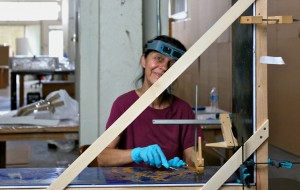
For a long time, I’ve know that Eleonora Nagy is an expert at conserving Donald Judd’s artworks, but it wasn’t until after her presentation last month at the American Institute for Conservation’s Annual Meeting in Philadelphia that I really got to know her. You may know her from the flattering New York Times profile about her work on the Paul Thek exhibition at the Whitney Museum of American Art (The Improvised Remedies of an Art Healer, which was accompanied by the equally flattering NYT video, Using Science to Conserve Art).
Nora holds Master degrees in Fine Arts and Art Conservation and has 20 years of experience working at institutions including the Tate Gallery, Musee de Quebec, Canadian Conservation Institute, and the Guggenheim Museum. Today she is the principal conservator and owner of Modern Sculpture Conservation, LLC. Since 2000, she has been a consulting conservator for the Whitney and is recognized for inventing new conservation methods and taking on and resolving unusual projects. Her conservation interest focuses on the works of Donald Judd, Alexander Calder, David Smith, Paul Thek, and modern metals.
I invited her here to talk about the work she’s done over the years working on Donald Judd’s artworks.
Richard McCoy: How did you first become involved in the conservation of Judd’s artworks?
Eleonora Nagy: I first began treating Donald Judd’s works in 1995 while working at the Guggenheim Museum in New York. The Guggenheim has a significant collection of Judd’s works.
On very short notice I worked on the treatment of a “Stack.” I started the project assuming that reaching out to my colleagues specializing in modern art would provide me with sufficient advice on how to proceed. Soon I realized that good information was scant, especially about how to treat Judd’s metal works.
It was then that I realized that I had to “deep dive.” And you know the usual result of a deep dive is that you either surface, or sink.
Necessity is a good teacher. I worked on the Guggenheim project around the clock both mentally and physically and ultimately came up with some new ideas that worked. This news got around and my colleagues then started to call me about their problems with Judd’s works.
New York Close Up: The First 10 Films
Art21′s newest documentary series, New York Close Up, just premiered its 10th film in its first installment. More film are forthcoming in the fall. In honor of this milestone, we’ve created a visual map of the inaugural ten. Mouse over an image for a link to the full film. Enjoy!
Art21 Educators 2011-2012: Christopher Tourre and Derek De Haan
This week is the final installment of Art21 Educators introductions, featuring the eighth pair of extraordinary educators chosen to participate in the third year of the program. It’s hard to believe we will be meeting all sixteen educators in person in just two weeks! The program begins with the Summer Institute in New York City, July 6-13. We are thrilled to have assembled such a great team of passionate educators to embark on this yearlong collaboration.
Last week, we featured Karen Melvin and Sue Carris from Pittsburgh, PA. This week, allow us to introduce Christopher Tourre and Derek De Haan.
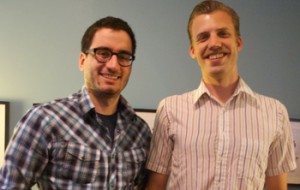
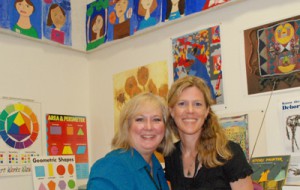
Christopher Tourre and Derek De Haan teach in Chicago, Illinois. The two have been friends and colleagues for over three years and are also former roommates. Christopher teaches 10th grade Digital Media and Design at Perspectives Charter School, as well as at an after school art club. He has taught there for two years, and was previously an instructor in Time-Based Media at the University of Illinois. Derek has been at Amandla Charter School for two years. This year, he taught 7th grade writing and Chess Exploratory to 5th-7th graders. Prior to teaching writing, he was a student aide for 3 years in special education.
Christopher holds an MFA from the University of Illinois at Chicago and a BFA from Pennsylvania State University. He is a practicing artist whose work includes socially engaged projects such as raising chickens and delivering eggs to households, creating an open furniture studio using materials from torn down houses, and opening a public brewery in the West Loop gallery district. Christopher often finds inspiration in the work of artist Rirkrit Tiravanija: “I was introduced to his work . . . and my practice changed dramatically as I became a true social practitioner.” He aims to link his artistic practice with the content in his classroom, and says, “Contemporary art makes students feel connected on a deeper level to the art making . . . by helping students self-actualize process, they are able to connect to contemporary works and feel as if their own work has an equal and valid voice.”
As part of his application, we asked Christopher to share his goals for the coming year for his classroom. He articulates his efforts to advocate for the arts program in his school while building the curriculum for his technology class. Christopher states, “We have little money and our priorities are essentially on staying open.” He elaborates:
When I began my current position, it was strictly a technology position. I was able to transform the course into a digital design course the first year and in my second year of teaching began adding more and more curriculum centered on contemporary artists, practices, and authentic applications of technology through design. My plans are to continue this trend and essentially create a contemporary art course with a technology focus. I want to learn about as many contemporary artists and techniques to help me create a thorough and engaging curriculum that utilizes minimal resources (other than computers with Adobe CS3) and student-centered learning.
In his video biography, Christopher discusses his experience teaching in a low-income school district and his ambition to engage students with contemporary art.
When I initially saw the promotional poster for File Type, currently on view at University of Illinois at Chicago’s Gallery 400, I was immediately intrigued by the curatorial premise posed by curators Chaz Evans and Lorelei Stewart regarding how “formats… represent ways that artwork in digital or Internet media create particular standards of representation” (quoted from the curatorial statement). The variety of artists selected for the exhibition — a combination of local, national, and international makers – would have given me enough reason by itself for me to attend the opening. As I entered the space and browsed the works on display, I felt my curiosity continue in ways that I had not expected when initially considering the above statement by Evans and Stewart. Even after I left the show, questions kept reappearing and presenting themselves to me with intense frequency. Initially, I couldn’t help but question why some works were displayed on flat panel monitors as opposed to computer screens and as I continued to peruse the show, I wondered how the mounting of a physical show reflecting on the effects of network technology on artistic inquiry inevitably varies from a digital exhibition of identical material (something that perhaps I have had more comfort in discussing as of late). Can an exhibition highlight recursive dialogues between the language of the screen and the language of the gallery? Is there a sense of irony in the idea of a file type, since a great majority of the works deal with the translation and fluidity between codecs and mediums, as opposed to the static state of objects that galleries and museums tend to support and reenforce? Without outright calling File Type a “media art show,” how does this show effect the reception of the work, or even more importantly effect my (and the viewer’s) understanding of “media art?”
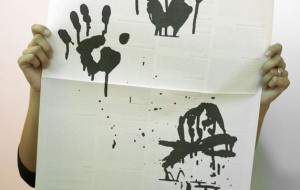
As these questions bubbled around in my brain, I decided take the initiative and voice these queries to the curators themselves. One such proposal I was unsure of regarded how the work in the show appeared to me to exist as either documentation or execution (or on rare instances, a simultaneous state) of translations of one file type to another. Christopher Meerdo‘s Cipher, the flagship piece of the show, is perhaps the best instance of what I find to be the prevalent theme I’ve described above. Meerdo’s work reinterprets the encryption of the Wikileaks “doomsday” file into binary black and white pixels that are then reprinted onto a 100 x 350-inch seamless piece of paper. I wondered how these processes of translation and migration of one format into the other specified what I observed as separation of works existing in two unique camps: exhibiting the imperfection of those conversions vs. the exhibition of a seamless or hidden transition between different formats. Although Evans and Stewart didn’t immediately think that these camps were drawn within their initial selection process, they did say that they sought to provide a variety of works containing divergent aesthetic approaches:
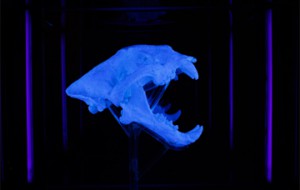
Chaz Evans: … if there were going to be a dichotomy, it would be between some like Casey Raes’s lush print, where we see contours which are very beautiful and which are also contrasted with the more glitch punk of Jon Cate’s skull [animation]… and there are all these different approaches [and these] are not exhaustive approaches, but just various ways.
Lorelei Stewart: Yeah, I didn’t actually think of them [the work] at two poles. I was thinking of the show having more of the glitchy stuff everywhere. Even in Kristin Lucas’s video, there are pretty little found backgrounds, and… the text elements made through mechanical turk, but… there is still some disconnect there despite what appears to be a very tight experience of the thing itself.
A Better Ghost [Interview w/Evan Meaney]
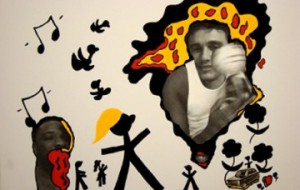
Evan Meaney is an artist, curator and educator currently teaching time-based media design at the University of Tennessee. His practice dives into the “liminalities and glitches of all sorts, equating failing data to ghosts, seances and archival hauntology.”
At the moment Meaney is hard at work experimenting with the super computing team at Oak Ridge National Laboratories as well as preparing for this years GLI.TC/H noise and new-media gathering. He is also just about to release his Ceibas Cycle DVD, a series Meaney has been working on for the last five years.
Weekly Roundup

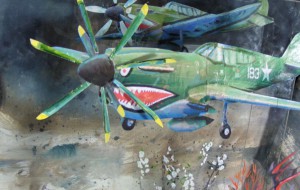
Martha Colburn, "Triumph of the Wild (Part I + Part II), 2008–2009," 2011. © Martha Colburn, Courtesy James Cohan Gallery, New York/Shanghai.
In this week’s roundup, Martha Colburn animates war, Jeff Koons and William Wegman are in the dog days of summer, and much more.
- Martha Colburn presents the topic of war through animation. The Saint Louis Art Museum presents Martha Colburn: Triumph of the Wild, a New Media Series installation by Colburn. The 10-minute animated film (2008-09) presents the history of American war from Bunker Hill to Baghdad through shifting moments of horror and destruction. This work is on view through September 5.
- Jeff Koons and William Wegman have work in Dog Days of Summer, which continues Laumeier Sculpture Park’s on-going investigation of the ‘archaeology of place.’ Videos by Wegman will be screened Sunday-Friday evenings until August 31. The exhibition closes October 2.
- Pierre Huyghe received a commission to create an aquarium and accompanying “live ecosystem” as part of Frieze 2011 (UK). The Fair recently released information about the artist commissions for the October event. Viewers can look forward to a range of creative projects, include Huyghe’s. The fair takes place October 13-16.
- Mariah Robertson is now on view at the BALTIC Centre for Contemporary Art and it is Robertson’s first solo exhibition in the UK and includes recent and new work. Robertson uses the photographic image and exposes objects directly onto the paper, bypassing the camera lens. Collaging disparate elements onto irregularly cut photographic paper, Robertson layers them into a single composition to create what she terms an ‘impossible’ image. This exhibition runs until October 30.