Looking at Los Angeles | Revealing “Unfinished Paintings”

Lisa Adams, "Stump Without a Pot," unfinished painting, 2011. Oil on panel, 30" x 36." Courtesy CB1 Gallery Blog.
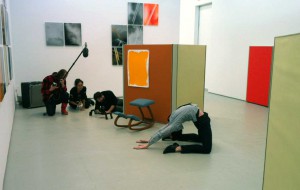
The nature of painting – its objecthood, its permanence — demands a level of resolution and wholeness to which other more ephemeral art practices need not always answer. Hence the exciting and complex impact of Unfinished Paintings, an exhibition that opened last week at Los Angeles Contemporary Exhibitions (LACE) featuring paintings by 38 different artists at various stages of completion. I asked curators Kristin Calabrese and Joshua Aster a few questions about the exhibition, which Calabrese fielded via email with input from Aster.
Lily Simonson: What was the inspiration for an exhibition of unfinished paintings? How was curating this exhibition different from your previous projects?
Kristin Calabrese: This project is more focused and specific than the other projects we’ve curated. We’ve been narrowing down each show, and I think it’s starting to get to the place where the criteria for the show really reflect our favorite — or most native — ideas as they pertain to art. Josh and I curated 3 projects together — Lovable like Orphan Kitties and Bastard Children — which was a show of 90 paintings under 11 x 11 inches, as you know and were a part of… We also did the [2010] LACE auction, where our curatorial premise was to find raw, unruly paintings, where someone might say when confronted with them, “What the fuck is that?”
It’s a Wrap: Looking Backward and Thinking Forward
Right around this time I usually write a post that relates to things we as art educators often think about at the end of the school year and before the onset (and sunsets) of summer. In 2009 and 2010 these posts related to summer reading possibilities and questions to think about as school wound down. This week I’d like to share a little of both as we get ready for the Art21 Educators summer institute in just a few weeks.
First, some recommended reading and books to check out (Fair warning… not all are suitable for the beach. The sheer weight of some would make it difficult):
- On Line: Drawing Through the 20th Century, by Cornelia H Butler and Catherine de Zegher
- Art School (Propositions for the 21st Century), edited by Steven Henry Madoff
- Work: The World in Photographs, by Ferdinand Protzman
- Teaching 2030, by Barnett Berry
- Just Kids, by Patti Smith
- Life, by Keith Richards
Next, I want to reemphasize a few questions and introduce others that may influence thinking and planning for next year:
- Which new artists did I introduce this past year? Why did I introduce these artists?
- Who are the artists (or works of art) that I especially want to make part of my teaching?
- Where have I made really important connections with my students? What connections or student interests still need to be explored and/or researched?
- How can I better balance skill-building and teaching students to create work driven by big ideas?
- How can I combat apathy and teach students to care more- about their work and one another?
- How can I teach students to interpret history through art, rather than learn a version of “art history”?
- How can students use sketchbooks in a variety of ways and truly make discoveries through their use that will impact learning?
- How can I continue finding ways to teach students that quality matters?
- How can my classroom better reflect my expectations, passions and vision for students learning about art?
- What do I want to model more often for students next year?
Which books are you reading this summer? What kinds of reflective questions are you asking as the summer begins?
Art21 Educators 2011-2012: Karen Melvin and Sue Carris
Last week we featured Samantha Melvin and Kim Timmons from Burnet, Texas. This week, in the seventh installment of Art21 Educators introductions, allow us to introduce Karen Melvin and Sue Carris, from Pittsburgh, Pennsylvania. Next week’s post will complete our introductions to this year’s cohort of Art21 Educators.
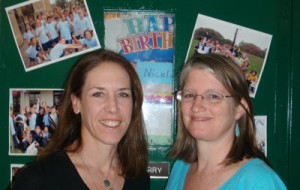
Karen Melvin has been teaching art for twelve years, and has spent ten years in her current position at Thomas Jefferson Middle School, in Pittsburgh PA. Sue Carris has been teaching English at the same school with Karen for the past seven years. Sue describes her working relationship with Karen, “I am lucky to work in a district that supports art education, but even luckier to work with a professional who engages and inspires our students as thinkers and creators.” Looking forward to participating in Art21 Educators with Sue, Karen says, “The multi-disciplinary approach will strengthen [our students’] experiences and their understanding . . . as we collaborate to create lessons that overlap and build sequentially.”
Letter from London | The Secret History

Jacopo Comin, aka Tintoretto, 'The Stealing of the Body of St Mark' (1562-66) and 'The Last Supper' (1592-94) at the Venice Biennale (image courtesy Phaidon)
Academic specialization is bad for art, and has led to a situation in which contemporary art seems more unmoored from its past than at any other moment in history. This obviously isn’t the case in literature or film, and certainly not in music, the latter of which seems (pleasurably, sometimes) stuck in a feedback loop that kicked off sometime in the late 60s. (In his book Retromania: Pop Culture’s Addiction to its Own Past, Simon Reynolds suggests that 1968, contemporary art’s much fawned-over annus mirabilis, was also the year pop definitively began to eat itself). It would be unimaginable for a young musician not to have listened to Elvis, the Beatles and the Stones, as it would for a young writer not to have read Joyce, George Eliot and Shakespeare, or a young filmmaker not to have watched Godard, Hitchcock and Truffaut. These are pretty much randomly chosen; there are many more that would form part of a general cultural education. And yet in art, as in no other cultural discipline, you can become a successful artist by pretending it all started as recently as Warhol.
The art world is historically polarized down to the last detail: unlike in film criticism, whose catholic approach has led to some of the best writing on culture of our time, you won’t find many art critics willing or able to review both, say, the new exhibition of treasures from Afghanistan at the British Museum as well as the latest contemporary art show at the Whitechapel. Or, rather, you will, but these critics occupy a distinctly marginal position within the contemporary art world as a whole. (See James Elkins’s discussion, in his book What Happened to Art Criticism?, of the sniffy October panel discussion for proof of that).
Weekly Roundup

Ursula von Rydingsvard, "Bowl with Fingers," 2007–2008. © Ursula von Rydingsvard. Courtesy the artist and Galerie Lelong. Photograph by Rosalyn and Michael Bodycomb.
In this week’s roundup, Ursula von Rydingsvard is obsessed with wood, Do-Ho Suh incites dreaming, Andrea Zittel explores fragmented patterning, LaToya Ruby Frazier takes on Levi’s, and more.
- Do-Ho Suh‘s “Staircase – Pulitzer Version” is on view at the Pulitzer Foundation for the Arts (St. Louis). This is part of Dreamscapes, an exhibition that incites questions about the act of dreaming – a succession of thoughts, images, sounds or emotions, which the mind experiences during sleep. A free web catalogue is also available. The show closes August 13.
- Part Two of the seven-part Huffington Post series, XX CHROMOSOCIAL: WOMEN ARTISTS CROSS THE HOMOSOCIAL DIVIDE reads art by Cindy Sherman and other female artists. Author/critic G. Roger Denson writes that Sherman’s work “conveys to what extent assuming homosocial identity is literally so much scripted performance and mimicry.”
- Carrie Mae Weems‘s photography will soon be on view at the Flomenhaft Gallery (NYC) as part of the Portraits Group Exhibition. Combining photographs with texts of African American lore, Weems reaches out to the earliest times when slaves were brought to America. The exhibition opens on August 12.
- Andrea Zittel is currently featured in Pattern of Habit at Sprüth Magers Berlin (Germany). Zittel’s new work examines how “psychological structures, thought systems and beliefs are manifested as physical objects in the world that we create around ourselves.” The show is an exploration of fragmented patterning and ways that people order and compartmentalize time. This exhibition is on view through September 10.
- Ursula von Rydingsvard has work on view at the DeCordova Museum’s sculpture park in Massachusetts. Ursula von Rydingsvard: Sculpture features the artist’s obsession with raw, fragrant cedar wood. Her woodwork is part of a connection to a long line of Polish peasant farmers for whom wood provided basic shelter and tools to work the land. This exhibition runs through August 28.
- The New York Close Up documentary features artists Tommy Hartung, Lucas Blalock, Martha Colburn, Keltie Ferris, LaToya Ruby Frazier, Rashid Johnson, Kalup Linzy, Shana Moulton, Mariah Robertson, and Mika Tajima. Check out the premiere of Latoya Ruby Frazier Takes on Levi’s.
- Mark your calendars. The Museum of Contemporary Art Chicago will house post-emerging contemporary artists beginning with Rashid Johnson in Spring 2012. Rashid Johnson: Message to Our Folks is the artist’s first major museum solo exhibition. Johnson’s work explores legacies of black intellectual and popular figures through various media rooted in his identity as a black man in the U.S. The show will run April 7 – August 5, 2012.
New guest blogger: Nick Briz
Thanks to Tom McCormack for his series of media- and newer media-centric posts. Up next is Nick Briz. About his practice, Nick writes:
I am a new media artist living and working in Chicago IL. I have an associate degree from Florida State University in cinema studies, a bachelor’s degree from the University of Central Florida in film and video production, and a master’s degree from the School of the Art Institute of Chicago in film, video, new media, and animation. I am co-organizer and moderator of Upgrade! Chicago and have curated and organized a number of new media art events, including most recently GLI.TC/H, an international noise and new media conference. As an educator, I focus on digital art and culture, having created and taught classes for summer camps, after school programs, and at the college level. My own work has been exhibited at various national and international galleries and festivals, such as the FILE Media Arts Festival in Rio de Janeiro, Brazil, the Sydney Underground Film Festival, the European Media Arts Festival in Osnabruek, Germany, and the Images Festival in Toronto, Canada. My work is distributed through Video Out Distribution in Vancouver, Canada as well as openly and freely on the web.
Nick will be guest blogging for us through July 3.
5 Questions for Contemporary Practice with Carlos Motta

Carlos Motta, "Brief History of U.S Interventions in Latin America Since 1946," 2005. Freely distributed newsprint publication, 22 x 16”. View of a newsprint during exhibition at CCS Bard Hessel Museum of Art, Annandale-on-Hudson, NY, 2008. Courtesy the artist.
While Carlos Motta’s work exists through a number of different media, I think of it primarily as putting forth a series of socially and politically committed archives. These archives are focused through a series of different questions related to Latin American geopolitics and queer cultural politics. In one such archival work, a video/performance project called Six Acts: An Experiment in Narrative Justice (2010), Motta restages speeches calling for peace delivered by six Colombian left-leaning presidential candidates that were assassinated during critical moments in the nation’s history. By employing actors to perform the speeches in public places during Colombia’s 2010 presidential campaign, the work solicits response from passersby, many of whom are unaware of the speeches’ import, or when and by whom the speeches were first given. Like Mark Tribe, Sharon Hayes, and a number of other younger contemporary artists, Motta employs the reenactment of political speeches as a way of both engaging a viewer in dialogue about political histories and allowing submerged historical narratives to live again through the bodies of actors situated within sites of public discourse and exchange.
As in many of Motta’s works, Six Acts constructs a kind of archive, an archive of what has gone unnoticed and that is at risk of being forgotten by a culture’s memory of itself. One can witness a similar archival tendency in all the works of Democracy Cycle, of which Six Acts is just one part. In The Immigrant Files: Democracy Is Not Dead; It Just Smells Funny (2009), the artist collects interviews with Latin American immigrants/exiles to Sweden. Through the series of interviews, one becomes able to see the contradictions and antagonisms within Sweden’s idealized democratic system. Similarly, by collecting over four hundred video interviews with pedestrians on the streets of twelve Latin American cities in The Good Life (2005-2008), Motta provides his viewer with a variegated composite of how Latin Americans view the US’s role in Latin American geopolitics throughout the past century. While many citizens are enraged by what they perceive as a gross injustice committed against that region by the US, others are ambivalent, if not seemingly ignorant, of the US’s actions. In his most recent project, We Who Feel Differently, the artist and multiple collaborators explore a variety of problems surrounding contemporary queer and LGBT activist communities in the US and abroad. Conducting video interviews and collating and commissioning articles for a journal, We Who Feel Differently offers an extensive web archive on issues regarding sexual and gender politics and histories.

Carlos Motta, "We Who Feel Differently," 2011. Website (wewhofeeldifferently.info). Courtesy the artist.
Another project by Motta that attempts to intervene through the construction of archives as well as through the distribution and collation of information is the artist’s SOA Cycle (2005). Whereas the Democracy Cycle offers numerous perspectives on democracy within and without Latin America, SOA Cycle focuses specifically on the repercussions of US intervention in Latin America via the School of the Americas, a US government sponsored educational institution for training foreign military officials and personnel. Notorious for its role in training the leaders of death squads and military coups that terrorized Latin America throughout the 70s and 80s, School of the Americas changed its name to Western Hemisphere Institute for Security Cooperation in the early 2000s, yet its involvement in contemporary Latin American politics remains active and unchallenged. Through his project, which involves video, printed matter, sound installation, and photography, Motta disseminates vital information about the US’s troubling role in Latin American geopolitics.
As Motta’s photographs and installations of political graffiti from Latin America show [Ideological Graffiti (2005-2011) and Graffiti Cuts (2010)], it is often through fleeting cultural matter such as graffiti that one may bear witness to larger cultural sentiments and underlying popular dissent. In his installation Graffiti Cuts, Motta monumentalizes these sentiments by carving them into a backlit metal surface. Similarly, by contrasting photographs of physically present buildings with photographs of their absence, a project like Leningrad Trilogy (2006) bears witness to the threat of disappearance and the inevitability of cultural change. I am interested in these two projects, as they seem to extend Motta’s work as an artist-archivist invested in the liminal registers of social reality and political antagonism.
Questionnaire for Ed Halter
Founded in 2008, Light Industry, which is run by Ed Halter and Thomas Beard, is already thought by many to be one of the premiere venues for cinema and new media art the world over. Bringing together artists, critics, curators, and academics from a range of fields, the frequently nomadic series has established a catholic sensibility that’s nonetheless recognizably its own: sometimes favoring the visceral, sometimes the heady, always looking for under-seen, lively, engaging work.
Light Industry recently teamed up with the online journal, Triple Canopy, and the educational institution, The Public School New York, to establish an arts-and-culture center at 155 Freeman Street in the Greenpoint neighborhood of Brooklyn. I posed some questions to Halter recently regarding the history of Light Industry and their plans for the arts-and-culture center.
Tom McCormack: What was the impetus behind Light Industry?
Ed Halter: We originally conceived of Light Industry as a kind of crossroads between the many fertile but disparate communities in New York devoted to cinema and the art of the moving image more broadly conceived. To this end, we created an ongoing series of weekly events that drew from these worlds: experimental film and video, the visual arts, the academy, documentary, new media, and the more adventurous channels of international feature filmmaking, to name only a few. Most weeks have been presented by a guest critic, curator, or artist and frequently conclude with a conversation. We also set out from the beginning to have our venue in Brooklyn, which at the time felt underserved by the kinds of programming we wanted to see.
TM: How has the series developed over the years?
EH: In 2008 and 2009, we were located in Industry City in Brooklyn’s Sunset Park neighborhood, with a dedicated space carved out of an unused factory floor. In 2010, we moved to downtown Brooklyn to a larger space that we shared with two other groups, The Public School and Triple Canopy, and produced our events out of there for most of that year. Now, we’ve just signed a five-year lease on a new space in Greenpoint, which we will also be sharing with these same two groups.
From the beginning to now, our operations have remained relatively simple, with just a set of folding chairs and benches, film and video projectors on tables, and the image projected onto a white wall. Our roughly once-a-week schedule and minimal structure is something we don’t plan to change—we feel it best suits the work we show, and keeps things on an intimate, human scale.
Internet Connoisseurship
Since the 60s, cinephilia—obsessive movie love—has proved to be a particularly popular, durable, and visible form of connoisseurship. Susan Sontag wrote that camp aesthetics tried to address the question of “how to be a dandy in the age of mass culture”; it seems like cinephilia has often tried to address the question of how to be an intellectual in the age of mass culture while actually engaging in that culture. The critics at Cahiers du Cinema proposed one answer, which involved discerning personal visions in supposedly factory-made goods.
Since the early 00s, another kind of mass culture connoisseurship has reared its head, one typified by Internet surf clubs like Nasty Nets: what we might call webophilia. Webophilia addresses a new question: how to be a dandy, or maybe an intellectual, or something, in the age of the Internet. Surf clubs scan the WWW for provocative, or beautiful, or absurd, or spectacularly ugly things and post images or links to a central site. They recontextualize ephemeral phenomenon and make them objects for contemplation (of one sort or another). The more esoteric or bizarre the found image or text, the cooler it’s thought to be (just as cinephiles get points for having seen particularly hard-to-find movies on the big screen).
Both cinephilia and webophilia imply an intense dedication carried over time. The types of attention they imply, though, are very different. Cinpehilia implies concentration, a single-minded devotion to movies, sitting through one after another after another. Webophilia, on the other hand, implies a more polyamorous attention, because experiences of the web have no fixed duration and tend to pack more heterogeneity into smaller spaces.
Using Art21 Video Exclusives
If you follow the Art21 blog and work with Art21 materials you know full well there are plenty of opportunities to see and share a huge variety of video about contemporary art and artists. Add New York Close Up to the lineup, which kicked off Monday, and it just keeps getting better. But this week I want to take a moment to highlight the blog’s video exclusives and an idea for grouping videos like these.
At two different professional development workshops this month, one at the Jacob Burns Film Center in New York and another at the Holland Area Arts Council in Michigan, I had the opportunity to teach with Art21’s video exclusives. For both workshop activities I grouped three videos that simultaneously addressed themes of peace, war and power in order to give participants a look at multiple perspectives on these subjects. I asked teachers and artists in the audience to consider how exposing students to these three videos together may open up the definitions of war, peace and power in order to give them diverse starting points vs. going with knee-jerk reactions to familiar (but often under-explored) topics. Let’s face it, if you simply ask a bunch of secondary teenagers to create art about war, don’t be surprised to see a lot of guns, blood, and maybe a few planes. Using the three videos in this particular example allowed me to more broadly define very different kinds of war, peace and power that exist in our world, and even in our homes.
When you compare An-My Lê’s video featuring “29 Palms” with Krzysztof Wodiczko’s interview discussing the meaning of peace, and then view Carrie Mae Weems’ “The Kitchen Table Series”, a broad picture gets painted with these themes. An-My Lê discusses the beauty of war and Krzysztof Wodiczko asserts that working towards peace “cannot be peaceful”. Carrie Mae Weems illustrates through her photographs and commentary that even our own kitchens are the stage for very different kinds of war and power struggles.
But what are the similarities between what each artist is saying? What are the main differences? And are there other videos you would pair or group in order to teach about particular themes, questions or ideas?
Utilizing Art21’s video exclusives allow us to compare artists in the series taking on questions and topics that are perhaps not highlighted in the original broadcasts. With the aid of concise descriptions that accompany each exclusive, educators can quickly read about any number of videos and then view selected exclusives that have potential to inspire students far beyond static “image searches” or, God help us, sifting through piles of old magazines. Give it a try!