Just When We Think It’s Safe…
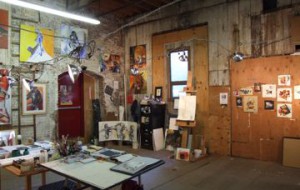
For the last seven years I have abandoned (mostly) Friday afternoon happy hours in favor of driving north and spending the late afternoons and nights in my studio. For anywhere between four and seven hours I am able to work in silence or blast the stereo and hammer away at any number of pieces in progress. During the summer I am even able to get there a few times a week to fuel my own projects, get ready for exhibits, host informal gatherings with friends, and even allow students to stop by to work if they wish. My time at the studio, like many of us who cherish our studio practice outside of the classroom, is priceless. It’s quiet. There are no clocks or bells ringing all the time. And the artists that I share our particular building with are just a wonderful group of people.
But yesterday when I drove up to the studio, my first visit since Hurricane Irene, I was greeted with something I didn’t expect at all: yellow police tape. The entire complex that houses my studio as well as dozens and dozens of other small businesses and artist studios was surrounded with posted signs saying it was a violation to enter the property. The floods caused by Hurricane Irene had swept through many of the spaces on the ground floors and the place was literally a disaster. Now I’m not much of a crier, but for the first time in a long time I was on the edge of doing just that. If it weren’t for all the people standing around me looking at the parking lot covered in mud, maybe I would have just let go. While we are lucky enough to have our studios on the second floor in one of the buildings, many of the first floor spaces had been ripped apart by what seemed like flood waters that perhaps rose four feet. Industrial equipment was in tangled piles. Furniture was broken and tossed onto heaps of trash. I mean, this was a MESS. And because the flood waters were so severe, the town has basically told everyone who rents space that they aren’t sure if the buildings are safe to enter since some or all may have structural damage. This is what causes me particular concern since my space is housed, technically, in a covered “bridge” between two buildings. For right now, my studio is basically a spinning pie plate on the end of a stick with a few decades worth of work inside. I have no idea if there’s water damage. I have no idea if the thing is going to come crashing to the ground as they continue assessing the structural damage. So for this week, I am asking everyone out there to cross their fingers and say a little prayer for those all over the east coast and in places like Vermont who are slowly recovering from the floods and damage caused by Irene. With any luck, we will all be able to clean up and slowly get back to our regular rhythm. For now, I could use a little happy hour…
In Your Court
Before I start, I have to confess: let’s just say writing about/for other people is not my strong suit. Writing about other people’s art gives me the nausea. Writing about another culture makes me want to make an excuse to get out of the guest blogging stint. Embarrassingly and unprofessionally, I thought about lying to the editor about a family emergency so I don’t have to write. (Also feels weird about lying using family emergency as an excuse, just feels like a bad omen.) I am one of those people who believe languages have a certain mythical power, so from now on, you can expect a “writer” who would almost lie but respects words too so much so he could not commit.
One of the reasons why I ended up in Singapore after grad school, or the reason that I tell everyone, is that I felt too American. I wanted to be somewhere else so I could think differently about my own practice, worldview, etc. Singapore seemed like a good place, a good transition for whatever comes next. I got to teach art, everyone speaks perfect English, and there is lovely weather. Speaking English is a big part for me because my work deals with language and spoken words, but what I realized soon is that I assume people who speak the same language should be able to understand each other. Man, was I wrong. I feel comically related to Bill Murray’s character in The Man Who Knew Too Little (1997), in which he plays an American visiting London but gets caught up in spy activity. The whole time, he thinks that he is part of a street improv theater while all the criminal euphemisms, spy codes, and threats (not to mention British humor) completely go over his head. Yet he is able to play along and amusingly diffuses a bomb attempt. To a certain degree, that’s how I feel being a foreign artist trying to produce work; I can hear and understand sentences, but feel lost in Singapore’s history, culture, and narrative.
New guest blogger: Mike HJ Chang
Thanks to guest blogger (and Lives and Works in Berlin regular) Ali Fitzgerald for her always entertaining and insightful posts. Follow her exploits back on the column throughout the year.
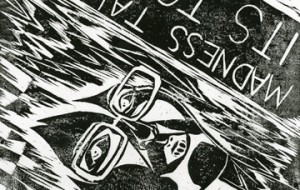
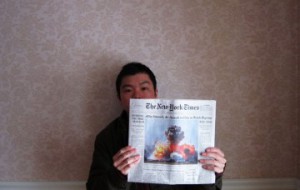
Up next is Mike HJ Chang. Mike is a Taiwanese American and he studied and practiced art making in Los Angeles. For the last two years, he has been teaching art in Singapore. Now he is an artist-in-residence at an independent high school, teaching interdisciplinary studies with a tinge of art, as well as starting a school video/new-broadcast program to teach students media and journalism. He will be blogging about the experience of teaching/learning/art making in a culture that is very different from that on the West Coast. He will focus on art practices in Singapore that are less object-oriented and more process-based, as well as the performance practices that inform his own work. For his own practice, in the past year he has been working on a text/illustration/performance/sculpture project called Is What, about growing up, a new lexicon, and feeling stuck. His website is www.boatship.net
Weekly Roundup
In this week’s roundup, Cao Fei in Istanbul, Fred Wilson works in paper, Iñigo Manglano-Ovalle edits a ritual, and more.
- Cao Fei will be featured at the Kurye Video and Digital Arts Festival in Istanbul, Turkey. This event will take place September 9 – 23 at the Yapı Endüstri Merkezi (YEM), a building with a new edition dedicated to video games. Structured around a main exhibition entitled “Space Invaders,” the festival will also include screenings, seminars, workshops and live performances and examine the boundaries between real life and the world of video games.
- Fred Wilson’s work is featured in the exhibition paper at the Bradbury Gallery in the ASU Fowler Center. All pieces in this exhibition demonstrate art that has been published by the Brodsky Center over the past 10 years. The show runs until September 28.
- Iñigo Manglano-Ovalle’s Always After (the Glass House) will be presented at the Urban Video Project (Syracuse, NY) later this fall. Always After focuses on broken glass accumulated after the windows of a Mies-designed structure were smashed by the architect’s grandson as part of a ceremony. Manglano-Ovalle edits out all clear reference to this ritual, leaving the viewer with a “dream-like sequence in which well-shod anonymous masses eternally exit and equally anonymous custodians endlessly move in to sweep up the crystalline debris of modernism.” This work is on view November 3 – December 31.
- Eleanor Antin and others will moderate a Regional Art Survey at Art San Diego Contemporary Art Fair. This event will take the pulse of San Diego’s visual arts community and examine the role local artists and institutions play within the region as well as the broader, national scene. This conversation will take place on September 3, 5pm – 6pm.
- Hiroshi Sugimoto’s Lightening Fields and Photogenic Drawings is on view during the 2011 Edinburgh International Festival which celebrates the influence of the arts and cultures of Asia. These collections reflect aspects of Sugimoto’s interest in combining art with science, experimental photography, and the links between photography and time. The exhibition closes on September 25.
- Laurie Anderson will bring her show, Delusions, to Usine C (Montreal), October 4 to 6. This solo piece was described in the London Times as “A questioning multimedia essay on the cosmos, coupled with an elegy for unconditional love.”
- Kalup Linzy’s and composer Luciano Chessa ‘s Heavenly Act preceded three performances of the Four Saints, an “opera installation” at the Yerba Buena Center for the Arts’ Novellus Theater (San Francisco).
- There’s still time to catch Andrea Zittel at Sprüth Magers Berlin for Pattern of Habit, an exhibition of new work by Zittel. The artist’s work examines how “psychological structures, thought systems and beliefs are manifested as physical objects” in the world that people create around themselves. This includes patterns and systems that are bound to habits, schedules and rules. The exhibition closes September 10.
Museum of…Stuff.

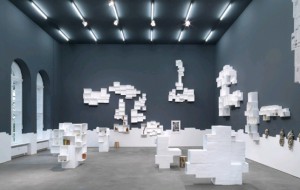
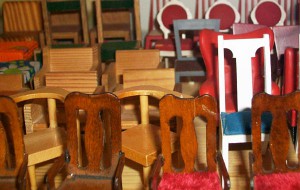
Model chairs at the "Museum der Dinge." Courtesy www.lazyoaf.co.uk.
Continuing my inverted vision quest in search of non-art, I went to the Museum der Dinge (Museum of Things), whose name and plucky mission beckoned me. The MDD sits on Oranienstraße, an increasingly back-packy, cruisy thoroughfare. In opposition to its location, the Museum is clean and somehow sweet. This perceived “sweetness” seems largely due to an overwhelming dose of nostalgia, although more subtly, it comes from simple and unobtrusive design. The collection is presented under glass in tall, unadorned wooden wardrobes. Often, the “things” displayed are divided by category–but those categories can seem laughably arbitrary. One shelf offers up model animals, but with all the animals mixed despite epoch, size, general condition and imaginary animal origins. So, a homemade stuffed bird looms over a 50s toy Lion in a weirdly psychedelic scale disparity.
The MDD is full of moments like these, as the curators of the collection seek to “visualize and re-experience (the) 20th century’s history of things.” The MDD houses 25,000 objects, spanning from the beginning of the 20th century to the present day. And, unlike most museums, chronology plays a very small part in its configuration. Instead, the MDD viewer mostly has to guess when objects were created, popularized etc.
*On Sundays, the Museum offers the assistance of “Thing-Interpreters.”
**Although the sequined Hitler pillows and Kaiser brand cigars kind of give themselves away.
Obvious crowd-pleasers are the shelves containing scrappy military toys from the Second World War, with small wooden tank replicas, German foot soldiers and a little Führer with arm-raising capability (erp!). One of my favorite WWII era things was an onyx-colored relief replica of the Olympic stadium from 1936, carved to scale with a cardboard map above it.
5 Questions for Contemporary Practice With Gregory Sholette
Artist, scholar, organizer, and professor, Gregory Sholette embodies multiple ways that artists can interrogate history, politics, and public discourse. Through his initial work with the group REPOhistory (1989-2000) (as in, “repossessing history”), he, along with other art groups and individuals of the 80s and early 90s, effectively drew attention to the artist as a social and political actor. Sholette’s collaborations with REPOhistory also presented art works as vehicles for addressing submerged socio-political histories, such as in the group’s Lower Manhattan Sign Project (1992-1993), in which they posted signs around Manhattan offering information about “the unknown or forgotten history of Manhattan below Chambers Street.” Sholette has also been an active participant in PAD/D (Political Art Documentation and Distribution [1980-1986]), an organization devoted to the publication and distribution of documents regarding the intersection of aesthetic politics and activism. Most recently Sholette has founded an archive for futures that “never happened” (The Imaginary Archive, 2010-present), and has been involved with The Institute for Wishful Thinking, an organization that attempts to harness the “untapped” potential of artists by soliciting proposals for projects which might effect governmental and social change.
Despite Sholette’s robust participation with other artists and activists and his tendency to only exhibit his own work in group shows, the works and projects he has produced independently of collaboration feedback vitally into a more collective practice (something he discusses at length below and in a previous “Inside the Artist’s Studio” feature). Meeting Sholette in person, I was struck by his interest in subjects ranging from the popular to the occult and counter-cultural. Sholette’s range of interests are brought to a focus in the book Dark Matter: Art and Politics in the Age of Enterprise Culture, in which he considers artworks that have fallen through the cracks of official art-historical discourse. Such works offer sites of (potential) resistance and autonomy inasmuch as they are not perceived as “art” proper and so remain liminal to the expropriative tendencies of cultural capital. Works by the “outside” artist, the craft artist, the hobbyist, the amateur, and the self-critical “drop-out” appear throughout Sholette’s book, offering examples, if not models, of what art can do guided by different values and habits.
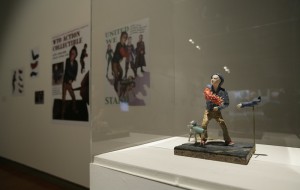
After the work of the film-essayist Chris Marker or the literary theorist Walter Benjamin (two professed heroes of the artist), Sholette turns his attention to the abandoned and unattended, cultural products so prosaic that they would seem neither worthy of our critical attention, nor our powers of reappropriation. The stuff ripe for re-use in Sholette’s work one would hardly call “redemptive,” and yet something is redeemed through the artist’s taking them up—a potential to make legible things just below the attention, what becomes “dark matter” because the culture at large just doesn’t know where to put it. Through the use of action figures in particular, a preferred format of hobbyists, he addresses problems ranging from post-Fordist labor practices (i am NOT my office, 2002-2004) to representations of Italian Fascism (Deconstructing Mussolini, 2007) and the exploitation of child workers (Little Workers Collectibles).
Sholette’s dirty messianic approach also comes across in his appropriation of dioramas, window and museum displays, and souvenirs. Playing upon our familiarity with these 19th century formats, Sholette moves fluidly between sentimentality and criticality, ironic abandon and the recognition that, as Walter Benjamin famously wrote (and Sholette quotes through a particular work of his citing the relationship between John D. Rockefeller’s founding of the New York MoMA and management of his public image after a mining disaster): “There is no document of civilization which is not at the same time a document of barbarism.” Moving within the flicker of “civilization” and “barbarism,” Sholette tells history slant, through the eyes of the losers, the unrecognized (and unrecognizeable), citing the places where anomalies and antagonisms crucial to history’s retelling “flash-up.”
One week left to join Art21′s “New York Close Up” Film Fund!
The New York Close Up Film Fund closes on August 31, leaving you only six more days to become a member! Don’t wait — join now to enjoy the benefits of membership before the summer ends.
In just nine weeks, the 13 New York Close Up films gained over 36,000 views. This success — rarely seen stories shared with thousands of viewers — is possible through the support of enthusiasts like you.
As you may know from viewing the films, the artists featured share their personal stories of diving into the New York art world. Artist Shana Moulton discusses merging her passion with a career in order to make a sustainable living. Lucas Blalock takes viewers into his studio to share his creative philosophy, developed through his photography of 99-cent store purchases. LaToya Ruby Frazier reveals how her roots in an economically struggling community have fueled her pursuit of a deeper and more facile artistic voice.
Support more documentary films like these and add your voice to the mix by becoming one of 100 New York Close Up Film Fund members. Your contribution will make a significant impact:
- $50 contributes to a day of on-site filming in an artist’s studio
- $250 supports the work of editors developing new short-format films
- $500 provides for Web-based programs reaching audiences worldwide
In return for your support, you receive:
- A first look at future New York Close Up Films
- Advance notice of New York Close Up programs and events
- An invitation to an intimate party in the fall with New York Close Up artists
Becoming a member is the best way to enjoy all that New York Close Up offers. Don’t miss out — join now.
Learn more about making a donation to Art21.

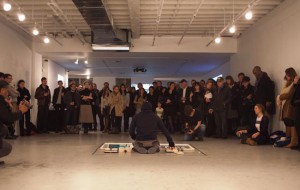
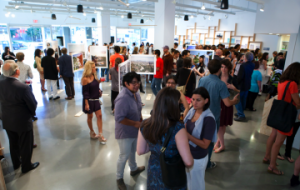
"Rethink/LA," installation view, opening reception, Architecture + Design Museum Los Angeles, 2011. Courtesy Wild Don Lewis.
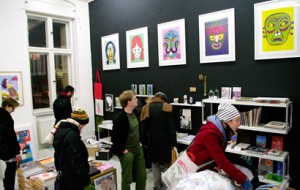
Los Angeles has a reputation for not only its excess, sprawl, and exploding population, but also for its unruly, anarchic and highly changeable landscape. Rethink/LA: Perspectives on a Future City, an interactive exhibition currently on view at the Architecture + Design Museum, explores that overwhelming potential for metamorphosis. Kellie Konapelsky and Jonathan Louie, co-directors of the eponymous organization, believe that change will be generated by individuals. They invited architects, designers, artists, writers, and policymakers to imagine Los Angeles 50 years from now through photographs, collages, text, video, and interactive installations. Konapelsky spoke with me about the vision of Rethink/LA and the future of Los Angeles.
Lily Simonson: What was the initial inspiration for the exhibition?
Kellie Konapelsky: We wanted to see what the citizens of Los Angeles had to say about the city they live and breathe in every day. We started the conversation by breaking the concepts down in a way that everyone could understand—by representing these ideas visually through collage. Photographs of recognizable locations throughout the city were interpreted through a collage of how that specific location would look in the next 50 years.
Teaching with New York Close Up: Lucas Blalock’s 99¢ Store Still Lifes
Lucas Blalock’s only plan is to work… preferably in the evenings. He deals with a set of parameters that his tools provide and brings things he purchases at local discount stores into his apartment. From there it’s open season.
In a world filled with artists that create work in a myriad of settings, Lucas Blalock’s situation is fairly similar to the scenario many of our own students face- working at home and trying to hold down a full-time job (or a full-time class schedule) while attempting to make art in between. And while Blalock often creates art with objects he purchases and photographs, right in the living room of his apartment in Williamsburg, his process is quite unlike many of the students we work with.
In Lucas Blalock’s 99¢ Store Still Lifes the artist talks about discovering and creating visual problems in order to solve them vs. starting with an idea and finding a way to photograph it. Blalock comes at making art from somewhat of an opposite angle than what we may be used to, and certainly opposite of someone such as Paolo Ventura. Instead of following through on plans to photograph particular objects in certain ways, he allows himself to be attracted to different things… and then finds a way to solve the problem of making this thing interesting to a viewer, as well as himself:
Sometimes an object will really give me a simple problem to deal with. Other times it’s much more of a kind of flirtation with the objects in the studio that something gets pulled out of it.
There’s a big part of me that can see educators feasting on a short film like this (it runs about 6 minutes) because it shares examples of things that ARE working for Blalock and also finds time to share what happens when things AREN’T working. For example, towards the end of the segment, we see the artist wrestle (literally, physically) with trying to photograph some multicolored foam he brought into the studio. While obviously excited to use this material at the start, Blalock quickly becomes frustrated with it and decides to wait on trying to capture this particular subject matter. The inspiration may have been there, but the material wasn’t “doing” anything to impress him. Instead of forcing the issue, he simply remarks that he may have to hold the foam in the studio for a while before deciding how to work with it. He doesn’t throw it away. He doesn’t have a fit and trash the joint. He simply decides to wait.
Lucas Blalock’s 99¢ Store Still Lifes is an inspiring piece for teachers and students alike because it also illustrates how one can create a complex and stimulating context for making beautiful works of art in a simple space. But Blalock makes sure we understand it’s not easy. For every 20-25 photographs he takes and develops using his large format camera each week, only one or two “really work”. He goes on to explain that the most successful pictures are ones that “don’t fall into a category”. Perhaps an easy label means the work isn’t complex enough? Regardless, here’s to steering clear of categories.
Check out New York Close Up and please be sure to share any artists you are planning on working with… in and out of the classroom! See you next week.
Center Field | Skokie Northshore Sculpture Park
Living in a fabulous art city like Chicago, it’s easy to become urban-centric when it comes to contemporary art. But there’s a place just on the border of Chicago that will make you forget the frenzy of the city, where you can immerse yourself in a forest of contemporary sculpture. The Skokie Northshore Sculpture Park is situated in an unlikely place, a narrow strip of land between the North Channel of the Chicago River and the super busy, five-lane McCormick Boulevard. Technically, the park runs two miles and is the westerly dividing line between the City of Chicago and the Village of Skokie, but a less official sculpture park continues on southward back into the city limits, and to the north into Evanston, though there are many fewer sculptures on the northerly end.
This charming park hugs the North Channel and winds alongside like its own little verdant river. Most of the park contains two bike paths—one on the McCormick Boulevard side that runs straight and will get you where you need to go, and the second on the river side that is much quieter and farther away from the traffic. Because the park is so linear, it is from this serpentine tributary of the path that the sculpture is most enjoyable. There are benches and big stretches of grass, conducive to a fun afternoon outing.
If you start your visit to the sculpture park on the Chicago end, one of the first works you will encounter is Inclination by Gail Simpson. A tipsy three-tier birthday cake in cotton candy colors, each tier edged in a swath of white frosting, the whole thing is topped with stripy candles. But upon closer inspection, this child’s cake begins to reveal itself as something else, something less sweet. The first impression of frivolity is belied by the steel from which it is constructed. The fluffy white frosting is cold and hard to the touch. (Don’t worry, you’re allowed to touch the work, just not to climb upon it.) The striped candles become chimneys or smoke stacks. Windows are cut into the top two tiers transforming the cake into a building or perhaps a ship. This must be where the title Inclination comes from. The destabilization of the structure indicates something, if not sinister, then at least less assuring than what we see on the surface.