

Looking at Los Angeles | The Language of Materials: Janne Larsen and Sibyl Wickersheimer’s “Big Haul”

September 29th, 2011


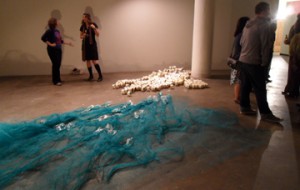
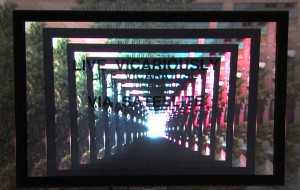
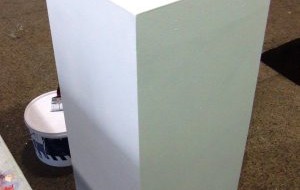
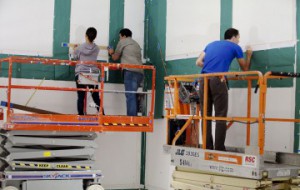
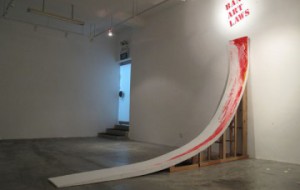
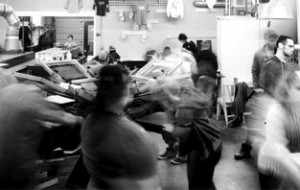
Big Haul: Janne Larsen's installation at Hi-Lite, 2011. Courtesy Carol Cheh.

Editor’s Note: This week, Los Angeles-based writer Carol Cheh fills in for Lily Simonson, who is travelling. Cheh is a writer and curator based in Los Angeles. She is the founder of Another Righteous Transfer!, a blog devoted to documenting LA’s performance art scene, and currently writes for LA WeeklyArtInfo, and Artillery. Her curatorial projects have included You Don’t Bring Me Flowers: An Evening of Re-Performances (PØST, 2010) and Signals: A Video Showcase (Orange County Museum of Art, 2008).

Earlier this month, I saw Thomas Crow give a keynote address at Pomona College on the occasion of their museum’s exhibition, It Happened at Pomona. Crow tried to make the case that the inventiveness of Los Angeles artists can be partially attributed to the fact that many of them have come at artmaking from other disciplines. He cited James Turrell, who majored in psychology and mathematics at Pomona; Chris Burden, who studied architecture; and an obscure artist named John Ware, who was influenced by Hollywood set design.

Crow’s words struck a chord with me, as I’ve long been intrigued by the collaborative work of Janne Larsen and Sibyl Wickersheimer, two Los Angeles set designers who also make and exhibit art. They are both highly inquisitive people whose mindset is perhaps just a bit different from that of artists who have maintained an exclusive focus on fine art.

Continue reading »

Taking the Long Way Home: Working With a Theme in a Series

September 28th, 2011

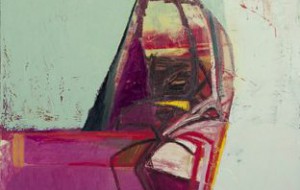
Amy Sillman, Untitled (object on table), 2007; courtesy the artist and Sikkema Jenkins & Co., New York

One of the students in my advanced classes is taking on the theme of “looking vs. seeing” for her first semester portfolio. She wants to explore the things people tend to overlook (or under-see) and over the next four months will create about a dozen works of art that explore the theme from different angles:

  • What does it mean to see something?
  • How is looking different from seeing?
  • When you really see something, how do you know?

And this is just one of the many outstanding themes students are exploring. Others include:

  • Picturing sound
  • The relationship between drawing and photography
  • Fear
  • Beauty and youth
  • Fairy tales and false promises

I even have one student who wants to explore, visually, particularly elusive phrases connected by the word “and” (such as “body and soul”).

Asking students to not only work thematically, but to work thematically in a series allows for the kind of immersion that most teachers dream about. Testing, unfortunately, has many of these teachers flitting from topic to topic trying to “cover a curriculum” that will surface on some standardized test vs. making space for students to become invested in exploring a theme and the big questions that go with it.

But getting to a theme that a student really wants to explore is perhaps the hardest hill to climb. Prior to choosing themes in the fall semester, I asked students to do a LOT of sketching as well as research into artists that have similar passions, ideas, or approaches to making art. We did a lot of exploring and talking about what makes us particularly happy, angry, confused and excited. We made lots of lists and notes. In just two weeks I have shared the “portfolios” of artists such as Eleanor Antin, Marilyn Minter, Ed and Nancy Kienholz, Amy Sillman, Sally Mann, Cindy Sherman and Barry McGee, to name a few.

In order to visualize working in a series, students need to see artists that not only work this way but think this way. Artists that do this especially well, and I am sure to bring into the classroom soon, include Dana Schutz (who happens to have a great show at the Neuberger Museum right now), Mark Rothko, Diego Rivera, Carrie Mae Weems, Yinka Shonibare MBE, Trenton Doyle Hancock, Nancy Spero, Collier Schorr, Rineke Dijkstra, William Eggleston, Robert Mangold and Mary Heilmann. Too often, students expect to generate great ideas by staring at a blank piece of paper and waiting for lightning. Instead, I encourage them to visually “wander” in order to compare the ideas they have with other artists, or compare the approaches and processes that some artists use with their own in order to inform their work… and ultimately inform the series.

How many of you get the opportunity to work with students on developing a body of work around a theme? What are your experiences? Are there other artists you use to illustrate working in a series? Share your stories with us!

Organs in the Snow

September 27th, 2011

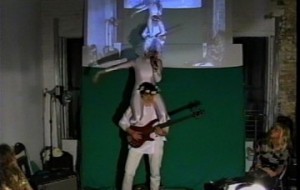
Rachel Mason and Little Band of Sailors performing for ESP TV.

Several months ago, I was invited to perform at an event organized by Scott Kiernan. I didn’t fully know what it was, but it had something to do with a TV show, and it was at an apartment in Brooklyn. It sounded fun, even if I didn’t really understand what I was getting into. When I arrived at the party/opening/ gig/ event/ TV taping I was even more confused. There was a crowd of people waiting in the hallway with looks of great anticipation on their faces. They stood in dead silence, saying, “Shhh…” as we approached, and “you can’t open the door!” This wasn’t a typical show, I realized at that moment. So we waited until the door opened up and I was greeted by a famous art dealer/Drag Queen called “Mary Boom” (aka Bradford Nordeen), whose orange-fake tan was coated over by so much Vaseline I could see my own reflection in her face. That’s when it hit me, this really IS a Live TV Taping–with an audience and performers and cameras, and this guy behind a console of super 80′s video gear–the kind I haven’t seen in a very long time, in the digital age. The guy was a DJ…? Oh wait, it turns out this is Scott…and this was Louis V E.S.P.

I later came to understand the accidental nature of the name is in keeping with the strange nature of a lot of aspects of Louis V. (A neon Louis Vuitton sign was left outside their apartment building and it just said, “Louis V” and so Scott added “ESP”… Extra Sensory Powers…which is perfectly appropriate for what’s going on in the video editing). Louis V E.S.P. is a not-for-profit gallery and project space run by Scott and Ethan Miller, which is located in Brooklyn’s  Williamsburg neighborhood. They feature solo and group shows, and they also produce a cable access show and live taping event called E.S.P. TV, which airs on Manhattan public access television. The show features New York City-based performers, video, film and visual artists and uses rotating guest hosts in a variety-show format.

E.S.P. TV / Louis V ESP

I did my Little Band of Sailors routine. It was super fun, and then I left. The whole show was taped before the live studio audience of Louis V E.S.P. A few weeks later, the show was aired on public access television in Manhattan. I live in Queens, so I didn’t get to see it, but Scott hosted an event at a bar where we could all come out to watch.

Continue reading »

Centerfield: Art in the Middle with Bad at Sports | Hand in Glove

September 27th, 2011


Between these two covers is artist Vince Leo’s Nobody Remembers Timetable Project, commissioned in 1990 by the now-defunct National Association of Artists Organizations (downloadable through Gregory Sholette’s Dark Matter archive). Starting in 1905 and ending in 1990, the timeline catalogs an idiosyncratic range of cultural and political milestones. For instance, in 1912: the U.S. invaded Nicaragua, Man Ray attended art classes at the Ferrer Center, and the IWW lead the successful “Bread and Roses” textile workers strike in Lawrence, MA.  I wish I could have been at some of these events as a fly on the wall. Like the Neighborhood Art Programs National Organizing Committee (NAPNOC), formed in 1976 at an NEA-funded retreat attended by two dozen community artists at a United Auto Workers’ center in Black Lake, MI. Or in 1977, when NAME, a seminal alternative art space in Chicago, hosted a Midwestern Alternative Spaces Conference.

I am in the midst of organizing what we hope will be a like-minded gathering to these earlier efforts, the Hand in Glove conference at threewalls, which will take place this October in Chicago.  Designed for both the artists who participate in these spaces and the organizers, administrators, and curators who run them, Hand in Glove is for anyone and everyone who engages artist-run culture to talk about its past, its current manifestations, and its potential futures. It’s a four day event of national scope that will address the state of self-organized, noncommercial and artist-run spaces, publications, residencies, and a variety of other projects happening at the grass-roots level. Conversations will range from sustainability to funding to unconventional organizing models, as well as the kind of creative administrative strategies people are using to stay open.

Continue reading »

Weekly Roundup

September 26th, 2011
Gabriel Orozco. "Red Flower Shadow," 2011.

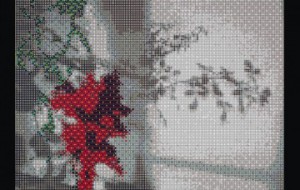
Gabriel Orozco. "Red Flower Shadow," 2011. Courtesy the artist and Marian Goodman Gallery, New York.

In this week’s roundup Gabriel Orozco paints with vectors, Florian Maier Aichen explores new forms of photography, Cindy Sherman is honored, several artists contribute calls to action and explore environmental sustainability, and much more.

  • Gabriel Orozco‘s first solo exhibition to follow his recently completed retrospective is on view at Marian Goodman Gallery (NYC).  Gabriel Orozco: Corplegados and Particles includes a series of large format drawings and paintings that use shapes inserted with axels to explore behaviors of form and construction. Orozco utilizes vector and raster computer graphics to deconstruct, divide, and open up the images as a data structure based on a grid, but divided in dots.  This work is on view until October 15.
  • Florian Maier Aichen at Baronian_Francey (Brussels) is Florian Maier Aichen‘s third show at this venue.  The artist continues his practice of picking apart and expanding notions of photographic representation. Works utilizing practices of photography, painting and drawing in equal measure have allowed the artist to explore image-making in pursuit of a new form of ideal photographic document.  The exhibition closes October 29.
  • John Baldessari, Barbara Kruger, Eleanor Antin and others were invited to submit personal calls to action expressing political or social concerns which will be worn on T-shirts for Trespass, a parade through the Broadway Theater District in Downtown Los Angeles, on October 2.  Trespass continues into Monday evening, October 3 with a celebration featuring interactive and musical performances by progressive artists to benefit nonprofit West of Rome.
  • Ann Hamilton will discuss The State of the MFA as part of the Sculpture X symposium at the Cleveland Institute of Art (CIA) in Ohio.  With “spatial awareness” as a recurring theme, more than 80 sculptors affiliated with colleges and universities in the region submitted pieces to the “Sculpture X” website and gallery.  Hamilton’s keynote will take place on October 15.
  • Cindy Sherman will be honored by The Smithsonian’s Archives of American Art in October.  She will receive an Archives of American Art Medal at the organization’s annual benefit.  The Archives is the world’s preeminent resource dedicated to collecting and preserving the papers and primary records of the visual arts in America.  The event will take place October 25.
  • Robert Adams and several other artists examine issues related to water use, mining, nuclear testing and its effects as part of The Altered Landscape: Photographs of a Changing Environment at the Nevada Museum of Art in Reno.   A large number of the photos are of the American West, taken post-1970s to the present, and drawn from the museum’s 1,000-piece photography collection.  The exhibition is on view until January 8, 2012.
  • Julie Mehretu‘s work is featured in a traveling show, Excavations: The Prints of Julie Mehretu, at Wesleyan University’s Davison Art Center gallery.  Mehretu is best known for her large-scale paintings and drawings, which layer maps, urban planning grids and architectural renderings with abstract markings and bright shapes of color. This is the first-ever comprehensive exhibition of prints produced by the artist thus far in her career.  The exhibition closes December 11.
  • Collier Schorr, Matthew Barney, Paul Pfeiffer and others are also at Wesleyan University, as part of the traveling exhibition Mixed Signals: Artists Consider Masculinity in Sports in the Ezra and Cecile Zilkha Gallery.  These works explore the male athlete, a subject that has been overlooked by scholars until fairly recently, after a critical mass of art addressing this subject grew large enough to allow for such an exploration.  This work is on view until October 23.
  • Andrea Zittel‘s new and ongoing work is on view at Regen Projects II in Los Angeles.  Zittel’s show will be presented at the same time as the Getty Museum’s multi-institution initiative Pacific Standard Time: Art in L.A 1945-1980 about the Los Angeles art scene.  The artist’s unique and unusual practice embraces the social and personal spheres engaging sculpture, textile, design, and painting. Her Regen Projects II exhibition consists of four bodies of work and closes on October 29.
  • Kiki Smith‘s I Myself Have Seen It: Photography and Kiki Smith at the Tang Teaching Museum (Saratoga Springs, NY) is a traveling exhibit that features the first comprehensive look at the role of photography in the artist’s work. It includes over 5,000 snapshots, over 100 large-scale photographs, including source photos alongside the sculptures inspired by them as well as prints, artist’s books and videos.  This show is open until December 30.
  • Maya Lin will soon lecture at the Illinois Institute of Technology on “design for a living world.”  The artist will discuss her contributions to The Nature Conservancy’s global effort to turn raw sustainable materials into works of art and has designed a piece that’s part of a show at The Field Museum.  The artist’s talk will take place on October 24, at 6 pm.

New Guest Blogger: Rachel Mason

September 26th, 2011

Rachel Mason

Thanks to Chris Cuellar for his wise, witty, and highly informative series of “How To” guides to art-making on the Internet and off. We’re also grateful to Chris’ contributor-collaborators Mark BeasleyNick BrizAMJ CrawfordJake ElliottEric FleischauerAlan & Michael FlemingJesse McLeanJonathan VingianoAndrew Norman Wilson, and Bob Hotdog for their willingness to go anon for this series, and for joining Chris in sharing their expertise with Art21 Blog’s readers!

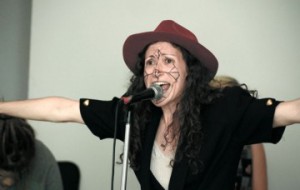
Next up is Rachel Mason, a New York-based sculptor and musician. Rachel’s work in nursing homes inspired Code Flight: A Musical Tale of Dementia and Love, a rock opera she wrote and performed at Dumbo Art Center in March of 2011. A related full-length album was also released in 2011. In 2012, Rachel will release two albums on Shatter Your Leaves Records: Woman With A Suitcase (whose album cover is an original work by John Baldessari) with Little Band of Sailors, and The Lives of Hamilton Fish, a surreal murder mystery/rock opera produced by Stu Watson and based on true events occurring during the Great Depression in New York.

In addition to her performance work, Mason is known for a sculpture of herself kissing the President of the United States, as well as a project in which she wrote two albums of songs and sculpted her life through a timeline of miniature portrait busts of warring heads of states. She has also scaled an eight-story building for an ongoing series of performances as an alien superhero dressed in white, which began while she was an undergraduate at UCLA.

Rachel’s work has been shown at the Detroit Museum of Contemporary Art; the School of the Art Institute of Chicago; the Henry Art Gallery in Seattle; the James Gallery at CUNY; the University Art Museum in Buffalo; the Sculpture Center in New York; Andrew Rafacz Gallery; Marginal Utility Gallery; The Hessel Museum of Art at CCS Bard and at Occidental College. She has performed at venues that include the Kunsthalle Zurich; the Museum of Contemporary Art Detroit; The New Museum; Park Avenue Armory; Club Tonic; Art in General; La Mama; Galapagos; Dixon Place; and Empac Center for Performance in Troy. She has written and recorded hundreds of original songs and performs large scale experimental plays involving dancers, musicians and other artists with her band and theater troupe Little Band of Sailors. Rachel has been featured in publications that include the New York Times; the Village Voice; the Los Angeles Times; Flash Art; Art in America; Art News; and Artforum.

For more information, read an interview with Rachel Mason on Art21 Blog here, and Rachel’s 500 Words for Artforum here.

Inspired Reading | Trevor Paglen

September 26th, 2011

Trevor Paglen is an artist, researcher, and writer based in New York and San Francisco. His art practice centers around making what is typically invisible visible—specifically, covert military and intelligence operations in the United States. Paglen travels to remote desert sites to capture reconnoissance satellites in the night sky or hidden military installations. As a result, Paglen’s photographs are aesthetic explorations of his interest in “black sites”—attempts to grasp the abstract questions that these sites pose about the socio-political moment.

Paglen’s visual work has been exhibited at the Metropolitan Museum of Art, New York; The Tate Modern, London; The Walker Arts Center, Minneapolis; The Andy Warhol Museum, Pittsburgh; Institute for Contemporary Art, Philadelphia; The San Francisco Museum of Modern Art; Massachusetts Museum of Contemporary Art, North Adams; the Istanbul Biennial 2009, and numerous other solo and group exhibitions. Most recently, he was featured in a solo exhibition at the Vienna Secession in 2011.

Trevor Paglen. "Dead Satellite with Nuclear Reactor, Eastern Arizona (Cosmos 469)", 2011. Courtesy Altman Siegel.

The following is Trevor Paglen’s reading list, along with his commentary.

Walter Benjamin, The Arcades Project (2004)
I have read this several times, at the moment I am looking at it not in terms of the overall arguments but how the collage process succeeds and fails.

Dan Falk, In Search of Time (2008)
I picked this up at a bookstore in Reno and read it during long exposures shooting dead spacecraft in night skies over the Eastern Sierra.

Graham Harman, Towards Speculative Realism (2010) and Quentin Meillassoux, After Finitude (2008)
It seems like all the kids these days are into the speculative realism thing so I am trying to catch up.

Assorted academic articles on “anthropogeomorphology” by Roger Hooke, in particular On the Efficacy of Humans as Geomorphic Agents (2000)

George Lakoff and Rafael Núñez, Where Mathematics Comes From (2000)
I have been reading this for about a year. It has taken me that long to start understanding their argument. I was always terrible at math and had to learn a lot about calculus and set theory to even begin understanding this book. Fortunately, Rafael Núñez is a great guy who is best friends with Teddy Cruz and has become my personal math tutor over Skype and on a recent visit to his lab at UCSD. I love my job.

Kevin Mitnick, Ghost in the Wires (2011)
This is a fun book I read on an airplane last month. It is really interesting to see the depth of Mitnick’s understanding of telecommunication infrastructures.

Carl Sagan, et. al., Murmurs of Earth: The Voyager Interstellar Record (1978)
The book for the Voyager “golden records”—something like “The Family of Man” meets ET.

Paglen and I spoke over the phone on September 24, 2011 to discuss his reading list and process.

Kelly Huang: It is evident that you have a research-based practice, as your photographs often reveal drones, satellite, and other “secret” military and intelligence operations. Can you share with me your artistic process? Specifically, where do some of these texts fit into your process?

Trevor Paglen: It’s different from project to project. One project always leads to another, for the most part. For example, the CIA creates various infrastructures, and I wanted to understand what those kinds of landscapes look like and how they were put together.  Over the course of doing that, I got really interested in how aviation infrastructures work. As a result, I ended up talking to hobbyists who track airplanes. As a part of doing that work, I realized there is another hobby that even fewer people did that was tracking satellites and different types of spy satellites. I kind of put that in the back of my mind and later came back to it and learned how that worked.

Continue reading »

Gimme Shelter | Full Frontal

September 23rd, 2011

I am on my way to New York, but not before finding Exercises for Rebel Artists: Radical Performance Pedagogy by Guillermo Gómez-Peña and Roberto Sifuentes delivered to my door on my last day at my Chicago address. Gómez-Peña is an original performance art activist whose work combines a very real goal of exploding race, class and gender constructs with an equally real goal of achieving a singular aesthetic. The book is an instructional how-to manual for creating workshops and performances based on the exercises developed within his collaborative group, La Pocha Nostra (of which Sifuentes is a long-standing member). I am not sure that I have ever seen a manual for performance such as this before, with illustrations, step by step breakdowns and documentation of the workshops.

Cover of "Exercises for Rebel Artists: Radical Performance Pedagogy."

What the book is establishing in 2011, the year of its publication, is that yes, performance art does involve technique. It’s not dance technique, it’s not acting technique, and it’s not directed toward the goal of becoming virtuosic. It’s taking the foundational movement exercises, warm-ups, and techniques centering the body and pairing it with social consciousness to generate radical intimacy.  As participants walk through a room with their eyes closed, or hold one another’s gazes for an interminable length of time, or perform tableaux-vivants as ethnic stereotypes (all extractions of exercises that are detailed in Exercises for Rebel Artists), they are breaking down conscious and unconscious barriers to connect with one another and with future audiences. On my last night of attending exhibition openings in Chicago, I was struck by more than one showing of performance, sex, and ritual action. At Intimacies, a group show curated by Lorelei Stewart and John Neff that’s currently on view at the University of Illinois at Chicago’s Gallery 400, I spent time with a video by Elijah Burgher, whom I had met on his way to Skowhegan a few months prior [Burgher has also been a blogger-in-residence on Art21 Blog]. Burgher draws from magick and the occult to generate glyphs or sigils that he then draws, paints, and carves into his body in his studio.

Continue reading »

Because Our Work is Never Done, or How To Make Art with an iPad (and Hot Dogs)

September 23rd, 2011

OMG we managed to cover SO MUCH in the past two weeks!!!

Many thanks to all of our talented and knowledgeable contributors for sharing their arcane art-making secrets. We can only go forward.

Contributors:

Mark BeasleyNick BrizAMJ CrawfordJake ElliottEric FleischauerAlan & Michael FlemingJesse McLeanJonathan VingianoAndrew Norman Wilson, and (introducing) Bob Hotdog.

And because the work of an artist is never done, we have one last instructional for those of you ten steps ahead of the rest of us and already making art with your iPad! Here’s “How to Recreate a Famous Movie w/ Animation, Hotdogs & iPad!”

You need to a flashplayer enabled browser to view this YouTube video


How To Embed A Microcontroller Inside a Sea Shell to Generate “Real” Ocean Sounds

September 22nd, 2011

In this How-To, we’ll go through the steps of assembling a small circuit to generate a continuous ocean sound from a microcontroller. This will require some basic soldering skills and a computer, along with some affordable and widely available electronic components.

Note: Each step has a selectable i at the top left corner with short captions for each step.


You need to a flashplayer enabled browser to view this YouTube video

Resources

Arduino Code

Standalone Arduino