
How Much Is That?

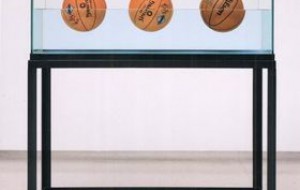
Jeff Koons, "Three Ball Total Equilibrium Tank (Two Dr J Silver Series, Spalding NBA Tip-Off)", 1985 Image: themainevent.us
“How much is that?” or “How much is that worth?” are popular questions students ask, especially when teaching with contemporary art. Often I find myself embarrassed having to admit that the piece in question recently sold for hundreds of thousands of dollars. Inevitably, the student will then exclaim something along the lines of, “What?! That thing costs more than our house?!”
But lately I find myself trying to broaden (not avoid) the conversation by talking about the cost of art vs. what art is worth or why it’s valued by different people. While it won’t make it easier to explain a seemingly random collection of objects that sells for half a million dollars, it certainly gets students thinking from the opposite end of things. So this week I’d like to suggest some questions that may provoke our students to think differently about the price, cost, and even the value of works of art. Here we go:
- How do artists come up with prices for their work?
- What kinds of things should an artist consider when pricing a work of art?
- As a student, if you had to price a work of art for your first group exhibit, how would you decide on that price?
- What makes certain works of art cost so much more, or less, than others?
- Describe the relationship, if there is one, between cost and value.
- Is there a work of art or particular object that you would consider “priceless”? If so, what makes this object hold such enormous value?
Getting back to the original question, because we can’t avoid it, let’s also consider getting students to begin answering the question for themselves instead of us, for example, trying to justify the price of Damien Hirst’s latest endeavor:
- Why do YOU think someone would pay so much money for a particular work of art?
- What are some of the reasons people decide to purchase or collect art vs. other objects?
- Does the price of a work of art communicate its value? Why or why not?
In the end, the reason that someone might pay half a million dollars for a work of art that most people would consider worthless is fairly easy: There’s a market for it. Just like there’s a market for great shortstops, miracle drugs, head-spinning gowns and head-spinning vehicles. But what art costs compared to what it’s worth- to the owner or the artist themselves- can be quite different. Teaching students to step back from what art costs and getting into the relationship between cost and value can be a much more rewarding conversation.
Open Enrollment | Talking Shop, Lurking Around Presses
Is art school relevant? Good question. Are galleries? Museums? The rotary telephone? High heeled shoes?
It’s all a matter of perspective, I suppose. There are some people out there with whom I would plead to NOT go to art school. There are some, like myself, that believed the time was “right” to go back and develop skills I haven’t had the opportunity to hone in the real world. Now I’m a first year graduate student working towards the completion of an MFA at the University of the Arts, Philadelphia, in the Book Arts/Printmaking program.
Personally, I want to learn. Period. While working in a non profit print studio in Pittsburgh, Pennsylvania I always wanted to learn more. I wanted to know how to fix that acid bath or maintenance that press. I wanted to know how to sharpen my tools for that perfect wood engraving, how to really make those colors pop in that silkscreen. As an Adult (Oh god, am I using that word?) I lusted after the opportunity for uninhibited learning.
I chose to go back because I believed the opportunities in grad school would help me to create a strong professional art practice — better chances at a wider range of teaching positions, more likely to be considered for those dream grants and residencies (I’m looking at you, Skowhegan), more opportunities to show, and just more work getting made in general.
But depending on the day, when the last time I ate was, and how well I think I’ve been adjusting socially to my new city*…my opinions are inclined to change.
What does my learning experience look like? As one of my classmates stated recently, “I have never been this tired for this long before.” Two things you should know: she already holds a PhD from an Ivy League school and this was said after only one month of class. Grad school might have it in for me.
My average day is spent often trying to reconcile the differences between a bookmaker and a printmaker. Until recently I had considered myself to be in the latter category, however my program is very heavy on the former. Something else you should know: in a book arts/printmaking program personality traits such as obsessive compulsion and anal retentiveness are actually badges of honor.** These are badges I have yet to earn.
After spending time trying to learn how to be a cleaner, neater, more methodical artist I often abandon trying and just give myself up to the full, overwhelming chaos that is my course load of work. This usually happens around lunch.When thinking about grad school I often want to describe it with words like chaos. Or miasma.
I was told not to do this because it might give the impression I’m lost or have no control. Quite the opposite — I’m exactly where I want to be, doing things I want to do. And this leads to a funny thing that happens in grad school, too. I’m not sure how to describe it exactly but, there is an interesting super-ego ego-less place I often arrive at by the end of the day. I’m so tired and overstimulated I feel completely disarmed and open to the world around me. I feel free and ready to receive anything that comes my way. I say “Yes” to more work at school. I tear up just watching the previews to The Darjeeling Limited. I discover things that inspire me that I never would have thought to look for on my own.
It’s a whole hornets nest waiting to be kicked to talk about my politics and how art school fits in there — especially in light of recent protests sweeping the country (and world!). Lets just say my interests in printmaking rise from ideas that the artist can be a social worker and that social workers shouldn’t speak for others, but offer processes that allow others to speak for themselves. Ask me in two years how that’s working out.
*I promise I have not now, nor will I ever, use OKCupid.com to meet people. I meet people the old fashioned way: by drinking in bars.
**This is not a diss. I am so far removed from that kind of mentality and so firmly entrenched in the fly-by-the-seat-of-my-pants methodologies I’ve developed over the years. Everyone knows that works great for shitty prints. As a first year grad student I pledge to try binding my books neatly, printing my lithographs cleanly, and not spilling my lunch everywhere in between.
Introducing New Open Enrollment Blogger Jenn Pascoe
As the end of the year and the end of the Fall semester looms, we’re slowly rolling out our new roster of Open Enrollment bloggers, who will be joining longstanding columnists Michelle Jubin and Antonius Wiriadjaja to report from the grad school front. I’m pleased to introduce Jenn Pascoe, who will be writing about her experiences at The University of the Arts in Philadelphia, PA, where she is working towards her MFA in Bookarts/Printmaking. Jenn grew up in a small town in Oregon, which she describes as “somewhere between Portland and Eugene.” After receiving her BFA in Intermedia from Pacific Northwest College of Art in Portland, she traveled around the world; highlights of her journey include walking across parts of Spain and scaling a volcano outside Quito, Ecuador. Besides travel, she enjoys good food, good company, and a good accordion. You can view her Tumblr here. Welcome aboard, Jenn!
More noise, more silence, sigils, and word viruses

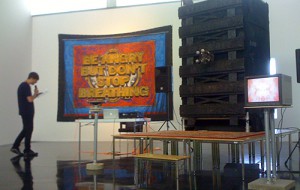
Mark Titchner performing at Warsall New Art Gallery in front of his installation "Be Angry But Don't Stop Breathing," September 2, 2011. Photo by Amelia Ishmael.
In September of this year I traveled to Wolverhampton, U.K. to present some of my research on Black Metal and contemporary art to the Home of Metal Conference, a three-day long event that brought together Metal academics—yes, there are such things—from across the U.S., South America, Europe, and the Middle East. In addition to the Conference, Capsule also organized an extensive program of events under the Home of Metal title throughout 2011—including film screenings, performances, and gallery exhibitions—to celebrate the Black Country and Birmingham as the birthplace of Metal. One of my favorite art events included was Mark Titchner’s solo exhibition “Be True To Your Oblivion” featured at the New Art Gallery in Warsall.
Mark Titchner is a British artist who is probably best known for his text-based works. Frequently assuming the format of large billboards, these works pull quotes from a wide range of sources—from Black Sabbath to the Black Panthers, and countless smart, consumer-targeted phrases in between—to create inspiration-speak such as “if you can dream it you must do it.” Titchner’s art practice is located somewhere between advertising, social activism, political and cultural criticism, and motivational speaking. He has exhibited in solo exhibitions at locations including Vilma Gold and the Tate Britain in London, the Macedonian Museum of Contemporary Art in Thessaloniki, Peres Projects in Berlin and L.A., the Venice Biennale, and the Arnolfini in Bristol. In 2006, he was a Turner prize nominee.
On September 2, Mark Titchner gave a performance at the New Art Gallery in front of his installation “Be Angry But Don’t Stop Breathing;” the next day he was joined by the artists Nicholas Bullen and Charlie Woolley for a panel discussion at Lighthouse on the University of Wolverhampton’s campus. I was fascinated with Mark’s exhibition, and the discussion that ensued at the Lighthouse shook me out of my jet-lag long enough to attempt hijacking the conversation towards issues of interdisciplinary art practices, Metal as Sound Art, and where subculture ends and “high culture” begins. I met with Mark afterwards to ask if I could follow up with him in the future about his work. The following interview is an extension of this discussion.
Amelia Ishmael: I’d like to start by asking about the way your artwork incites public participation. From the 2006 “Thought is Signal” project in Bristol to the 2011 stage installation “Be Angry But Don’t Stop Breathing” at the New Art Gallery in Walsall, part of your practice involves handing the mic over—sometimes quite literally—to the public. This type of activism seems based on the notion that, as an artist, you have a particular platform to speak to larger groups of people; it draws attention to the artist, and artwork, as a sort of mediator. Can you tell me about this practice? Do you have an aim in mind with who the public is speaking to… is it a political entity? Or does the work exist as a broader exercise in clearing the throat, reacting to one’s world, and speaking out?
Mark Titchner: There are a number of intentions with these “interactive” works. The first is a very simple idea about the functional potential of sculpture, that it becomes a device rather than an object. When I started to think about this concern a number of years ago, I suppose that I was thinking about creating the notion within the viewer that the work would always remain lacking or incomplete without their participation. This is obviously the case with any work of art, but I wanted to play with this idea by trying to replace some type of mental process with a “use” one. It was also very simply about the viewer taking some form of responsibility. Secondly, these works are about the way that we occupy public spaces, how we behave in them, and what a public space actually is. Artists do have a particular platform, but this is complicated in a gallery/museum situation as we have a space with a very clear hierarchy, and we learn to behave a certain way in these spaces. Though I think that this is a situation that is changing, given the emphasis on education, particularly for the young.
Set Me Free! Performa 2011 Part II: Beyond the Biennial

Performa 11: "You don't really love me, you just keep me hanging on"
If moribund is defined as an adjective for that which is approaching death or obsolescence, then perhaps it is the best word to describe my experience of Performa’s last week. This is not to say that the biennial ended without a bang, indeed it seemed that the best was saved for last. However, my patience for big names that delivered less than quality performance did not hold out through the week. My attention veered toward performance that was not lassoed into that calendar of events, but was nonetheless invigorating and contemporary.
Liz Magic Laser’s I feel Your Pain, an intervention-cum-reenactment of political folly, utilized the audience as the stage at the SVA Theater. Actors coming out of their seats performed caricatures of politicians debating, negotiating, or seeking sympathy in the form of romantic comedy.

Scene from Liz Magic Laser's "I Feel Your Pain." Photo credit: Yola Monakhov, via Artfagcity.com.
The performances, projected on a large screen on stage, suggested the spectacle of newsmedia as the whole theater was implicated in the events, making this take on the “living newspaper” a living, breathing beast of the political underbelly. As actors playing Glenn Beck and Sarah Palin sweet-talked one another until converging in a make out session, it felt like the audience was witnessing what everyone was thinking while watching Beck interview Palin on Fox News, but couldn’t say. Many of the parodies felt this way, indulging self-evident posturing while peeling off the veneer of political sincerity or redemption.

An audience member sampling cocaine offered by a docent in Tania Bruguera's 2009 piece. Image via www.animalnewyork.com
While there was an adrenaline rush of sorts that comes from everyone in the audience realizing that actors could pop up from anywhere, I couldn’t help but sense a formulaic-air on the side of entertainment. I Feel Your Pain was promising on the side of Tania Bruguera’s 2009 staged intervention at the Hemispheric Institute of Performance and Politics. At the Universidad Nacional of Bogota, Colombia, Bruguera created a fake panel that included a right-wing paramilitary fighter, a left-wing guerilla, and a refugee displaced by the fighting, as a docent walked through the aisles offering cocaine to the audience.
Weekly Roundup

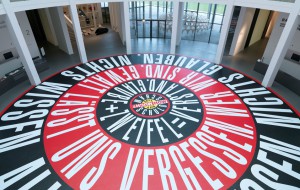
Barbara Kruger. Floor piece for the Pinakothek der Moderne, installation view. Photo: Nicole Wilhelms, Courtesy Sprüth Magers and the artist.
In this week’s roundup Barbara Kruger designs in Munich, Josiah McElheny reflects a mirage, Laurie Anderson joins the Occupy movement, Jeff Koons get under your skin, Lucas Blalock intervenes digitally, and much more.
- Barbara Kruger designed the 2011 EDITION 46 issue of the Süddeutsche Zeitung Magazin which, in the 46th week of each year, is in the hands of an international contemporary artist. The magazine was published on November 18 as a supplement. This project has given rise to a temporary work that the artist has designed especially for the floor of the rotunda in the Pinakothek der Moderne in Munich where visitors can walk around the work.
- Cai Guo-Qiang‘s solo exhibition Saraab, will soon open at the Mathaf: Arab Museum of Modern Art in Doha. The work shows the artist’s connection to the Gulf through installations and a series of gunpowder drawings in which he incorporates elements from Islamic miniature paintings, decorative art, and textiles, as well as ancient maritime routes between the Arab world and his hometown of Quanzhou, China. On the opening day of the exhibition, the artist will create a large-scale daytime explosion event titled Black Ceremony that will be free to the public on a “first come, first served basis.” The main exhibition will be on view December 15, 2011 – May 26, 2012.
- Josiah McElheny‘s latest installation for The Bloomberg Commission: Josiah McElheny: The Past Was A Mirage I Had Left Far Behind is at the Whitechapel Art Gallery (London) . McElheny has created seven huge mirrored sculptures, comprising screens that constantly play abstract films and distort, refract and multiply both the films and everything in the room. This work is on view until July 20, 2012.
- Lucas Blalock has a one-person exhibition, xyz, at Ramiken Crucible (NYC). The show features pictures that begins on film, shot with a 4×5 camera by the artist, and digital interventions follow. Blalock leaves these pictures unprotected from these overlapping strategies, which often contain procedures lifted from the technical production of commercial photography – the technology that was originally conceived of as invisible is put on stage to act among the intersecting possibilities of the mechanical, the procedural and the historical. This exhibition closes December 23.
- Laurie Anderson joins Occupy Musicians, a website that includes a list of hundreds of singers, guitarists, song writers and producers who put their names under the statement: We, the undersigned musicians and all who will join us, support Occupy Wall Street and the Occupy Movement around the world.
- Yinka Shonibare, MBE‘s Nelson’s Ship in a Bottle maquette has been selected for the third in a series of exhibitions featuring work from the Government Art Collection at the Whitechapel Gallery (London). The exhibition Travelling Light features an image of the work as the cover image for the catalogue that will accompany the exhibition. The exhibition runs from December 16, 2011 – February 26, 2012.
- Mark Bradford is featured in the publication Parkett edition 89. Christopher Bedford of the Wexner Center explores Mark Bradford’s shimmering grids, that to him evoke the live news footage shot by helicopters hovering over Los Angeles. Tate Modern curator Jessica Morgan elaborates on Bradford’s assorted paper trail, revealing a frantic ethos of pest control, cheap divorce, prison phone services, money wires and credit lines. The artist retells the ancient legend of King Arthur by submerging a switchblade rather than a sword in a solid rock.
- Do Ho Suh’s installation Cause & Effect has been commissioned for the Academic Instructional Center at Western Washington University (Bellingham, WA). Cause & Effect evokes a vicious tornado, a vast ceiling installation of densely hung strands that anchor thousands of figures clad in colors resembling a Doppler reading stacked atop one another. The work is an attempt to decipher the boundaries between a single identity and a larger group, and how the two conditions coexist. The first phase of the installation will be on view December 12 – 30 while the sculpture’s support structure is installed.
- Jeff Koons teamed up with Kiehl’s to raise money for the International Centre for Missing and Exploited Children through a limited-edition holiday collection of the brand’s signature Creme de Corps body moisturizer. The label of the 2011 edition features an image of the artist’s Balloon Flower (Yellow) sculpture from his Celebration series against a fuchsia background. The flower, which was exhibited in Versailles from 2008 to 2009, holds a special significance for the artist.
- Carrie Mae Weems‘s 2012 exhibition at The Frist Center for the Visual Arts (Nashville) will receive $48,000 from the National Endowment for the Arts in support of Carrie Mae Weems: Three Decades of Photography and Video, opening Sept. 21, 2012, as well as production of the exhibition’s accompanying catalog. The exhibition will travel to the Portland (Oregon) Museum of Art: Feb–May 2013; to the Cleveland Museum of Art: June 30–Sept. 15, 2013; and to the Guggenheim Museum Oct. 18, 2013–Jan 19, 2014.
Inspired Reading | Alena Williams on Nancy Holt
Nancy Holt, perhaps best known for her Sun Tunnels installed the Utah desert, is currently the subject of a traveling exhibition, Nancy Holt: Sightlines, curated by Alena Williams. The exhibition originated at the Miriam and Ira D. Wallach Art Gallery at Columbia University, and then traveled to Badischer Kunstverein in Karlsruhe, Germany. It is currently on view at the Graham Foundation in Chicago through December 17. The show will then continue on to Tufts University, Santa Fe Arts Institute, and the Utah Museum of Fine Arts in Salt Lake City. Accompanying the exhibition is the publication, Nancy Holt: Sightlines, which serves as a retrospective on Holt’s 45-year career.

Nancy Holt. "Views Through a Sand Dune," 1972. Cement-asbestos pipe, sand, Narragansett Beach, Rhode Island. © Nancy Holt/Licensed by VAGA, New York.
This month, I spoke to Alena Williams about her curatorial process and, of course, the texts that influenced her the most in conceptualizing this exhibition. Williams was familiar with Holt’s earthworks, but became intrigued with learning more about the artist when she came across her video work in the archives of Video Data Bank and Electronic Arts Intermix in 2004. In thinking about ways to present Holt’s career, Williams kept returning to film, video and works on paper. In many ways, Williams’s approach is a study of the archive—what comprises an archive, what is needed to tell a story, what emerges through the process of uncovering material?
The following is Alena Williams’s reading list for Nancy Holt: Sightlines:
Carl Andre, Eleven Poems (1974)
Gaston Bachelard, The Poetics of Space [La Poétique de l'Espace] (1958)
Mikhail Bakhtin, Discourse in the Novel (1935)
Benjamin H. D. Buchloh, Conceptual Art 1962–1969: From the Aesthetic of Administration to the Critique of Institutions (1990)
Eugen Gomringer, From Line to Constellation [vom vers zur konstellation] (1954)
Nancy Holt, Hometown (1969)
Nancy Holt, Ransacked (1980)
Lucy Lippard, c. 7,500 (1973)
Ann Reynolds, Robert Smithson: Learning From New Jersey and Elsewhere (2003)
Ines Schaber, Unfinished Business: Lewis Hine’s Mine Photographs and Some Questions about Documentary Photography (2006)
Kelly Huang: What led you to the texts you listed above? Which were you familiar with prior to organizing the exhibition, and which were you led to through the process of looking at Nancy Holt’s practice?
Alena Williams: There are a handful of these that I was already aware of before the show started—Michel Bakhtin’s writings on the dialogic imagination, Benjamin Buchloh’s analysis of authorship in conceptual art, Ann Reynolds’ monograph on Robert Smithson—and then as I started working on this exhibition, these other things began sifting in. Of course, Nancy Holt’s artist’s book, Ransacked, I also knew before the exhibition. My relationship with those texts changed as I worked on the exhibition because I started to see things relevant for her work that I would not have otherwise assumed.
“My stance right now is that everything I ever make will be Transcendental Black Metal”

Hunter Hunt-Hendrix presenting "Transcendental Black Metal" at Denmark National Art Gallery, 2011 (image gleaned from "Black Sofie," via the Facebook).
Hunter Hunt-Hendrix’s work first caught my attention a year and a half ago when I came across his manifesto “Transcendental Black Metal” in Hideous Gnosis, a published compendium of the papers delivered at the 2009 Black Metal Theory Symposium. Since its inception, this manifesto—which explores European and American Black Metal music subcultures, philosophy, and musicology—has sparked a lot of friction. This reaction is due, in part, to Hunter’s unique definition of Black Metal and his amalgamation of ideas that typically have a nearly allergic response to one another. But, prominently, the most aggressive reactions have been incited because Hunter is not only delivering papers at alternative academic affairs, he is also actively redefining previous notions of the underground extreme music subgenre Black Metal as the frontman of the American Black Metal band Liturgy.
I first contacted Hunter because I was intrigued by his manifesto, ecstatic that his interpretation of Black Metal offered an account of Transcendence over the Nihilism widely prescribed to the subgenre, and inspired when I finally caught a Liturgy concert live. Since I began my art historical and curatorial research in Black Metal and contemporary art (the subject of my graduate thesis project at the School of the Art Institute of Chicago) I have gleaned scores of artists whose interest in Black Metal has drastically influenced their studio practice, yet it wasn’t until I joined Hunter for a three-mile-long walk from Chicago’s West Loop arts district to the Empty Bottle concert venue this Spring that I realized the relationship between Black Metal and contemporary art was much closer than I had previously conceived. Hunter was interacting with many of the same theories that my favorite artists were, traveling from Black Metal towards studio art… meeting at the same trans-modal stage.
This interview builds off of previous interviews Hunter has given with Elodie Lesourd for C.S. Journal and Scott Indrisek for Artinfo to explore the performances of “Transcendental Black Metal” he presented earlier this year at both MoMA and the Danish National Art Gallery, and his video project “Genesis Caul.”
Amelia Ishmael: Although your work with Liturgy [Tyler Dusenbury, Greg Fox, and Bernard Gann] is probably most widely recognized, you have also presented solo art performances, such as one held at MoMA in July earlier this year. How has your approach to Black Metal provoked these projects?
Hunter Hunt-Hendrix: I’d like to think that at the institutional level the divisions between the networks supporting all the different kinds of creative activity out there are evaporating—not just art and black metal. That said, there is clearly a particular resonance between the two. When I started Liturgy I was extremely frustrated, almost desperately frustrated by the realization that at a certain point I’d have to choose a “world” to deposit what I was making. I hate these “worlds” like the d.i.y. independent music scene, the metal scene, the art world, “serious music,” the so-called indie rock music industry, philosophy, critical theory. I was never able to compromise and choose a single path, so it’s been a struggle. We’ve always been half-deposited in a few different worlds. It has been very uncomfortable, because I always end up with the sense of being half-recognized, as an intriguing outsider and/or a charlatan. At the Hideous Gnosis symposium I was the only musician to present a paper, which was the “Transcendental Black Metal” lecture. The presentation at MoMA of the same lecture was a meant to be a cross between performance art, ritual and pedagogy, in homage to Joseph Beuys, which is why I wanted to do it next to his “Eurasia Siberian Symphony” (1963) sculpture. I presented it as a Powerpoint with laser pointer along with chanting and candles at the Danish National Art Gallery just a week ago. It was pretty cool to actually do it in Scandinavia. I get off on infiltrating art institutions; these are concrete ways of crossing boundaries.
Looking at Los Angeles | ASCO and Activisim in Pacific Standard Time

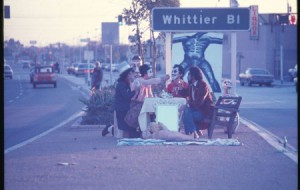
Asco. "First Supper After a Major Riot," 1974/printed 2011. Photograph by Harry Gamboa Jr. Courtesy Harry Gamboa Jr. Image via LACMA.
When I moved to LA from Northern California, my Bay Area friends accused me of taking up with a city that was historically cultureless and apolitical. If Pacific Standard Time–the year long collaboration of 60 cultural institutions throughout Southern California–does not seem to protest too much, it might actually manage to address both grievances. Pacific Standard Time promises to represent every major L.A. art movement from 1945-1980. But rather than explore aesthetic movements, many of the exhibitions parse LA’s sprawling cultural history through the lens of political and social activism.
Greetings from L.A.: Artists and Publics, 1950–1980 at the Getty explores the ways in which broader activist movements “mobilized artists to take their messages to the streets,” and features a vast array of prints, fliers, posters, and remnants from artists engaged in protest—from demonstrations in front of the Ferus Gallery, to photographs of Susan Sontag at the Peace Tower installation in Los Angeles, to old exhibition announcements for politically-engaged artists such as Vija Celmins and Judy Chicago. Peace Press Graphics 1967-1987: Art in the Pursuit of Social Change at the University Art Museum at Cal State Long Beach features prints made by the LA artist-run alternative Peace Press. MOCA’s Under the Big Black Sun: California Art 1974 – 1981 contextualizes its exhibition by confronting viewers with the text of Nixon’s resignation speech. According to curators, the show delves into the transformation of California’s art scene in response to a “collective loss of faith in government and other institutionalized forms of authority.”

Artist Peace Tower installation, 1966. Charles Brittin. The Getty Research Institute, Los Angeles. Courtesy J. Paul Getty Trust.
Still other exhibitions focus on art by marginalized groups seeking change: She Accepts the Proposition: Women Gallerists and the Redefinition of Art in Los Angeles, 1967-1978 at the Crossroads School (an exhibition that Catherine Wagley discussed in her last Looking at Los Angeles column); Otis presents Doin’ It in Public: Feminism and Art at the Woman’s Building; The Japanese American National Museum explores activism in postwar Japanese American Art in Drawing the Line; Now Dig This! Art and Black Los Angeles 1960-1980 at the Hammer Museum delves into work influenced in part by the era’s Black Power and civil rights movements; and various exhibitions at the Fowler Museum, the Autry National Center, and LACMA all highlight work by Chicano artists and collectives. One such exhibition that has gathered a great deal of well-deserved attention is LACMA’s Asco: Elite of the Obscure, A Retrospective, 1972–1987, the first-ever comprehensive museum exhibition of the infamous collective of East LA conceptual artists.
Praxis Makes Perfect | Did You Apply?
The other week, my non-sexual digital boyfriend’s laptop crashed. Our nightly online video chats were reduced to boring phone conversations. He said he lost years of writing: pages of journaling, ideas for memoirs, and random personal quotes that would one day make it into an inspirational coffee table book. As I browsed through my own external hard drive (having learned my lesson to back-up everything from a terrible computer crash in 2007) I noticed how borderline-obsessive I was about organization. Most importantly, I noticed how masochistic I was to keep track of every juried art competition I’ve ever entered in the last decade, most of which I failed to successfully achieve.

Google image search results fro "Juried Art Competition," from transartists.org.
After getting my BFA in 2005, I needed some way to get my artwork out there. “Did you apply” seemed to be the catch phrase with my peers, a kind of reminder of rigorous academic training in the fine arts. Creating artwork was one-third of the entire artistic process—the other two-thirds consumed by social networking and dreaded paperwork. Every week I stumbled upon a new art website with a new mission to bring you the newest calls for artwork. I manically applied to everything and anything, free or pay-to-play, and juried by anyone from the senior curator of X museum to a nobody with some extra time and money to make artists’ lives a living hell.
As soon as I saw an open call, I was ready to apply. I have a root folder in my external hard drive that has my artist’s statement, CV, biography, and title list ready to E-mail. I even have a fabulous picture of each and every single one of my artworks at a max size of 1000 pixels—but it’s the selection of the work that becomes the hardest part. The Present Group wants objects, Video DUMBO wants moving images, GLAAD wants queer themes, Avant Gaurdian wants fashion photography, Skowhegan wants this, Artists Wanted wants that, Future Generation wants this, 3rd Ward wants that…. Not only am I applying for group shows, I’m applying for opportunities to get myself out there. I’ll do anything! I’ll even try out for reality television! I want to express myself outside the walls of my studio. Am I sick or just a product of contemporary culture?

Google image search results for "The Real World," from dipity.com.
This year alone, I’ve sent out material for consideration to twenty-one calls. It’s a roller coaster ride with everything in life, and these applications have been no different. I participated in the highly controversial ArtPrize in Grand Rapids, Michigan after an application fee of $50. It turned out to be one of the most rewarding experiences of my artistic career thus far. Locally, I applied to multiple group shows at Southern Exposure and Root Division, and wasn’t selected for any. On a more depressing level, I applied to a free and all-inclusive Slide Slam show for graduate and recent graduate students in the Bay Area at Yerba Buena Center for the Arts—yes, everyone was accepted—and still managed to be omitted from the final presentation. Going back up the roller coaster earlier this month, I was a finalist for the inaugural Asian Contemporary Arts Consortium Writing Fellowship.
I’m tired of applying for everything but it’s already become second nature. I’m desensitized to rejection E-mails but I look forward to reading how professionals deliver “unfortunate” news, and of course, the acceptance E-mail every once in a while. At this point, I don’t even know what I’ve applied for or how many baskets I’ve put my eggs in until I’m contacted that “no, you suck,” or “yes, you’re in,” or my NSD boyfriend reminds me that I save everything. I don’t really pay-to-play anymore, unless the jury looks swell or the online buzz for the competition seems worth it. And I definitely stay clear of any website that looks super shady—terrible scrolls bars, icky font, no Facebook link, etc. I’ll leave you with this anecdote: the other week, I got a call from a casting director of a reality show, saying that she had saved my application from a few years ago, and that I might be perfect for a show coming out next summer. I don’t know if I’m ready for that, but you know what? Yes, I Did Apply.