
Like a Golden Allegory: Holly Lane’s Bright Monuments to Epiphany and Eureka

December 30th, 2011


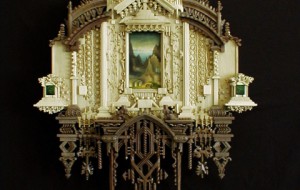
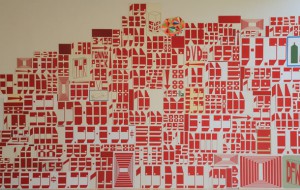
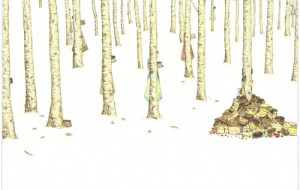
Holly Lane. "The Root Seeker", 2005. Acrylic on wood. 28 3/4" x 24" x 7 1/8". Private collection.

“Its soul its whatness, leaps to us from the vestment of its appearance. The soul of the commonest object, the structure of which is so adjusted, seems to us radiant. The object achieves its epiphany.”      ~ James Joyce

“… Like tales that were told the day before yesterday-/ Sleek in a natural nakedess,/ She attends the tintinnabula-…”     ~Wallace Stevens, “The Hermitage at the Center”

Over the past twenty years Northern California artist Holly Lane has created an impressive body of work that bears witness to her twin talents as painter and woodworker.  Known for her intricately carved frames which are the settings for her exquisitely rendered paintings, Lane’s pieces share in the art historical traditions of Gothic architecture, the Flemish Renaissance, Art Nouveau, Arts and Crafts and various modernist schools of landscape and figure. On viewing Lane’s oeuvre masters as far apart in time as Jan Van Eyck and George Tooker may come to mind. In these environments flora, fauna, weather and geography become conscious agents eager to communicate with and to play on the metaphorical capabilities of the viewer’s imagination. Imagery that one might classify as feminist or ecological is most certainly a persistent thread in Lane’s output. But if these works are didactic then it is in the sense of fables, those symbolically condensed vignettes in which talking animals or sudden reversals of plot manifest an important moral or truth about the human condition.

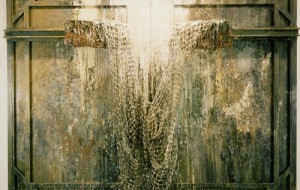
Holly Lane. "The Well-Traveled Mind," 2006. Gilded carved wood. 21 3/4" x 10 5/8" x 8 3/4". Courtesy the artist and Forum Gallery, NYC.

In recent years the richly layered architectural elements of Lane’s wooden frames have been set free to play a more prominent role. Those meticulously realized, almost animated foliages and decorous accretions drawn from the temples and palaces of history have embarked from their former roles as buttress and commentary. Liberated from their older alliance with the paintings, these elements have taken on a new weight- both literally and figuratively.  Lane’s forms are no less ornate than before, but by allowing them to exist on their own a different level of significance emanates from them. They do not so much function as stories as the solidification of powerful experiences or ideas gathered up and exquisitely presented in a single moment: the epiphany ( a manifestation of a powerful, singular presence) or the eureka (a flash of insight into the heart of the matter). In this sense Lane’s golden sculptures are monuments to the very experience of fulfillment.

Continue reading »

The Art21 Blog’s Most-Viewed Posts of 2011

December 30th, 2011

The Art21 Blog's Most-Viewed Posts of 2011

The Art21 Blog continued to grow over 2011, adding five new columns and presenting original writing from a wealth of fantastic contributors. In between all of the publishing, we bid farewell to our founding editor, Kelly Shindler, and welcomed our new editor, Claudine Isé.

Needless to say, the posts featured in this ‘most-viewed’ list only represent a fraction of the writing featured on the Art21 Blog throughout 2011. Please be sure to browse through posts from all of our columnists and contributors via the ‘columns’ category list in the right sidebar, includng the year’s worth of guest blog posts. Be sure to also check out additional writing in the Ideas area of the recently-launched Art21.org.

And with that, we present to you the top 10 most-viewed posts on the Art21 Blog for 2011.

Continue reading »

The Top 10 New Media Moments of 2011

December 30th, 2011

Who says the coolest artistic moments of 2011 had to happen at Venice?  I sure don’t!  To say that I’m at my computer all the time is an understatement, so the following list reveals the most exciting artistic gems that made for some very sad and lonely evenings hitting replay for hours on end.  The magic and wonder (or haunting sign of the apocalypse) of the Internet is that everything is archived and we can watch it over and over and over and over again!  So, enjoy!

Continue reading »

Looking at Los Angeles | Top 5 of 2011: Entertainers Who Moonlight as Artists

December 30th, 2011

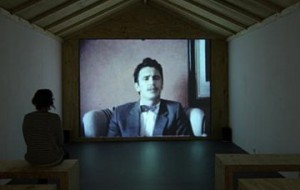
James Franco, "The Dangerous Book Four Boys" at Peres Projects, Berlin. Installation View. Courtesy The Hollywood Reporter.

5. James Franco, how can we miss you if you won’t go away?  Back in 2009 Franco topped our list of entertainers moonlighting as artists when he wrote a book report on performance art and claimed that his guest star role on General Hospital would be his foray into the genre.  But since then, Art21 has facilitated his artistic growth, featuring his collaboration with Kalup Linzy in our New York Close Up series.  This year Franco even scored shows at Gagosian in Los Angeles and Peres Projects in Berlin.  He is even pursuing an MFA at RISD–concurrent with his PhD in English at Yale, because grad school is NBD right? With his penchant for meta, Franco unsurprisingly seems to be delving deeper into the realm of institutional critique.  He recently teamed up with art duo Praxis to launch the Museum of Non-Visible Art, selling non-existent works of art through Kickstarter.  Be careful if you visit the page—it might just blow your mind!

Phyllis Diller and Jeffrey Deitch in Diller's studio. Courtesy Paper Magazine.

4. Is there something funny about painting?  Groundbreaking female comedians Phyllis Diller and Joan Rivers both refuse to retire or quit their day jobs–and their weekend hobbies.  Both maintain avid studio practices alongside their continued comedy careers, despite mixed reviews. Ever self-deprecating, Rivers bemoaned, “not one person in 10 years has asked me for a painting, that’s how bad I am.”  Maybe Rivers just needs to stick it out a little longer, as the more senior Diller recently enjoyed some art world attention, scoring a studio visit from Jeffrey Deitch.  According to Paper Mag, Deitch even bought one of her paintings on the spot.  Not so surprising–as the producer of television’s first art reality show, Art Star, we wouldn’t expect Deitch to shy away from the often problematic intersection of art and celebrity.

Rosario Dawson's "Misting Vagina" at Burning Man 2011. Courtesy NBC Bay Area.

3. Rosario Dawson tried her hand at installation work—and feminist art?—creating a giant misting vagina at Burning Man this year.   Though yours truly attended–and worked for–the orgiastic art festival this year, I did not happen upon Dawson’s piece among the countless large-scale sculptures and interactive works installed around the Black Rock Desert.  But the buzz from those who did dive into the giant vulva and complimentary balls and sperm sculpture was pretty positive.  Looks like Rosario made her own grindhouse!

Ringo Starr with "Face and Flowers." Courtesy Gallery 319.

2. Each Beatle has been known to make his own visual art, but Ringo Starr is the only one to venture into the realm of New Media, having exhibited his computer generated paintings since the 1990s.  Represented by LA’s own Gallery 319, which specializes in leveraging the cultural capital of rock stars such as Grace Slick and Ronnie Wood to sell their art, this year Starr decided to think outside the white gallery box, creating a piece of public art.  Ringo dedicated the statue—a colorful gun tied in a knot—to John Lennon, unveiling it on the 31st anniversary of his death.  Inspired by Carl Fredrik Reuterswärd’s bronze “Knotted Gun” sculpture, the piece was commissioned by the Non-Violence Project Foundation and will tour schools around the United Kingdom, as part of a program advocating nonviolence.  Starr’s background in computer-generated painting came in handy when creating the slightly nauseating psychedelic design for the sculpture. Starr divulges, “I just did my artwork on my iPad, put it on my computer and transferred it onto paper with the outline of the gun.”  Though this might suggest a lack of aesthetic rigor in his process,  we still have to give props to Ringo for using channeling the loss of his friend and band mate into a strong message.  Reflecting on Lennon’s death, Starr recalls “they called and said, ‘John’s been killed. He’s been shot and he’s dead’…It was a bad day. But it was a bad day because someone took one of these and shot John.”

Jenni "JWOWW" Farley of Jersey Shore. Courtesy Gawker.

1. Jersey Shore’s Jwoww was recently outed by Gawker as a onetime artist.  The gossip blog uncovered a website from her bohemian college days as an art major, featuring charcoal drawings and acrylic still lives that range from pseudo-pop art (Family Guy of course) to academic figure drawing.  Gawker says their favorite is her still life of “a beach towel, stuffed animal, detergent container, and two empty bottles of booze.”  But how can you ignore her naked body covered in multicolored paint?  Move over Yves Klein!

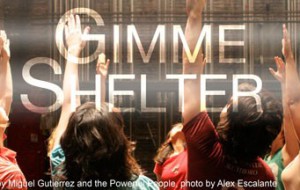
Gimme Shelter | Smash Your Idols: Clifford Owens at MoMA PS1

December 29th, 2011

Am I living in the 21st Century? Perambulating the art world, there are times when my senses tell me I am, but my overall experience feels stuck in the conceptual mire of minimalism, emptied of the latter’s social gravitas, while at the same time standing in the wake of relational dystopia. All this, even before I consider those in this world who have the power to shape my experience of art. If there is one artist who has the ability to shake me out of this Gen X-Y, zombie trance of ironic equanimity and break this century open, it is Clifford Owens.

Clifford Owens. Anthology (Jennie C. Jones). C-print. 30x40 inches. Image courtesy On Stellar Rays.

“Breaking open” is the operative phrase in describing Owen’s solo exhibition Anthology at MoMA PS1.* The phrase functions on the level of history and on our present experience of race, class and gender, both in the art world and beyond it. The exhibition is comprised of “performance scores” given to Owens by over twenty inter-generational Black artists, all of which he performed and documented during his five month residency at PS1.

By acting as the vessel through which Black art is anthologized, Owens puts himself in a space that is fraught with struggle and contradiction. He sustains his own image as a Black artist by obliterating the notion that there is a unified definition of Black art, and as such, he also problematizes the way an anthology is supposed to function. Different scores seem to scrape against each other, creating a conceptual friction between identity and its meaning. Through his labor, Owens reveals a broken narrative of Black history, and Black art history, with himself at the vortex, channeling the ideas of his fellow artists while serving as the site and subject of his audience’s projections.

Clifford Owens. Anthology (Glenn Ligon), detail. 3 c-prints. 20x24 inches. Courtesy On Stellar Rays.

This is a hard place to be. Where, exactly? In Clifford Owens’s body, within the institutional structure of PS1, in the 21st century–where post-race discourse has subsumed post-colonial discourse–and even in my small, white woman’s body. For me, walking through Anthology feels like walking among the shards of a cultural suicide bomb. The texts, photos and video works appear to fit together to form a smart, visually stunning installation in which the combined works reflect multiple histories, from Fluxus to Minimalism to Body Art. Owens’s own project–to reflect a heretofore invisible history of Performance Art by Black artists–is embodied by his interpretation of the scores. On close inspection, the scores’ contents are rife with conflicts about what it means to be Black, to be a man, to be inventing a history, to be re-staging a history, and ultimately, to be staging oneself.

Clifford Owens. Anthology (Kara Walker), detail. C-print. 16x24 inches. Image courtesy On Stellar Rays.

As part of the exhibition, Owens is performing various scores on a monthly basis, through March 2012. I had the opportunity to participate in his performance of Kara Walker’s score during the exhibition’s opening. The following is my account of the experience.

We are all lining the hallway of the 3rd floor in front of the Anthology exhibition at PS1. Owens hands Walker’s score to curator Christopher Lew, and asks him to read it aloud. “Score: French kiss an audience member. Force them against a wall and demand Sex. The audience/viewer should be an adult. If they are willing to participate in the forced sex act abruptly turn the tables and you assume the role of victim. Accuse your attacker. Seek help from others, describe your ordeal. Repeat.”

Continue reading »

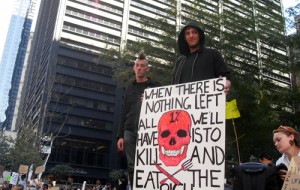
Top 10 Memes of Occupy Wall Street

December 29th, 2011

Image: from Adbusters.com

Protesters in Zuccotti Park, October 2011, Image: J. Gleisner

The nature of people demands that most of them be engaged in the most frivolous possible activities—like making money.”

“News, far more than art, is artifact.”

– Marshall McLuhan

Somewhere in the ether Marshall McLuhan is smiling. The oft-quoted maxim of the Canadian futurist — “The medium is the message” — has been reified by the Occupy Wall Street movement. Protest is the medium; moreover, protest is the message.

To the annoyance of its detractors, Occupy Wall Street has avoided articulating its own agenda. The singular, most resounding demand of the protesters is the simplest: to be heard.

Protesters, 2011 was your year. Still many ask, what exactly have you accomplished?

In brief, you reinvigorated America’s roots as a protest nation, you extended the Occupy movement beyond New York’s Zuccotti Park to 900 cities worldwide, you cajoled celebrities (Susan Sarandon, Michael Moore, Russell Simmons) into action and you moved musicians (Lupe Fiasco, Kayne West, Jeff Magnum, Tom Morello) in Liberty Plaza. Most importantly, you have made the phrase “income inequality” a political hot-button for the upcoming election year.

As this year crawls to its end, media coverage of Occupy Wall Street has slowed to a near halt. This movement began online and it could have easily ended there. It didn’t.

However, the new year must bring with it a new phase of the movement. At present let’s look back at Occupy Wall Street — not its message per se (or lack thereof), but at its media; not at its dreams, but at its memes.

The Top 10 *Memes of Occupy Wall Street

*I am liberally defining “meme” to include all the viral internet media — posters, catch-phrases, photos, images, street art and videos — that have defined the Occupy Wall Street movement.

1. America’s “Tahrir Moment”

July 13, 2011 – The Canadian anti-consumerism magazine Adbusters proposed the following:

“On September 17, we want to see 20,000 people flood into lower Manhattan, set up tents, kitchens, peaceful barricades and occupy Wall Street for a few months. Once there, we shall incessantly repeat one simple demand in a plurality of voices.”

- From “A Shift in Revolutionary Tactics,” Adbusters, July 13, 2011.

[/caption]

Buttressed by social media sites like Twitter and Facebook, talk of the “Tahrir moment” went viral within two weeks. Two months later Wall Street was occupied.

2. “The Ballerina and the Bull”

September 17, 2011 – Protesters were entreated, they tweeted and they accreted. On Saturday, September 17, The New York Times announced the beginning of the movement. Protesters arrived, singing “The Star-Spangled Banner” and dancing around the movement’s unofficial mascot, Arturo di Modica‘s 7,100 pound bronze sculpture Charging Bull on Broadway.

This bull is featured prominently in another widely-circulated poster from Adbusters (below).

Image: from Adbusters.com

As if to prove that anything really is possible, a ballerina danced atop this sculpture in early December as the poster illustrates.

3. “We Are the 99%”

August 23, 2011 – An anonymous post on Tumblr by a 28-year old New York activist named “Chris” (last name, unknown) voiced the collective frustrations from underpaid and overworked Americans. The post, like the media generated by Adbusters above, rippled through cyber space. The poignant expression from the We are the 99 percent tumblr became the movement’s slogan.

Image: wearethe99percent.tumblr.com

Also, I would be remiss if I didn’t mention We Are the 99 Purrcent.

Continue reading »

Under the Radar: Best of 2011, Part 2

December 28th, 2011

Katharina Grosse, installation view of One Floor Up More Highly at Mass MoCA. Image: ContemporaryArtDaily.com

Following up on last week’s post, I’d like to conclude with a few more shows that flew under the radar in 2011:

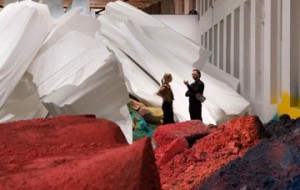
“Katharina Grosse: One Floor Up More Highly” at Mass MoCA. Hated this show the first time I saw it and loved it on the second and third visits. Grosse teaches us, like many artists who work with installation, that an exhibit has to work on you before making a decision about whether or not you “like” it. Spray painting directly onto the walls as well as huge mounds of dirt and Styrofoam, this show had the effect of stepping into another world. And while Grosse sees her work as neither representational or abstract, one couldn’t help associating some elements with massive piles of dried pigment or hyper-enlarged ice crystals. Another thing I really enjoyed was how the installation changed dramatically depending on where you stood in the gigantic space.

“Dana Schutz: If The Face Had Wheels” at the Neuberger Museum. As much as it kills me to admit it, especially after what I wrote about him last year, Jerry Saltz really said it best: “Given the continued imbalance in the system, for a woman to paint at all is still a political act; for her to do so in a vaguely gestural figurative style is almost insurrectionary. The show proves that like all outstanding artists, Schutz probably has an extra wrinkle in her frontal lobe.” Besides, how can anyone resist “Shaking, Cooking, Peeing” as a metaphor for…. everything?

“Richard Serra: Junction/Cycle” at Gagosian Gallery. Serra’s two new sculptures at Gagosian left me with the same reactions I had experiencing his work for the first time many years ago. While feeling a little seasick I simultaneously wanted to walk and weave through the spaces, encounter other visitors unexpectedly and run my hands along the orange-brown walls that tilted and loomed in many of the tight spaces. Getting these two pieces into Gagosian’s gallery must have been one hell of a trick and I wonder if anyone has it on time-lapse video? That would be something to share with students.

“Glenn Ligon: AMERICA” at the Whitney Museum of American Art. Stepping off the elevator and into Ligon’s silkscreened photograph, Hands, was a tremendous start to a show that was both gorgeous and provocative. In so many of the works, both  literally and figuratively, America stared us in the face and then turned away, leaving us with nothing but space to reflect on where we are in this place and time.

“Laurel Nakadate: Only the Lonely” at MoMA P.S. 1. What I enjoyed most about this show was how Nakadate experiments with meeting strangers and role playing in order to create films and photographs. It literally made me fear for her safety but also admire that ability to inject herself into very different situations in order to make the work.

Happy New Year to All and THANK YOU for reading in 2011…

The Warriors’ Turn: Compassion and Control in Jason Hanasik’s Militaria

December 28th, 2011

Jason Hanasik, photograph from the series "I slowly watched him disappear." Courtesy the artist.

“A uniform provides its wearer with a definitive line of demarcation between his person and the world… It is the uniform’s true function to manifest and ordain order in the world, to arrest the confusion and flux of life, just as it conceals whatever in the human body is soft and flowing, covering up the soldier’s underclothes and skin…” ~ Hermann Broch

“Spontaneity is only a term for man’s ignorance of the gods.” ~ Samuel Butler

In October of 2011, a number of San Francisco artist Jason Hanasik‘s photographic and film works were installed at Krowswork Gallery in Oakland. Hanasik has become well-known for his portraits of military men. His images are uncluttered and sparse, but there is always something quietly seductive in the way they lure the eye beyond a first impression of simplicity. Hanasik’s photographs are only one aspect of his multimedia installations which incorporate film-footage and occasionally objects. When seen as a whole, these function not only as intense, visual biographies, but as serious tools for deconstructing the performance of “the self” in both public and private spheres. The lives of soldiers have given Hanasik an effective way to explore the processes of self-fashioning and self-revelation. In two of his projects, “I slowly watched him disappear” and “He Opened Up Somewhere Along the Eastern Shore,” Hanasik focuses on gestural control and the expression of spontaneity between men to get at deeper questions of identity, and to collapse our social ways of seeing men’s “innate” qualities.

Jason Hanasik, photograph from the series "I slowly watched him disappear." Courtesy the artist.

For several years Hanasik has photographed Sharrod, a young African-American man who has spent much of his life within the U.S. military system. The images of Sharrod that make up “I slowly watched him disappear” reveal a great deal about how the body is made into a sign for things totally unrelated to its everyday biological functions. Who this young man is outside his (chosen?) career path is a tantalizing secret that hovers evasively beneath his intense gaze and his salute.  Hanasik has taken Sharrod’s picture in a number of civilian spaces that accentuate his presence as a soldier. They  also remind us that we are free at any time to see through that layer of social reality. Sharrod’s role as a cadet and future warrior is the visual starting point for any other question we might pose about who this young man is in the world.

Continue reading »

Open Enrollment | The Tomb of The Unknown Craftsman

December 28th, 2011

End of year “best of” lists abound, so I will keep it short and offer just one very favorite moment of 2011: Grayson Perry’s exhibition at the British Museum in London which I visited this October. Sandwiched between a glorious wedding in Stoke Newington Church and dinner with two much-missed girlfriends, I have to admit I was more susceptible than usual to persuasion as I was a) more than three miles away from school, and b) therefore really happy to be somewhere else than the library.  I was an easy customer, but this is beside the point. The show was a gem.

Perry pot.

Since he won the Turner Prize in 2003, Perry has cut a controversial figure, addressing transvestism (his female alter-ego Claire), outsider and naïve art (his pottery), the figure of the artist (Perry’s personal history provided the score for this exhibition), and the role of textile, craft, and collaboration, often working with artisans to complete his work.  I could give you the detached, scholarly review of The Tomb of the Unknown Craftsman, but I loved it too much not to effuse. Besides, the whole point for Perry – much to the discomfort of a few of his critics/Brian Sewell – is that the expected academic approach of the British Museum is cast off in favor of the personal pilgrimage of both the artist and the visitor. Perry’s male alter-ego, teddy bear Alan Measles, greets the visitor at the door on a personalized motorbike, heralding the deeply idiosyncratic and pretty darn wonderful selection of one hundred seventy objects chosen from the museum collection, and the thirty or so that Perry made especially for the exhibition.

Unlike MoMA’s regular collaboration with figures like Vik Muniz for the Artist’s Choice series, only Eduardo Paolozzi (who rifled through the collection in 1985 for the show Lost Magic Kingdom) and Xhu Bing, who did the same this past summer, have had such free rein with the curatorial direction of the permanent collection of the British Museum. Over two and a half years, Perry talked to staff across many of the museum departments  and created a very personal art survey, a jewel box of an exhibition that voyeuristically fulfills most visitors’ secret wish: to roam the British Museum’s basement and choose their favorite objects for display. In a way, that’s just what happens every time anyone crosses the threshold of the British Museum. Any museum. If you’re a tourist, you’ve perhaps come for a special exhibition. However, at your local museum – and this has been Perry’s local since childhood – you gravitate to one or two old favorite objects or areas – the modern wing in the Met. The Scottish Colourists in the Kelvingrove in Glasgow. Or, perhaps my absolute favorite: walking upstairs at the Scottish National Gallery in Edinburgh and looking to the end of the room to see John Singer Sargent’s Lady Agnew of Lochnaw staring back, always with the same sharp beauty.

Continue reading »

Centerfield | Against Nature: An Interview with Hernan Bas

December 27th, 2011

Painter Hernan Bas is known for unabashedly dabbling in the glittery realm of cliché, populating his work with red roses, flamingos, and most recently, fairies, as a whimsical retort to the perpetual tag of neo-romantic, Miami-based, gay artist. It only makes sense that since relocating to Detroit, paintings once read as decadent are now being labeled portraits of decay. It’s true that Bas’ work has certainly expanded in scale; the precious vignettes of years past evolving into epic, sprawling landscapes. These precariously balanced landmasses—multifarious collages of abstract brushwork and screen print, do appear on the verge of collapse. The eminent failure of the stage set merely serves to accent the ambiguous, and perhaps even suspect nature of the drama. Indeed, Bas’ boy scouts have been evicted from their childish hiding places to make way for the mythological, the paranormal, the sinister, and the absurd.

Hernan Bas. "A Landscape to Swallow You Whole," 2011. 72 x 120 inches.

In conversations I have had with Bas over the preceding months, the painter often cites J.-K. Huysmans’s nineteenth century novel, Against Nature, as a source of intrigue. In essence, the novel is about surface, and one character’s quest to cultivate artifice that surpasses the beauty of the natural world. “Nature has had her day,” muses des Esseintes, “there’s not a single one of her inventions, reputed to be so subtle or grandiose, that human ingenuity cannot create.” Bas applies paint to canvas to present a veneer of another world. Unlike his literary predecessor, Bas does not attempt to rival nature, but rather, open up the possibility for imaginary alternatives—a magic circle in which elements of the miraculous and supernatural are at play. Saints intermingle with demons, lost folklore is revived, and momentary encounters between shadowy figures become fodder for myth.

Bas himself is a collector of paranormal oddity, and once purchased a haunted jar containing a Ghostbusters soundtrack cassette tape on Ebay. Of course, the jar contains a story, not a member of the spirit world (although the painter has refused to open the jar “just in case!”). An apt metaphor for Bas’ paintings, the haunted jar is a vessel housing belief in the unbelievable, existing far away from the conventions of nature and the world’s established truths.

I spoke to Hernan Bas in his studio in Detroit’s Eastern Market.

"A Landscape to Swallow You Whole," detail.

Sarah Margolis-Pineo: You’re of course best known for your depictions of waifs and dandies—characters very conspicuous in your earlier paintings who have been subsumed by vast landscapes in your more recent work. I’m wondering if you can elaborate on your concept of “fag limbo,” and articulate how it has conceptually framed your work?

Hernan Bas: I started producing work that entered the art world at 18, 19, 20 years old—a time when I was still dealing with identity issues—being the waif or the skinny boy, and identifying with that character. The whole idea of fag limbo to me begins with a character or an identity that doesn’t quite fit the clichés that one would expect for a young homosexual character. I wasn’t necessarily the young, flamboyant gay—I didn’t fit that cliché, but I didn’t fit the male, straight-boy cliché either. I always felt like I was sort of in the middle and not quite sure what to identify with. That’s sort of where it stemmed from, but oddly enough, even in this new painting, The Jack of the Lantern, the character is of course stuck in limbo. I guess, after all, I am sort of still playing with limbo in one way or the other. These characters have always been described in these landscapes as being solitary and lonely, but in a sense, it’s sort of a purgatory. On TV right now is “Children of the Psychics.” I watch all those kind of paranormal shows, so I’m a firm believer in the afterlife, ghosts, and all the things that go bump in the night. If you think of it that way, I’m always sort of in limbo so to speak.

SMP: How did the adolescent version of limbo become the more paranormal and existential version that it is today? A few years ago you described your work as “individual chapters in a coming of age novels for queers.” Is this still accurate?

HB: I think the characters have really grown up alongside me….The characters that I was painting would, today, be thinking about different issues besides the jocks beating them up and looking like Calvin Klein models. Now, they’d be reading Dickinson and Thoreau. The characters have grown up, and obviously I’ve grown up.

"Ubu Roi (the war march)," 2009. 84x144 inches.

Continue reading »