


Talking with Janine Antoni and Getting Set for NAEA: Part Two
Below is part two of my recent interview with Janine Antoni in advance of her keynote address and workshop at the National Art Education Association’s annual conference here in New York from March 1-4. For part one of the interview, please click here.
Enjoy! See you later this week…
This Friday you will have about three thousand art educators from all over the country listening to your keynote address at the National Art Education Association’s annual conference. What do you most look forward to about participating in this year’s conference and what made you originally want to participate?
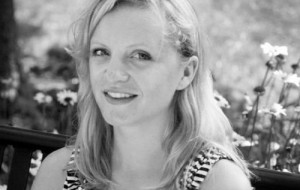
Janine Antoni: I want people to love art and appreciate the richness it can provide for one’s life. I see teachers as our first initiators. This introduction can set the stage for what a relationship with art can be. One does not need to be an artist to have one’s life enriched by art. Art provides an alternative way of learning that could be valuable in all aspects of our lives. Although I am far from a trained teacher of art, I feel that looking at an artist’s creative process can give clues about how to approach teaching art. It is a great pleasure and honor to be given the opportunity to share my practice with people that play this important role.
What other things will you be doing at the conference? You are also conducting a workshop. What will that be like?
JA: I’m particularly excited for the workshop. I have the opportunity to speak at art institutions and universities around the world and when possible I conduct a workshop rather then do studio visits. I am drawn to the workshop model as a way of generating and sharing ideas while creating an intimate atmosphere where people can engage in an inner search. For me, art isn’t necessarily about making things but about a way of thinking and accumulating tools for learning. The workshop will not be about how to teach art but to engage in the unknown.
Tell me more about how teachers will be “engaging with the unknown”. What kinds of things might they doing, or sharing with you, during that time? As someone who works with high school students every day, I think I have an idea about engaging with the unknown, but I’m not sure it’s the same kind you’re talking about…
JA: I want to approach the same subject matter from different perspectives: scientific, psychological, social, and emotional. The spaces we will create between these perspectives will allow for observation, contemplation, and interiority. The conclusions that we come to through this experience is unknown.
Many art educators find it difficult keeping an art practice and teaching practice going simultaneously. I often suggest to teachers there are ways to make connections between the two. What do you think? Does your art practice influence your teaching practice and vice versa?
JA: I’m drawn to teaching what I don’t already know. It allows me to treat the classroom as a space for exploration where my students and I learn together. I try to look for questions that are relevant to us all. When we all contemplate the same questions, we accumulate approaches that broaden our perspectives. We all bring this back to our work in uniquely particular ways.
This is not unlike my approach to making art. By locating problems I identify questions that often draw me to unlikely materials and unknown approaches to making.
During our last conversation in 2009 you said, “I like to talk to my students about the importance of fantasy, because I think we all have a secret conversation with an imaginary viewer in our mind when making.” How might we encourage our students to engage in this kind of dialogue more often?
JA: I see teaching as working towards sharpening the skill of moving from the subjective to the objective and back again. For many of us our ideal viewers are ourselves. We engage in fantasy when we separate our making self from our viewing self. In teaching, I try to parallel this process by creating situations where we play out these two selves for each other. It is this kind of fantasy that produces limber thinkers and makers.
No Preservatives | Looking Back to Nigeria: Ben Osaghae’s Critical Observations [Part III]

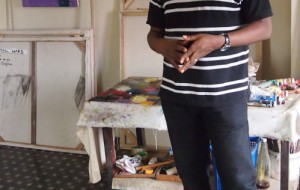
Ben Osaghae in his Lagos Studio. Photo by Richard McCoy.
*Ed. Note: This is the third post in a five-part series by Richard McCoy on the art and artists he encountered during a recent trip to Nigeria. Here are links to Part I and Part II.
Before travelling to Nigeria, I had known of a number of artists living around Lagos from Indianapolis friends who have been collecting contemporary Nigerian art during their time living and working there. Among their favorite and most collected artists was Ben Osaghae.
Ben was born in Benin City, the capital of the Edo State and studied painting at Auchi Polytechnic college. He has taught painting in Nigerian universities but has since retired from this work to focus solely on his painting.
At once thoughtful and light hearted, he’s just as likely to tell you something very serious and important as to come with a quick and light laugh about his observations.

Ben Osaghae. "Prey and Predator," 2011. Oil and acrylic on canvas. Courtesy the artist.
I want to show the point of view of the participant of a police check point and the observer driving by. Both at the same time. I don’t worry about making my paintings ‘naturalistic,’ rather I want them to be descriptive. — Ben Osaghae

In Ben's Studio. Photo by Richard McCoy.
Open Enrollment | Artist vs. Manager
It feels like decades have passed since the new semester started. I keep saying to myself “it’s only been six weeks” like six weeks is a short amount of time in a life that is jam-packed to the seams. Soon will come midterms, spring break, finals; then BAM semester over – year one done.
Despite the inevitable grumblings of the few students whose graduate studies are shaping up to look like this,
I am optimistic. It is so cliché to talk about how much of a bigger and better person I am from a year ago, but I honestly have to admit to it and succumb to that truism. Maybe I’m just finally accepting the passage of time and the onset of adulthood, or maybe it is the program I’ve enrolled in. I’m choosing to believe it is a combination of the two, but more the latter than the former.
This degree is just a small part of the vehicle that is moving me towards my career goals. It is who I meet, what I do, how I do it, and how I utilize the tools my program provides to my advantage. If anything, I am thankful for the strong foundation in non-profit management that Claremont Graduate University is providing me. So much of what we do is rooted in the arts, but I could see it easily transitioning into working for any nonprofit in whatever sector. If my dream art job at the Tate Modern does not materialize right away, I feel like I have a fall-back plan.
Exciting things have happened this semester: I met James Turrell when I inadvertently sat next to him in Skyspace, I’ve learned to like finance and accounting enough to let it inform my real-world life, and I’ve felt encouraged and uplifted by all the guest speakers who have come to speak about things like not-for-profit law, board development, programming, consulting and strategic planning. I’ve realized that there are a lot of people out there who care about the arts. Like, a lot, a lot, a lot. It is both positive and inspiring, especially since I consider myself a key part of this upward movement.
5 Questions for Contemporary Practice with Andrea Geyer

"Imagine to be here, right now. (Comrades of Time)," 2011. Digital C-prints, 20 x 30", color. Courtesy Andrea Geyer.
Through Andrea Geyer’s work we are offered a veritable blow-by-blow of political and social emergencies from the 2000s, in addition to more anachronistic socio-political problems and events that her work confronts. Her video installation, Parallax, for instance, begins an ongoing investigation into the fate of citizenship, foregrounding conditions of displacement among a world population unsettled by governmental responses to 9/11, 2001. Using photographs and texts in tandem, as Geyer explains, “Parallax tries to defamiliarize the ‘naturalized notion of citizenship.’”
The notion of denaturalization, which Geyer attributes to Hegel, may be a fruitful theoretical ground through which to encounter many of her images and texts, where we find a relentless questioning of the world as it exists through common sense. What overturns common sense is the drive for resistance. Geyer’s installations—guided by expertise in photography and research, as well as the tendencies of a storyteller—offer critical sites where common sense can become visible, and where this visibility can open towards the potential for resistance.
In a series of slide projections of airport interiors, one becomes able to reflect on these interiors as built architectural spaces, the projections forcing a remediation of their seamless mental and physical semiologies. In another photographic project, Spiral Lands, we see the mythologized land of the American Southwest demythologized by the doubling of photographic images that make one question the representation of natural spaces haunted by colonial violence and primitive accumulation. The miniscule differences in these photographs act as traces, opening the land to encounters beyond the transcendentalism of the genre originated by Ansel Adams and others.
The Energetic Persistence of Water: An Interview with Mary Jane Jacob
Mary Jane Jacob has long been established in the world of contemporary art. As a pivotal figure in socially engaged practice, she pioneered new ideas about public art, and the artists’ relationship to an audience. She continues to curate, teach and write about unconventional forms of aesthetic experience, forever probing the bounds of our expectations.
Since 2004 she has been editing an on-going series of books on the subject of Buddhism and its relationship to contemporary art. Over the course of the following conversation we discuss the development of this interest and the potential insight a Buddhist framework might afford art’s function in society.

"Buddha Mind in Contemporary Art," Jacquelynn Baas (Editor) and Mary Jane Jacob (Editor), University of California Press, 2004.
Caroline Picard: “Buddha Mind in Contemporary Art” and “Learning Mind: Experience into Art” are two collections of rich, varied essays and interviews that examine the relationship between Buddhism and contemporary art practice. How did you conceive of that project?
Mary Jane Jacob: In one way this all came about quite accidentally—a happy accident, as in John Cage’s terms—when I was asked to advise on a show about Buddhism. The invitation, I believe, was actually to help imagine how to undertake a large collaborative program. But in preparation, putting a toe into the subject of Buddhism and art, I found there was a lot there that resonated with the intention of my public projects (things I did outside the museum context and which involved collaboration) and which was consistent with my speculative processes of curating.
But then they asked to get their organizational work rolling, and I found that if I put my whole self into this subject, there were many things about Buddhism that helped explain the nature of artmaking and art-experiencing. Moreover, I felt that in seeking to do a show on this subject, those who had brought me in had both an opportunity and necessity to devise a form to match the content. Well, they weren’t ready for that; this show was just one on their season’s roster. But this experience turned me on to Buddhism.
I was thinking about structure for the subject, a structure that could hold the content, and most of all, a structure that was open and could allow for creative thinking to happen collaboratively, for personal insights, and for art to be imagined. Eventually I would find that this open space—cultivating an open mind—was not just about thinking in an unprejudiced way (important as that is), but to be open so as to have energy and clarity. This is what Buddhist meditation practice affords.
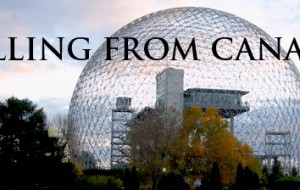
Calling from Canada | The Audain Collection at Vancouver Art Gallery
At the Vancouver Art Gallery’s exhibition Shore, Forest and Beyond: Art from the Audain Collection, I saw a middle-aged man facing an Emily Carr painting. He let out a slow whistle in disbelief, and turned to his friend to ask incredulously: “How have I never seen this before?” I understood his sense of discovery. The early Emily Carr work depicted an Arbutus – the common west coast tree characterized by its orange-red flaking bark. The colouration in the painting is expressive rather than realistic, making it quite different from the oeuvre of dark and deep forests more commonly associated with the artist’s work (as exemplified in the image below).

Emily Carr. "Quiet," 1942. Oil on canvas. Collection of Michael Audain and Yoshiko Karasawa. Photo Heffel Fine Art Auction.
The painting was a kind of revelation; insight into Carr’s vision that appears, luckily, as part of an important exhibition that closed last month at the VAG – 170 works from the private collection of philanthropist Michael Audain and his wife Yoshiko Karasawa. Given that Audain’s holdings are considered one of the most significant private collections in all of Canada, the show was surprisingly personal and emotional.
The Weekly Roundup

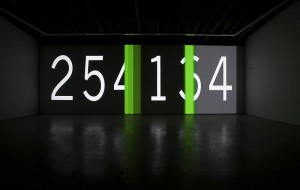
Charles Atlas. "The Illusion of Democracy," 2012. Installation view. Photo courtesy Luhring Augustine Bushwick.
In this week’s roundup, Charles Atlas projects videos with numbers and grids, Rashid Johnson is honored, Sarah Sze to represent the U.S. at the 2013 Venice Biennale, Mike Kelley is honored in LA, Maya Lin re-creates nature, Jessica Stockholder will create a Chicago color jam, a Barry McGee cocktail drink in Miami (!), and more.
- Charles Atlas has a new exhibition at Luhring Augustine Project Space in the Bushwick neighborhood of Brooklyn. The Illusion of Democracy features video installations and projections that combine mathematical and diagrammatic images with art historical precedents to create moving vistas of floating numbers and grids. This work is on view until May 20. A user-generated video posted online documents the show:
- Mark Bradford is at the San Francisco Museum of Modern Art through June 17 and at Yerba Buena Center for the Arts through May 27. This is Bradford‘s first major museum survey of paintings, sculptures, and multimedia works to be presented on the West Coast. The selection of works captures the development of the artist’s sensibility, from modest-sized canvases to monumental public projects, and from purely formal investigations of material to engagement with sociopolitical questions.
- Rashid Johnson had been named a winner of the 2012 David C. Driskell prize by the High Museum of Art in Atlanta. The prize is annually presented to an artist who is “in the beginning or middle of his or her career whose work makes an original and important contribution to the field of African-American art or art history. Continue reading »
Inspired Reading | Anthony Elms
This month, I had the pleasure of speaking with a former colleague, Anthony Elms, who recently joined the Institute of Contemporary Art, Philadelphia as Associate Curator. Anthony, more than anyone I know, is always looking, reading and listening, and is interested in a wide range of topics and genres. His first exhibition at the ICA will open February 1, 2013. The concept of the exhibition is still developing, but his thoughts begin with a quote from JG Ballard that has stayed with him for over ten years: “Fashion: A recognition that nature has endowed us with one skin too few, and that a fully sentient being should wear its nervous system externally.” The interest lies in fashion as much as it does in the pose—how does one reveal or project an idea of self into the world? Anthony’s approach is nuanced. He refers to a quote from Wayne Koestenbaum’s foreword for Roland Barthes’ The Lover’s Discourse: “Banish the message. Preserve the exaltation that surrounds it. Investigate the perfume that the message leaves behind.” Anthony describes his thoughts around the quote as follows:
That is a quality I keep coming back to. You might have a message, you might have a thought, but what is the perfume in the air with what you do? I am looking at artwork that is really good at capturing the perfume around however you’ve posed yourself, so you can actually see the pose as opposed to where the pose might be coming from. It’s a slippery thought, but I think I am getting close.
The following is a list of texts that have been floating around Anthony’s head, “possibly in order of importance,” as he prepares for his upcoming show at the ICA:
Marcel Proust, The Guermantes Way (1920/1921)
Hilton Als, The Women (1996)
Merlin Carpenter, “Fashion is Fun: An interview with Stefano Pilati by Merlin Carpenter,” Texte zur Kunst Vol. 20 No. 78 (2010)
Diedrich Diederichsen, “Radicalism as Ego Ideal: Oedipus and Narcissus,” e-flux (2011)
Wayne Koestenbaum, “Foreword: In Defense of Nuance” from Roland Barthes’ The Lover’s Discourse (1978)
Kelly Huang: You mentioned to me previously that Proust’s The Guermantes Way is the most important of the texts provided. How has this text proved most influential?
Anthony Elms: Probably two-thirds of that book is made up of gossipy dinner conversation—complaining about who’s not at the table, or who could be at the table, or even the people who are at the table or dismissing people for how they are dressed at the table. I was stunned at how much can happen in just those quick glances that we discard. And I can’t think of a better way that that happens than in fashion. I can’t think of a better way that that happens than in clothing. In the Proust, there is a brief little description when the narrator says,
Ahead of me there was simply a gentleman in evening dress walking away from me; but around him, as if I were playing with a clumsy reflector which I was unable to focus accurately upon him, I projected the idea that he was the Prince de Saxe on his way to join the Duchesse de Guermantes. And although he was alone, this idea, external to him, impalpable, immense, and as unsteady as a searchlight, seemed to go before him as a guide, like the deity who stands beside Greek warriors in battle but is invisible to others.
Springtime of the People..for the People and by the People

Emanuel Leutze. "Washington Crossing the Delaware," 1851. Oil on canvas. Metropolitan Museum of Art, NY.
As an art writer, I anticipate the Whitney Biennial as much as a kid does Christmas. Maybe twice as much because it comes half as often. But for some reason when it actually arrives I end up treating the spectacle more like Joan Rivers does the Oscars, with an institutional scrutiny and criticality that, assuming we’re all in this thing together, borders on masochism.
And I don’t think it’s just me; it seems like every other year in spring the entire art world grows claws and starts going after its own kind. Something about the pomp of the spectacle begs for extra institutional vigilance. It’s a corollary to my “Damien Hirst theory:” that critics build up hostility towards an artist until he or she is prominent enough to safely absorb the criticism, then they let loose. In the end the extra criticality is probably a good thing because the art world does a more-than-adequate job of avoiding self-sabotage for the majority of the time.
New Guest Blogger: Shane McAdams
Thanks to previous blogger-in-residence Monica Westin for her fantastic series of posts looking at the relationship between research, writing, and contemporary visual practices. You can read more of Monica’s writing and keep up with her latest projects by visiting her website here.
Next up, we’re pleased to be joined by guest blogger Shane McAdams for the next two weeks. Shane is artist, curator, writer and professor, who splits his time between Brooklyn, New York, and Cedarburg, Wisconsin. Welcome, Shane!