
No Preservatives | Looking Back to Nigeria: The Center for Contemporary Art, Lagos [Part II]

February 24th, 2012


Center for Contemporary Art, Lagos. Photo by Richard McCoy.

*Ed. Note: This is the second post in a five-part series by Richard McCoy on the art and artists he encountered during a recent trip to Nigeria. Part I is here.

One of the most interesting places I visited in Lagos was the Center for Contemporary Art, Lagos (CCA) which was founded in 2007 by Bisi Silva, who remains the artistic director. When we visited, Bisi was away on travel but we were kindly met by CCA volunteer Jude Anogwih and CCA-staffer Taieye Idahor. Jude is a remarkable artist and curator, responsible for a number of projects in Lagos, co-founder of the Video Art Network in Lagos, and co-curator of the Tate Modern exhibition, Contested Terrains, which features four artists working in Africa; as part of this exhibition, he gave a lecture at the Tate Modern last march about the CCA (you can find a link to his lecture here).

CCA volunteer Jude Anogwih and CCA staffer Taieye Idahor. Photo by Richard McCoy.

Since 2007, the CCA has become an important hub of activity for contemporary art in Lagos, hosting a number of critically-engaged exhibitions, public programs, as well as being home to the “largest library of contemporary art materials in all of West Africa,” according to Jude.

Some notable recent exhibitions include Identity: An Imagined State, which was the first international exhibition of video art in Nigeria. Complete with a small catalog, this exhibition featured the work of 12 artists all working on the continent of Africa.

Continue reading »

Gimme Shelter | Power Games or Two at the Kitchen

February 24th, 2012

What is a faygo shower?

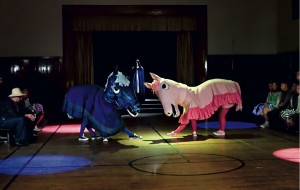
If someone had asked me this before Neal Medlyn’s Wicked Clown Love premiered at the Kitchen February 2-4, my response would have been, “a fay-what? Sounds like a secret queer military hazing ritual.”

Nope.

You need to a flashplayer enabled browser to view this YouTube video

It is a ritual of sorts, but only for a certain population in America that defines itself as the Juggalos/ettes, followers of the Insane Clown Posse (ICP). Faygo is their adopted drink, and a faygo shower is well, just that. According to the Urban Dictionary’s definition, “When a Juggalo/lette is showered in this drink it is a representation of the old you dying, and the new you coming to life.”

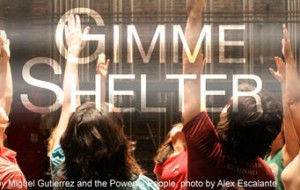
Medlyn offered this symbolic death and rebirth in his performance of Juggalodom to a reserved NYC audience, showering himself and his motley cast at intervals. With a set designed by Kathleen Hanna that harkened to rural Americana–clotheslines strung with underwear hung across the ceiling, a white preacher’s tent, a dj booth and many bright bean bag cushions–Medlyn created a group experience of “truth-telling” the ICP way. This means that for one hour, the Kitchen echoed with chants of “woot-woot!” and cursing that even for a New Yorker went to extreme heights. It is hard to filter form and content in Wicked Clown Love, and hard to tell when Medlyn is performing his own material or acting as a Juggalo, rapping ICP songs as a kind of 21st Century minstrelsy. At best, the persona of the Juggalo serves as a confessional platform for poverty, ignorance, soul-searching and figuring out what it means to be a man.

Continue reading »

Research and Relationality: An Interview with Zach Cahill

February 24th, 2012


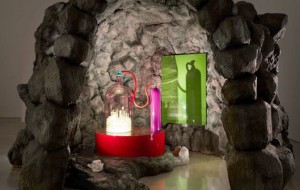
Installation view of Zach Cahill's "The Orphanage Project" at threewalls, Chicago.

Chicago-based multimedia artist and writer Zach Cahill’s The Orphanage Project is easily the most conceptually difficult gallery show I’ve attempted to write about in criticism. A sprawling conceit about the parental nation-state, the exhibition ostensibly spun out from Cahill’s purported attempt to create an orphanage on the South Side–conceived partially as a relational art project. In a Bad at Sports podcast previous to the show’s opening at threewalls this past fall, Cahill expounded on this project to his seemingly confounded interviewer, fellow artist Philip von Zweck, describing it as both a “site for orphans” and “living painting or sculpture,” which was enough for people to come into the gallery show enraged. (Cahill refused to elaborate on any truth status regarding the actual orphanage project in my own interview with him.)

The Orphanage Project’s first incarnation at threewalls in October was a baffling and exhilarating collection of pseudo-propaganda art, sculptural flotsam and jetsam, and the Soviet bear iconography–the use of the USSA epithet in several works clearly drew parallels between authoritarian, imperialistic power here and in the former Soviet Union. Some rough drawings Cahill attributed to his orphans. The back room of three walls was turned into a darkened cave with stalagmites.

Installation view of Zach Cahill's "The Orphanage Project" at threewalls, Chicago.

All of the work gestures at a murky project with no clear outlines and loaded with political and social suggestions more than answers; what exactly is the role of the orphanage here? If it is merely symbolic, what structures is the metaphor standing in for? Or, as it seemed after awhile, not standing in for?

Continue reading »

Cairo in Context | Alluring Archives: On Memory, Omission, and Research in an Unstable Region

February 23rd, 2012


A specialist sorts through books damaged in the fire at the Institut d'Egypte. Image from mauriceincairo.blogspot.com.

Researchers who work in the ambiguously defined “Middle East/North Africa” region inevitably complain about the intimidating, confusing bureaucracy that interrupts their access to primary sources. In Egypt, for instance, the state maintains strict control over the national archives and libraries, restricting which researchers have access to what documents. And many primary sources relating to the arts are not archived or catalogued in these institutions at all, meaning a whole different type of limitation is at work – restriction by omission.

In my own research on mid-century Egyptian art history, I often proceed by seeking out information in the form of oral histories, or by consulting pertinent documents in private collections. For instance, I frequent the home of an elderly woman who is the widow of one of Egypt’s best known modernist painters, spending many afternoons sifting through stacks of old notebooks, letters and family photos. But even her personal, family archives suffer from gaps and omissions—the result of various curators and Ministry of Culture officials who have helped themselves to her collection over the years. And while I’ve found that the state-operated Museum of Modern Egyptian Art has become increasingly transparent over the past year (thanks to the efforts of its newly appointed director), new obstacles arose for my research when I realized how many items were inexplicably missing from the institution’s storage rooms.

My sometimes exciting, sometimes amusing, sometimes frustrating attempts to obtain a particular form of knowledge have been like a micro-scale, domesticated version of much broader, much more difficult attempts to access information about current political realities. Life and work in Cairo has often felt absurd in the past months, due to how little I am actually able to understand the events that surround me. With each new episode of violence, I read both independent and state news sources to compare their coverage, while relying heavily on less mediated media for information, like Twitter, blogs, and YouTube videos, or on stories from friends who had been present at the latest clashes. But none of these testimonies cohere into one cogent narrative—it’s difficult to understand exactly what happened, and essentially impossible to understand why, as the military government, the protesters, and other parties contest the authorship of this rapidly unfolding history.

Continue reading »

Looking at Los Angeles | CAA #ProTips from an Adjunct Pro

February 23rd, 2012


College Art Association Conference 2012 Logo. Courtesy College Art Association.

This week the College Art Association descends on Los Angeles for its annual conference and illustrious centennial celebration.  The annual event brings together thousands of visual arts professionals in an unholy union of glorified job fair and academic conference. Surrounded by aesthetics, it might appear very pure and civilized, but under the surface we’re dealing with the sordid world of “networking.”

It can be easy to find yourself adrift in a sea of countless academic sessions, workshops, and interviews.  But following the 2009 CAA Conference, I managed to land a part-time lecturing position (“Adjunct Pro” is actually a stretch).  So listen closely, Grasshopper, as I parse my infinite CAA wisdom into some key points.

"The CAA Book and Trade Fair hosts more than 130 publishers of art books, journals and magazines, manufacturer and distributor of materials for artists, and providers of digital images and resources, among other companies and organizations." Courtesy College Art Association.

  • Stakeout: While the list of activities may seem endless, skim for interesting session titles and familiar names.  Chances are, the number of events that apply to your interests will be highly manageable.  If you are looking for a teaching position, frequent the interview hall, even if you do not have any appointments set up ahead of time.  Most institutions send at least two faculty representatives that conduct informal interviews.  If you are genuinely interested in pursuing a position at a specific college or university, try to speak with every faculty member present.  But save the sweet talk for quiet moments–if the table seems busy, return during one of the frequent lulls to chat with other faculty. Continue reading »

Praxis Makes Perfect | When I Was Your Age

February 23rd, 2012

My first year of grad school at San Francisco Art Institute happened to be Renee Green’s last year as Dean of Graduate Studies.  One day while I was waiting for a class that Renee was teaching to start, she and I got to talking about the press surrounding her exhibition at Yerba Buena Center for the Arts.  I remember she started laughing when I mentioned I saw her headshot in the paper.  She said that back in the day, artists weren’t required to provide an image of their face to accompany the artwork.  I slumped in my chair for the rest of that class thinking about whether artists today had any new responsibilities like that to deal with.

After class ended, I remember walking to my studio and texting a friend, “damn, we’re so lucky that we can just focus on our artwork and not worry about anything else.”  He texted back, “hell yeah, oh hey, check out this new watercolor I’m working on.”  He sent me an iPhone pic and I texted back, “it’s awesome,” but I thought it looked too purple, so I added, “maybe some more green or black.”  He texted back, “oh yeah, good tip.”

Google image search results for "iPhone," from kottke.org.

Google image search results for "iPhone," from kottke.org.

I remembering sitting in my studio trying to come up with a plan of action for a great studio day.  I grabbed my laptop from my backpack to turn on some music and I quickly logged on to Facebook to update my status with “studio day.”  My classmate in a studio down the hall just uploaded a new picture of a drawing he was working on, so I commented “you’re almost there!” and immediately he responded, “I know!” to which I immediately responded, “are you in your studio now?” to which he immediately responded, “yeah, are you here?” to which I immediately responded, “yeah, I’ll come visit after I do some work” to which someone I didn’t know responded, “wow that looks amazing – ur so talented.”

Continue reading »

Talking with Janine Antoni and Getting Set for NAEA: Part One

February 22nd, 2012

Janine Antoni, "Lick and Lather" (detail), 1993

This week’s column features a new interview with Janine Antoni in advance of her upcoming keynote address and workshop at the National Art Education Association’s annual conference on March 2nd here in New York City.

As many of you already know, Antoni’s work blurs the distinction between performance art and sculpture. Using her body, she transforms everyday activities such as eating, bathing, and sleeping into ways of making art. She has chiseled cubes of lard and chocolate with her teeth, washed away the faces of soap busts made in her own likeness, and used the brainwave signals recorded while she dreamed at night as a pattern for weaving a blanket the following morning.

The second half of my interview with Janine will post next week. For links to both parts of our conversation from 2009 click here: part one & part two.

Enjoy!

Tell me about some of the things you have been focusing on at Columbia University since the last time we spoke. What course(s) are you teaching and what has the experience been like?

Janine Antoni: I’ve been teaching for the graduate program at Columbia University over the past 12 years in a very interesting program they’ve developed called the Master Class/ Mentor Groups.  The students chose two mentors from a pool of twelve artists from very different perspectives. It is a one-week workshop that happens every semester during their two years of graduate school. There is an intensity created from being together all day that leads to a kind of intimacy that’s very productive to teaching. Columbia has never instructed me on what to teach but the intention of the class is for the students to get into the mind of their chosen artist, allowing them to experience one way of being an artist in the world. This enables me to model the class alongside my current creative process and explorations. Over the years, after a lot of experimentation, I’ve slowly developed a methodology that seems to foster creativity in interesting ways. I create a loose theme for the week, and I vary the activities as much as possible. We make, we look, we move, we explore, we create dialog, and I intentionally create gaps between these approaches and the theme is never revealed. These gaps are created to allow the artists to find bridges in relationship to their work and interests. Again and again I am surprised at how their experience during mentor week triggers new work. The thing that I’m interested in is that the creative process is never in a straight line, so if you teach in a straight line you won’t get the best results. To create you have to be out on a limb and to teach requires the same risk.

Since you have a child in school now, I am wondering about your reactions to the art making experiences she has had so far. What kinds of things has she described when it comes to participating in “art class”?

JA: She rarely speaks about her art classes specifically. But the other day she told me that she’s the only one in her class that can cut a perfect circle. She wasn’t so interested in the fact that she perfected this craft but what she wanted me to know is that she could make a perfect circle as a lefty using a righty scissor. She instinctively invents a personal way of approaching all tasks. What’s important for me is that I value that personal approach in her and that her teachers have the sensitivity to do that as well. Continue reading »

Open Enrollment | You, Me, and Everything Else We Can’t Contemplate

February 22nd, 2012

I first learned of the term horror vacui last semester, when a professor of mine overheard my attempts at describing why I like layering and overprinting in my work. I did some very superficial research and became fascinated with the topic.

I at first wanted this to be a very simple, show-and-tell post: “These are examples of horror vacui,” placed next to images of work by Adolf Wölfli, a carpet page from Kells Illuminated manuscript, or a poster by psychedelic artist Victor Moscoso. But then I became fascinated with all the similarities between these very disparate art movements. Why are people across eras and cultures moved to create work that covers every square inch of their chosen media? What leads them to repetition, ornamentation, or obsession?

Where’s Waldo?

To begin, the term horror vacui is often associated with the art critic and scholar Mario Praz (1896-1982). Praz wrote extensively on the history of interior design and decoration and was one of the first critics to comment on these choices as reflections on the individual. He used the term horror vacui in reference to what he saw as the clutter of interior design in the Victorian age.

Aldoph Loos had a similar take in his book Ornament and Crime, believing that evidence of how advanced a culture is can be seen in their use of ornamentation, or lack thereof.

So, it’s easy to assume Loos and Praz would have hated the Artistic Printing movement.

Continue reading »

Reasons to Write Into Art: On Textual Collaboration with Artist Heidi Norton

February 21st, 2012

Focusing on the relationships/constellations between the act of writing, the process of research, and contemporary visual art practices is how I’ve attempted to anchor this series of guest blog posts, but until this winter I could only have spoken to the first two. It’s curious that as a critic and arts writer, you can work full-time to become as fully fluent as possible in the language of contemporary visual art–recognizing it, and occasionally producing its most important turns of phrase, without ever actually speaking it yourself, so to speak. (In other words, so many people who write about art only ever have to learn enough to be able to identify the most important connections, the most obvious expressions, and so forth, without ever learning how individual words and phrases might actually translate to everyday practice.)

Then one day last spring I bought a piece of work by Heidi Norton, my first real significant art purchase, after seeing her show at ebersmoore gallery (the title of the piece I bought, The Radicant, also happened to be precisely the same as that of a Bourriaud book I was arguing with in my head at the time), and I began an email conversation with her about her work, after which she invited me by for a studio visit. The rest of that history should make up a blog-post-long disclaimer about conflict of interest as a writer, because I want to write about a show that I was involved in creating–and what I learned about the process of making artist books and more generally making text that’s part of a visual art show rather than a response to one. So, here is my disclaimer: this entire blog post is a conflict of interest (and in a way, it is also about that very conflict). 

Some very brief background on Heidi’s work: She works in photography, living plants, wax, the earth, and is influenced deeply by the light and space movement. Her photographs are among the most exquisite surfaces I’ve ever seen.

Continue reading »

No Preservatives | Looking Back to Nigeria [Part I]

February 21st, 2012


Richard McCoy with Amanda Thompson, MfAA registrar , and senior staff at the National Museum of Lagos.

*Ed. Note: This is the first post in a five-part series by Richard McCoy on the art and artists he encountered during a recent trip to Nigeria.

At the conclusion of the Indianapolis Museum of Art (IMA) exhibition, Dynasty and Divinity: Ife Art in Ancient Nigeria, I was invited by the U.S. organizer, the Museum for African Art (MfAA), to help their registrar, Amanda Thompson, with the return of more than 100 important artworks to their home country — the works had been out of Nigeria for three years, travelling to six venues in Europe and the USA.

It was truly a privilege to play even a small part in returning these artworks to Nigeria, and a mind-changing experience traveling to Africa for my first time.

While our work days were busy carefully examining each artwork to ensure that it was in the same condition as when it left, in the evenings and weekends I investigated a number of galleries, exhibitions, and studios of contemporary artists working in and around Lagos. What I saw were individuals looking at the rich history and traditions of Nigeria through the lens of the 21st century, in some cases preserving traditions and in others challenging the colonial past and current government, which is infamous for its corruption.

Staying at the hotel Bogobiri House, with its live music just about every night and walls and courtyard filled with contemporary art, it felt like I was at one of the centers of the Lagos art scene. Bogobiri, which is also home to the gallery, Nimbus, is owned by Chike Nwagbogu; he has received a lot of attention for his ideas of putting art at the center of the transformation of Nigeria.

Musicians at the Bogobiri House. Photo by Richard McCoy.

Continue reading »