
Teaching with Change
Last week I presented a Season 6 Access screening of the Change episode featuring Catherine Opie, El Anatsui and Ai Weiwei. During the screening I made some notes to share when it comes to ideas for teaching with this particular hour…
First, what kinds of change are illustrated in this episode? Some of the art featured calls for different kinds of change and other works shed a light on changes occurring around us. Which works in this episode specifically engage with the theme? Which works ask the viewer to consider a specific kind of change?
Second, how does each of the three artists document the transformation and change of physical materials, places, and even ways of thinking? How does each artist work with transformation and change in multiple ways and how does collaboration affect the art created?
Finally, what kinds of things can students experience and learn from working with this episode? Possibilities include:
- Investigating how different artists document and perhaps provoke change.
- Exploring a single theme by engaging with diverse media and materials (and this goes for each Art21 episode- all twenty four of them).
- Engaging communities-small and large- as collaborators and subjects.
- Experiencing diverse approaches to storytelling.
- Enabling conversations that include topics we sometimes avoid talking about, such as how we perceive (not to mention treat) people who don’t look like we do or the role of surveillance in our lives.
If you missed the Change episode last month you can view it here as well as download the educators’ guide in a simple PDF file.
Until next week. Spring is here.
Open Enrollment | The Alienating “Blah”
Well, it’s done. I am a Master(ess) of Arts. (Unofficially, though, since I won’t receive my diploma until I put the finishing touches on my thesis and submit it to the library.) Now for the hard part.
The great risk of going to grad school is the possibility that several years down the road, you will find yourself with another piece of paper and no better idea of how to gain entry into and function within the professional world. Luckily, I don’t doubt for a minute that pursuing an advanced degree was the right choice for me. I feel much better equipped to begin a career as a cultural worker than I did two years ago. Still, I worry that sustaining my current level of passion for issues in my chosen field will become increasingly difficult as the pressures of getting a job and figuring out the rest of my life intensify.
In my last post, I wrote about my interest in dialogue, and discussed it in relationship to contemporary art, literature, and museum practice. I neglected to mention Paulo Freire, the scholar who is perhaps the most provocative theorist of dialogue. Freire, a Brazilian educator and author who died in 1997, is something of an icon in my social justice-focused art education program. Part of my reluctance to talk about his work is my conviction that I cannot do proper justice to its eloquence and meaning.
In his book Pedagogy of the Oppressed, Freire refers to dialogue as “an existential necessity,” and “the way by which men achieve significance as men.” He further explains:
Dialogue is the encounter between men, mediated by the world, in order to name the world. Hence, dialogue cannot occur between those who want to name the world and those who do not wish this naming – between those who deny other men the right to speak their word and those whose right to speak has been denied them. (Excerpts from Paulo Freire, 1970, pp. 75-86)
This naming of the world through dialogue, Freire warns, cannot transpire “in the absence of a profound love for the world and for men.”
5 Questions for Contemporary Practice | Melanie Gilligan

Melanie Gilligan. "Popular Unrest" (2010). HD video, five episodes, total running length 67 min.
Encountering Melanie Gilligan’s work only four years after the financial collapse of 2008, there is a uncanny sense of recognition: that she is providing an extemporaneous fiction for our time. Worlds nearly like our own, but set just beyond it, exaggerating its features. That she is also looking forward to a future time, a world that we might wish for in our present.
One quality that lends the work this sense are her uses of language. In both Popular Unrest, Crisis in the Credit System, and Self-Capital one feels the language is thoroughly of a discourse about financial capital. Gilligan understands this language so well that she can play with it, revealing its shibboleths and operative myths. One could start to talk about these uses of language in Gilligan’s Crisis in the Credit System, in which she shows financial analysts in workshop/group therapy improvising ways to cope with a volatile marketplace. Or in Popular Unrest, which imagines a social universe where market exchange has been perfected by a force called the “World Spirit.”
All of Gilligan’s work investigates the feeling of (political) economy. Which is to say, what the affective cultures and structures of feeling are that undergird economic relations in advanced Neoliberal societies. Crisis in the Credit System offers both a cynical view, in which traders/analysts know what they do all too well, and yet keep doing it (that is until the end of the miniseries when they become the victims of the very system they have been instrumental in creating). In Self-Capital, a video series from 2009, the individual is figured through its doubling in affective and im/material exchange. This doubling is envisioned through an actor who plays both analyst and analysand, among other roles that reverse the polarities of self and other.
The most radical kernel of Gilligan’s exploration of economy and affect may be found in Popular Unrest. While the World Spirit randomly murders citizens, stabbing them from above with a dagger—a situation that literalizes the brutal logic of the current world financial market—it also draws groups of strangers together inexplicably. On the one hand, these groups seem indicative of relationships facilitated by social media and Internet analytics, through which forms of intimacy and senses of community have obviously become thoroughly mediated. On the other hand, they also resemble the affinity groups and resilient swarms driving global occupations and revolutionary movements. Gilligan’s art reveals these intersubjective phenomena to be not exclusive but rather inextricable in our current political climate.
Centerfield | Transforming Space into Place: An Interview with Leyya Tawil, co-creator of The Grand Re-Map
At what point does space become place? Questions relating to geography and identity are most often left to urban planners, ethnographers, and cultural theorists. Locality is defined as the social relationships produced by and through the built environment; in essence, a bringing together of cartography and sociology. There is disparity though between the permanence of municipal infrastructure—timeless architectural landmarks and preordained civic identity—and the evolving tangle of day-to-day lived social interactions. The context-specific experience of place is the research interest of choreographer Leyya Tawil and composer Lars J. Brouwer. Through their ongoing project, The Grand Re-Map, Tawil and Brouwer seek to observe, record, and reinterpret the perceptions, sounds, and physical interactions between body and landscape as a means to unpack locality and remap place.
Tawil and Brouwer’s journey through cities, neighborhoods, and even specific buildings captures the embodied experience of each location. They interweave sounds and gestures to create elaborately choreographed compositions that reveal the extraordinary character within mundane interactions. The two artists are urban travelers, surveying locations by foot, bike, bus, and car, to approach each site with the untarnished ears and eyes of vacation-happy tourists, even when the city has been frequented a number of times before. The Grand Re-Map proves that locality is necessarily an incomplete project, and much to the advantage of cities like Detroit, the project indicates that every place is ripe for remapping and reinvention. In effect, The Grand Re-Map transforms space into place, anchoring each location in time in order to cultivate narrative and meaning.
I spoke to Leyya Tawil in her Oakland, CA studio about The Grand Re-Map, Detroit.

Tim Hetherington. "Nevalla, Korengal Valley, Kunar Province, Afghanistan," 2008. Digital C-Print. © Tim Hetherington, courtesy Yossi Milo Gallery, New York.
In her 2002 article “Looking at War: Photography’s View of Devastation and Death,” the late critic Susan Sontag considered the capacity of war photography to mobilize and affect the viewer, and whether such images might circumscribe our comprehension of events by functioning in the popular imagination as defining, yet only partial, evidence of an event. Sontag does not deny the seductive power of a war photograph’s immediacy and authority, citing several canonical instances when images of war moved opinion, catalyzed sentiment, or bore witness to seemingly climactic events (for example, Nick Ut’s iconic 1972 photograph of Vietnamese children running down a road after their village had been bombed with napalm).
“The problem,” Sontag contends, “is not that people remember through photographs but that they remember only the photographs.”[1] A war photograph’s symbolic and emotive power is problematic, she concludes, insofar as it offers concision to what can only be our vicarious experience of the enormity and intensity of war: “We [as viewers] don’t get it. We truly can’t imagine what it [war] was like. We can’t imagine how dreadful, how terrifying war is—and how normal it becomes. Can’t understand, can’t imagine. That’s what every soldier, every journalist and aid worker and independent observer who has put in time under fire and had the luck to elude the death that struck down others nearby, stubbornly feels. And they are right.”[2] On some level the viewer must generalize from the particular, processing images of war by summoning forth more universalizing responses drawn from culture, and thus comprehending the images by contextualizing them within more readily relatable experiences and understandings.
Gimme Shelter | Anti-Establishment in the Establishment: Dawn Kasper at the Whitney Biennial, Part 2
*Ed. Note: This is Part 2 of a two-part conversation between Marissa Perel and Dawn Kasper. To read Part 1, click here.
MP: So, this work [at the Whitney Biennial] is changing how you see yourself as a performer, and how you present yourself to an audience?
DK: Yes, definitely. As I said, before I would do an isolated performance, and then go home and collect myself, chill out, or whatever. And now it’s like I go home, but going to the Whitney is essentially a job. How is it different than anyone else working here on the fourth floor? I’m not really doing anything different. So with that in mind, this is a performance, and there are questions like “how am I not myself?” There was this group of teens, all hanging out here, chatting, looking at me, and one of the girls asked, “are you acting?” Teenagers that come to my piece end up asking me that. It stops me dead in my tracks, like “am I acting? I don’t know!” I think maybe I am, but I don’t know because I don’t feel like I am. Is it this environment? Is it the fact that there are people? The music? The art? Because this is, essentially, my stuff—my living space. But then right there, there are people coming, and there’s someone else’s artwork, and this is someone else’s establishment. No matter how hard I try to ignore the situation and do my thing, something will always dismantle it. Questions about art, my position in art, what I’m making come up daily.
MP: Does it make you think about re-contextualizing your work or your persona?
DK: That’s an incredible question. Yes, I’ve been thinking about my work in a different manner since being here. I feel like this is definitely a stepping stone, or really a milestone. In order to do the next work I want to do, I needed to do this. I’m interested in durational performance, and it’s a bit blurred that in fact this is durational performance. It does address issues with respect to performance art and its lineage. The mess, clutter, bits of text and images, the “work-in-progress” feel form a subtext about durational performance and its effect on artists in this day and age–on my generation. Everyone’s talking about the word “performance” in lights, but I don’t see a huge need to compartmentalize it. I think it’s interesting to explore the degrees of ability that performers have under the umbrella term of “performance art.” Obvious forms are theater and dance, but there are also other approaches to performance art. Even within those forms, there are subtexts or sublevels of interest. I’m fascinated with exploring performance art in the many facets of what it has to offer.
Weekly Roundup
In this week’s roundup, Arturo Herrera presents a series; a Jeff Koons retrospective; Laurie Anderson and Cindy Sherman are honored; and more.
- Arturo Herrera opened a show of collages at Corbett vs. Dempsey (Chicago). Series features groups of related collages ranging from diptychs to ten-piece works, each cluster of work providing a different vantage on the nature of a series as a theme. Series is presented simultaneously in three different galleries: Corbett vs Dempsey, Thomas Dane Gallery (London), and Sikkema Jenkins & Co. (NYC). The Corbett vs. Dempsey show closes June 23.
- Jeff Koons‘s retrospective is on view at Fondation Beyeler (Basel). The show focuses on three central series of works: New, Banality and Celebration – which represent crucial stages in Koons’s development and lead to the nucleus of his thinking and creative activity. The New comprises the ready-made-like cleaning appliances of his early period, symbols of newness and purity. This work is on view through September 2.
- Cao Fei: Simulus at Surrey Art Gallery (Vancouver) features work by Cao Fei. The show includes an interactive game environment and two films constructed from “real” events that have taken place in the simulated online environment Second Life. Apocalypse Tomorrow depicts an expansive seascape where the viewer-player, as a stoic, surfboarding monk, must avoid obstacles made up of familiar architectural forms and monuments from China’s recent past. Videos from the RMB City are composed of montaged scenes from a fictional city collaged from existing cities in turn-of-the-millennium China. The exhibition closes June 10. Continue reading »
Exclusive | Glenn Ligon: Installing “Warm Broad Glow II”
Our latest Exclusive video is now live! Watch Glenn Ligon: Installing “Warm Broad Glow II” on Art21.org.
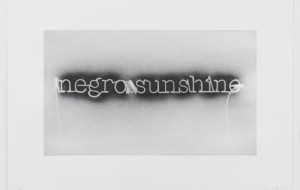
Filmed at the Whitney Museum of American Art in early 2011, this Exclusive video shows artist Glenn Ligon as he installs his twenty-foot neon artwork Warm Broad Glow II (2011) in the museum’s front window before the opening of his mid-career retrospective “Glenn Ligon: AMERICA.” With assistance from curator Scott Rothkopf and neon fabricator Matt Dilling, Ligon works to determine the best placement on the neon while battling against wind, rain, window mullions, and a view-obscuring hotdog vendor. Ligon selected the text “Negro Sunshine” from the Gertrude Stein novella ”Melanctha” (1909) and has used the phrase in projects of varying media.
Glenn Ligon is featured in the Season 6 (2012) episode History of the Art in the Twenty-First Century series on PBS. Watch full episodes online for free via PBS Video or Hulu, as a paid download via iTunes, or as part of a Netflix streaming subscription.
Gimme Shelter | Anti-Establishment in the Establishment: Dawn Kasper at the Whitney Biennial, Part 1

I spent an afternoon with Dawn Kasper at her installation This Could Be Something If I Let It at the Whitney Biennial. The following post is a document of that experience, and is meant to follow the collage-like form of Dawn’s work.
3:00 pm: I show up and wait. I spend time observing the piles of artwork, stacks of DVDs, CDs, VHS tapes, shelves of books and equipment, photographs on the walls, videos playing on monitors, a drum set.

"Fragments," from Dawn Kasper's "This Could Be Something If I Let It," 2012, at the Whitney Biennial. Image courtesy the artist.
Two women walk by me:
“This is just like a boy and his stuff. It’s too much, I can’t take it.”
“Oh, you think so? It is quite a lot. Do you remember who this is?”
“No, but come to think of it, this might not be all of his stuff, it might belong to someone else and he just showing it.”
“You might be right, but I get the feeling this belongs to the artist. Are you sure it’s a man? I can’t see the name anywhere.”
“I think so, or it could be a woman.”
I break the news to them that it belongs to a woman. I say “Dawn Kasper, D-A-W-N.” They laugh, shrug, walk away.
I start to panic; could she just not show up to her own show? Impossible, if she’s here, she is going to have to come up eventually. I read an article on her desk about hoarding, and the lengths a son had to go to in order to empty his parents’ house. I see the connection. It’s not about the things themselves but about her attachment to them.
3:30pm: Dawn comes in, a little frayed, spinning about the installation, fixing the video, straightening something up. I start recording.
Marissa Perel: How long have you been living in Los Angeles?
Dawn Kasper: Twelve years.
MP: So, that’s home definitely?
DK: I thought to live here [New York]. But, it’s hard here. I understand there are rewards for putting up with this place, but, I’m poor so in order to live anywhere in the world, I need to live somewhere where I know how to hustle. I’ve lived in L.A. for so long that I know where to go to get food, I know where to go to eat for free. I know that kind of stuff. I don’t know that here. I mean, it’s great here, but it’s unnecessary. Eight hundred dollars for rent? It’s unnecessary. I don’t how people live here. It seems like it could be a lot of fun, but everyone’s too busy working all the time to hang out with each other.
Eyes in the Sky
For the past couple of months I’ve been watching as my life partner, Christina Ondrus, embarks on a massive artistic, spiritual, and logistical undertaking. Christina is the Founder/Director and co-curator of KNOWLEDGES, a non-profit arts organization that she runs with Associate Director and co-curator Elleni Sclavenitis. I wanted to wrap up my Guest Blogging stint with some thoughts regarding their upcoming event KNOWLEDGES at the Mount Wilson Observatory, which will be held June 23rd and 24th. The event is free and open to the public. For more information and to donate or volunteer, visit theknowledges.org.
Space exploration was once a reliable source of national pride. Enormous resources were poured into the study of the heavens. Today, our country is mired in massive debt and draining colonial wars, with little moral support for government spending on the development of anything but outright weapons, military subcontractors and invasive body scanners. The U.S. government is gradually extricating itself from the business of exploring the heavens, just as it has washed its hands of developing the country’s art. I don’t mean to infer our government will not continue to explore and exploit the entire known universe in order to figure out creative ways to kill people, retain supremacy, and maybe control the weather, but the whole thing doesn’t really grab people’s imaginations like it used to.
Today’s frontier is cyberspace, a human-generated thought cloud of neurotic dark matter that permeates all interpersonal communication. The seeming infinitudes of outer space are too vast and impractical for us to think about. Better to colonize the digital wilds of personal information and cultivate them to yield money.

Mt. Wilson Observatory as photographed by the Observatory's live towercam.
In this smartphone-hampered context, The Mount Wilson Observatory stands as a temple of a bygone era of scientific advancement. It’s a pre-digital site of immense scientific significance. The 100-inch telescope built on the site in 1911 held the title of largest telescope on Earth for a solid 30 years. Edwin Hubble used this telescope when discovering the general expansion of the universe. The telescope’s mirror was the largest in the world and was crafted over the course of six years by a team of French artisanal glassmakers. The looming domes of the telescopes evoke cathedrals. On Mount Wilson you may hear contemporary, digital-based telescopes dismissed as “light collecting buckets.”