
One of my favorite places in Guadalajara, art related or not, is currently housed on the top floor of a nineteenth-century house in the downtown area.
The Taller Mexicano de Gobelinos has been in operation more or less since 1968, when it was founded by the Austrian artist Fritz Riedl. It is currently administered by the Ashida family, who also operate Arena México Arte Contemporáneo, a contemporary art gallery.
Riedl arrived in this city in 1967 after having explored tapestry as his main medium since 1948. For the most part, his tapestries reflected his interest in geometric abstraction and were exhibited in venues such as the Venice Biennale, the Sao Paolo Biennale, and Documenta. Riedl lived in Guadalajara from 1967 to 1976, and along with running the tapestry workshop, he was a visiting lecturer at the University of Guadalajara.
Riedl himself trained several young men to be weavers, and some of them still work at the Taller. Though each tapestry’s authorship is attributed to the artist that commissioned the piece, the weavers themselves are involved in every aspect of its creation, as they dye the wool and weave it in order to transpose the image into this medium. Moreover, they are aware that they are not simply copying an image or work of art, but rather, creating another version of it.
The Taller is the sole place in Mexico where this art form is preserved. The history of gobelin tapestries dates to the mid-1400s, when Jehan Gobelin rented a house in Paris to use it as a workshop to dye wool. The workshop eventually began to manufacture tapestries according to Flemish techniques. Henry IV rented the space for his tapestry makers, and Louis XIV made this into an upholstery factory which was in operation more or less until the French Revolution. Though the factory was reopened by the Bourbons, it was burned during the Commune and is now run by the state. The Manufacture des Gobelins currently produces tapestries for the French government as well as preserves this technique.
All of the weavers employed are experts in the “alto liso” (haute lisse) loom typical of these tapestries, or gobelins. It is administered by Renata Trejo and Rafael Morquecho Martínez, the latter one of the original weavers who learned this process from Riedl. Nine other weavers are employed on either a full-time or part-time basis, including several of Morquecho’s relatives.
The Taller’s workers have created tapestries for artists such as Francesco Clemente, Sandro Chia, Rufino Tamayo, Juan Soriano, Matthew Antezzo, John Currin, Christian Jankowski, David Scher, Rachel Feinstein, Pae White, George Condo, Greg Colson, Jason Fox and Karen Kilimnik. For the most part, artists request a tapestry based on a work of art they created themselves; tapestries are also made from readymade images.
Other than admiring the individual tapestries, the best way to learn about this practice is to speak to the weavers themselves. I spent some time with Rafael Morquecho, the Taller’s head weaver, in order to hear more about the technical and artistic aspects of weaving. Rafael has been weaving for about forty years, and is very proud of the Taller itself, noting its evolution and its ability to compete with similar workshops in Europe in terms of quality and artistic execution. Beyond his work for the Taller, he also paints and weaves tapestries based on his own designs.
One of the main elements that separate these tapestries from other forms of textile-based art, according to Rafael, are the chromatic effects that can be achieved. The Taller’s weavers usually achieve the required tones by weaving different colored threads at once (rather than one at a time), which leads to more vibrant and richer colors. In a way, it is almost as if they were blending oil paints.
As for the entire process employed at the Taller, Rafael and his brother Leopoldo demonstrated how the wool is dyed, measured, woven, and finally, mounted onto another piece of fabric. They use synthetic dyes, since they are better able to achieve the desired colors with these materials. When weaving, they employ about three threads per square centimeter, significantly fewer than the thirty threads that were used in the past and that some workshops still employ. (Most operating workshops use three threads).
After the piece is finished, it is sent to a sewing workshop to be sewn together, since the individual blocks of color are not fully connected to one another. In essence, the stitches function as lines that bind everything, though this process remains invisible to the untrained eye.
Talking to Rafael, Leopoldo, Renata, and the rest of the weavers made me realize that these are not copies, rather, each tapestry is an interpretation of works of art. In other words, the weavers are not unlike professional musicians that perform their own version of a classical symphony or concerto.
Arena México’s Taller Mexicano de Gobelinos is an establishment that reminds us that Guadalajara’s presence within the global art world is made up of the efforts of a series of devoted individuals who receive little or no government backing. The Taller makes tapestries for artists represented by Arena México and for other artists or galleries.
Thirtysomethings: Three Mexican Artists under Forty
This account is somewhat of an autobiographical approach to three Mexican artists under forty. The connecting thread beyond their age and nationality is that I have seen their work in person, and their own trajectories are as nomadic as my own. Though none of them has a “Mexican aesthetic,” their latest projects engage with capitalism and contemporary life in various ways.
I first became acquainted with Humberto Duque’s practice in 2008 at a group exhibit, Cutting Fine, Cutting Deep, held at the University of the South featuring works by Swiss and North American artists. I was intrigued by the fact that a guy from Mexico City was speaking about his work in the middle of rural Tennessee, which only brought home the absurdity of my own time teaching there. This was over four years ago, and there are several things I remember about his talk: awkward videos, references to pop culture, a descent into a cartoonish universe, and his love of baseball. His latest projects were completed in Japan, at the CCA Kitakyushu Research Program 2011/2012.
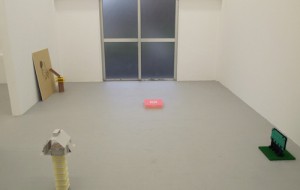
Duque’s works are oblique and seemingly cheerful, and their strength comes when several of them are exhibited as a group in order to propose a narrative scenario that is never quite clarified. Works from the series Conspiracy to Commit Public Nudity tread the line between dreams and daily life. They don’t form a unified story, but rather, link elements such as science fiction, architecture, language, and baseball. This series relies heavily on pieces that evoke discrete architectural structures, creating what appears to be a community or neighborhood. There is a house, a fragment of a stadium and scoreboard, a diving platform and an upside-down billboard. This is Americana, and the installation of the works underlines their interrelated nature.
Weekly Roundup
In this week’s roundup, Gabriel Orozco exhibits detritus, Cai Guo-Qiang, Jeff Koons, Shahzia Sikander, Kiki Smith and Carrie Mae Weems are honored, Sally Mann in Stockholm and more.
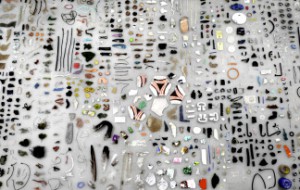
- Gabriel Orozco has chosen to exhibit two collections of artwork at Deutsche Guggenheim (Berlin). Sandstars is culled from the wildlife reserve in Isla Arena, Mexico, and Astroturf Constellation take as its inspiration a soccer field on pier 40 in New York City. Asterisms was arranged from collections of detritus to create a catalog of human and natural impacts on two separate environments, one organic, and the other manufactured. This work is on view through October 21.
- Cai Guo-Qiang, Jeff Koons, Shahzia Sikander, Kiki Smith, and Carrie Mae Weems have been selected in recognition of their commitment to the ART in Embassies Program (AIE) mission of furthering diplomacy through the visual arts and expansive cultural exchange initiatives. AIE will be honoring these artists for its 50th Anniversary in Washington, D.C. on November 30, 2012.
New Guest Blogger: Mariana Aguirre
A big thanks to Colin Darke for his in-depth series of posts looking at the state of contemporary art in Detroit, Michigan. You can keep up with Colin’s writings by visiting his website here.
Next up, we’re excited to introduce Mariana Aguirre, whose guest blog series will focus on contemporary art in Mexico. Most recently, Aguirre has worked at Taxi Art Magazine, a contemporary art publication from Guadalajara. She also has a monthly column at Revista Replicante, a Mexican magazine which focuses on contemporary art and culture. Her current interest in art criticism and contemporary art has led her interview artists such as Ming Wong, Ernesto Neto and Christian Jankowski and to write about Hennessy Youngman, the Jumex Collection and Tate Modern.
Aguirre’s academic research has focused on Italian modernism, specifically Giorgio Morandi and Futurism. Her essays on Morandi, Ardengo Soffici, and Italian modernist magazines have appeared in several scholarly publications. She has been a visiting assistant professor at several universities in the United States and has a PhD from Brown University.
Welcome, Mariana!
Exclusive | Sarah Sze: Improvisation
Our latest Exclusive video short is now live! Click to watch “Sarah Sze: Improvisation” on Art21. org.
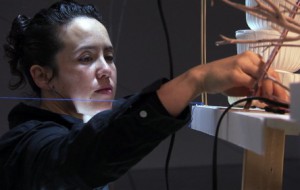
Filmed in 2010 at the Museum of Modern and Contemporary Art in Nice, France, Sarah Sze discusses the importance of improvisation and spontaneity during her installation process. Originally shown at her New York City gallery, Sze altered “The Uncountables (Encyclopedia),” (2010) for its reinstallation in France by incorporating locally found items. Sze’s use of improvisation allows for viewers to trace her decision making process as they explore and investigate the artwork.
Sarah Sze is featured in the Season 6 (2012) episode “Balance” of the Art in the Twenty-First Century program on PBS. Watch full episodes online for free via Art21.org, PBS Video or Hulu, as a paid download via iTunes, or as part of a Netflix streaming subscription.
CREDITS: Producer: Ian Forster. Consulting Producer: Wesley Miller & Nick Ravich. Interview: Susan Sollins. Field Producer: Agnes Jammal. Camera: Miguel Sanchez Martin. Sound: Roger Phenix. Editor: Morgan Riles & Mark Sutton. Artwork Courtesy: Sarah Sze & Tanya Bonakdar Gallery. Special Thanks: Museum of Modern and Contemporary Art, Nice. Theme Music: Peter Foley.
Why Detroit Matters: Closing Comments
When I started my guest blog series on the Art21 blog, I felt that I was riding a wave of positive press about Detroit. I don’t want the momentum of that positive press about Detroit–about Detroit’s comeback–to slow. I try to shine a light on Detroit’s positive art community as often as I can, because–like most people–I like to be inspired. During my blogging stint, I was inundated with more positive press about this community. Among others, I saw the PBS NewsHour spotlight this past Wednesday that showcased a few great people doing great things in Detroit. I was then contacted by a group in Bushwick (Bruno Design Studio) who are working on an exhibit this coming October that will highlight people doing creative work in Detroit. So the conversation about Detroit’s art scene has started and it continues to build upon itself. I love good conversations. I love those conversations where you learn more about yourself. Artists create artwork to open a dialogue. If you listen and engage, you are open to great artwork, which can tilt your perspective on life, which can make you grow, which can make you a better conversationalist. Detroit matters because it embraces the belief that artists and creative people can change a community. Detroit matters because people matter. I am thankful to Art21 for allowing me this opportunity to continue the conversation.
Gastro-Vision | Summer Round Up

Rainer Prohaska. "Floor Cuisine, ACF New York," 2012. Ink on paper. 16.6 x 23.4 in. Courtesy the artist.
The heat and humidity of New York City summers make walking into a cool gallery all the sweeter. When you’re ready to come inside, here are six local exhibits on which to feast your eyes:
Our Haus @ Austrian Cultural Forum
On view through August 26
Rainer Prohaska’s latest culinary project Cuisine à tous les étages (Kitchen on every floor) winds from the top to the bottom of this multi-floor group exhibition. A series of cooking stations, set up between each flight of stairs, provide food items, a cutting board, cooking utensils and instructions. At the opening reception, Prohaska led guests through the preparation of vegan beef tartare. An empty dinner table remains in the basement as a remnant of the communal dinner and continues to encourage conviviality. Visitors can make use of the table when partaking of Mathias Kessler’s interactive beverage installation Das Eismeer. Die gescheiterte Hoffnung (2012). Kessler invites visitors to remove and enjoy a cold Budweiser from a small refrigerator, and in so doing help him to create another object. The repeated opening and closing of the door adds layers of ice to a small sculpture behind the freezer flap–a replica of Caspar David Friedrich’s icy landscape of the same title. Curated by former Eyebeam director Amanda McDonald Crowley, Our Haus commemorates the ten-year anniversary of the building and the Forum’s ongoing efforts to be a space for cross-cultural exchange. Crowley writes, “With a kitchen in place, we will surely celebrate with food, as many of the finest conversations begin over good food.”
Detroit’s Artistic Opportunities

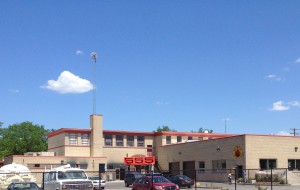
555 Nonprofit Gallery and Studios at their new home, which is a renovated police station. This is a great example of the unique opportunities in Detroit.
During Art Basel in 2010, Creative Time and Art Basel Miami Beach teamed up for Oceanfront Nights, which showcased the “big four” art cities: Berlin, Glasgow, Mexico City, and—to the surprise of many—Detroit. Similarly in 2010, the poet and rocker Patti Smith surprised many with her advice that young artists should move to Detroit, because “New York has closed itself off to the young….”
It has been two years since these two events; should artists move to Detroit? I talked to artists and gallery owners in the city to get their thoughts about Detroit and its artistic present and future. I also spoke to established and rising art stars in New York—an undeniable art capital—to compare and contrast that city’s opportunities with Detroit’s opportunities.
There are a lot of similarities and a lot of differences between the areas. New York cannot compare with Detroit in terms of cost of living, and Detroit cannot compare with New York in terms of established networks (and pure size of everything). What Detroit does have right now is a steady stream of media interest in its art scene. In fact, PBS NewsHour just ran a segment on Detroit’s art scene this past Wednesday (July 25, 2012) titled: Detroit Art City. Detroit’s art narrative has captured the imagination of many.
I initially talked to Monica Bowman, an arts professional who moved from the Detroit area to New York, and then back to the Detroit area in 2008 to start The Butcher’s Daughter Gallery in Ferndale, which is part of Detroit’s metro area. Her gallery received instant attention. She explained that the gallery has doubled its business every year, and she has been able to create a bridge between Detroit and the national art market. Part of that bridge is participating in the PULSE brand of fairs, and working with rising art stars locally and nationally.
Looking at Los Angeles | An Interview with Vishal Jugdeo: Making “Goods Carrier” for Made in L.A.

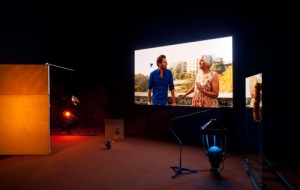
Vishal Jugdeo, Goods Carrier, 2012. Installation view by Brian Forrest. Courtesy the Hammer Museum.
Made in L.A., the Hammer Museum’s innaugural biennial of Los Angeles art, features work from 60 artists working in the city. Artist Vishal Jugdeo’s installation, Goods Carrier, pairs mechanical, TV set-like sculptures with an emotionally fraught 20-minute video set and shot in Mumbai, India. We spoke about transplanting his Los Angeles-centric art practice to a new, charged place, and the themes–new and old–that emerged as a result.
Lily Simonson: As with much of your work, the five characters in Goods Carrier enact a sort of nonlinear dialogue that evokes the domestic tension of familial or romantic relationships. Often, your dialogue seems to represent complex interpersonal dynamics while operating as a metaphor for global and political issues. Were you thinking about this consciously when writing Goods Carrier?
Vishal Jugdeo: When I’m writing the scripts for my videos, I think what I’m doing is experimenting with dialogic language rather than properly writing dialogue. I try to have the actors act things out in a realistic way, so that they’re transmitting real emotional states and putting themselves into tense exchanges with one another. At the same time, the words that they are saying is often, as you say, operating in a metaphorical or symbolic way. I’m interested in how the language itself breaks away from what is being acted out, and the words then take on a meaning of their own, unhinged from the drama that’s unfolding, but juxtaposed against it.
LS: I am specifically riveted by the way your work addresses arguing, and its surrounding awkwardness. At the same time, sweetness pervades. Do you see the conflict in your videos as being about increasing distance, or about resolving dissonance and becoming closer?
VJ: That’s a really interesting question. In my work I always see conflicts as intense acts of love. The characters never hate each other, they’re simply frustrated. And the words they are saying to one another often come from a place of deep fear, but also from a place of deep familiarity and intimacy. I’ve always thought of the works as “power plays” in a sense, and I think both words – power and play are key to understanding what I’m doing. It’s almost like practicing S&M through language alone or something, testing out what it is to say violent things, and to have violent things said to you. I hope that the charge that is transmitted to the viewer does have a kind of sweetness or warmth, which is why I use a lot of humor. I don’t want for someone to walk away feeling alienated, I want for them to feel an intense connection and even closeness to the work, even if that connection is uncomfortable or disconcerting.
The Anchor Art Museums in and of Detroit
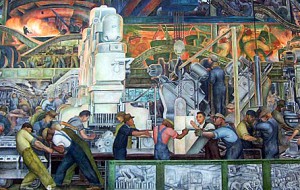
Because of its solid foundation, I am confident that Detroit will have a renaissance in the arts (among other fields). This confidence springs from a community of art enthusiasts who invested heavily in cultural institutions. Images of abandoned buildings steal a lot of the headlines, but the media often fails to balance those images with images of the gilded and ornate buildings that house Detroit’s cultural treasures: The Michigan Opera House, The Gem Theater, The Masonic Temple, The Fisher Theater, the Fox Theatre, and The Detroit Institute of Arts, among many others.
These institutions are as good as or better than they have ever been.
Why do cultural institutions thrive in a city that has so many hurdles? Simply put, because of a community that values culture. Another benefit of Detroit’s strong foundation is the fact that these bedrock institutions educate and inspire future generations of artists and patrons. There are numerous people, both paid employees and volunteer stewards, whose passions push these institutions to provide Detroit and surrounding areas with the culture every thriving community deserves. Detroit’s rich culture flowed and continues to flow to its extensive Metro area, and beyond.
I want to highlight two museums that show the importance of anchor institutions, and that symbolize the delicate relationship between Detroit and its suburbs: The Detroit Institute of Arts and The Cranbrook Art Museum (as part of the Cranbrook Educational Community). These are two of the most influential and widely respected art institutions in the world, and they can both be found on the same street, Woodward Avenue.