
Week in Review 03.30.13

March 30th, 2013
by

Week in Review 2

Here’s what you may have missed this week and last week (in order of appearance):

Weekly Roundup
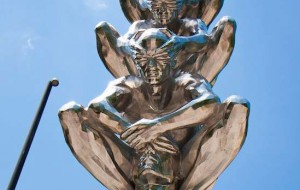
We start this super-sized Week in Review with a Weekly Roundup by Nettrice Gaskins, in which she gathered news on Do-Ho Suh’s sculpture Karma in New Orleans, Beryl Korot’s groundbreaking work at Manchester’s Whitworth Art Gallery, Ursula von Rydingsvard’s thoughts on woodwork, Ai Weiwei’s Neruda mural, William Wegman’s first animated GIF(!), and lots more.

Looking at Los Angeles | Barbara T. Smith: Cheek To Glass, Electric Impressions of the Material Body
Danielle McCullough discussed the Box Gallery’s retrospective of Barbara T. Smith’s rare books and the artist’s odyssey from homebody-lithographer to boundary-pushing performance artist.

Home and (or) Away
Professor Joe Fusaro expounded the benefits of bringing students on a field trip all the way to class.

Word is a Virus | LA Existancial
Carol Cheh had a lot to say about a flurry of French artists dominating LACE (Los Angeles Contemporary Exhibitions), Guy de Cointet, Emily Mast, Sophie Bonnet-Pourpet, and Andrea Fraser among them.

Exclusive | Elizabeth Murray: “Bop”
Ian Forster introduced a new Exclusive of artist Elizabeth Murray and her 2002 trials with large-scale painting Bop.

Weekly Roundup
Nettrice Gaskins returned with more of the latest art news, including a new film and performance by Hiroshi Sugimoto,  photographs of an industrial town’s decline by LaToya Ruby Frazier, a group show on the evolution of feminism featuring Carrie Mae Weems, and a major retrospective by Ai Weiwei.

Centerfield | Embracing the Cliché: An Interview with Michelle Grabner
Caroline Picard spoke with Michelle Grabner—artist, curator, and explorer of marginalized American frontiers—on collaboration, transition, translation, and texture.

Teaching with Contemporary Art | Well Beyond Everyday
Gallery-hunting Joe Fusaro found three Chelsea shows that wet appetites for strange sculptures of everyday objects.

100 Artists | Vija Celmins
Nicole J. Caruth featured Vija Celmins from our yearlong celebration 100 Artists, with select works and quotes pulled from the artist’s varied career.

Blogger-in-Residence | An Avatar of Self: A Conversation with Mira Schor (Part 1)
After a studio visit, Amanda Beroza Friedman spoke with Mira Schor on figuration, narrative, and the act of lying fallow.

Blogger-in-Residence | An Avatar of Self: A Conversation with Mira Schor (Part 2)
With so much to say, Amanda Beroza Friedman and Mira Schor continued their discussion on expropriation, the ever-present attack on painting. and working with rigor.

Praxis Makes Perfect | The Lure of the Line
Erin Sweeny found calm in Taos, New Mexico with Agnes Martin’s paintings, and it led to some thoughts on the relationship between artist and environment.

Inside the Artist’s Studio | George Georgakopoulos
George Kotretsos spoke with art hub creator George Georgakopoulos on the draw of curatorial work, being mindful of community, the state of art in Greece, and opportunity found in crisis.

April Blogger-in-Residence | Thea Liberty Nichols
We bid farewell to Amanda Beroza Friedman after a terrific stint on the Art21 blog, and Nicole J. Caruth welcomed the return of Chicago writer and curator Thea Liberty Nichols as our next Blogger-in-Residence.

Art21 Access Screenings
To cap things off, Access 100 Artists—the global campaign celebrating a decade of artists featured in our documentary series Art in the Twenty-First Century—will hold  screening parties, panel discussions, and more. We encourage you to join us at one of the Access events happening this week.

Local and regional teachers in the Bella Vista, AR area can watch the series at Bentonville Public Schools all next month as an effort to link the documentaries to current curricula. On April 5th, Long Island City, NY’s Noguchi Museum will air the great episode “Place” as part of its traditional First Friday extended hours. That same day, you Vermonters and Illinoisians have Access events scheduled at the Brattleboro Museum & Art Center and Springfield Art Association respectively. Finally, on April 6th, Kansas City’s Plug Projects has its kickoff for a 12-week run of Art in the Twenty-First Century, with new episodes every Saturday.

If you would like to get in on the action throughout 2013, learn about the opportunity to host a screening of your own at www.art21.org/access or contact us at access@art21.org.

April Blogger-in-Residence | Thea Liberty Nichols

March 29th, 2013
Thea Nichols.

Thea Liberty Nichols.

Thanks and best wishes to Amanda Beroza Friedman, our March blogger-in-residence, who contributed a series of conversations between herself and other women artists living in New York. If you missed any of Amanda’s posts, you can find all of them here.

Next up we have Thea Liberty Nichols returning to the blog for the third time. Thea is a writer and curator living in Chicago. She recently co-curated Afterimage with Dahlia Tulett-Gross, and will be opening another exhibition at The Franklin in 2014.

Throughout April, Thea will loosely cover artists who are working outside of their practice or across disciplines. The artists she’ll profile might curate exhibitions, work as teachers, act as “informal mentors,” or collaborate with other artists to create work. Check back next week for Thea’s first post.

When asked what she’s most looking forward to in April (aside from her stint on the Art21 Blog), Thea expressed my own sentiments: “Fun in the sun. I try and stay away from complaining about the weather, but I can’t wait to sweat again, eat ripe fruit, and hop on a bike.”

Happy spring and happy to have you back, Thea!

Inside the Artist’s Studio | George Georgakopoulos

March 29th, 2013
George Georgakopoulos.

George Georgakopoulos.

George Georgakopoulos is an art hub creator based in Athens, Greece. He attended the Deutsche Schule Athen (1976-1982), studied at the School of Fine Arts HBK Braunschweig (1983-1989), and did his postgraduate studies Meisterschueler at the HBK Germany (1989-1990). In 1991, he completed his postgraduate studies at Magister Artium. Georgakopoulos has since built an impressive resume that includes co-curating the traveling exhibition Weihnachtsausstellung at Zentrale Kunst Gallery in Hamburg (1991-1994); and co-founding three cultural organizations in Athens: Cheapart (after which he named the board game he created in 1999), The Art Foundation, and Contemporary Art Meeting Point (aka CAMP). His book Savoir Vivre for Artists was published in 2010. I am very happy to present my interview with Georgakopoulos.

Georgia Kotretsos: You started out as an artist but artist-run initiatives, curatorial projects, and collaborations won you over. What was that first project that sealed the deal for you and paved your career path?

George Georgakopoulos: My practice and research consists of two parts. The first one is the complete approach and dedication to artistic values—to the way they are formed and change daily—whereas the second is a deeper understanding of the function of art in relation to its recipient—the public.

Cheapart, CAMP, Athens, Greece, 2001.

“Cheapart 2001″ installed at Contemporary Art Meeting Point (CAMP) in Athens, Greece, 2001.

This is undoubtedly the most difficult way to work, taking into account that in such a case the artist is expected to ignore his obvious “ego” and become a creator and recipient at the same time. Once this process is completed a new, vast field opens before us—deprived of competition and any art related anxiety. At that point only inspiration, harmonious coexistence, cooperation, and creation itself are considered of value.

As far as the first part is concerned, studying in early ’80s in Germany, I was influenced by New German Expressionism, focusing my research on purely painting values. With the passage of time and the evolution of the media, a new world was revealed in which what we think and plan is not a path trodden by imaginary people and ghosts. Reality is all around us. Daily issues set our minds into thinking processes. Each project is a comment, each project reflects our mood, and inspiration reflects our mood. Newspaper clippings, slides, expressions of speech, or behaviour constitute a source of inspiration and meditation. I do not hide what I intend to say and illustrate.

Continue reading »

Praxis Makes Perfect | Lure of the Line

March 28th, 2013

PRAXIS_MAKES_PERFECT_Santtu_Mustonen

Looking at the horizon, an apparent line is the natural authority we rely upon to separate earth and sky. It is deceiving in its precision, often transcendent in its effect. Recently, I made a trip to the Harwood Museum in Taos, New Mexico to visit the Agnes Martin Gallery. The calm authority of the space conjured up similar feelings, as I studied a series of Martin’s paintings and discovered expanding qualities in defiance of their spare forms.

Agnes Martin Gallery, Harwood Museum of Art of the University of New Mexico

Agnes Martin Gallery, Harwood Museum of Art of the University of New Mexico

“We live a transcendental life all the time, all day long.” —Agnes Martin

Sitting on a small bench in the center of the octagonal space, I was reminded of a visit to the Rothko Chapel in Houston a number of years ago. Both places invoke feelings of reverence, perhaps eclipsed here by a surprising sense of lightness. Designed according to the artist’s wishes, the gallery features a series of seven paintings completed in the early 1990s when Martin returned to live in Taos. An oculus installed overhead and four Donald Judd benches placed beneath guide viewers in an experience best described by Martin’s own phrasing: “trembling and sensitive images are as though brought before our eyes even as we look.”

While the artist’s clarity of vision emphasized a non-objective approach, I could not help but relate these paintings back to the surrounding environment. A series of repeating horizon lines emerged; undoubtedly, inspired by the daily views I’ve experienced since arriving in Santa Fe. The surrounding mountains and ridges create a series of long, undulating lines, rising and falling like illegible script. This aspect is one of my favorite things about this landscape, contributing to its unique sense of place.

Since visiting the Harwood, I’ve been thinking about Agnes Martin’s hermetic working methods and the dynamics of relationship between artist and place. For her, the solitude found in this landscape was vital to the pursuit of a vacant mind and emotion in the abstract. Martin aimed to detach from the world and its ideas in order to realize her artistic vision and embody her unique worldview. One might argue that she was in but not of this place, though she is now highly revered as part of its history. Others could say that in the creation of her paintings, she sought to provide us with a sense of freedom from complications of the involved life. This trajectory raises interesting questions about the notion of authority in relation to artistic practice, both in terms of how we define our aesthetic vision and the agency we have (or seek) in relation to the respective communities we work in.

Continue reading »

An Avatar of Self: A Conversation with Mira Schor (Part 2)

March 28th, 2013
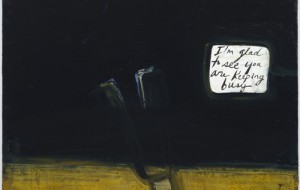
Mira Schor. “Expropriation Series: I'm Glad to See You Are Keeping Busy,” 2012. Ink and oil on gesso on linen, 24 x 28 in. Courtesy the artist.

Mira Schor. “Expropriation Series: I’m Glad to See You Are Keeping Busy,” 2012. Ink and oil on gesso on linen, 24 x 28 in. Courtesy the artist.

ABF: Can you talk about your other recent body of work, the Expropriation series? In our discussion these works came up in connection with Federici’s argument on how we got to our current state of the triumph of global capitalism.

MS: In those works the figure is not resting in the earth of her own volition, she’s been thrown there head first. Expropriation surrounds us, whether it’s corporate downsizing, unemployment, climate-caused displacement, or expropriation of bodies of knowledge that are deemed obsolete. In one painting, painted at the peak of Hurricane Sandy between 7:30 and 9PM on the night of October 29, 2012, the figure had landed head first in the earth pitched down from a stormy dark sky. A cheery snarky little caption reads, “I’m glad to see you are keeping busy.” I was using appropriated language, quoting verbatim a haplessly condescending comment a former student wrote me in an email this winter.

ABF: We spoke about the possibility of painting paradoxically, defying commodity culture because of its specific relationship to time. I often think about how paintings can exist in their own time.

MS: Painting is always under attack, as a prime example of art as commodity and an exemplar of the modernist idea of the autonomous artwork. And most of us are conditioned by media to prefer movement. I often talk about the idea of the displacement of pictorialism, the way the exact same area of wall space that might previously have been occupied in a museum by a large painting, let’s say Courbet’s The Studio of the Painter or his Funeral at Ornans, is now the site of the same-sized projection of a video. There’s image, narrative, pictorialism, the only difference is motion, sound, and the specific time of the particular video. However paintings also contain time. In fact at best they contain time in a way that opens up contemporary time and defies spectacle. It is not Fordist time of the minute by minute, digital time of the microsecond by microsecond, it is the layered time of your experiencing it through vision and your relation to it in space. That experience contains, whether you’re consciously aware of it or not, the time of the painting’s making, the time of its layers, edges, and surfaces. A painting can open up time, liberate it—when you paint or when you look at a painting. That’s the time I’m interested in and I think that kind of time does defy commodity culture.

Continue reading »

An Avatar of Self: A Conversation with Mira Schor (Part 1)

March 27th, 2013
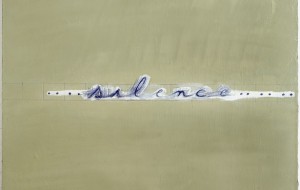
Mira Schor. “Silence,” 2006. Ball point pen and oil on linen, 24 x 28 in. Courtesy of the artist.

Mira Schor. “Silence,” 2006. Ball point pen and oil on linen, 24 x 28 in. Courtesy of the artist.

Introduced to Mira Schor through her writing, I first saw her work in person last year at Marvelli Gallery. A few weeks ago I had the pleasure of visiting her in her studio. The following is our post-visit email exchange centering on her recent work and ideas. In February, she participated in the Annual Artists’ Interviews series (along with Art21 artist Janine Antoni) at the 2013 College Arts Association Conference.

Amanda Beroza Friedman: You had been making text-based works for more than a decade. What prompted the injection of figuration and narrative in your more recent work?

Mira Schor: The figure’s return emerged out of the work that I did when there were no words to express how I felt after a personal loss, the death of my mother in 2006. I had been working with language for about 15 years at that time. Language as image was the subject of my work from the 1970s also. Then the language was personal and autobiographical in nature. In the work from the ’90s to 2006, the language was appropriated, mostly from the news, or was related to art making itself: words like trace, sign, painting, drawing, even the word writing. After my mother died, I felt I had to start back at a kind of zero of my identity as an artist; I started with basically just a blob of black ink and that developed into the empty thought balloon. It turned out to be a great space in which to paint paint, to place paint where you expect to find language. Some of those thought balloons looked a lot like heads so I put eyeglasses on them, and then about a year later gave them a very basic body, with stick figure legs so they could start walking around and encountering the world.

Continue reading »

100 Artists | Vija Celmins

March 27th, 2013

100 Artists is a yearlong celebration of the 100 artists who have appeared to date in Art21′s award-winning film series Art in the Twenty-First Century. Throughout 2013, we are dedicating two to three days to each artist on our social media platforms—TwitterFacebookTumblr, and here on the Art21 Blog. Our current featured artist is Vija Celmins.

la-et-cm-la-modern-auctions-to-sell-celmins-no-001

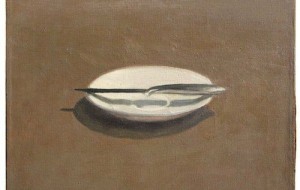
Vija Celmins. “Untitled (Knife and Dish),” 1964. Oil on canvas.

On May 19, Celmins’s early still life Untitled (Knife and Dish) will go up for auction at Los Angeles Modern Auctions. The Los Angeles Times reported in January that the painting had been hanging in a household kitchen for almost 50 years. The original owners purchased the piece from Celmins in the ’60s, when she was based in Southern California and attending the University of California, Los Angeles. (Celmins has primarily lived and worked in New York since the ’80s.) From everyday interior objects to found rocks to spider webs to starry skies and ocean waves, Celmins’s subjects and styles have varied throughout her career. This is no more evident than in the array of solo and group exhibitions currently featuring her work. Accompanying this roundup are quotes from the artist pulled from Art21′s vast archive.

95.19_celmins_imageprimacy_606

Vija Celmins. “Heater,” 1964. Oil on canvas, 48 x 48 in. Collection of the Whitney Museum of American Art, New York; purchased with funds from the Contemporary Painting and Sculpture Committee.

sinister-pop-33_800

“Heater” hanging in “Sinister Pop.”

Sinister Pop
Whitney Museum of American Art, New York, NY
Closes March 30, 2013

“I remember kind of feeling the joy of being able to paint anything. At that time I painted a lot of different objects. Things that turned on, like my hotplate and the lamps…pretty much everything I had in the studio.”

Drypoint - Ocean Surface 1983 by Vija Celmins born 1938

Vija Celmins. “Drypoint – Ocean Surface,” 1983. One-colour drypoint on Arches Satine paper (first state). 7 x 9 1/2 in.

Vija Celmins: Artist Rooms
Tate Britain, London, UK
Closes May 6, 2013

“Most of the changes in the work occur when I have had some kind of an experience that has been like a little awakening. Usually, I’ve forgotten all about it and then somehow it creeps into the work. The night skies I think came out of the pencil, pushing the pencil so hard and getting in love with the black. The ocean came from maybe walking my dog on the beach all the time and beginning to think of this giant surface…The [changes] come out of poking around my own life.”

Continue reading »

Well Beyond Everyday

March 27th, 2013
Nayland Blake, "Oh", 2013. Courtesy Matthew Marks Gallery.

Nayland Blake, “Oh,” 2013. Courtesy Matthew Marks Gallery.

If you are even remotely interested in how everyday materials can become bizarre and (sometimes) brilliant sculpture, there are three shows ready and waiting for you in New York’s Chelsea galleries: Nayland Blake’s What Wont Wreng at Matthew Marks; B. Wurtz’s Recent Works at Metro Pictures; and Mark Dion’s two-floor delight titled Drawings, Prints, Multiples and Sculptures at Tanya Bonakdar. In all three cases, viewers (especially contemporary art educators) are treated to new works by artists who are playful with their materials and simultaneously manage to teach us about the issues and concerns that drive their work.

Nayland Blake’s exhibit greets viewers with a vinyl poster of himself—donning a leather cap and harness, black sunglasses, and his signature beard—presented under the name of “The Spectre.” The handful of sculptures and installations on view actually have enough space in the tiny gallery for viewers to examine how Blake incorporates themes of gender, identity, and community in his work as “a modern-day flaneur.” And like any good sculptor, his work invites you to look into vs. at it. I found myself walking around and around works such as Buddy, Buddy, Buddy and Oh, both standouts because of simple layering that allows for a constant mind-game of associations. Continue reading »

Centerfield | Embracing the Cliché: An Interview with Michelle Grabner

March 26th, 2013
Michelle Grabner, "DRAFT," Installation view. Autumn Space, 2013. Photo courtesy of Autumn Space.

Michelle Grabner, “DRAFT,” Installation view, Autumn Space, 2013. Courtesy Autumn Space.

Michelle Grabner exhibited at Autumn Space last month. Her show, DRAFT, ran the gamut of Grabner’s practical, visual, and material practice. A black and white print of two San Francisco 49ers hung in a frame by the front desk near a round, black field painting of white dots. One side of the grand warehouse windows were dressed with larger-than-life red and white gingham curtains. Across from this hung a white gessoed painting and beside that a too-large-to-be-casual Post-it Note doodle adhered to the wall. A fifth long and heavy-looking sculpture of wood and cement lay diagonally across the floor. This last work was produced by Grabner and her husband Brad Killam. The two have been working collaboratively for many many years and the piece supplied a grounding, perpendicular line amongst otherwise vertical planes. In addition to being a painter and writer, Grabner is a professor and chair of painting at the School of the Art Institute. She co-curates exhibitions at The Suburban and Poor Farm with Killam, exploring the potential in rural and suburban curatorial sites. She is represented by Shane Campbell Gallery, Chicago, and will co-curate the 2014 Whitney Biennial at the Whitney Museum of American Art. Whether operating as a teacher or facilitator, or as a painter, printer, collaborator, and sculptor, Grabner returns again and again to marginalized and overlooked frontiers for aesthetic inspiration, culling a minimalist sensibility from the banal pattern of picnic table place mats, gessoed cloth onto a canvas, white dots in a black field, or black pixelation on a white print. By juxtaposing scale and material she tills a subtle American vernacular, and by this constellation of works explores the pursuit of happiness. 

Michelle Grabner and Brad Killam, "Untitled," 2013, Wood and Concrete. Photo courtesy of Autumn Space.

Michelle Grabner and Brad Killam. “Untitled,” 2013. Wood and concrete. Courtesy Autumn Space.

Caroline Picard: I want to ask you about collaboration, the when and how of it. When I was at Autumn Space looking at Untitled (2013)—the large wood and concrete sculpture that crosses over the ground of the gallery—it struck me that this piece was a collaborative effort between you and Brad Killam. It has such a striking materiality. It’s so heavy looking, and seems to ground the whole show. I thought it was interesting given that you also work so closely together on The Suburban, and The Poor Farm—what are also unusual and very physical platforms for art. I guess what I’m trying to ask about is the materiality of collaboration, especially your collaborating with Killam. How do you decide to collaborate? How do you define that medium? And is there a relationship between the wood and concrete piece and the curatorial art spaces you run together? 

Michelle Grabner: When Brad and I finished our MFA degrees in Chicago we moved to Milwaukee, leaving our colleagues and the discourse we came to depend on in graduate school behind. It was the early ’90s and we had a young family so Brad and I started collaborating under the moniker of CAR (Conceptual Arts Research). Again, let me underscore that this was the early ’90s and the smack of “identity” was inescapable. So in addition to our individual painting practices, we started making work about our family, examining its social dynamics as pressed through the geeky political writings of Maxine Greene, Trinh T. Minh, Homi Bhabha, etc. The CAR work was readily received and we mounted exhibitions at White Columns, Chicago’s Uncomfortable Spaces , Richard Heller, LA, the Milwaukee Art Museum, and All Girls, Berlin in a very short period of time. Milwaukee was the perfect incubator for us. Here we became friends with Felix Gonzalez Torres (MAM hosted his first museum exhibition), the artist Nick Frank, and curator Peter Doroshenko. But once we moved back to Chicago in 1997 (settling in Oak Park for the public school) we immediately launched The Suburban, and that collaborative effort soon replaced the family-focused work that defined our Milwaukee years. However, in 2007 when our youngest kid turned two, Brad and I started making “things” together again. But this time the work is built around formal ideas and the everyday. You are right to identify the material effects that we are investigating. The large-scale manipulation of found materials are distinctly a two-person operation: two middle-aged bodies arranging, stacking, and cobbling together common things like kindergarteners. But instead of Fröbel wooden blocks we build with the cast-off materials and residue from our life that is now split between Chicago and rural Wisconsin.

Continue reading »

Weekly Roundup

March 25th, 2013
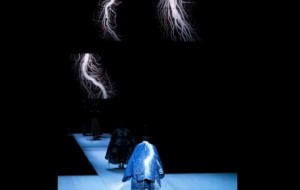
Mansai Nomura and Hiroshi Sugimoto. "SANBASO, Divine Dance," 2013. Courtesy Japan Society and the Solomon R. Guggenheim Museum.

Mansai Nomura and Hiroshi Sugimoto. “SANBASO, Divine Dance,” 2013. Courtesy Japan Society and the Solomon R. Guggenheim Museum.

In this week’s roundup, Hiroshi Sugimoto presents film and performance, Carrie Mae Weems explores feminism’s evolution, James Turrell kicks off a series of exhibitions, and much more.

  • Sugimoto‘s Memories of Origin is being screened in conjunction with SANBASO, Divine Dance–Mansai Nomura + Hiroshi Sugimoto, a site-specific performance at the Solomon R. Guggenheim Museum (NYC). SANBASO stars Kyogen actor Mansai Nomura and features a stage set and costumes designed by Sugimoto using techniques developed through his Lightning Fields series. The performances will take place in the museum’s rotunda on March 28 at 2pm and 8pm, and March 29 at 8pm.

  • LaToya Ruby Frazier: A Haunted Capital is on view at the Brooklyn Museum (Brooklyn, NY). Through  approximately 40 photographic works, the exhibition looks at how Frazier uses social documentary and portraiture to create a personal visual history of an industrial town’s decline, and offers an intimate exploration of the effects of deindustrialization on the lives of individuals and communities. On view through August 11.
  • James Turrell: Roden Crater and Autonomous Structures is now on view at Pace Gallery (NYC). The display is in anticipation of an upcoming exhibition of Turrell‘s work that will be presented concurrently at the Guggenheim, New York, Los Angeles County Museum of Art, and Museum of Fine Arts, Houston. Roden Crater and Autonomous Structures is on view through April 20.

Continue reading »