As I mentioned in an earlier blog post, I grew up during the 1980s, the era of videogames and heavy metal. I started to listen to German Thrash and Speed metal and eventually ended up a fan of Death and Black Metal. If the combination of videogames and art is a small yet growing part of the contemporary art scene, Black Metal represents an even smaller part of it. But things are changing. It has been a while since Black Metal was a subversive Norwegian subculture. Today, Black Metal has become both mainstream and commercial. During 2011, Sweden saw an increasing interest for darkness and Black Metal within its contemporay art scene. Two Swedish exhibitions–Nordic Darkness and Om ljuset tar oss–focused on Black metal (it may not sound like much, but remember Sweden is a small country, and compared to previous years, that’s a lot of exhibitions). During the summer of 2011, I wrote a series of articles about Black Metal in contemporay art and realized that the subject was much broader than I had thought. For example, I came across the artist and theorist Amelia Ishmael (a previous Art21 guest blogger) and realized that Black Metal theory is now even taught in the programs of several different Universities.
After I had finished writing this series of articles, I came across an interesting performance held at Skånes Konstförening in Malmö, Sweden. I’d like to share an interview I did with the artists, in order to illustrate one of the ways that artists are using Black Metal in contemporary art today.*
Videogame Appropriation in Contemporary Art: Grand Theft Auto (GTA)
The freedom to explore all of a game’s territory is one of the keys to the success of the Grand Theft Auto (GTA) series from Rockstar Games. The first game in the series was released 1997. Since then, ten stand-alone games and four expansion packs has been produced for PC consoles and Xbox and Playstation devices. It’s not only the players that love the freedom of the game’s storyline–many artists have been attracted to GTA’s virtual world and are inspired to explore it further, in their own ways. GTA is a good example how artists today are using different techniques to appropriate commercial videogames for works of art.
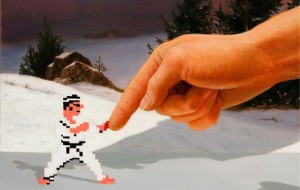
But first, I think I need to make a distinction between fan art and game art. As in many popular cultures, there is a lot of fan art connected to videogames that is created by dedicated players. That art can take the form of paintings, stories, videos and so on. But fan art is often only a reproduction of an existing game world. The fan artists are mimicking the aesthetic of the games and are following certain templates created by the fan community. Game art, on the other hand, experiments with and challenges the image and the idea of what a game can be. It can borrow the aesthetic of the game, but it is often critical of that aesthetic. The artists use the game as a platform or interface to explain and explore larger questions of gender, violence, and economic and social realities that are played out in the game world.
Artistic Machinima and Britney Spears’s Pink Mansion
Do you know the feeling of buying a brand-new computer and realising that your favorite games will no longer run on your new system? This is also a big problem for Game Art, along with many other New Media art forms, that are using new techniques that are nevertheless aging quickly and will soon become obsolete. Game Art is a young art form, dating back to around 1995, but during the last twenty years much has happened with the development of computer hardware and videogames. Try to play older games like Doom, Quake and Unreal on a computer using the Windows 7 operating system, and you will see it doesn’t work. You can always try to buy or save an old PC with Windows 95/98 and hope that the hardware never breaks in the future–if that happens, it will be impossible to experience the art work. Or, you can be more realistic and realize that the only way to preserve Game Art is by documentation as screenshots and machinima. Machinima, a shortened version of the term ”machine cinema,” are computer animations and movies created inside the games with the help of tools that are often included in the videogames themselves.
Since the early days of Game Art, machinima have been used to create walkthroughs of artistically-modified videogames, which is an important way to preserve and document the work for the future. Machimima has also served as an alternative way for artists to show their works as video installations in art galleries, instead of using a computer with the videogame installed. Today, when many artists are using online worlds and videogames to enact performances, machinima is frequently used to document and preserve these types of temporary works of art. Artists such as Joseph DeLappe and Eva and Franco Mattes, for example, are well-known within the contemporary art scene for their performances in online worlds. DeLappe’s Death in Iraq is an ongoing performance piece and anti-war project that takes place within the online videogame America’s Army. DeLappe has also been active in Second Life, where he has reenacted Mahatma Gandhi’s famous salt march. Eva and Franco Mattes have also created synthetic performances in Second Life, where they have reenacted some of art history’s most famous performance works. Machinima have played an essential role in documenting and preserving these performances.
Kristoffer Zetterstrand: King of Old School
Kristoffer Zetterstrand is my favorite game artist, but it would be unfair to label him a game artist. There are very few if any artists that work exclusively with videogames and art. Instead, videogames are one of many tools and sources that artists can use to create their works. Zetterstrand is interesting, because he was trained as a classic painter. He makes large oil canvases, but he starts by creating a 3D-model with help of software tools such as Maya. In the computer, he can mix and arrange the objects and experiment with different angels and lightning before he starts to paint on the canvas.
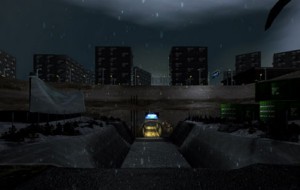
It all started in 2002, with the game Counter-Strike and a killing. During a play session, Zetterstrand was killed and found that he was floating outside the graphic in a virtual near-death experience. The effect fascinated him, and he started to paint the landscape in the game where the graphic ended in nothingness. He named this series of paintings Free-look Mode, which is a term used in 3D games to describe the choice of the player to move or fly in any direction in the game.
It’s All Fun and Games Until Someone Blows Their Brains Out
What happens when we live our lives through a videogame interface? In May 2007, the Iraqi-American artist Wafaa Bilal created a performace called Domestic Tension, in which he lived for one month inside the now-defunct Flatfile Gallery in Chicago. In the gallery was the artist’s bed, desk, chair, computer and a loaded paintball gun connected to a web server. Anyone could visit a website connected to the exhibition, and once there, aim and shoot the paintball gun at the artist in the gallery. The question asked by Bilal was, what happens to our emotion and empathy for other humans when we are using an interface on the Internet? Will a visitor hesitate to fire the gun if they are aiming at a real person, or will the videogame-like interface create a sense of distance from the human being behind it? After a month, 60,000 people from 130 countries had shot around 65,000 paintball blasts at Bilal, which I assume answers the question.
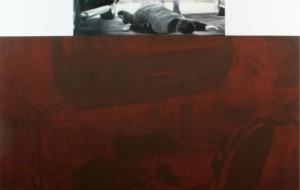
Another artist interested in videogame interfaces is the Swedish art student Mikael Vesavuori, from Valand Art School in Gothenburg. In his exhibition It’s All Fun and Games Until Someone Blows Their Brains Out, he examines how interfaces affect our understanding of space and experience. I conducted this interview with him in early January 2012.
Confessions of a Game Art Addict
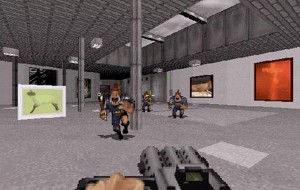
Like a punch in the solar plexus of fine art: that’s what it felt like six years ago when I stumbled upon the piece Museum Meltdown by the Swedish artists Palle Torsson and Tobias Bernstrup. Museum Meltdown is a series of three artistically modified videogames based on reconstructions of famous art museums. The first piece was created in 1996, when both artists were still studying at art school. Museum Meltdown #1 is a reconstruction of the Arken Museum of Modern Art outside Copenhagen–with help from the classic videogame Duke Nukem. In a new level added to Museum Meltdown, you can run around the museum, shoot at monsters, and destroy art. I found the combination of videogames and art, popular culture and fine art, violence and destruction in contrast to the typical silence of the exhibition hall fascinating. The fact that there has been relatively little written about videogames and art is the main reason that I have followed this path for the last six years.
But I must confess that I myself am not a gamer. I played videogames when I was young, as many in my generation did, but as an adult I don’t really have time and I find most of the games boring. The concepts haven’t changed since I was young: shoot, kill, hit, jump, run, collect and solve puzzles. The graphics and sound qualities are now better of course, but the games themselves usually aren’t. Instead, I prefer to investigate and write about how artists are using videogames to create art.
When I grew up in the 1980s, videogames and heavy metal music were considered by adults and established society to be low and “dangerous” forms of popular culture. For me, artworks like Museum Meltdown were a revelation: this new creative and artistic medium that had for so long been looked down upon, even despised by the art world, was now being exhibited in established art museums. Videogames were finally being taken seriously, and they were kicking the art world’s ass. You could now enter an art museum with a gun and blow art history to pieces–virtually, anyway. In some sense, works like Museum Meltdown remind me of the 1909 Futurist Manifesto which declared: “We want to demolish museums and libraries.” With this videogame, you could do so, at least with a virtual copy of the art museum.