South of the Lou, North of NOLA

August 3rd, 2009
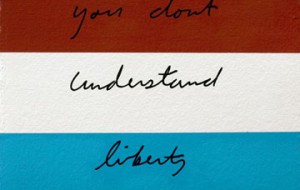
Dwayne Butcher, "You Don't Understand Liberty," 2009. Acrylic on paper, 11 X 9 inches. Courtesy the Artist.

Dwayne Butcher, "You Don't Understand Liberty," 2009. Acrylic on paper, 11 X 9 inches. Courtesy the Artist.

Since my stint here is winding down, I’m going to ask your indulgence as I write about Memphis. My suspicion is that many of you haven’t been yet, or weren’t intending to come, or plain don’t care about what goes down in our neck of the woods. I must admit, I know where you’re coming from. I’m an East Coaster, born and raised in New Jersey, who left for college and traveled all over the place, determined to avoid that vast bland-o-sphere we call middle America. I just couldn’t figure out what would be compelling about anything more than 50 miles from an ocean that wasn’t Chicago. I know this makes me sound like a jerk, but I also know that there are scads of people who think the art world exists only in New York, Berlin, London, and wherever the present Biennale du jour happens to have set up the big tent this week.

But let me assure you, I was wrong. Necessity being the mother of invention, we in Memphis have more than a few goings on and an art universe that keeps me constantly intrigued and entertained. What I find particularly compelling about the way things happen in Memphis is that everyone is everywhere all of the time. The city is too small for it to be otherwise, so we actually have what I can justifiably call an arts community. Everybody ends up at the same bars, the same openings, the same panel discussions, the same backyard parties, and so forth. I know for certain that people show up at art events when they have other things to do, other places to be, or just don’t feel like it simply because we all know that we are our own audience and the more we do for one another the more we do for everyone collectively. It’s a nice way to go about it, actually feeling involved in things, participating rather than observing. I’m well aware that Flash Art may not set up a branch office, but I think you should give us a try. Hell, all of your FedEx packages come through Memphis. So should you.

To help you along, I’ve made a little primer to some of the core nodes of our art world. To be honest, I was shocked at how long it was, but heartened to know that each of the below is an integral part of our machine.

Full disclosure: I know, work with, and/or patronize every one of the below.

Levitt Shell, Memphis, TN. Photo: Adrian Duran.

Levitt Shell, Memphis, TN. Photo: Adrian Duran.

Dwayne Butcher’s Blog. Start here. Dwayne is an artist and graduate of both the University of Memphis and the Memphis College of Art. His blog is the most up-to-date resource for all things artistic in Memphis. Galleries, museums, panels, whatever, Dwayne will find out and let you know. It is also a forum for his own art, which is well worth a look.

The Memphis Brooks Museum of Art, in Overton Park, is our city’s museum. A comprehensive collection, strongest in European and American art. Our African and Native American collections are smaller, but strong. The Brooks also hosts films, performances, lectures, and all of the other events one would want their local museum to host. And their restaurant is particularly good.

The Dixon Gallery & Gardens were once a private home and now contain a small but immaculate collection of late-19th century European (mostly French) paintings. They also host travelling exhibitions which are not to be overlooked. The gardens are best on a Spring day and are proof that nothing finishes a day at the museum like a snooze on the grass.

The Power House, which is downtown in the South Main arts district and serves as the umbrella organization for both Delta Axis and Marshall Arts, is a bit like a Kunsthalle in an old power station.  Exhibitions of international and local artists rotate through here, panel discussions, etc. Recent shows include Glen Ligon, local photographer William Eggleston, and Alec Soth.

The Urban Art Commission is exactly that. It serves as the central node for public arts funding and commissions in Memphis.  Murals, sculpture, performance, architecture, it all happens here.

The David Lusk Gallery, along with L Ross, and Jay Etkin spearhead the commercial gallery scene in Memphis.  Downtown’s South Main arts district is a hub, as is the stretch of Poplar Avenue between the Public Library and the Davis-Kidd bookstore.  Don’t be fooled. Just because some of our galleries are in strip malls doesn’t mean they don’t have quality art.

Each of our three primary institutions of higher learning have their own art spaces as well. The Memphis College of Art, where I hang my hat, has galleries both in the main building, Rust Hall, and in the South Main district, where we run our On the Street Gallery.  The University of Memphis has a small museum, and Rhodes College houses the Clough-Hanson Gallery.

What is perhaps my favorite aspect of Memphis’s art scene is that we often do for self, and we do it well. Instead of languishing in the reality that Memphis isn’t one of the usual stops on the art train, local artists take matters into their own hands. In the few years I’ve been in town, galleries and collectives such as these have been central to keeping things fresh and forward-thinking. Collective studio and exhibition spaces such as the Medicine Factory, VINI (Five in One), and the Rozelle Artists Guild (bragging rights: founded and run by current and former Memphis College of Art students) offer younger artists exhibition space and remind us all that the official structures are not the only means of building a career.

What they’ve done with studio spaces, others have done with gallery spaces. Material, which is run out of what appears to be painter Hamlett Dobbins’s living room, is always jammed to the gills with good work and everyone artist, critic, and gallerist around town. Odessa, nearby Material on the Broad Street art strip, has been a welcome recent addition. Performances, bands, panel discussions, and art exhibitions make up their menu, which never fails to satisfy. A personal favorite is the P&H Artspace, housed in the P&H Cafe on Madison Avenue. In truth, this is Memphis’s smokiest bar, but it’s filled to the gills—floor, ceiling, walls, table tops, you name it—with works of art. One wall is dedicated to a rotating series of exhibitions and poetry readings happen about once a month or so.

At the risk of stating the obvious, Memphis is responsible for much of American music. W.C. Handy invented the 12 bar blues downtown on Beale Street, some white kid from Tupelo made rock acceptable to the mainstream, and the Stax sound more or less perfected soul music. And we’ve got some damn good Hip Hop as well.

The Stax Museum of American Soul Music may be the best museum in America, if you like soul or have one.

Graceland, you’ve heard of. It’s owner was a guy named Elvis Aaron something.

Sun Studios is where the King launched his reign, Johnny Cash recorded more famous songs than I can remember, and even U2 came to worship.  Maybe the most important room in the history of music.

A recent rebirth has been the Levitt Shell, which has hosted Elvis, Johnny Cash, and the Dead. Housed in Overton Park, adjacent to both the Brooks and the Memphis College of Art, the Shell has two concert series each year, in May/June and September/October, when the heat and humidity are low enough that sitting outside is sensible.

So please, come by. We’re on the way to just about anywhere, and fully worth a whole trip to ourselves. Eat BBQ at Cozy Corner and fried chicken at Gus’s. Let me know if you’re on the way, and I’ll find out what’s worth seeing.

Away Game

July 31st, 2009
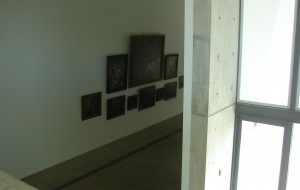
Installation view of "Ideal (Dis-)Placements: Old Masters at the Pulitzer." Photo: Adrian Duran.

Installation view of "Ideal (Dis-)Placements: Old Masters at the Pulitzer." Photo: Adrian Duran.

I’m in St. Louis, visiting family and art museums that I can only get to once in a while. There were some hits, some misses, but this seems like an opportune moment to do some actual art reviewing. I’ve been feeling a bit guilty about the quantity of non-art that has been getting most of this press.

Here’s a great idea that didn’t go well. The Pulitzer Foundation for the Arts currently (through October 3) has on view Ideal [Dis-]Placements: Old Masters at the Pulitzer. To its great advantage, the Pulitzer Foundation is housed in a fantastic Tadao Ando building, poured concrete and those cute little recessed circles, plus a nicely calming, rectangular pool of water. There are loads of natural light and large, airy galleries.

The abundant natural light truly makes the Pulitzer a great venue for looking at works of art, though their usual collection of Richard Serra sculptures and other Minimalia doesn’t really make one aware of what that light can do. So, the introduction of old master paintings seems like a great idea. Oil paint and natural light are one of the world’s great pairings. Like beans and rice, Asterix and Obelix, Michael Jackson and Paul McCartney. Even the guy working the front desk was in on it. He told me something to the (paraphrased) effect of, “We wanted to see what would happen when we put the works in a setting like the one they were originally in.”

Quiz: What is wrong with the above statement?

Listen, I think the Pulitzer should get the prize for a noble effort, for bringing together a beautiful set of works from the St. Louis Art Museum and the Fogg at Harvard. Lovely things, the kind of works that really do it for me. Lots of 18th century Venetian painters, a Bartolomeo Vivarini Madonna and Child, a trio of wonderful canvases by Joachim Wtewael.

What went wrong is quite simple. Tadao Ando buildings are not good for viewing old master paintings unless the lights are on. And moreover, polished concrete is not “a setting like the one they were originally in.” Where’s the brocade, the charcoal braziers, the wafting incense, the stench of faded aristocracy and Grand Tourists? To try to convince anyone that looking at paintings with the light off is somehow more authentic is like trying to convince someone that Taco Bell is Mexican food. It’s an approximation, a bad approximation that is missing a million of the essential ingredients.

Attention all curators: I know you are much better at your jobs than I will ever be, so I am overstepping my bounds. But please don’t fall for the gimmicks. I know the economy is down and this is the climate where we pull things out of the basement, where we trade collections with other museums, but that doesn’t have to be done badly or disingenuously. I mean, hell, this exhibition had fantastic works in it. But the cheap premise absolutely undermined whatever good that may have supplied. I’d much rather go see a show called Good Paintings We Borrowed from the North Brunswick Museum of Contemporary Art than something plagued by an idea that seems like the bastard offspring of too much reception theory and curatorial studies pseudo-innovation. I mean, did we not learn from that thematic reinstallation of MoMA, or all of the shenanigans that surrounded the opening of Tate Modern?

Continue reading »

Yeah, but no, but yeah, but…

July 28th, 2009
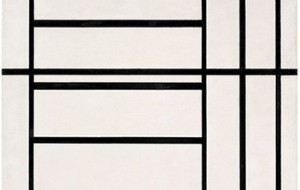
Piet Mondrian Composition No. 1 Composition with Red 1938-39 Oil on canvas mounted on wood support Courtesy of the Peggy Guggenheim Collection.

Piet Mondrian, "Composition No. 1 Composition with Red," 1938-39. Oil on canvas mounted on wood support. Courtesy the Peggy Guggenheim Collection.

Select ONE answer for ALL of the below questions:

  • Does art expand our ability to imagine?
  • What’s Matt Cassel without Randy Moss, Wes Welker and Bill Belichick?
  • What came first: the chicken or the egg?
  • City or United?
  1. Sporty Spice
  2. Sure, why not
  3. The $63 million man
  4. The egg

I love this. Truly and seriously, I absolutely love impossible-to-answer questions.

Who’s your favorite artist of all time? I always vote Titian, but I’m going to say Jeff Koons, if only in solidarity with my colleague from London Town.

If you could only take one album to a desert island what would it be? Probably Blue Train, but I almost said the first Wu-Tang album.

Why do I always make groups of three? Catholic school, ZZ Top, a vast Freemason conspiracy.

This is a fortuitous collision of a number of things I’ve been trying to crowbar into a single post for a minute, so I’m pleased that Art21 has made Question #1 this month’s Flash Points topic. I’ve been reading Elliot Kalb’s Who’s Better, Who’s Best in Basketball?, which attempts to use statistics to demonstrate the sequential superiority of the top 50 hoopsters of all time. Think Roger de Piles with a 360 slam-dunk. Fun stuff, but, like much of the academic endeavor, an attempt to fix and quantify the unquantifiable, or the invisible or the undemonstrable, like the definition for “undemonstrable” in the dictionary. But if Krauss gets “Modernist not-ground,” then I get undemonstrable.

Continue reading »

On Painting

July 26th, 2009
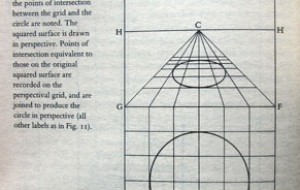
Fig. 14 of Leon Battista Alberti, "On Painting," page 70. Penguin Books, 1991.

Fig. 14 of Leon Battista Alberti, "On Painting," page 70. Penguin Books, 1991.

I’m a PC, and I’m about to become a Mac. How is it that in this world of Al Gore-invented internet, Steve Jobs-overlorded life 2.0 and tweeting Twitter twits I can actually have a whole day of work completely undone by a single, cantankerous, God-forsaken PC? I swear, today was a good day and it’s been nearly two hours since I switched the thing on, and it only just now stopped making that quick, field of crickets clicking noise that all PCs make when they are deciding whether or not to continue living. It’s not even a Vista machine and I’m able to make and eat breakfast before IE and iTunes decide which is going to rule the roost for the day. IE: 2, iTunes: 0. Yesterday’s shenanigans lasted until 2pm, at which point I thought it would be satisfying to plug in my new government assisted and subsidized digital converter box. All that did was make it impossible to watch the DVD player. Turns out that the box makes your tv compatible with the new signal but the box isn’t necessarily compatible with the old antenna. Technology: 2, Adrian: 0.

So, the dog ate my homework, which I why I didn’t write anything the last few days. Plus, I was struck by an epidemic of mid-week, rainy day malaise, offset by the certainty that if I wrote about the baseball game that I went to Monday night, I’d lose some people’s attention. It did, however, get me to thinking about Fantasy, the theme of the moment for Flash Points.

Now, believe me, I don’t like baseball one bit, at least since Billy Martin retired. But I am constantly amazed at the way in which going to a game at the stadium, during which I not only had a big beer in a big plastic cup (non-commemorative), an absolutely excessive hot dog (with ketchup, mustard, kraut, and relish), and soft-serve ice cream in a plastic baseball helmet (Houston Astros? I thought they were supposed to be home team helmets. We’re not even in Houston.), I found myself in the most profound state of bliss since early last week. It’s such a stereotype. Americans at a baseball game—night game, weather clear, about 80/mid-20s for the Celcioids—drinking beer, eating excessively, piddling away time and money, eyeballs-deep in an economic collapse. Nero, loan me your fiddle. It was fantastic, fantastical, one of the most, nostalgia-laden, Hallmark card-worthy, saccharine moments anyone might ever have. One of those peculiar instances where fantasy and reality collide, much to everyone’s surprise and enjoyment. Reminds me of the passage in Mad Love when Breton finds the spoon with the slipper at the end. Hardly, but I love that sensation. That glint of the unheimlich, like in a Gregor Schneider haus, when it’s just strange enough. You know, been here before, I think I’ve seen this somewhere. Why can’t I remember?

Castellani Enrico, "Superficie rosa," 1963. Acrylic on canvas, 130x92x21 cm (possibly mislabelled). Courtesy Haunch of Venison.

Enrico Castellani, "Superficie rosa," 1963. Acrylic on canvas, 130x92x21 cm (possibly mislabelled). Courtesy Haunch of Venison.

Which brings me to Enrico Castellani. I don’t know the time-space rules on a blog, but I want to go way back in the past, to May, which was before June’s Biennale opening, so I suspect May doesn’t matter anymore? That was, like, OMG, so last Biennale ago. Anyway, back when the dinosaurs ruled the earth, I went to see the Castellani show at Haunch of Venison, way above midtown. I’ve known about Castellani’s work for a while, mainly because I’m obsessed with 1960s Italian painting and what it does to space. Lucio Fontana gets the most press, and probably rightfully so, but Emilio Vedova and Agostino Bonalumi certainly deserve as much attention. I can hear all my friends groaning. Castellani is the fourth Beatle.

What really struck me about this show, other than its absolute magnificence, was how traditional it looked, old even. Albertian.  The two works that really did it for me were two 1963 paintings, both listed as Superficie rosa, though the one is more bianca than rosa to me. I would know if I would have bought the catalog. Big mistake. The white one might as well be a diagram from Alberti’s On Painting. I have the 1991 Penguin Classics edition. Look at figures 6, 8-11, 13, 14 and try to tell me that Castellani isn’t going back to basics. He’s making leaps here as well. Superficie rosa—the red one—is even more interesting because it bends the corner. Castellani’s nails are gone, but the lines created by the join of the two canvases, what was reinforced by a drawn perspectival space in the white one, is now mediated by an actual, real-space bend. Albertian perspective, as actualized in a picture, at least at one point, presumed one flat field of vision at a time. A painting, that we’re standing in front of, on a perpendicular, looking at. Castellani has shifted this, elaborated it on two planes. The point, the vanishing point, what was supposed to be a nearly invisible point in the infinite distance has been transmogrified into one point among the infinity of others that make up the line that is the bend of the wall, the corner. Alberti has been multiplied outward and what should be our Albertian point of reference, where the canvases join, is offset, one among many. Maybe it’s not that exciting, that painting went from flat to spatial through the mechanism of spatializing flatness. Check out figure 14 again, and think about the line from G to F, the bend in the image. Maybe this is the ultimate tautology, but it makes sense. It makes sense that an Italian painter working at the end of painting as it had been since Alberti is using Albertian principles, not against themselves, but beyond themselves, to transcend painting. To keep it as painting, but still more than painting.

castellani-enrico-superficie-rosa-1963-acrylic-on-canvas-130-x-92-x-21-cm-probably-mislabelled-courtesy-of-haunch-of-venison

Enrico Castellani, "Superficie rosa," 1963. Acrylic on canvas, 130x92x21 cm (probably mislabelled). Courtesy Haunch of Venison.

Somewhere in there is a life lesson for me, that I keep telling myself so that I don’t forget it. Now, I wouldn’t follow half of my own advice, but I love those moments when I’m reminded how deep the history of art is, how long the memory of an artist can be, how negligent it is to look at anything in a vacuum. Remember that game Memory? It’s like flipping two tiles over.  Castellani, Castellani…where’s the other Castellani…there it is, the Alberti.

Things That Made Me Go Hmmm…

July 21st, 2009

Hello again and Happy Scopes Monkey Trial Day, though it wasn’t a good day for the monkey.

That went fairly well, or so I’d like to think. People responded (your checks are in the mail) and the multi-limbed game of blog pong begins. I’ve emplaced a new system. Blogging begins right as the coffee peaks and ends right around that time where the pre-lunch blood sugar is low and the inevitable grouchiness begins. Optimal circumstances. It’s an absolute lock that I’ll have what Timothy Egan called an “itchy Twitter finger,” though he said that in the context of Sarah Palin and crystal meth. Hmm. And I don’t Tweet. That fake Christopher Walken and Chad Ochocinco are impossible to keep up with.

It did occur to me that I might have gotten a bit slappy on the cakes, so I’ve done what every self-respecting art historian does when they need to tone it down a bit. I’ve been thinking about Adorno. Now, before everyone gets really excited (put away the streamers and screw the top back on the champagne), know that I’ve been thinking about Adorno similarly to the way that SportsCenter thinks about games: partially, superficially, with maximum speed, and minimum engagement. But hear me out.

I’m not here to dispute the viability of Adorno and Horkheimer’s theory of the Culture Industry. I actually like it quite a bit, because I think it’s mostly true, though like all other theories in its requirement of suspension of disbelief. And it allows me to grumble endlessly about whatever it is about American life that bothers me, which is really convenient — far more so than those Segway things ever were.

I think MTV actually helped undo the Culture Industry. Maybe only once, but somewhere between the time “Video Killed the Radio Star” and MTV killed Britney’s chances at a normal adolescence, something really remarkable happened. Right about the Summer of 1989, MTV began broadcasting Public Enemy’s “Fight the Power” video.

Continue reading »

Step One: We Can Have Lots of Fun

July 20th, 2009
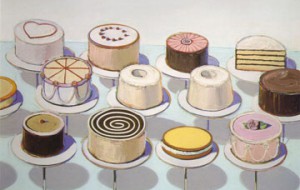
Wayne Thiebaud, "Cakes," 1963. Oil on canvas. Courtesy the National Gallery of Art, Washington DC

Wayne Thiebaud, "Cakes," 1963. Oil on canvas. Courtesy the National Gallery of Art, Washington DC

Greetings from Memphis and Happy Moon Landing Day.

Here we go. I’ve never done this before. Well, not really. I’ve tried it twice. The first time, nobody cared. The second time, I was posting syllabi for my students, so the deck was stacked in my favor. But this is new to me, an unknown known, as they used to say. They probably still say it—I just did. This is already wandering, which I’m going to justify by thinking of a blog as nothing more than a mediated thought process. At least for today, until I get limbered up.

I wrote a list. It’s a nervous tick that I presume creates organization. For an absolutely miniscule moment, I thought I’d be slick and draw up a chart that linked everything I was going to discuss into one highly legible image, but the list came instead. It made me wonder if charts were no longer sufficient for making order of my world…if I had entered into some kind of post-Barrian existence, which made me sad because I truly love Alfred Barr’s chart, if only as part of a Sisyphan struggle to hammer it into a form closer to the way I understand Modernism, which is a fun, if futile, endeavor. Futile fun. Almost as enjoyable as fun futility. I’ve just ticked off the second thing on the list. The first was the moon landing.

The list, in truth, is compensation for my own sense of wonderment at this task of blogging. Self-consciously blogging about blogging seems excessive, but a logical place to start. One of the notes on my list says “admit implicit delusions of grandeur afforded to the blogger.” Please don’t misunderstand me. I doubt this will be the best thing you read today, or ever. But this forum certainly fertilizes the megalomania. Art21 offers a beautifully blanche carte to its bloggers and, like all blogs, the possibility that everyone on the Internet will read what you’ve said. It’s an odd thought, given that most of what most academics write sees only a limited audience. This whole blog format is truly amazing, way more than the Facebook…Edmund Burke above the mists and the like. I thank the Art History gods that I recently reread parts of Barthes’ Mythologies and Eco’s How to Travel with a Salmon. Now, at least, I can point to them when I write something embarrassing. “Well, you know, it’s not like I’m Roland Barthes…” See what I mean about delusions of grandeur? I’m presently finding comfort in the notion that smoke signal-sending humans were the first bloggers.

New post: We’ve got ourselves one of those hairy elephant things for dinner over here. Bring some berries. We’re out.

Ostensibly, I’m to discuss art, which brings me to a point I’ve been trying to make for a while to anyone who is caught in my sights. Everyone should go to the library and get a copy of Susan Sontag’s Against Interpretation and read the essay of the same name. At the very end of a very exciting argument, Sontag says that we should all replace a hermeneutics of art with an erotics of art. Less think, more fun? Probably not what she was going for, but I’d like to imagine that there is something in here that we’ve been neglecting. So in the spirit, I’m going to make an absolutist statement, meander around what might count as an argument, and then ask everyone else to help me supply the evidence.

Continue reading »