Reflection in the Porcelain Pond

May 22nd, 2009
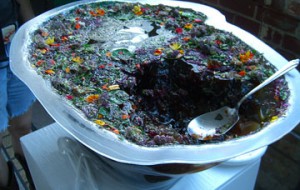
Pilar Tema and Ilana Percher, "Jell-O Bog," 2007.

Pilar Tena and Ilana Percher, "Jell-O Bog," 2007

In the fine art world, the story of the thing is the stuff comprising the thing. Paint, bronze, steel, video, screenprinting, mud, written language—the work is about the medium. And it’s also about another medium, its cultural context—movies, comic books, advertising, written language, or the art gallery itself.

But the point of a piece of art is primarily its social role, rather than some physical or symbolic essence. Melting into its environment, its audience, and its constituent pigments, the modern artwork tries both to command and to disappear, leaving us with volitional interrogation, an expensive insistence of excess matter. In doing so, it comes to represent another medium—a medium of exchange.

In a market society, art’s function, content, and exchange-value are all connected by the idea of excess. Art, like the rest of us, announces its place in the world in predominantly economic terms. In the dreams and desires of the unconscious mind, as in an unfettered free market, boundaries are meaningless, and enough is never enough. As we consume and produce, the excess currency—the profit we create—is another form of what is left over when we consume. Depending on how you take “consume,” this could mean sacralized cultural fetishism. Or, on the other hand, excrement. Either way, we long to contain it or to manipulate it.

The ephemeral abstractions of high finance and the primeval repugnance and joy in bodily processes are joined in modern visual art—a talisman to the sublime force of individual will (will being a faculty, sayeth Freud, that we discover during the period we learn to control our bowels). While visual art remains far from the mainstream, mostly by choice, it is in some sense the most dramatic result of humanism, the ideological bedrock supporting the motivational matrix of our society commonly known as capitalism. A visual icon—like a flag, religious symbol, or work of art—is a deeply affecting “interpellation,” a term coined by Louis Althusser for an ideological signifier that hails me and to which I respond. It addresses me like my own face in the mirror, without any acknowledgment of the assumptions and connotations of the icon. Artwork in the last century has teased out many of the implications of the current core dogma of the First World. which I sum up below in three motifs: autonomy, transparency, and the new man.

Jacques-Louis David, "Patrocle," 1780

Jacques-Louis David, "Patrocle," 1780

Autonomy, the principle of individual freedom that insists on choice and rejects interpellation, is the hallmark of the commercial gallery, as well as the classical avant-garde. The artwork reveals the anointed maker in a way that words never could, in the retentive tableaux of Jacques-Louis David’s paintings, or in the explosive cartography of Jackson Pollock. The writings of Clement Greenberg and Dave Hickey offer lengthy modernist apologies for having anything at all to say about these ineffable things, whose solipsism admits no error. Purity is the only experience, and the market frequently rewards this work. The anal retentivity that Freud associates with the miser can simply replace one unspeakable medium of exchange with another. Damien Hirst’s preserved animals, much like the gleeful food-based artwork of Surrealist sculptor Meret Oppenheim, depict a closed statement, decay forever suspended, echoing the food-smeared African idols that have served as touchstones of authenticity since the height of European imperialism.

Piero Manzoni, "Merde d'artista (Artist's shit no.066)," 1961

Piero Manzoni, "Merde d'artista (Artist's shit no.066)," 1961

Transparency connects art to writing, but in modern times has rejected interpretation, or any other form of exegesis whose gaze turns away from the hideous fascination of the Thing itself. This oracular reading is enunciated in the symbolism of the cultural and pedagogical institution. Rosalind Krauss and Susan Sontag are noteworthy haruspices of this post-war tendency, in which images and words are allowed to taint one another as multiple expressions of a single perception, and art starts to attempt depicting the conditions of its own legibility—often using empty spaces and vast grids. National Endowment for the Arts culture-wars martyr Andres Serrano has been displaying closeup photos of stool as signifiers, much in the same way Wim Delvoye created a defecation machine, Piero Manzoni canned his offal for sale, and Marcel Duchamp anointed a urinal as artwork—all in self-aware gestures that try to realize our alchemical dream of turning filth to gold.

Continue reading »