VeniceЯUs

June 9th, 2011

Allora & Calzadilla, installation of "Track and Field," 2011. © All rights reserved by IMA - Indianapolis Museum of Art

Walking into the Venice Biennale is like traversing into an art-induced headlock set in a labyrinthian wonderland. Slather on enough Vaperetto excursions and optical trickery, and you’ve got a fabricated case of vertigo. Upping the ante are the sumptuous parties and enough celeb sightings to make LA look dull. Want Courtney Love to cuddle with another grunge rock boy, this time Salem style? Head to the Brauer and you’ve got it. Need a mega-sized yacht owned by Forbes‘s 53rd richest man in the world (sorry Abromovich, but this is the 54th edition), take a walk near the Giardini. This year’s rich ‘n famous lineup was so absurd it looked like Cannes on high-qual crack. As a long-time attendees put it, the Biennale used to be about seeing the exhibition, attending the afterparty, and heading back to the hotel to sleep it off and do it all over again. But this year, unless one had the willpower of a health-conscious pregnant woman or the iron tolerance of an English coal worker, it was a sure thing that full coverage was mitigated by Alka-Seltzer.

Christian Marclay, "The Clock," 2010

Having just clicked the send button on final papers, my attendance to last week’s preview checked out under the pleasure category. So while my strongsuit is probably the gossip (shoes, aristos, amorous journalists, and even hotter artists all trotting around at 4am deliciously inebriated), the recently interpolated student in me is going to abstain from discussing what happened after I fell asleep in front of Christian Marclay’s Golden Lion winning 24-hour film The Clock. For saucier coverage, tune-in to the usual suspects.

Jacopo Tintoretto, "La creazione degli animali" at the Venice Biennale

Back in 2007, Robert Storr curated a highly political biennale, and while this edition’s title, ILLUMInations, may sound like it, Bice Curiger’s edition places little emphasis on titular italicization. Curiger’s exhibition plays it safe, piecing together curating’s current top 40: a high number of strapping young artists born post-1975, artists curating artists, and the inclusion of a very deceased art star, in this case Italian Mannerist painter Jacopo Tintoretto.

Continue reading »

iheartnewhistoriographies: Conversing with Laurel Ptak

April 25th, 2011

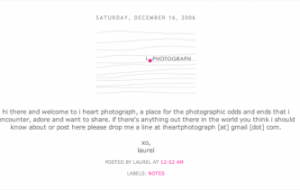
iheartphotograph, screenshot, December 16, 2006

I met Laurel Ptak three years ago back when she was coordinating Aperture’s educational programming and I was their intern terrible. Running into her a few weeks ago in one of those typical everyone knows everyone New York moments, I thought I’d catch up with her as she puts the finishing touches on her MA in Curatorial Studies from Bard about her blog I Heart Photograph. Launched in late 2006, and one of New York’s first blogs to showcase young artists’ hybridizing excavation of photography’s borders, I Heart Photograph has morphed into a venerable index of young photographers and their websites. But within minutes of chatting we were off questioning the methodological means of historicizing art which doesn’t fit into art history’s 30-year rule, and the ways in which we can begin borrowing lessons from curating and digital networks to pursue new means of historiographic argumentation. And while our trail of thoughts poses more questions than answers, it’s one of those conversations that forgoes the pop topic hits to conspire on where to go from here.

Alex Freedman: Tell me about iheartphotograph’s beginnings.

Laurel Ptak: It started from a desire to really explore the margins of contemporary photographic practice and take my own stab at re-authoring its discourse. It opened up a space for me to explore questions that I didn’t find good answers to in my “real world” engagement with the medium. What were photographers doing that went unseen on the walls/pages of the normal art channels? How were younger image makers tinkering with the medium in new and unexpected ways? What were photographers producing or thinking about in other parts of the world? I also thought of it as a kind of critical curatorial practice. I appreciated the way that the Internet allowed the distribution of artworks to function outside of more typical market-driven concerns that seem to prevail here in NYC. I had worked in the ‘culture industry’ here for some years and was frustrated with it on a lot of levels. IHP was in some ways my stab at wondering how things could function differently. Could one open up space for images as ideas more than commodities? Could their immateriality complicate how images circulated in other ‘real world’ circumstances?

Continue reading »

How to Explain Sherrie Levine to Your Grandmother

April 15th, 2011

Museums have spent millions on art education trying to reach out to the young and elderly. But if you have a grandmother like mine, the kind who, despite a PhD in another field, immerses herself in your interests, then it doesn’t matter how many octogenarian-friendly wall texts or emails LACMA, MOCA or the Getty write. Her reviews always look a little like: “X friend of 50 years and I went to see the Baldessari exhibit. She knew as much about what was going on over there as I did. Except all those dots everywhere.”

John Baldessari, "Heel," 1986

So in honor of this year’s pilgrimage to Grandma’s house, and with a nod to the Dutch filmmakers Lerner’s and Sander’s series How To Explain It to My Parents, I decided to take on the role of an arts educator and follow up on a comment that in its first iteration ended up in cupcakes and gossiping about early 20th century movie stars: “Sash that Sherrie Levine sounds like a nice Jewish girl.”

Continue reading »

Disembarking: Christina Knight on “Glenn Ligon: America”

April 14th, 2011

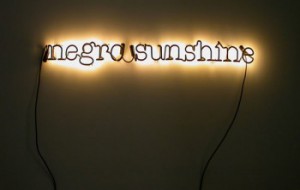
Glenn Ligon, "Negro Sunshine," 2005.

I first saw Glenn Ligon’s Negro Sunshine at Harvard’s Fogg Museum in 2007. And for the rest of the exhibition I was trailed by a staff member to keep me from doubling over in voracious laughter. Culled from Gertrude Stein’s Melanchtha, the piece is representative of Ligon’s signature style that has made him into a chef de intertextual. It was during in his stay at the Whitney’s Independent Study Studio Program in 1985 that conceptualism rushed in. Before that, Ligon’s paintings referenced heavyweights like Willem De Kooning, Robert Rauschenberg, and Cy Twombly. To New Yorkers, Ligon is perhaps best remembered for his contribution to the 1993 Whitney Biennial and his solo show at the museum that year, which cast him as a sardonic artist with an appetite for form — a point Scott Rothkopf sets out to prove in curating Ligon’s comprehensive retrospective Glenn Ligon: AMERICA at the Whitney Museum of Art. A must-see according to every reviewer, this retrospective breakdowns the wit, lust, caution, and skillful erudition of Ligon’s work into an aesthetically pleasing, contextually accessible chronological narrative. Although the sequential take does perhaps delimit the aesthetic possibilities, it provides enough literal space between the decades for once-dismissive critics to contemplate. Walking through, the only thing I really missed was Christina Knight‘s commentary. So I rushed home to ask her about the show, Ligon, and her in-progress dissertation, Performing Passage: Contemporary Artists Stage the Slave Trade.

Daniel Martinez, "I can't imagine ever wanting to be white," 1993

Alex Freedman: In a Time Magazine article, Robert Hughes called the 1993 Whitney Biennial “A Fiesta of Whining.” Today, it’s considered a watershed exhibition that laid bare a conglomeration of critical debates fanning the culture wars. How did this installment’s overall criticism stack up?

Christina Knight: Though many critics admitted that the 1993 Whitney Biennial was responding to important trends, much of the criticism voiced exasperation with the show’s relentless focus on race, sex, the AIDS crisis, and other topics familiar to the culture wars. These complaints were couched euphemistically under terms like “multiculturalism” and “political correctness.” Race did play an important role in these debates, though I wouldn’t say that African-American artists were singled out. For instance, Daniel Martinez’s admission buttons drew particular ire: though museum-goers received different words on their badges, together they read, “I can’t imagine ever wanting to be white.” Interestingly enough, Ligon escaped some of this criticism because of his understated, non-polemical style. For example, reviewing Ligon’s work the same year, Washington Post writer Hank Burchard said, “unlike many of his fellows who exhibited in the outrage-us 1993 Whitney Biennial, Ligon has something fairly interesting to say and clever ways of saying it […]. Instead of demanding our attention, Ligon invites it by drawing upon black writers and poets and by assuming a series of ironic identities.” To me, it is interesting that Ligon gets a pass because of his “irony” in spite of the always-political content of his work.

Continue reading »

Waiting for Fonda

April 12th, 2011

Ronald Regan: Hi Ed. Call me Ron.

Edward Said: Hi Ron, you don’t mind do you.

Marcel Broodthaers: Hello Edward. Well I’m told we are waiting for Jane Fonda.

— Arpanet Dialogues, vol. 1

In the fictional serial Arpanet Dialogues, an ongoing collaboration by Bassam el Baroni, Jeremy Beaudry, and Nav Haq, the creators of the Advanced Research Projects Agency Network (ARPANET) invite diverse quadruples to test out their chat app in secret US State Department testing centers from 1975-1979. Flowing like a script from absurdist theatre, salient nods to late-1970s politics current import are flanked between revolutionary rhapsodies. In this ersatz chat room, Ronnie gets his patriot on, MB lets loose his emotional side, and Said tantrums that Jane will understand him.

Marcel Broodthaers, "Berlin oder ein Traum mit Sahne," filmstill, 1974.

Published a few months later, Volume 2, which debuted at Art Dubai, takes a poker-faced, allegorical tone. Though Marxist Economist Samir Amin, activist Steve Biko, last historian Francis Fukuyama, and modernist architect Minoru Yamasaki only talk Soweto, econ, and architecture, the gravity between the two works’ publication dates is apparent. Fukuyama pushes the neo-liberal democracy as endgame. Biko relays his doubts about applying readymade political action to an uprising. Amin foretells the future of capitalism. And the failure of Yamasaki’s partitioned utopian dreams take on surplus meaning when he sadly laments, “they destroyed my buildings in the end.”

Continue reading »

Sampling the Document or Documenting the Sample: An Interview with Banu Cennetoglu

March 11th, 2011

Banu Cennetoglu, "CATALOG" and "iheartphotograph," installation view, 2011. Courtesy the artist.

Banu Cennetoglu’s website has read “meşgul/busy” since the summer. And even after four months of emails, having never meet in person, Banu Cennetgolu is still a source of fascinating mystery to me. Sources report that she’s shy; a mutual acquaintance leaning over a freezer stuffed with a pre-biblical stalagmite raved about how lovely she is; my best guess is that she’s damn independent. Born in 1970, Cennetoglu left Turkey in 1994 after receiving a BA in Psychology to study photography in Paris. What came next was a whirlwind of travel dates and photographic assignments, before trading in New York for the Rijksademie in 2002 to do “something more concrete.”  Returning to Istanbul in 2006, she founded  BAS, Turkey’s first archive dedicated to contemporary artist’s books, and Bent, the country’s first artist book publishing house with Dutch artist Philippine Hoegen. Her early works articulate a desire to document, chronicles which bare traces of her photo assignments for mags like Purple, while her recent works circulate documents, or witnesses, rendered fragile and whisked with an ardor for saving and making material public. But check it out for yourself at Guilty feet have got no rhythm, now on view at Kunsthalle Basel through March 31.

Banu Cennetoglu, "Sample Sale 2010 BC," 2010. Courtesy the artist.

Alex Freedman: Last fall you had your first commercial solo exhibition, Sample Sale 2010 BC, at Rodeo Gallery in Istanbul. This is pretty unusual for an artist who has already shown at the Venice Biennale.

Banu Cennetoglu: For a long time, I was doubtful about showing work in this context, so the only interesting way was for me to do this show was to deal with the subject of selling. Each “sample” was conceived individually, but is simultaneously expected to coexist with CATALOG.

Banu Cennetoglu, "CATALOG," installation view, The Pavilion of Turkey 53rd International Biennale, 2009.

CATALOG was originally conceived to function as a mail order catalog for 6 months in the Turkish Pavilion at the 2009 Venice Biennale. The piece contains 450 of my photographs dated between 1994-2010, classified under 15 categories, varying from personal photographs to iconic images such as 9/11, documentation of the Turkish Parliament, and of the UN zones between North and South Korea. They are all framed the same way, questioning the hierarchy among them, embedding a bit part of their content into the thickly bound book, while somehow trying to co-exist with the others in keeping their self-referentiality. The categories are defined by subjective parameters, each holding a different number of images. During the Biennial, viewers could download any of the photographs for free from the catalog by taking a form home and imputing the photograph’s code.

Continue reading »

Egypt Rising

February 10th, 2011

Cairo International Airport, Terminal 1, January 30, 2011. Photo by Alex Freedman.

On January 31, BA177 hummed with mixed messages. Tourists who’d been vacationing in Cairo’s International Airport sighed with relief. Evacuated expats who left their homes doubled up on tiny vodkas. Several Egyptians heading out on tickets booked long in advance chatted with nervous hope about the revolution’s success. And in first class, an Egyptian family of three sat comfortably, having sped directly up to the airplane, bypassing the marathon queues that could only be described as inevitable in an airport armed on security-lite.

To counter protesters’ tenacity, the government had shutdown the Internet, the curfew had moved from 4 to 3pm, tanks had rolled into residential areas, plainclothes police offers were sparking mayhem, and fighter jets had been released over Tahrir. Concentrated on the octogenarian control freak in question, my thoughts turned to the Egyptian Military Museum and a work no one needs to be tweeting about: the mammoth painting of Hosni surrounded by parades, pyramids, and the most romantic looking pigeons ever painted by anonymous North Koreans. Letting go, I imagined the museum’s curator going rogue and burning the work as a performative gesture in celebration of Egypt Rising: Part Let My People Go, and laughed out loud wondering: had it really been only a week since I told one of my students that if she wanted to set fire to her paintings to voice her frustrations that I wouldn’t think it Haraam?

Hosni Mubarak in Abdeen, unknown North Korean painter, ca. 1993. Photo by Alex Freedman.

Last month, Lindsay Lawson and I directed a weeklong intensive Internet art and professional skill-building workshop, Future Tense, for a group of young Egyptian artists-in-residence at MASS-Alexandria, a new space opened by Wael Shawky last November. At the time, I joked that we’d fulfilled the government’s paranoid delusion that American elements were out to alter young minds, and in hindsight it seems almost too ironic that Future Tense began as Tunisia’s Ben Ali fled to Saudi Arabia and wrapped up as Egyptians took to the streets. MASS-Alexandria’s inaugural residents are typical young artists: creative producers searching for a means to articulate themselves, the world, and the future, falling short at times and succeeding at others. But alongside the universal questions young artists wade through was their inspiringly collective desire to conceptually dwarf what they’d seen and made before. To acquire the means to renew art, their educational system, their communities, and their country. Coming into it, I never imagined that a group of ten predominately hijab-donning women, would open up so immediately, and so actively engage questions of desire, power, abuse, self, and sexuality. Or even more surprisingly, attentively critique statements in a second language six hours a day for a week straight.

Continue reading »

Lives and Works in Berlin | Stage your Melodrama: An Elmgreen and a Dragset

December 17th, 2010

When the art historians start treading through Berlin’s turn-of-the-millennium years to chart artists’ march to Neukölln, Michael Elmgreen and Ingar Dragset‘s studio will be a main stop for tea and insight into the city’s physical transformations, and Berlin’s metamorphosis into a home for globetrotting artoholics. And it’s not just because the former couple who brought us Prada Marfa, The Welfare ShowDrama Queens, and The Collectors, 2009′s 2 for 1 Nordic Pavilion, were featured in the New York TimesHome & Garden section. The Scandinavian duo moved to Berlin in 1997 from Copenhagen, the year that scores of galleries cruised into Mitte and Hamburger Bahnhof celebrated its first birthday. Five years later, they were awarded the Preis der Nationalgalerie für Junge Kunst by the then-six-year-old institution for their spatial tours of sex, power, and white cubes in Powerless Structures. But before I get all monumental and start speculating about these artists’ design savvy, humor-heavy installations, and Berlin’s contemporaneous remodeling of empty lots into hot spots, here’s a fireside chat with Ingar Dragset.

Elmgreen & Dragset, "Sculptures Speak No Evil," performance, 2010. Courtesy of Pablo Leon de la Barra.

Elmgreen & Dragset, “
Tala,” 2006. 
Courtesy Galerie Emmanuel Perrotin.

Alex Freedman: Before we get into talking about boys, tell me about your leading ladies: Irina, Rosa, Tala. Since 2006, at least one of them is always jet-setting to a new E&D location, and yet I’ve seen little written about this trio of gilded maids. Do tell, what’s the story?

Ingar Dragset: The golden maids are all named after the cast’s original model, who come from different corners of the world. Most of them have been maids at some point in real life. Silently they stand and watch you, the viewer – almost ghost-like – but in spite of their stoic posture, their face expressions hint at their personal stories.

Continue reading »

Jaunting to K’ruhe

December 2nd, 2010

ZKM | Museum für Neue Kunst, ©2010 ZKM

When asked a few weeks ago to accompany a friend to Karlsruhe earlier this month for Elmgreen & Dragset‘s opening of Celebrity: The One and The Many at ZKM, I jumped at the chance to participate in my favorite activity: traveling to meet an institution whose net presence I’m familiar with. So while the column’s next post will chat up Berlin-based artists Elmgreen & Dragset, this week takes a turn out of Berlin to look at ZKM ❘ Center for Art and Media, Germany’s bastion of intermedia arts. Founded in 1989, the Center for Art and Media has championed digital media, acting as a leading force within the global community in exhibiting, collecting, and conserving works in the days before most museums thought about digital database systems. So what better timing to get acquainted than during an opening and the ZKM’s hosted symposium, The Digital Oblivion?

IMAGINING MEDIA@ZKM im ZKM | Medienmuseum, 2009, installation view, © ZKM, Foto: ONUK.

Munition Factory pre-renovation. Lichthof 7 des Hallenbaus A
, ©1993
, Foto: Dirk Altenkirch

Coming from Berlin, the first thing one notices about ZKM is its sheer size. And then, for those of us often confused at Germany’s lack of digitization, the automatic question is: “Karlsruhe, really? The seat of the German Federal Constitutional Court?” (For those unfamiliar with the German legal system, it’s a lot of paperwork). Yet, it makes sense. ZKM is home to to a core group of arts-related practitioners focused on developing theoretically sound strategies for long-term institution building. When asked, museum sources will tell the story of how in 1988, a committee of professors, politicians, and nuclear researchers put forth Konzept 88, which outlined the creation of a research institution for the emerging field of media arts technologies. Following the Center’s 1997 move into its current residence, the roving center transformed into ZKM ❘ Center for Art and Media, a think tank whose vast programming is a testament to director Peter Weibel’s philosophy that media art is not entertainment. But as it turns out, the history is a lot less stoic than it sounds: until reunification, Karlsruhe was Germany’s Internet capital (Universität Karlsruhe sent out the nation’s first emails in 1984) and from 1980-1994, the munition factory was outfitted with squatting artists’ studios. Though the institution’s press department would eschew this kind of language, it’s safe to say that ZKM was built out of a whole lotta cyber love. And no where is that more apparent than in Peter Weibel and Berhard Serexhe’s exhibition, IMAGINING MEDIA@ZKM.

Continue reading »

Interview with AIDS-3D

October 21st, 2010

Affiliated with a vivacious current of young artists melding techie chops and ’90s graphic aesthetics, the Berlin-based duo, AIDS-3D (Daniel Keller and Nik Kosmos) popped up on the radar last year when their work was featured in the New Museum’s  Younger than Jesus show. Meeting viewers in real life too, their OMG Obelisk shot them from group show obscurity to having their name dropped in nearly every Frame section announcement in this year’s pre-Frieze media blitz. Yet when viewers came to Frame last week, there seemed to be some confusion: computers? curing cancer? waterfalls?  So for those of you also jonesing for an answer, here are a few.

AIDS-3D, "World Community Water Features," 2010. Cast fiberglass, Fit PC 2, and water, installation view. Courtesy the artists and Gentili Apri.

Alex Freedman: In Dispersion, Seth Price said, “what better description of the artist than an amateur inventor?” Science and art are now both hyper-professionalized fields, but much of your work pushes to find the correlations. How do you feel navigating between the two?

Aids-3D: Its admirable to aspire to that kind of role, but even if science is a frequent subject matter, we’re artists, plain and simple. With science, we are communicating some semi-educated opinions about it, reconfigured for an art audience, which is in general fairly uninformed about technology and science.

AIDS-3D & Paul B. Davis, "Miller-Urey Bong," 2010, mixed media. Courtesy the artists and Seventeen Gallery.

AF: The work you’ve produced and collaborated on this year all have a science fair feel to them — the admixing of programming, engineering, and science into aesthetically judged, functioning objects. Did you ever compete in math or science fairs?

A3D: We’ve been interested more and more in ideas of utility, and how those notions relate to the artistic process and role of the artist, and tried to execute projects that deal with our idealism, in contrast to our pragmatism as creative producers. But no, we never competed in any science fairs in school; we both intended to become artists in middle school. However, we read Science Daily as much or more than we read essays on e-flux. So it’s a main source of inspiration and excitement for us.

Continue reading »